
This Article is a part of
Network Security Guide
SD WAN Definition
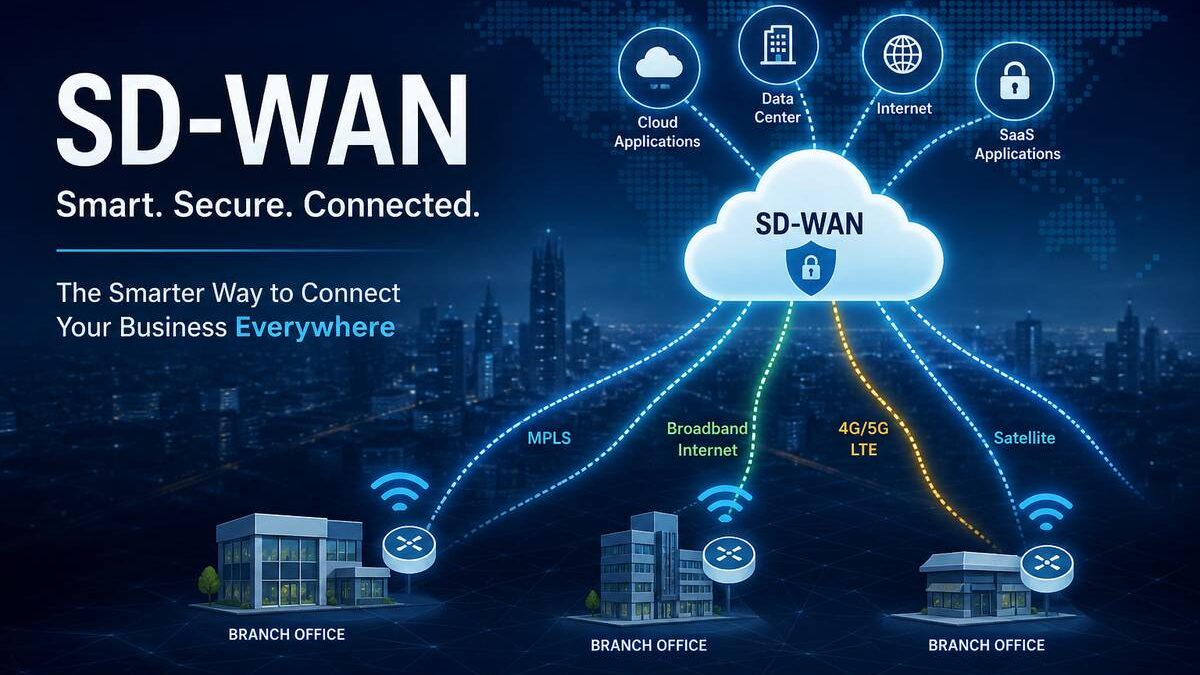
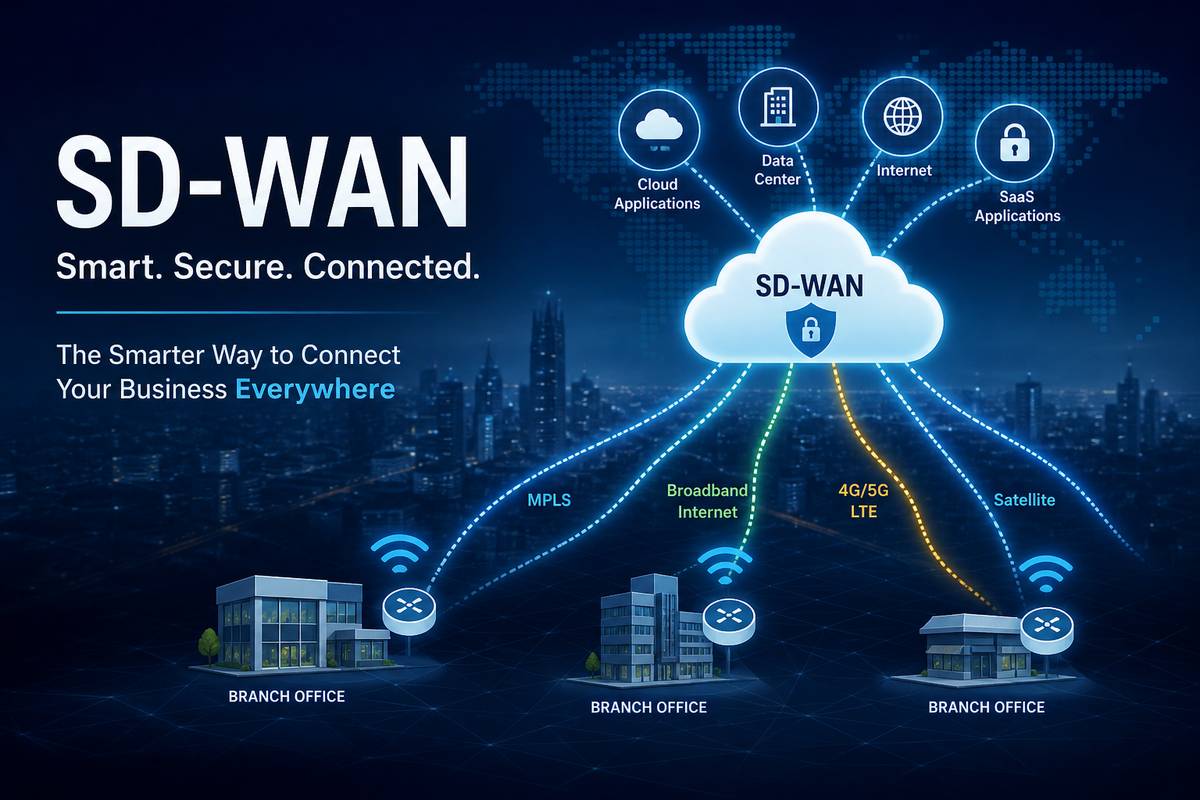
SD-WAN (software defined WAN) is a software defined method of creating and maintaining wide networks where virtual secure tunnels are created on top of any type of physical transport circuits– whether they be MPLS, broadband Internet, 4G/5G, or satellite. Instead of relying on expensive proprietary hardware and manual router-by-router configuration, SD-WAN centralizes the network’s intelligence in a controller and lets branch edge devices handle traffic forwarding dynamically.
If you’re still running a traditional WAN, you probably know the pain: cloud apps slow to a crawl because traffic backhauls through a central data center, new branch sites take months to connect because you’re waiting on a carrier, and every policy change means touching multiple devices. SD-WAN was built to fix all three.
Table of Contents
How Does SD-WAN Work?
The best way to visualize SD-WAN is to compare it to a road trip.
Legacy MPLS is like a train on fixed tracks. It’s predictable, private, and secure—but you pay a lot for the route, and you can’t change it when traffic gets bad. SD-WAN is more like a fleet of cars using Waze. Each edge device constantly checks the “road conditions” of every available link and makes split-second decisions about which path to take. Voice calls and video as well as other meetings go the fast way; while file backup and other not so serious traffic need to travel the cheap way.
Under the SD-WAN isolates two elements control plane (where routing decisions are made) and the data plane (which forwards packets) that in a traditional router are bundled together. The control plane is moved into a central controller that may be cloud-hosted, with edge devices merely following its directions. This creates a secure, virtual overlay network on top of your physical overlay circuits. This overlay is encrypted with tunnels(IPsec/TLS) so your traffic is kept private even over the public internet. You could have MPLS, broadband, LTE etc all running underneath, but the overlay would see it as a single bundle of paths.
Edge devices keep sending probe packets around all possible paths and gather latency, jitter and packet loss metrics. They also detect applications (sometimes at the very first packet) and steer the traffic according to the business needs. If a broadband link gets congested, latency-sensitive apps like VoIP automatically shift to a healthier circuit before users notice. This is application-aware routing, and it’s the “brain” of SD-WAN. Newer platforms layer AI/ML on top of those probes to predict link brownouts before they happen, but the measurement is still the foundation.
Adding a new site is easier too. Most SD- WAN don‘t have ZTP. You send to the branch a preconfigured edge router. You connect it to the local access and then it automatically gets to the controller, authenticates and gets its configuration. No need of an on-site network engineer.
SD-WAN vs. MPLS vs. SDN: What’s the Difference?
People tend to refer to these two terms as identical, but in fact they are not.
- MPLS is a private transport service. It’s reliable and secure, but expensive and slow to provision. SD-WAN can use MPLS as one of its underlay links; it isn’t always a replacement.
- SDN (Software-Defined Networking) is the broader architectural concept of separating control and data planes across any network. SD-WAN is SDN applied specifically to the wide area network, with a practical focus on branch connectivity and application performance.
- SD-WAN isn’t one product either. It’s a category of features: centralized management, overlay tunneling, app-aware routing, and increasingly, built-in security.
Vendor implementations differ quite a bit. If you’re evaluating options, it helps to compare Cisco Meraki SD-WAN, Cisco Viptela SD-WAN, Silver Peak SD-WAN, Nuage SD-WAN, and VeloCloud SD-WAN. They’re built on the same core concepts, but the management experience, licensing, and integration options can be very different. For a deeper look at the building blocks, check out our SD-WAN architecture guide.
The Benefits: Why Teams Make the Switch
The financial case is usually the first sell. An SD-WAN allows you to offload non-business critical traffic away from expensive MPLS circuits over broadband or LTE, thereby removing a reliance on expensive private transport. The majority of companies offload most of their non-sensitive traffic where possible onto the internet with the MPLS only used for sensitive traffic.
Performance improves too. DIA (Direct Internet Access) with data is when branch users access SaaS apps such as Microsoft 365 or Salesforce directly rather than backhauling through a data center. Your sat-nav gets a break and the user experience improves.
Then there’s agility. Because policies are pushed from a central controller, opening a new branch is no longer a months-long carrier project. Sites come online in hours or days, and IT gets a single dashboard to monitor everything. That’s a huge operational win, especially for distributed teams.
The Not-So-Pretty Side of SD-WAN
Vendors are crazy about calling SD-WAN, a different technology. It isn’t. Let’s be honest about what can go wrong.
First, migration can get messy. If you’re locked into a multi-year MPLS contract, you can’t simply cancel it. Running a hybrid network—MPLS plus broadband plus LTE—is more common than a clean cutover, which means you’re managing multiple transports, not fewer.
Secondly, vendor lock-in exists. A number of SD-WAN controllers are based on proprietary protocols and are compatible with limited range of edge appliances. So, if you opt for a vendor and decide to switch later on you may need to replace everything. Think about the exit strategy up front.
Third, the operational model: A DIY deployment gives you all control over the architecture, but you‘ll need people who know about routing protocols, overlays, troubleshooting. Co-managed and fully managed options make life easier but cost more and put someone else behind the wheel. Pick based on your team’s skills, not the vendor’s promise.
SD-WAN and SASE: The Security Connection
As SD-WAN opens more direct internet access, security can’t stay back at the data center. This is where SD-WAN comes into the equation. This is where you overlay the “how” (smart, fast connectivity) of SD-WAN with the “what” (cloud-delivered security Zero-Trust Network Access, secure web gateways, firewall-as-a-service, etc.) of SASE Secure Access Service Edge. Policies follow the user, not the physical location.
If you’re planning a modern network, this convergence is the bigger story. We’ve written a separate deep dive on SASE and the future of network security—worth reading before you commit to an architecture.
Where Does SD-WAN Fit in Your Security Strategy?
SD-WAN is not a replacement for security; it’s a foundation for it. It makes your WAN more agile and cost-efficient, but it also changes where and how trust is enforced. To see how it fits with firewalls, VPNs, and broader network defense, start with our network security guide and work from there. Done right, SD-WAN can be the connective tissue of a modern, software-defined enterprise network.