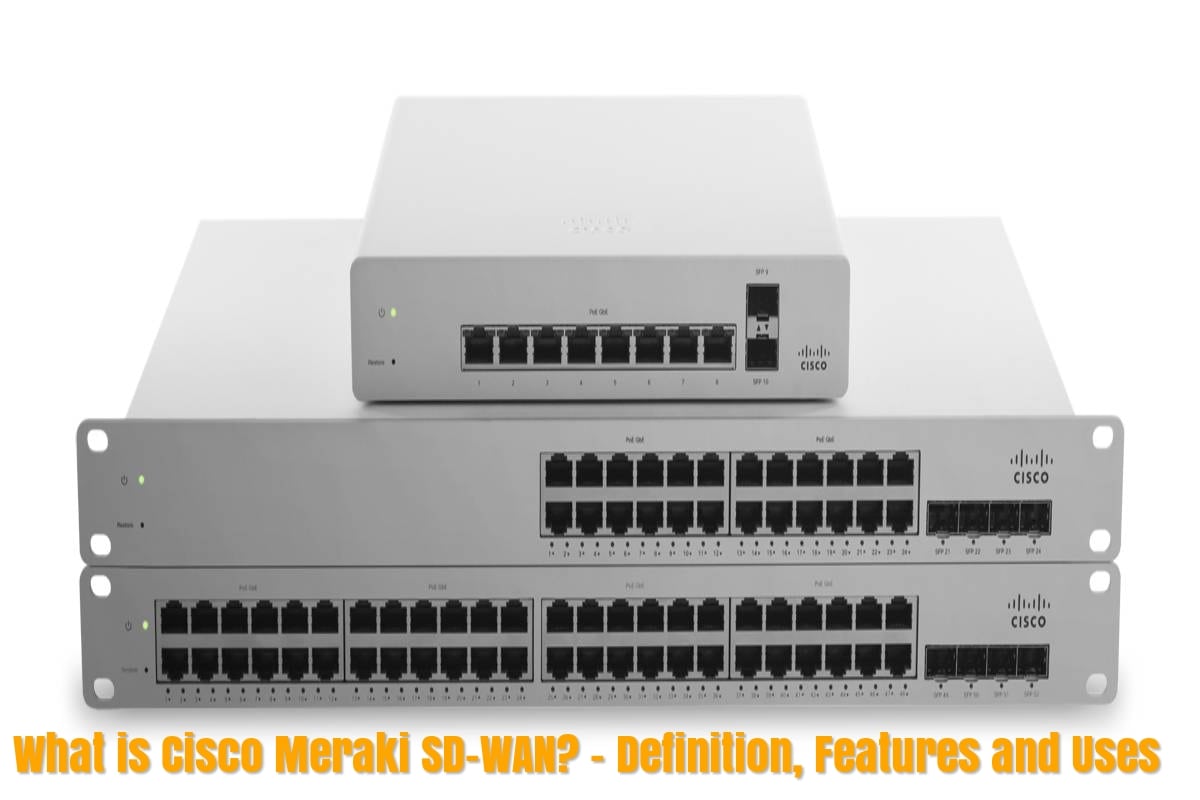

Cisco Meraki SD-WAN Definition
Cisco Meraki SD-WAN – If you work in the network technology sector, you have probably heard the term SD-WAN many times in recent months. In this post, we will discuss concepts to help show why SD-WAN could be of great benefit to your business.
SD-WAN means different things to different providers, not to mention all the dedicated hardware, software, and licenses necessary to run these solutions. The goal of SD-WAN is to allow organizations to save money and meet their connectivity needs faster.
Cisco Meraki Features
At Cisco Meraki SD-WAN solution included with the base license (business license) on all Meraki MX SD-WAN security devices and did not require additional servers or hardware. Just connect it, configure it in the Meraki panel, and start saving money, add value in other areas of the business.
SD-WAN is an acronym for Software-Defined WAN and is a technology that forms the family of software-defined network technologies (SDN), with another example being software-defined access. Being defined by software means that decisions about how traffic can be routed between all sites in the WAN are defined by the policy, and their behavior adapts to the condition of the WAN rather than having a fixed configuration.
Cisco Meraki SD-WAN solutions achieve this through a series of functions, such as resistance, security, quality of service, application optimization, and much more.
If it is not broke, do not fix it
Innovator’s dilemma teaches us that if you don’t introduce disruptive technology into an established space. Established space such as WAN, then someone else will do.
The simplicity of Cisco Meraki SD-WAN means that power and flexibility. Which are directly in the hands of the customer or service provider. This means that without the need for additional devices or updates, customers can benefit from more network connectivity.
While this type of preferential routing is available in traditional MPLS networks, it is usually only available at a premium level, in a set of limited classes. And also for predefined networks or applications. While Cisco Meraki SD-WAN combines application detection based on layer 7. Layer 7 that comes across the entire Meraki stack to achieve this in a shorter way.
Why use Cisco Meraki SD-WAN?
We often joke that the SD-WAN is just a magical, policy-based entertainment built on the Cisco Meraki automatic VPN. It also uses open standards-based technology that you have probably already used. What we specifically refer to here is a technology originally creates on Google. But later open source, which is incorporates into most of its products (for example, Gmail, Google Drive).
Security devices and SD-WAN MX use this technology to infer latency and jitter. And also, loss of virtual path packets between 2 MX. These three things jointly give us the ability to calculate an Average Opinion Score (MOS). This MOS can be used to rate the acceptability of a WAN route for voice traffic.
This means that one of the pre-configured policies is the ability to choose the virtual route. And that is best for voice traffic: a quick profit for everyone.