Every enterprise breach story ultimately comes to the same sentence: “the attack used a legitimate username and password to log in”. Not a zero-day. Not a clever exploit chained across six systems. Just a login that should never have worked, using an identity that should never have had that level of access, going unnoticed for months. According to IBM’s 2025 Cost of a Data Breach Report, breaches where compromised credentials served as the initial point of entry cost organizations an average of $4.67 million, and it took security teams roughly 246 days to even realize the intruder was there. That’s not a technology gap. It’s an identity gap — and identity and access management is the discipline built to close it.
This guide covers what IAM actually is, how its components fit together, where the field is heading as machine identities and AI agents multiply faster than anyone can govern them, and what a realistic implementation plan looks like. We’ll also get into a few things most IAM explainers skip entirely: what happens to identity for the roughly 2.7 billion people who never sit down at a desk, why “we vaulted 90% of our secrets” is a much shakier claim than it sounds, and why post-quantum cryptography is now an identity problem, not just a cryptography problem.
Table of Contents
What Is Identity and Access Management?
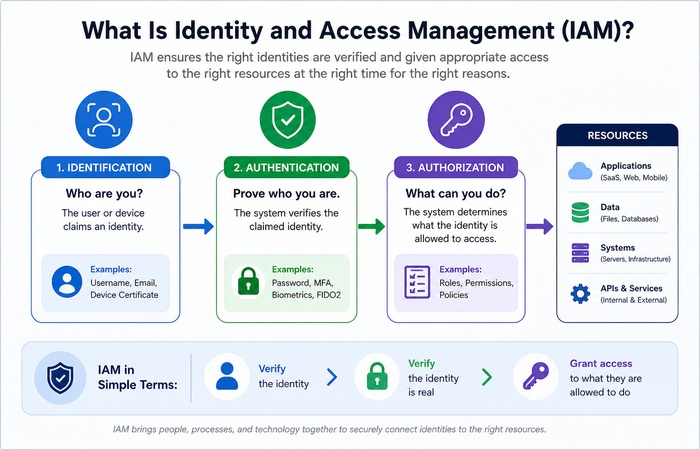
Identity and access management, or IAM, is the policies, processes, and technology an organization employs to ensure that the correct entities – to include humans, machines, applications, and ever more AI agents – receive the correct access to the correct resources at the correct time and for the correct reasons. If you remove the vendor marketing from the equation, IAM addresses two questions that seem fairly straightforward but are less than in fact: who are you, and what are you authorized to do?
Those two questions split IAM into two halves that get bundled together constantly but function differently. Identity management is about proving who or what an entity is — creating accounts, verifying credentials, maintaining a directory of identities across their lifecycle from onboarding to off boarding. Access management is about deciding what a verified identity can actually touch once it’s in the door: which applications, which data, which administrative functions. A system can nail the first half and still fail badly at the second — plenty of breaches involve an entirely legitimate, correctly authenticated user account that simply had far more privilege than its job required.
The reason the market has focused in on a few major players is exactly because scaling this efficiently is so difficult. This recognition over and over again in the Gartner’s 2025 Magic Quadrant for Access Management has got to mean more than just a buying tip; it‘s a reliable indicator of just how mature and commercially critical this space is becoming. Okta, for nine years running, was named a Leader, with Microsoft Entra, Ping Identity and SailPoint, among others, on the governance side. Enterprises aren’t shopping for a login box anymore; they’re buying an identity platform meant to sit at the center of every other security control they own.
The Four Pillars of IAM
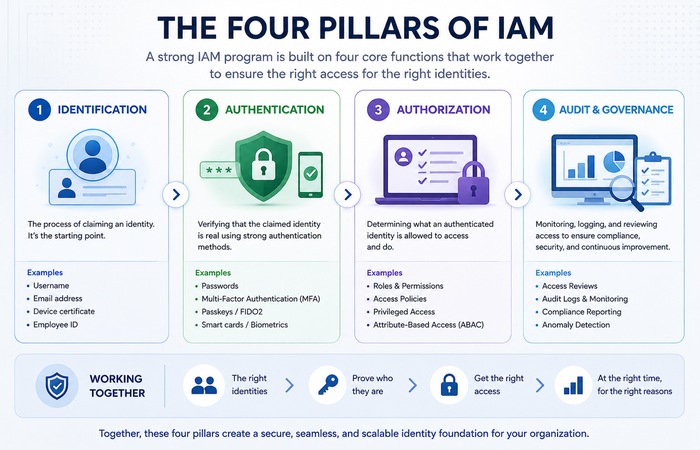
Most mature IAM programs are built around four functional pillars, and it’s worth understanding them separately before looking at how modern protocols implement them.
Identification is the act of claiming an identity — typically a username, an email address, or a device certificate. On its own, identification proves nothing; anyone can claim to be anyone. It’s simply the starting point.
Authentication is where that claim gets verified. This is the pillar most associate with “security” in a broader sense and it has changed significantly in the last 10 years. Passwords alone are now considered a legacy control rather than a real defense — password security practices like complexity requirements and rotation policies do little against credential stuffing, phishing kits, and infostealer malware harvesting logins at scale. That’s why multi-factor authentication became table stakes, and why the conversation has since moved further, toward phishing-resistant methods. CISA’s Implementing Phishing-Resistant MFA guidance draws a hard line here: SMS codes, authenticator-app one-time codes, and simple push-approval notifications can all be relayed or socially engineered by a motivated attacker in real time. Only methods built on FIDO2/WebAuthn (passkeys and hardware security keys) or PKI-based smart cards qualify as genuinely phishing-resistant, because the authentication ceremony cryptographically binds to the real website’s origin — a fake login page simply has nothing to relay. Federal agencies have been required to move toward this bar since OMB memo M-22-09, and NIST’s revised SP 800-63-4 makes phishing resistance an explicit requirement at its highest assurance level. Biometric authentication — fingerprint, face, or behavioral — often serves as the local unlock mechanism that activates one of these hardware-bound credentials, which is why “biometric” and “phishing-resistant” tend to show up in the same sentence even though they’re solving different problems.
Authorization determines what an authenticated identity can do — which systems, which records, which actions. This is the pillar where access control models like RBAC and ABAC live, covered in the next section, and it’s also the pillar most commonly under-invested relative to authentication. Organizations pour money into stronger logins while leaving authorization rules that were reasonable three reorganizations ago quietly rotting in place.
Accountability, sometimes called auditing, closes the loop: logging who did what, when, and whether it matched policy. Without this pillar, the first three are unverifiable — you can’t prove your access controls work if you can’t reconstruct what actually happened after the fact, and you certainly can’t satisfy an auditor or a regulator without it.
Authentication and Access Protocols, Compared
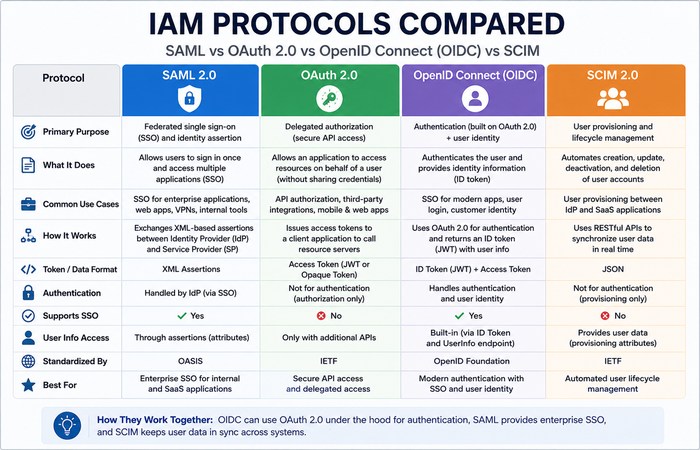
A recurring source of confusion — including in a lot of published IAM content — is treating SAML, OAuth, OpenID Connect, and SCIM as interchangeable competitors. They’re not. They address different but complementary issues, and in most real installations, multiple of them are run in parallel.
| Protocol | What it actually does | Typical use case | Format |
| SAML 2.0 | Authenticates a user and passes identity assertions between an identity provider and a service provider | Enterprise single sign-on into legacy and SaaS web apps, especially in regulated industries with entrenched on-premises infrastructure | XML, browser redirect-based |
| OAuth 2.0 | Authorization only — grants a token that lets an application access specific resources on a user’s behalf, without ever handling the user’s password | An app requesting limited access to your calendar or files via a third-party API | JSON/REST, bearer tokens |
| OpenID Connect (OIDC) | An identity layer built on top of OAuth 2.0 that adds actual authentication, using a signed ID token | Modern consumer and workforce “log in with” flows, mobile and single-page apps | JSON Web Tokens (JWT) |
| SCIM | Automates the provisioning and deprovisioning of user accounts across systems | Keeping HR systems, directories, and SaaS apps in sync so an employee’s departure actually revokes access everywhere, not just in one place | JSON/REST |
The reason SAML hasn’t disappeared, despite being the oldest protocol on this list, is straightforward: it’s deeply embedded in the identity fabric of banks, hospitals, government agencies, and any enterprise running a decade or more of accumulated on-premises infrastructure. Ripping it out is a multi-year project most CISOs won’t greenlight just because a newer standard exists. OAuth and OIDC dominate anything built in the last ten years because they’re lighter weight and native to mobile and API-driven architectures. SCIM is the unsung hero in the IAM marketing literature, and one of the most critical protocols on this list if minimizing risk is the paramount concern – a significant percentage of “orphaned account” cases can be pinned on a deprovisioning step that fell to a person to do in their head rather than employing an automated SCIM sync.
Access Control Models: RBAC, ABAC, and PBAC

After an identity has been authenticated, a policy must be brought into play to determine what the identity is permitted to do. Three separate models have emerged, each suited for different types of access rules within an organization.
Role-Based Access Control (RBAC) Ties permissions to job roles instead of people. A “Finance Analyst” role might be granted one set of permissions while a “Finance Manager” role might be granted another. RBAC is simple to reason about and simple to audit and this is exactly why it became the default model for most enterprises; its documented failure mode is role explosion whereby as an organization grows and edge cases form, teams create narrower and narrower custom roles until the role list reaches the same level of difficulty as list of individual permissions.
Attribute-Based Access Control (ABAC) evaluates a set of attributes — Who is the user, what resource is she requesting, what time is it, and on what device, at what location all state of policy rules at the moment she tries to gain access. It‘s a lot more fine grained than RBAC and a lot more expressive than roles I can see rules that would be impossible to express in roles, like “allow access to this record only during business hours, only from a managed device, only if the user‘s department matches the record‘s department.” Of course the obvious tradeoff is added complexity: it‘s harder to write ABAC policies than roles in the first place, and they tend to be more difficult to test than Rolereg; this is the difference between “this role gets this access”.
Policy-Based Access Control (PBAC) generalizes this further with a centralized policy engine — Examples include policy engines like Open Policy Agent discussed in more detail below that evaluate access decisions against policy-as-code managed outside of the applications that enforce it. This is now the de facto standard for cloud-native architectures, where micro services architecture has hundreds of services requiring common authorization logic.
All of these paradigms no longer exist in a vacuum. Zero Trust, as described by NIST SP 800-207, is built on the principle of having no inherent trust within the network, involving ongoing verification this, in fact, and means that authorization must increasingly apply ABAC-style contextual checks to each access, and not just at point of login as in traditional models.
The Identity Gap Nobody Designs For: Frontline and Shared-Device Workers
Nearly every piece of IAM content, including most vendor documentation, is quietly written for a specific kind of worker: someone with a laptop, a named account, and a desk. That worker is now a minority of the global workforce. Research cited by Gartner puts the number of frontline workers worldwide at roughly 2.7 billion — about 80% of everyone employed on the planet — spanning retail, healthcare, manufacturing, hospitality, and logistics.
This population breaks nearly every assumption baked into standard IAM design. Frontline workers frequently share physical devices across shifts rather than each having a personal endpoint. They may not have a persistent corporate email address, which undermines identity flows built around email-based verification and password resets. Their access needs change by the hour, not by the quarter — a nurse floating between units, a retail associate covering a different register, a warehouse worker rotating equipment. And because they punch in and out via kiosks, communal tablets, or badge readers instead of personal logins, traditional MFA flows designed for a single named user on one trusted device rarely match up so neatly with their experience either.
The emerging business solutions, however, are quite distinct from traditional workforce IAM: closeness-badge tap-in, which associates a tangible badge to a common terminal; biometric authentication at the beginning of each work shift instead of each work session; and identity functions that provision access based on a work shift or on the membership of a specific role, instead of based on a long-lasting account. Vendors serving this segment — largely outside the big-name IAM platforms most content covers — have built entire product categories around exactly this gap. If your organization has any hourly, in-person, or shift-based workforce, treating your IAM strategy as “done” once desk workers are covered leaves the majority of your headcount running on ad hoc, undocumented access patterns.
Non-Human Identities: The Fastest-Growing Attack Surface
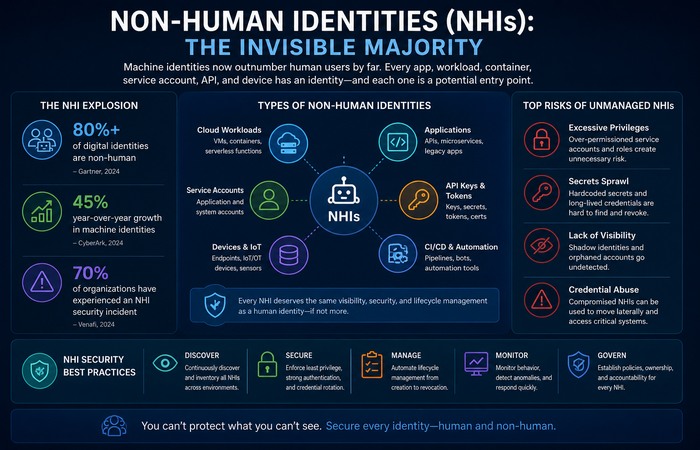
Every service account, API key, OAuth token, certificate, and automation script is a non-human identity (NHI) — and by nearly every measure available, NHIs now dramatically outnumber the human employees they were created to support. The exact ratio, though, is where things get genuinely messy, and it’s worth pausing on that mess rather than repeating whichever number sounds most alarming.
Different vendors, drawing on different frameworks, and quantifying different things, have published wildly different figures over the course of the last year: Cloud Security Alliance’s research puts the median at roughly 45:1, a sharp jump from around 17:1 just a couple of years earlier; KPMG‘s 2026 cybersecurity report quotes 80:1; and cross-vendor examine, such as Palo Alto Networks’ Identity Security Landscape, arrive at as high as 109:1, when the AI agents are added to the regular service accounts. That‘s not a typo it‘s around 6 times the spread between the most cautious and the most optimistic published projections, because “non-human identity” is all over the place because it‘s all damned if vendors include cloud IAM roles, API keys, certificates, AI agents, or all of the above. The honest takeaway isn’t a single scary number; it’s that the ratio is large, growing fast in every methodology, and poorly enumerated almost everywhere — one CSA survey found 53% of CISOs couldn’t confidently enumerate even half the machine identities in their own environment.
What’s more consistently corroborated across sources is the privilege problem sitting on top of that sprawl. Entro Security’s research found that 97% of non-human identities carry more privilege than their actual function requires, and separate telemetry from cloud environments found that a majority of machine identities in AWS deployments show no activity for 90 days or more while still retaining full access. Dormant, over-privileged, and effectively invisible is a dangerous combination, and it’s exactly the profile attackers look for.
This is also where secrets management earns its own conversation, and where a specific analytical trap is worth naming directly: the denominator problem. When a vendor or a security team reports that “92% of our secrets are vaulted,” that percentage is only as meaningful as the count it’s measured against — and that count is almost always undercounted. GitGuardian’s research on secrets sprawl found that credentials and API keys leaking into Slack, Jira, Confluence, and similar collaboration tools account for a substantial share of exposure incidents, entirely outside the code repositories most secrets-scanning programs are built to monitor. An organization can have excellent vault coverage over the secrets it knows about and still be sitting on a much larger, invisible population of hardcoded credentials it never counted in the first place. Before trusting any vaulting-coverage statistic — your own or a vendor’s — the first question should always be what’s in the denominator.
Agentic AI and the Shift From Login Control to Execution Control
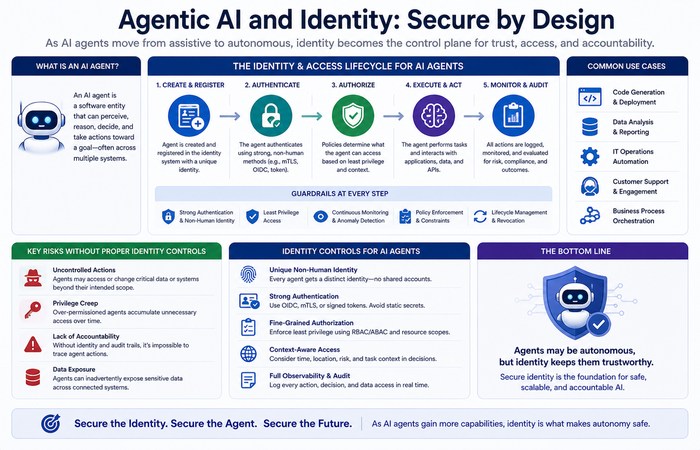
The identity conversation changed meaningfully in 2026 with the arrival of AI agents that don’t just authenticate once and sit idle — they act autonomously, calling APIs, moving files, and making multi-step decisions on an organization’s behalf. This exposes a structural weakness in how IAM has traditionally been built: almost every control in this guide so far governs the moment of login. Very few govern what happens after.
That distinction — login control versus execution control — is becoming the central design question for identity teams. A traditional IAM stack asks, “did the right identity get through the door?” An agentic AI system needs something more granular: does this specific action, at this specific moment, with this specific data, fall within what this agent should be doing right now? An agent with broad, session-level access that behaves perfectly 999 times can still cause serious damage on the thousandth call if nothing is evaluating individual actions against policy in real time, rather than just checking a token’s validity once at the start of a session.
Governments have begun reacting with sufficient seriousness to spur collective action. On 01 May 2026, a group of six national cybersecurity agencies (U. S. CISA and NSA, plus their allies in Australia, Canada, New Zealand and the UK) released the collective policy guidance, Careful Adoption of Agentic AI Services, an unrivaled collaboration for autonomous AI agents. It organizes agentic AI risk into five categories — privilege, design and configuration, behavioral, structural, and accountability — and its central recommendations map directly onto identity practice: give every agent a distinct, cryptographically verifiable identity rather than letting it inherit a human’s credentials; issue short-lived rather than long-lived credentials; start deployments with narrow, low-risk permissions and expand only as trust is earned; and build in the ability to immediately and completely revoke an agent’s access the moment it misbehaves.
Practically, this pushes identity architecture toward the same policy-engine approach discussed under PBAC above, extended to evaluate individual agent actions rather than just session-level access. Expect “agent identity” to become as standard a line item in IAM roadmaps over the next two years as MFA rollout was a decade ago.
Post-Quantum Readiness: Why “Harvest Now, Decrypt Later” Is an Identity Problem
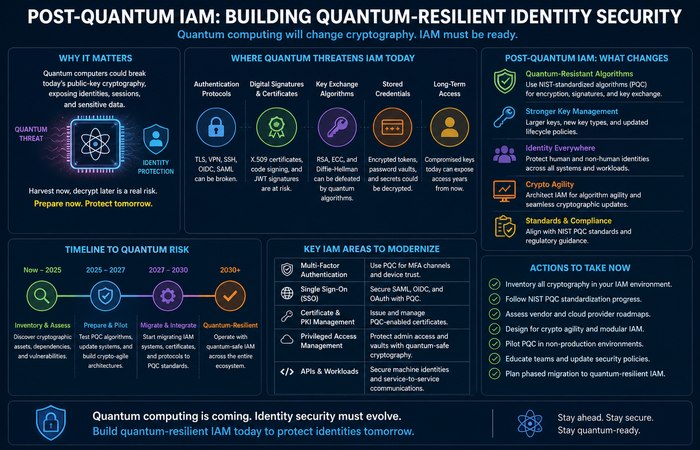
It’s tempting to file post-quantum cryptography under “someone else’s problem” — a cryptography team’s concern, not an identity team’s. That‘s wrong. IAM depends heavily on public-key cryptography: certificate-based device authentication, PKI smart cards, signed SAML assertions, and TLS connections securing every single one of the authentication transactions all are built upon RSA or elliptic-curve algorithms that, given enough computational resources of a quantum nature, could be compromised.
The threat isn‘t only theoretical, or long term in the way it sounds. It‘s called “harvest now, decrypt later” and describes real action taking place right now: foes are monitoring and recording encrypted traffic and credentials today in the hope they‘ll be able to undo it once quantum computing has been developed, which could be many years away. Any identity data, session data, or credential material with a long shelf life is exposed under this model right now, regardless of when a working quantum computer actually arrives.
NIST finalized its first quantum-resistant standards in August 2024: FIPS 203 (ML-KEM, for key exchange), FIPS 204 (ML-DSA, for digital signatures), and FIPS 205 (SLH-DSA, a conservative hash-based signature fallback). The NSA’s Commercial National Security Algorithm Suite 2.0 sets 2030 as the migration deadline for National Security Systems, which is rapidly becoming the de facto timeline regulated industries are planning around even outside government. For IAM specifically, this means inventorying every place cryptography touches identity infrastructure — certificate authorities, SAML signing certs, VPN and TLS endpoints, hardware security modules — and building a phased, crypto-agile migration plan well before 2030, not starting one after a compliance deadline forces the issue.
Decentralized Identity and Verifiable Credentials
A parallel change in the issuance and verification of identity itself is happening, away from a reliance on monolithic directories owned by a single entity and toward a model where a person has ready access to and control over their own, independently Verifiable Credentials Data Model. With the Recommendation of both the W3C’s Decentralized Identifiers (DID) specification reached full Recommendation status in 2022, the industry has a concrete, standards-based framework to explore rather than a plurality of proprietary solutions.
The simple, practical concept is quite simple, even if the cryptography for it is complex: Rather than a university, employer, or government holding the sole, authoritative record of a credential, and requiring every third-party verifier to return to them directly, the credential-holder bears a computationally signed, tamper-evident copy they hold and carry that can be presented anywhere, and that the verifier can authenticate directly. Governments in the US, Canada, and the EU are actively exploring this model for digital identity and verification — the EU’s eIDAS 2.0 framework, for instance, is built around giving citizens a digital identity wallet that works the same way. Retailers use it for age verification without demanding a full driver’s license scan; educational institutions use it for portable, instantly verifiable diplomas and certifications.
For enterprise IAM teams, decentralized identity is still early-stage relative to the protocols covered earlier in this guide, but it’s worth tracking closely — particularly for any organization handling credential verification, onboarding, or Know Your Customer processes where reducing reliance on a centralized, breachable identity store is a genuine security improvement, not just a compliance checkbox.
Building an IAM Strategy: A Practical Starting Point

Most published IAM guidance stops at concepts and never quite gets to “okay, so what do we actually do first.” A workable rollout tends to follow this order:
- Inventory before you architect. You cannot secure identities you don’t know exist. This means human accounts, service accounts, API keys, certificates, and — increasingly — AI agents. Most organizations are surprised by how large this list turns out to be once shadow IT and forgotten integrations are included.
- Fix authentication first, but don’t stop there. Implementing phishing-resistant MFA for the entire user base including administrative and privileged accounts eliminates the most heavily targeted route of attack more quickly. Think of this as merely the starting line.
- Move toward least privilege deliberately, not aspirationally. Pick an access control model — RBAC for most workforce use cases, ABAC or PBAC where context-sensitive rules genuinely matter — and audit existing permissions against it. Expect to find far more standing privilege than anyone estimated going in.
- Automate the account lifecycle. Manual provisioning and deprovisioning is where orphaned accounts are born. SCIM-based automation tied directly to HR systems closes this gap far more reliably than a policy document telling managers to “remember to submit the offboarding ticket.”
- Extend coverage to non-human and frontline identities explicitly. Both are omitted by default because the majority of IAM tools and much IAM thinking was conceived of as for named, desk-bound human users. Budget for and design them as a completely different workstream not an add-on to the main rollout.
- Build accountability infrastructure before you need it. Centralized, tamper-resistant logging and regular access reviews should be running well before an incident forces you to reconstruct what happened after the fact.
Common IAM Challenges — and What Actually Works
A handful of problems show up in nearly every IAM program regardless of industry or size. Role explosion under RBAC is one of the most common: the fix isn’t abandoning RBAC entirely, but periodically consolidating roles and pushing genuinely dynamic, contextual rules into an ABAC or PBAC layer rather than creating yet another narrow role. Orphaned accounts — access that outlives the employee, contractor, or integration it was created for — are best solved structurally through SCIM automation rather than through better manual processes, because manual processes fail exactly when organizations are busiest, which is precisely when offboarding tends to slip. Shadow IT, where employees and even AI agents connect unsanctioned tools directly to company data, is increasingly countered with continuous discovery tooling that surfaces new SaaS connections and API integrations as they appear, rather than relying on a point-in-time audit that’s outdated within weeks. And the visibility gap around non-human identities — the same gap where over half of CISOs can’t fully enumerate their own machine identities — generally requires dedicated NHI discovery and governance tooling, since traditional IAM platforms built for human directories were never designed to track a population that can be spun up programmatically in seconds.
FAQs
Q1: What’s the difference between identity management and access management?
A: Identity management (IdM) manages who or what an id is creating, authenticating, administering accounts during their lifespan. Access management manages what that authenticated Id is not id management, it‘s a separate function permitted to do once inside a system. They‘re often referred to by the single term “IAM,” but one can be done quite well, and the other quite badly; secure authentication combined with weak, excessively coarse-grained authorization is one of the top security gaps auditors uncover.
Q2: Is multi-factor authentication the same as phishing-resistant MFA?
A: No. All phishing-resistant MFA is MFA but not all MFA is phishing-resistant. SMS, authenticator apps, push-approval messages are all “a second factor” (note the a: all of any one of any of them can be relayed or approved with a social engineering attack by someone willing enough). An exclusive FIDO2/WebAuthn or PKI smart card anchored credential is the only countermeasure that prevents this type of attack from occurring rather than just making it marginally more inconvenient.
Q3: What is a non-human identity, and why does it matter?
A: Any digital id that isn‘t a physical person service accounts, API keys, OAuth tokens, certificates, even AI agents; for example. It is important that a non-human identity already exists in almost every enterprise environment I work in now outnumbers actual people, often has far too many privileges, and is far less rigorously watched over than human users, which is the path of least resistance for many attackers who have ‘discovered’ that rather than phish a well-trained staff member, it‘s easier to compromise a little-used, over-privileged service account.
Q4: Do small and mid-sized businesses need formal IAM, or is that only for large enterprises?
A: Formal IAM scales down more than most SMBs assume. A 10 person company doesn‘t require an enterprise identity governance platform, it does require MFA everywhere, a single source of truth about who should have access and what, and an offboarding process same basics as enterprise IAM, but implemented with lighter weight tooling. Attackers don‘t check company size before deploying stolen identities; smaller companies are targeted because their identity controls are traditionally so much weaker.
Q5: How is AI changing identity and access management?
A: One addition to the arsenal of tools available to mitigate these threats to IAM is the adoption of AI and machine learning technologies. AI is transforming IAM in a multi-directional fashion. From a defensive perspective, AI-powered anomaly detection is enabling security teams to identify unprecedented access attempts and credentials faster than a human ever could. On the other side, autonomous AI agents are themselves becoming identities that need governing — with their own credentials, their own permissions, and a need for real-time control over individual actions rather than just session-level login checks, which is pushing the entire discipline toward more granular, continuous authorization models.
Related Reading
- What Is Multi-Factor Authentication?
- Password Security: Best Practices and Common Pitfalls
- How Biometric Security Is Transfiguring Cybersecurity
- A Single Sign-On Solution for Your Enterprise
- Okta: Definition and Identity Platform Overview
- What Is TACACS? Authentication and Authorization Explained
- Defining the Future of Digital Identity
- Cloud Security: The Complete Guide for 2026
- Application and Web Security: The Complete Guide
- Data Security and Privacy: The Complete 2026 Guide
- Data Security Compliance Guide
- Network Security: The Complete Guide to Protecting Modern Infrastructure
Sources and References
- IBM — 2025 Cost of a Data Breach Report: Navigating the AI Rush Without Sidelining Security
- IBM — What Is a Data Breach?
- Okta Newsroom — Okta Named a Leader in 2025 Gartner Magic Quadrant for Access Management for Ninth Consecutive Year
- CISA — Implementing Phishing-Resistant MFA (fact sheet)
- CISA — More Than a Password
- CISA / NSA / Five Eyes partner agencies — Careful Adoption of Agentic AI Services
- NIST — Post-Quantum Cryptography FIPS Approved (FIPS 203, 204, 205)
- W3C — Decentralized Identifiers (DIDs) v1.0 Becomes a W3C Recommendation
- W3C — Verifiable Credentials Data Model v2.0
- SecureW2 — The Non-Human Identity Crisis: When Machines Outnumber People 45 to 1 (citing Cloud Security Alliance, Entro Security, and Veza research)
- UKG — Global Study Reveals Flexibility and Financial Wellness Are Top 2026 Priorities for Frontline Workers (citing Gartner frontline workforce estimates)
Note on methodology: Non-human identity ratios (17:1 to 109:1+) vary significantly by vendor and measurement scope; this guide presents the range rather than a single figure to avoid overstating precision that the underlying data doesn’t support.