
Data Security and Privacy
A fingerprint cannot be reissued. That’s the detail that made the NYC Health + Hospitals breach different from the hundreds of other healthcare incidents disclosed in 2026. When the health system confirmed in May that hackers had spent roughly two and a half months inside its network before detection, the stolen files didn’t just include medical records and Social Security numbers — they included the fingerprint and palm-print scans of at least 1.8 million patients and staff. A stolen password gets reset. A stolen card gets cancelled. A stolen fingerprint follows you for the rest of your life, in every system anywhere that ever asks for one.
That single fact is a decent way into why “data security” and “data privacy” keep getting talked about as though they’re the same thing, when they’re really two different disciplines that happen to fail together. NYC Health + Hospitals had encryption, access logs, and a HIPAA compliance program — the standard security toolkit. None of it stopped an attacker from walking in through a compromised vendor and copying files for eleven weeks straight. That’s a security failure. But the reason it matters so much — the reason a lock-and-key metaphor undersells it — is that biometric data, once exposed, creates a privacy harm with no expiration date. Security is what should have kept the attacker out. Privacy is the reason the consequences of failing don’t go away.
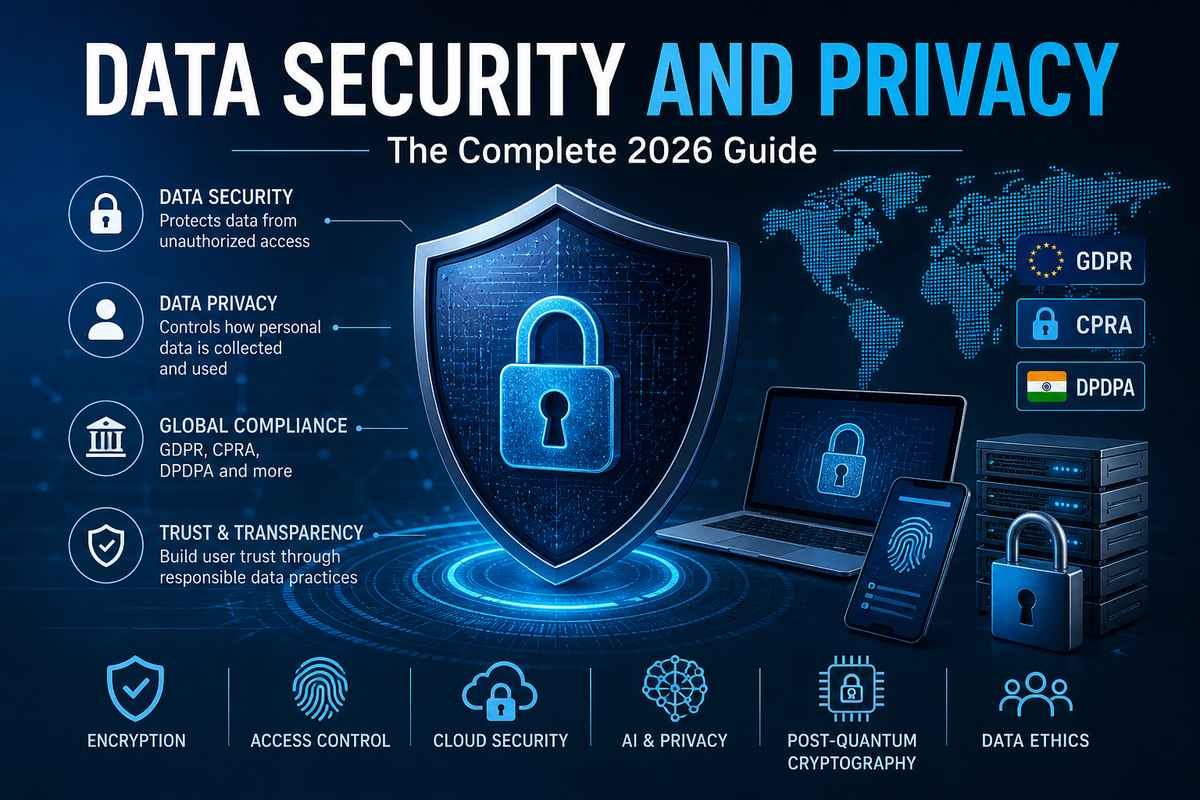
This guide walks through both halves: what data security actually meansas a technical discipline, what data privacy means as a legal and ethical one, where the two 2026 regulatory frameworks that matter most right now (GDPR, CPRA, and India’s DPDPA) are heading, and where the genuinely new problems are showing up — machine learning models that can’t easily forget what they were trained on, encryption standards that are already being harvested for a decryption that hasn’t happened yet, and a new generation of tools that let organizations analyze data without ever actually seeing it. Every case study, date, and figure below is sourced at the bottom of the page, because a topic this consequential shouldn’t be taken on faith.
Table of Contents
Demystifying the Terms: Data Security vs. Data Privacy
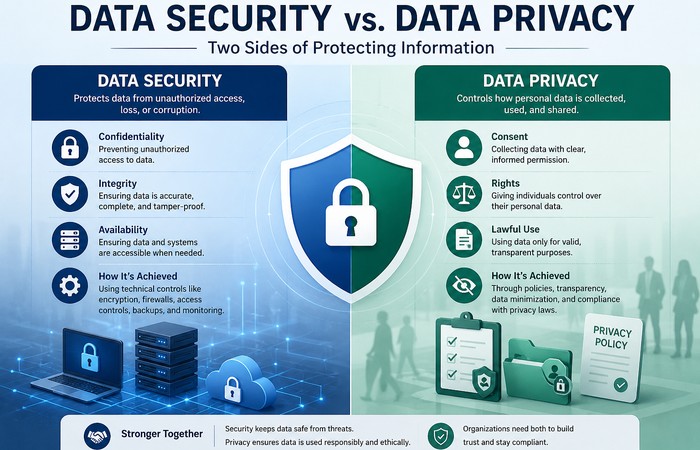
Most explainers on this topic reach for the same metaphor almost immediately: security is the lock on the door, privacy is the policy about who gets a key. It’s not a bad starting point, and we’ll use it too — but it’s worth being precise about what each term actually covers before leaning on any analogy, because the two disciplines have different goals, different failure modes, and in a lot of organizations, different owners entirely.
What Is Data Security? (The CIA Triad)
Data security is the technical field concerned with protecting data from potentially malicious users of the systems on which it resides, preventing accidental corruption or destruction of the data, and preventing data loss- regardless of who is ‘should’ have access to the data for what reason. It does not concern itself with whether gathering the data was desirable in the beginning. It concerns itself with whether the data, once gathered, is protected. Nearly every security control that exists can be reduced to three properties, usually called the CIA triad:
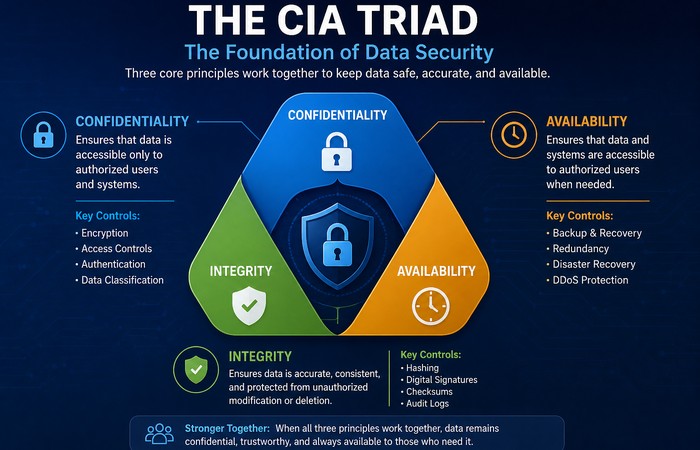
- Confidentiality — Must be readable by only authorized persons and systems. Encryption, access controls, and authentication do most of this work.
- Integrity — the data isn’t altered without authorization, whether by an attacker tampering with records or a system bug corrupting them silently. Hashing, checksums, and digital signatures are the usual tools for catching this.
- Availability — the data and the systems that hold it stay accessible to the people who legitimately need them. A ransomware attack that encrypts a hospital’s patient records doesn’t touch confidentiality at all, but it obliterates availability, and that can be just as dangerous.
A security program that nails confidentiality but leaves availability exposed to a denial-of-service attack hasn’t actually done its job — all three properties have to hold at once.
What Is Data Privacy? (Consent, Rights, and Lawful Processing)
Data privacy is a distinct issue of not ‘is this attackable data’ but ‘should this org have this data’, did the person consent, is the org free to do whatever they please with the data. Privacy has always been rights, authorizations, and authorization management, rather than ‘technology’. It covers things like:
- It must exist a legal justification for processing the personal data concerned (such as the consent, contractual obligation, legitimate interests, etc., varying from one country to another)
- Whether the person was told what would happen to their data before it was collected
- Whether the organization is only using the data for the purpose it was originally collected for
- Whether the person can access, correct, or delete their own data on request
- If the data is being obtained by any third parties the individual was never willing to disclose it to
Here‘s what confuses most people: an organization may possess top-tier encryption, employ multi-factor authentication, and never have any infringement in the breach history, and it still breaches data privacy by collecting browsing data unannounced, selling it off to a data broker without agreement, or holding onto it forever after the person requested deletion. No attacker was involved. No security control failed. The privacy violation happened entirely within the organization’s own lawful, secure systems.
Data Security vs. Cybersecurity: Where the Line Actually Sits
These terms get used interchangeably enough that it’s worth drawing the line explicitly. Cybersecurity is the broad discipline covering an organization’s entire digital footprint — networks, endpoints, identities, applications, cloud workloads. Data security is a more specialized slice of that discipline, focused specifically on protecting the data itself: how it’s classified, encrypted, masked, and governed across its lifecycle, independent of where it happens to be sitting at any given moment. A network security team asks “can this device reach that server.” A data security program asks “if this device does reach that server, is the data on it still unreadable to whoever’s holding the device.” Treating those as the same job is how organizations end up with a hardened perimeter and a wide-open database sitting just behind it.
The Lock-and-Key Analogy, and Where It Breaks Down
So: data security is the lock, data privacy is the policy that specifies who is allowed a key and what they‘re permitted to do with it once they have it. That framing is useful for a first pass, and it’s the one nearly every vendor explainer on this topic reaches for — TermsFeed, Osano, and most of the compliance-SaaS blogs ranking for this exact keyword all land on some version of it.
But the metaphor has a real limit, and it’s worth naming: a lock only has to make one decision — open or closed. Data privacy isn’t binary like that. The same person can be authorized to see a customer’s name and shipping address but not their payment history; authorized to see aggregated health statistics but not any individual patient’s diagnosis; authorized to process a dataset for fraud detection but not for a second, unrelated marketing use. Privacy isn’t a key that opens a door. It’s closer to a running set of conditions — purpose, scope, consent, retention period — that has to be re-evaluated every time the data is touched. A better mental model, especially for the AI and cross-border data sharing questions later in this guide, is less “lock and key” and more “a contract that travels with the data itself, wherever it goes.”
Why Security and Privacy Can’t Be Separated
Treating data security and data privacy as two separate checklists, owned by two separate teams, is one of the more expensive mistakes an organization can make — not because it’s inefficient, but because each discipline fails without the other one.
Security Without Privacy: When Airtight Systems Still Violate Trust
A system can be technically unbreakable and still cause real harm. Imagine a company with flawless encryption, a mature Zero Trust architecture, and zero breaches on record — that nonetheless collects location data from a mobile app without disclosure, retains it indefinitely, and quietly sells it to a data broker. No unauthorized party ever gets in. Every control does exactly what it was built to do. And the company is still violating the rights of everyone whose data it holds, because the harm here isn’t unauthorized access — it’s authorized misuse. This is precisely the gap that CPRA’s expanded rights and the EU AI Act’s data-governance requirements exist to close, and it’s why regulators increasingly ask not just “was the data protected” but “should you have had it at all.”
Privacy Without Security: The Unlocked Database Problem
The reverse failure is just as common, and arguably more dangerous, because it turns a privacy promise into a lie the moment an attacker shows up. An organization can publish an exemplary privacy policy, obtain granular consent, and honor every deletion request on time — and if the underlying database is misconfigured, unpatched, or accessible with a phished password, none of that policy work matters. The AssuranceAmerica breach discussed later in this guide is a clean example: an insurer whose privacy notices presumably said the right things, undone by one employee’s compromised credentials and roughly seven million driver’s license numbers walking out the door. A privacy commitment with no technical backbone is a promise the organization can’t actually keep.
The practical takeaway is that data security and data privacy have to be designed together, from the same architecture, answerable to the same accountable owner — not bolted onto each other after the fact by two departments that don’t talk to each other.
What Getting This Wrong Actually Costs: The 2026 Breach Landscape
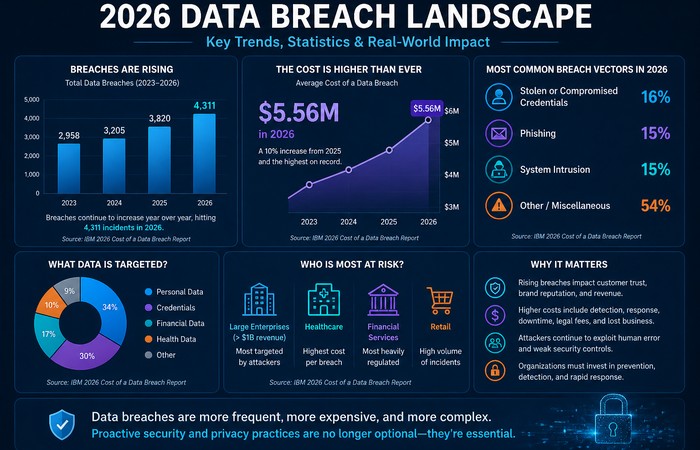
Numbers on a slide are easy to skim past. Specific companies, specific dates, and specific things that went wrong are harder to ignore — so before getting into the regulatory frameworks meant to prevent all this, it’s worth looking at what actually happened in the first seven months of 2026.
The Headline Number
IBM’s Cost of a Data Breach Report 2026, released July 29, 2026 and based on research from the Ponemon Institute covering 602 organizations across 16 countries and 17 industries, put the global average cost of a data breach at $4.99 million — a new record, and a 12% increase over the prior year. In the United States specifically, the average climbed to $11.5 million, more than double the global figure. The report also found that AI-driven attacks increased 56% year over year and added roughly $1 million to the average cost of a breach when one occurred, while phishing remained the single most common initial attack vector for the fourth consecutive year. For a practical look at reducing exposure before an incident, see our guide to preventing data breaches before a compliance incident occurs.
That last point matters more than it might first appear, and it’s the thread connecting nearly every case study below: the defining vulnerability of 2026 isn’t a firewall being breached. It’s a legitimate login being handed over.
Four Breaches, One Pattern
AssuranceAmerica — 6.99 million driver’s license records, via one phished employee. In March 2026, the Atlanta-based auto insurer detected suspicious activity that traced back to an attack targeting a single employee’s credentials on March 16–17. The forensic review, completed June 15, confirmed attackers had copied files containing names, contact details, insurance policy and vehicle information, claims data, and driver’s license numbers for 6,998,886 people — the largest known U.S. driver’s-license data spill of 2026 to that point. Notification letters went out starting July 10. AssuranceAmerica stated the incident did not involve Social Security numbers or payment card data.
Ernst & Young — Social Security numbers and tax records, via a third-party support platform. EY informed that on 28 March 2026 to 12 April 26 (discovered 23 April) an unauthorized actor accessed a third party IT service management platform used to support tax client work. Support tickets on the platform regularly had client tax documents attached, and EY confirmed that the affected data may have included clients names and addresses, social security numbers, bank account data and card payment data. The Shiny Hunters extortion group claimed responsibility and gave a deadline of 31 July 26 before threatening to disclose the information. The firm has confirmed at least 1,366 affected residents through regulatory filings in California and Texas, though the firm‘s global client base means this number is almost certainly a floor, not a ceiling.
Abbott / Exact Sciences — roughly a million Social Security numbers, twelve weeks after a $20.6 billion acquisition. Abbott completed its acquisition of Exact Sciences, a cancer-diagnostics company, on March 23, 2026. In mid-June — about twelve weeks later — attackers used a vishing (voice phishing) campaign against Abbott and Exact Sciences employees to compromise a Microsoft Entra single sign-on account, gaining access to legacy Exact Sciences systems. The data was in their possession was the stored amount of customer data lines when ShinyHuntershad the data. That was about 1,000,000 SSNs, Names, Addresses, Phone Numbers and Dates of Birth. Abbott confirmed on August 5 that some of the affected files contain personal health information. In a separate, unrelated incident the same month, a different group calling itself ShadowByt3$ claimed to have exfiltrated internal product and regulatory documents from Abbott’s LabCentral portal — a reminder that a single acquisition can hand an attacker two unrelated ways in at once, simply because legacy systems rarely get modernized as fast as the org chart does.
NYC Health + Hospitals — 1.8 million people, including biometric data, via a compromised vendor. As described at the top of this guide, an unauthorized party had access to NYC Health + Hospitals’ network from approximately November 25, 2025 to February 11, 2026 — about eleven weeks — after breaching one of the health system’s third-party vendors. The revealed data was different for the different people but might include health records, SSN, driver‘s license, and passport numbers, banking details, exact latitude and longitude and biometric data (fingerprints and palmprints). The health system reported the case to U. S. Department of Health and Human services on 24th of March 2026 and made the information public on 18th of May.
Compare those 4 incidents together and it’s obvious: Not a single one hit a firewall in the first place, employed malware written from scratch, or used a zero-day. One employee got phished. One vendor’s support system leaked tax documents through routine ticket attachments. One voice call to a help desk compromised a single sign-on account twelve weeks after an acquisition. One vendor relationship became the entry point into a hospital network for two and a half months. In every case, the attacker didn’t break in — they logged in, using access that looked completely legitimate to whatever monitoring was in place at the time. That’s the “valid credentials” problem IBM’s report keeps surfacing year over year, and it’s a big part of why the technical safeguards section further down in this guide leans so heavily on identity, not just perimeter defense.
Liability With No Expiration Date
There’s one more thread worth pulling from the NYC Health + Hospitals case specifically. A stolen Social Security number is bad, but it can be flagged, monitored, and eventually replaced. A stolen password gets reset in seconds. Biometric identifiers — fingerprints, palm prints, iris scans, voiceprints — can’t be reissued at all. Once they’re exposed, the exposure is permanent, for that person, for life, in every system anywhere that might ever ask for a fingerprint. That irreversibility is exactly why regulators are increasingly treating de-identification, tokenization, and pseudonymization as baseline requirements for biometric and other permanent-identifier data, rather than optional hardening — a theme that shows up again in the DPDPA discussion below.
The 2026 Global Regulatory Matrix
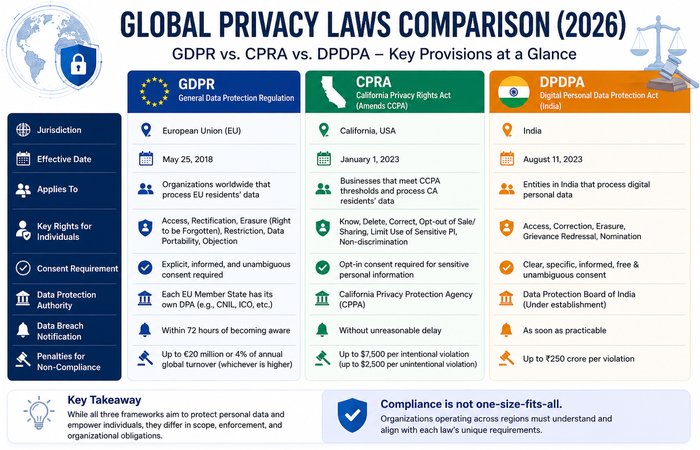
Compliance pressure is the reason most people land on a page like this one in the first place — usually because an audit is coming, a new market is opening up, or a breach just happened and someone’s asking what the legal exposure looks like.Today, three frameworks are of the utmost importance, and all three are at very different points in their life cycle in August 2026.
GDPR: Still the Reference Point
The EU‘s General Data Protection Regulation, in force since 2018, is still the benchmark against which every other landmark privacy policy is measured. The mechanics behind the regulation are identical to those of the present day: processing of personal data must have a lawful basis; data subjects have defined rights (access, rectification, erasure, portability and objection); and organizations have to face fines of up to EUR20 million or 4% of global annual turnover (whichever is higher) for serious breaches. What‘s changed over the past few years is not the text of the regulation itself it‘s how, having defined what counts as “processing personal data”, the law applies to ever more data that is contained within models, rather than databases. That’s a big enough shift that it gets its own section further down.
CPRA: The US Patchwork’s Sharpest Edge
California‘s privacy law namely, the comprehensive California Consumer Privacy Act as fully amended by the California Privacy Rights Act (CPRA), overseen by the states loan regulator, the California Privacy Protection Agency (CPPA), remains to be the most comprehensive state-privacy law in the U. S., and 2026 turned out to be a busy year for enforcement. On January 1, 2026, effective new ADMT regulations became effective that required any ADMT weapons integrated in a business makes “significant decision” as to the consumer to (i) give notice prior to such ADMT, (ii) given consumers that opportunity to opt-out, and (ii) reply to requests with the “meaningful explanation” of the logic in use by the ADMT. The same day also saw the start of the California Delete Request and Opt-Out Platform (DROP), which is meant to enable consumers to direct each registered data broker in the state to delete their data at once; the requirement to respond to DROP requests became effective for data brokers on August 1, 2026.
Enforcement hasn’t been theoretical. Reported CPPA and Attorney General enforcement action in 2026 include a settlement for 12.75 million dollars with G. M. for connected-vehicle data sales and data-minimization breaches (May 2026), a settlement for 2.75 million dollars with Disney for opt-out failures (February 2026), a settlement for 1.1 million dollars with PlayOn Sports for youth privacy breaches (March 2026), and a settlement for 375,000 dollars with Ford Motor Company for opt-out friction (March 2026). No matter what else they do with U. S. privacy law in the next couple of years, those numbers are a pretty clear response to any one who still takes California‘s program as a lot of late-night paperwork, rather than a serious enforcement risk.
India’s DPDPA: A Deadline That’s Closer Than It Looks
India‘s Digital Personal Data Protection Act, 2023 was given presidential assent on 11 August 2023, but its real teeth will be borne in a phased implementation schedule to be determined by the DPDP Rules, 2025 notified on 13 November 2025. At this point the Act is about two thirds the way through that schedule:
- November 13, 2025 (Phase 1) — the Data Protection Board of India was formed establishing the first functioning enforcement body under the law.
- November 13, 2026 (Phase 2) — the Consent Manager framework becomes operational, and registration opens for companies that want to act as one. That date is about twelve weeks away as of this guide’s publication — closer than most compliance teams outside India seem to have on their radar.
- May 13, 2027 (Phase 3) — the substantive obligations activate in full: notice and consent mechanics, breach notification, data-principal rights requests, security safeguards, retention limits, and verifiable parental consent for children’s data.
A Consent Manager (as defined in the DPDP Rules) is a separate legal entity, incorporated in India, and assuming the 2 crore net worth requirement is adopted requires a significant investment in tools to encrypt data (that is, AES-256), diligence in keeping legal consent records in machine-readable format for at least 7 years, and regular audits by the Data Protection Board. It acts as a protected partner on behalf of the individual informing the company about what data controls they can and should exercise and provides a single portal separate from the dozens of privacy dashboards across the website where the individual can give, revoke, and update dozens of different permissions. But it cannot unlike a Data Fiduciary or Data Processor “perform the role of a Data Fiduciary or Data Processor,” requiring the Consent Manager to be separate from the company managing the individual‘s data.
The penalties are real enough to change board-level priorities: up to ₹250 crore (roughly $30 million USD) per contravention for failing to implement reasonable security safeguards where that failure results in a data breach, with the Data Protection Board weighing the gravity and repetitive nature of a violation when setting the final figure. And like GDPR, the DPDPA applies extraterritorially — any organization processing the personal data of individuals in India, regardless of where that organization is headquartered, falls within scope if it’s offering goods or services to those individuals.
For organizations with any footprint in India — even indirect, through a vendor or a regional office — the practical message is simple: 2026 is the year to have consent infrastructure, breach-notification workflows, and verifiable parental consent for any under-18 users built and tested, because May 2027 arrives faster than most eighteen-month compliance timelines feel like they should.
(Compliance frameworks focused specifically on network-level obligations — the EU’s NIS2 Directive, PCI DSS 4.0, and similar — are covered in more technical depth in our Network Security guide; this section focuses on the frameworks governing personal data specifically.)
Technical Guardrails for Modern Data Security
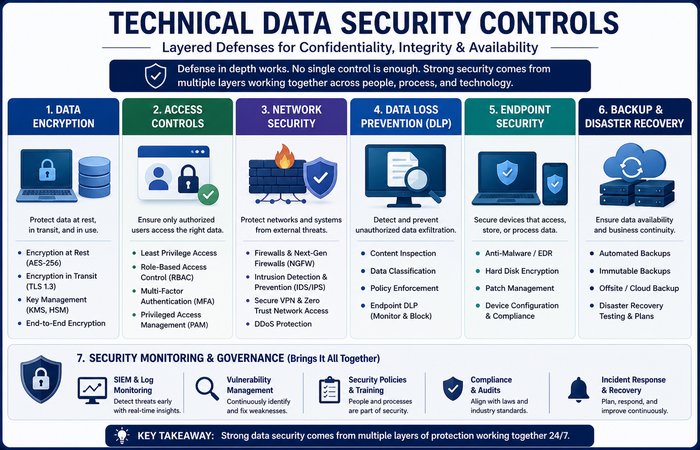
Regulation tells you what you’re obligated to protect. This section is about how you actually protect it — at the data layer specifically, as distinct from the network-perimeter controls (firewalls, VPNs, ZTNA) our Network Security guide already covers in depth. The distinction matters: a network security program asks whether a device should be able to reach a server. A data security program asks whether the data on that server is still protected if the device does reach it.
Zero Trust at the Data Layer
Zero Trust as defined by NIST Special Publication 800-207 takes the previous assumption that anything established within the confines of the network perimeter can be taken as trustworthy and simplifies this assumption to the following rule: verify explicitly, always. Our Network Security guide covers Zero Trust Network Access (ZTNA) — controlling which applications a device can reach. The data-layer version of the same principle is about controlling what a verified, authorized user can actually do with the data itself once they’re in: which fields they can see, which records they can export, which datasets get flagged the moment access patterns look unusual. This is where data classification and labeling stop being a compliance checkbox and start being the mechanism that makes least-privilege access technically enforceable rather than just a policy on paper — you can’t apply a least-privilege rule to data you haven’t first identified as sensitive.
Encryption, Key Management, and Data Loss Prevention
Encryption remains the single highest-leverage technical control in this entire guide, provided the keys are managed at least as carefully as the data they protect — a compromised key renders even the strongest encryption algorithm irrelevant. Current day management involves, to a large degree, automated key rotation, HSM‘s to protect your most sensitive keys, and a defined recovery procedure (lost key = lost dataset).
DLP toolingworks at the same level as encryption to monitor datain motion – email attachments, upload to the cloud, copying to a USB – and stops or alerts when a data transfer crosses the security threshold – for example, a mass export of customer information to a private email address. DLP is also where the AssuranceAmerica and EY breaches above make an uncomfortable case for endpoint-level monitoring specifically: both incidents involved an attacker who already had valid credentials, which is exactly the scenario where perimeter defenses have nothing left to stop and DLP, anomaly detection, and tightly scoped access become the last meaningful line of defense.
Identity and Access Management, and Why It’s Now the Front Line
Identity and Access Management (IAM) — provisioning, authenticating, and continuously verifying who gets access to what — has effectively become the new perimeter, for the same reason IBM’s breach data keeps pointing to compromised credentials rather than malware as the dominant attack vector. Multi-factor authentication, least-privilege provisioning, and regular access reviews aren’t just good practice anymore; they’re the specific controls that would have changed the outcome in at least three of the four breach case studies above. Our guide to choosing the right security software goes into more detail on selecting IAM and endpoint tooling for a smaller organization that doesn’t have a dedicated security team building this from scratch.
Operationalizing Privacy: Practical Strategies
Technical controls protect data. Operational practices decide what data an organization has in the first place, and for how long — which, for anyone who’s ever had to respond to a breach, is usually the difference between a bad week and a genuine catastrophe. A company that never collected a customer’s Social Security number can’t leak it.
Privacy by Design and by Default
The basic inspiration for this idea was delivered by Ann Cavoukian, the former Information and Privacy Commissioner for Ontario, whose Seven Foundational Principles of Privacy by Design have been incorporated into GDPR Article 25 in the form of privacy by design. What that means is that privacy‘s built-in: web security is set up by default to use the greatest privacy protections until and unless a user overrides them, and privacy concept discussions are part of the development process, not part of the review after it‘s done.
Data Minimization and Purpose Limitation
Data minimization is the operational practice of gathering only what actually needs to be gathered for a specific, stated purpose and purpose limitation is the corollary doctrine that data gathered for one purpose not unduly ‘migrates’ into a different purpose without eliciting informed, reaffirmed consent. When taken together, these two measures are the most economical privacy controls a company or government can apply because they reduce the impact of any future data breach up-front. A retailer that only collects a shipping address, rather than a shipping address plus a full purchase history plus browsing behavior, has dramatically less to lose if its database is ever compromised.
Automating Data Subject Access Requests
GDPR, CPRA, and DPDPA all grant individuals the right to request access to, correction of, or deletion of their own data — and at any meaningful scale, handling those Data Subject Access Requests (DSARs) manually becomes both a compliance risk and an operational drag. Mature privacy programs automate the intake, identity verification, data discovery, and response process, typically committing to a defined turnaround window (GDPR sets a baseline of one month; India’s DPDP Rules reference a 90-day resolution window for rights requests). The organizations that struggle most with DSARs tend to be the ones that never built a unified map of where personal data actually lives across their systems in the first place — which is really a data minimization failure showing up downstream as an operational one.
Emerging Frontiers: AI, Quantum, and Privacy-Enhancing Technology
Everything above is the established core of data security and privacy — the material most competing guides on this topic cover, in roughly this order. Below are three areas in which the ground is still moving in 2026, and where starting the ride early is significantly less expensive than retrofitting the solution later.
Machine Unlearning and the Right to Be Forgotten in AI Models
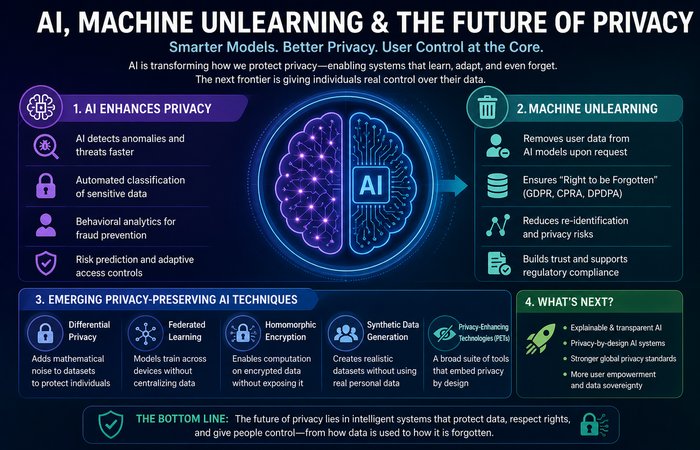
According to the General Data Protection Regulation, in Article 17, anyone shall have the right to request the erasure of his personal data. For a conventional database, honoring that request means deleting a row. For a machine learning model trained on that person’s data, it means something far harder, and regulators and courts still haven’t fully settled what “erasure” even requires in this context.
The core technical problem is that deep neural networks don’t store training data in discrete, retrievable records — they absorb it into millions or billions of weighted parameters during training, in a process researchers have described as compression with memorization. Academic work on privacy attacks has repeatedly shown that individual training examples can sometimes be reconstructed or inferred from a trained model through membership inference attacks, which is precisely why regulators and privacy researchers increasingly argue that Article 17 has to reach the trained model itself, not just the original training dataset sitting in storage. The European Data Protection Board has taken the position that AI developers can be considered data controllers under GDPR, but the regulation’s text was written years before anyone had to answer “what does erasure mean for a neural network,” and that gap is exactly where machine unlearning research has stepped in.
Machine unlearning is the general term for techniques that remove a specific individual’s data — and, ideally, that data’s downstream mathematical influence — from an already-trained model, without the extraordinary cost of retraining the entire model from scratch. The field breaks down into two broad approaches:
- Exact unlearning retrains the model on the retained data only, guaranteeing the removed data has zero remaining influence. It’s the gold standard for compliance, and for anything beyond a small model, it’s usually far too computationally expensive to run on-demand for every individual deletion request.
- Approximate unlearning uses techniques like targeted fine-tuning, gradient-based “scrubbing,” or influence-function estimation to reduce a data point’s influence without a full retrain. It’s dramatically cheaper, but it comes without the same formal guarantee that the data’s influence is fully gone.
The architecture most frequently cited as a practical middle ground is SISA — Sharded, Isolated, Sliced, and Aggregated training — introduced by researchers Lucas Bourtoule and colleagues at a 2021 IEEE Symposium on Security and Privacy. SISA partitions a training dataset into isolated shards and trains a separate model component on each one; when someone requests deletion, only the specific shard containing their data needs retraining, rather than the entire model. It’s a genuinely clever piece of systems engineering, and it’s also not a free lunch — it works best when data can be meaningfully sharded in advance, and it doesn’t help an organization that’s already trained a large model on an un-sharded dataset and only now needs to comply with a deletion request.
Two documented failure modes are worth knowing before treating machine unlearning as a solved problem. Researchers Nicolas Carlini and colleagues, in a 2022 NeurIPS paper, identified what they called the privacy onion effect: removing the training examples most vulnerable to a privacy attack doesn’t shrink the model’s overall vulnerability — it exposes a new, previously-safe layer of data to the same kind of attack, the same way peeling one layer off an onion just reveals another layer underneath. And separately, aggressive unlearning can trigger catastrophic unlearning (also called catastrophic forgetting in this context), where removing specific data points degrades the model’s broader performance far beyond what the removed data alone should account for — the neural-network equivalent of pulling one book off a shelf and having the whole shelf collapse.
None of this is abstract for long. The risk approach of the EU AI Act increases the real financial risks of mismanaging AI data governance: violations for the use of banned AI practices could be fined by up to EUR 35 million or 7% of worldwide turn over, deviations in high risk systems (including violations of the data governance duties (article 10)) could be sanctioned by up to EUR 15 million or 3% (plus a possible subsidiary penalty, not to be exceeded by the fine itself), or EUR 7.5 million or 1%, for misinforming regulators. Additionally, to paint the current picture rather than the anachronic one, it should be mentioned that – under a Digital Omnibus agreement, struck on 7 May 2026- the EU moved the is described deadline for compliance of the high risk AI systems under Annex III (i.e. self-standing use cases, such as screening and biometric identification) from 2 August 2026 to 2 December 2027, and the Annex I deadline for product-embedded systems from 2 August 2027 to 2 August 2028. The prohibited-practices tier, though, has been enforceable since August 2, 2025 — so the highest-stakes obligations are already live even as some of the others get more runway.
Post-Quantum Cryptography: Preparing for Harvest Now, Decrypt Later
Most “encrypt your data” advice treats encryption as a solved problem. It isn’t, not permanently — because the public-key cryptography protecting the vast majority of data in transit and at rest today (RSA, ECC-based algorithms) is mathematically vulnerable to a sufficiently powerful quantum computer running Shor’s algorithm. Nobody has built that computer yet. The threat is more immediate than “eventually” suggests, though, because of a strategy security researchers call Harvest Now, Decrypt Later (HNDL): an adversary captures and stores encrypted data today, with no ability to read it, betting that a future quantum computer will let them decrypt it retroactively. For any data that needs to stay confidential for years or decades — health records, trade secrets, national security information, genetic data — that bet is already paying off for whoever’s making it, regardless of how far off the actual computer is.
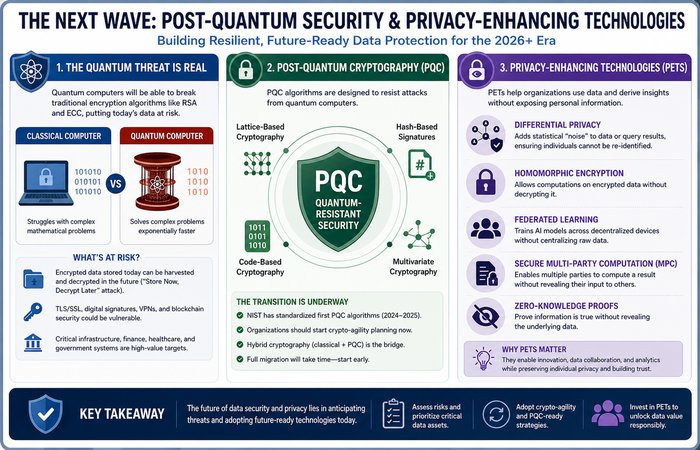
FIPS 203, 204, and 205 are the U.S. National Institute of Standards and Technology’s answer, finalized on August 13, 2024 after an eight-year public evaluation process:
- FIPS 203 (ML-KEM), based on the CRYSTALS-Kyber algorithm, handles quantum-resistant key exchange — the direct replacement for RSA and ECDH.
- FIPS 204 (ML-DSA), based on CRYSTALS-Dilithium, handles digital signatures using the same lattice-based mathematical foundation.
- FIPS 205 (SLH-DSA), based on SPHINCS+, provides a hash-based signature scheme as a conservative fallback, deliberately built on different mathematical assumptions than the other two in case a weakness is ever found in lattice-based cryptography specifically.
Although the NSA‘s Commercial National Security Algorithm Suite 2.0 (CNSA 2.0), published in September 2022, establishes the migration schedule for National Security Systems and, thanks to its being the critical-infrastructure supply chain‘s de facto go-to standard, applies to a much broader population of organizations than “government” alone for a truly large set of entities. The schedule is not truly a single cutoff date, so it bears talking about it as such: No mandatory transition will apply to existing-validated systems until December 31, 2025. Beginning January 1, 2027, all new procurement for National Security Systems must be capable of CNSA 2.0 algorithms. Software and firmware signing, along with traditional networking equipment such as VPNs and routers, are expected to reach exclusive CNSA 2.0 use by 2030; web browsers, servers, cloud services, and operating systems have until 2033; and the NSA’s overall goal, aligned with National Security Memorandum-10, is full quantum-resistance across National Security Systems by 2035. CNSA 2.0 specifically requires the highest available parameter sets — ML-KEM-1024 and ML-DSA-87 — which means organizations in scope need infrastructure capable of handling meaningfully larger public keys and signatures than classical algorithms ever required.
The practical response, for any organization holding data that needs to stay confidential for more than a few years, isn’t to rip out existing encryption tomorrow. It’s cryptographic agility: architecting systems so cryptographic algorithms can be swapped out without a ground-up rebuild, starting with an honest inventory of where cryptography is actually being used today, and prioritizing the systems protecting the longest-lived sensitive data first. For the deeper technical mechanics of deploying these algorithms across network infrastructure specifically, our Network Security guide covers the equipment side of this migration; the priority here, at the data layer, is making sure encryption-at-rest for your most sensitive long-lived datasets isn’t the last thing on that inventory list.
Privacy-Enhancing Technologies: Computing Without Seeing
The oldest framing of privacy and data utility treats them as a trade-off: the more useful a dataset is for analysis, the less private it can be, and vice versa. There are a class of technologies, called Privacy-Enhancing Technologies (PETs) that try to do this, by allowing organizations to gain insight or perform computation over sensitive data without ever revealing the raw data to another party, including itself.
FHE (Fully Homomorphic Encryption) was first practically implemented by research Craig Gentry at Stanford. It is done by carrying out the mathematical on the encrypt data to produce the encrypted answer that decrypts to the same answer as would be obtained running the calculation on the original unencrypted data (without decrypting the data during the computation). A published ETH Zürich research collaboration describes exactly this kind of pilot work with Roche, exploring FHE for quality-control rule checks and neural-network-based analysis on laboratory diagnostic data submitted by external labs, specifically so Roche’s systems can process the data without ever seeing the underlying patient records, and the labs can benefit from Roche’s proprietary models without exposing them either. It’s worth being precise here rather than overselling it: the specific models described in that research had not yet reached full production deployment at the time of publication, though the underlying model architecture is structurally similar to systems already used in comparable real-world applications. FHE remains computationally expensive relative to processing plaintext directly, which is exactly why it tends to get deployed for a narrow set of especially sensitive computations rather than as a blanket replacement for conventional encryption.
Data Clean Rooms (DCRs) solve a related but distinct problem: letting two or more organizations jointly analyze combined data without either one ever getting direct access to the other’s raw records. A typical DCR workflow runs in stages — participants upload their own data without granting the other party access to it, computation happens inside a secure, access-controlled environment (frequently a hardware-based Trusted Execution Environment, such as AWS Nitro Enclaves or Microsoft Azure’s confidential computing environment, which uses attestation to verify the integrity of the computing environment before any data is processed inside it), only pre-approved, aggregated queries are permitted, and only the final aggregated output — never the underlying rows — ever leaves the environment. Clean room platforms including Snowflake and Databricks now layer in differential privacy on top of this architecture: a mathematical technique that adds carefully calibrated statistical noise to query results, so that no single individual’s presence or absence in the dataset can be inferred from the output, while still preserving enough accuracy for the aggregate result to be genuinely useful. Because repeated queries against the same dataset can theoretically be cross-referenced to erode that protection over time, these systems track a running privacy budget for each account or dataset — every query consumes part of the budget, and once it’s exhausted, further queries against that data are blocked until the budget resets.
Taken together, machine unlearning, post-quantum cryptography, and privacy-enhancing technologies represent a real shift in how the field is starting to think about data protection: not as a static wall around a database, but as a set of properties — forgettability, forward-secrecy against future computing power, and computability without exposure — that have to be engineered directly into how data is processed, not bolted on around its edges afterward.
FAQs
Q1: How is machine unlearning different from just deleting a database row, and does it actually satisfy GDPR Article 17?
A: Deleting a database row removes a discrete record from structured storage — a solved problem decades old. Machine unlearning targets something much harder: the mathematical influence a piece of training data has already had on a neural network’s millions or billions of parameters, which isn’t stored anywhere as a retrievable row. Whether current unlearning techniques fully satisfy Article 17 is genuinely unresolved — exact unlearning (full retraining) offers the strongest guarantee but is often too costly to run per-request, while cheaper approximate methods carry real, documented side effects like the privacy onion effect and catastrophic unlearning. Regulators have signaled that AI developers can be treated as data controllers under GDPR, but detailed enforcement guidance on what “sufficient” unlearning looks like in practice is still developing.
Q2: What actually changes for a business when India’s DPDPA Consent Manager framework goes live on November 13, 2026?
A: Registration opens for companies wanting to operate as Consent Managers — India-incorporated entities, with a minimum ₹2 crore net worth, that act as fiduciary intermediaries giving individuals a single place to grant, review, and withdraw consent across every company processing their data. For most businesses that aren’t themselves becoming a Consent Manager, this phase is mainly a signal: the Data Protection Board is now fully staffed and operational, and the harder compliance deadline — the one with penalties attached, up to ₹250 crore per contravention — lands six months later, on May 13, 2027.
Q3: Is the January 1, 2027 CNSA 2.0 date really a hard deadline for all encrypted systems? A: No — and treating it as one is a common oversimplification. January 1, 2027 specifically applies to new acquisitions for U.S. National Security Systems, which must support CNSA 2.0 algorithms from that date. It is not a single cutover for all encryption everywhere. The fuller timeline is staged by category: software and firmware signing along with networking equipment are expected to reach exclusive CNSA 2.0 use by 2030, browsers, servers, cloud services, and operating systems by 2033, with full quantum-resistance across National Security Systems targeted for 2035. Organizations outside the government supply chain aren’t bound by these specific dates, but they’ve become the reference timeline much of the private sector is planning against anyway.
Q4: What’s the actual technical difference between data security and cybersecurity?
A: Cybersecurity is the broad discipline covering an organization’s entire digital environment — networks, endpoints, identities, cloud infrastructure, applications. Data security is a specialized subset of that discipline, focused specifically on the data itself: how it’s classified, encrypted, and governed, independent of where it’s physically or logically located at any given time. A cybersecurity program can successfully keep every attacker out of a network and still fail at data security if the data inside that network is unclassified, unencrypted, and accessible to far more internal users than actually need it.
Q5: How is Fully Homomorphic Encryption different from a Data Clean Room, and would an organization ever need both?
A: FHE lets computation happen directly on encrypted data belonging to a single party — the data owner’s own information stays encrypted throughout, even from the party running the computation. A Data Clean Room solves a different problem: letting multiple separate organizations jointly analyze combined datasets without either one seeing the other’s raw records, typically using a hardware-isolated Trusted Execution Environment plus differential privacy rather than FHE’s much heavier computational approach. An organization might genuinely use both — FHE for a single highly sensitive internal computation, a DCR for a multi-party collaboration with an external partner — because they’re solving adjacent but distinct problems.
Q6: Why do most of the highest-profile 2026 breaches trace back to compromised credentials or vendors, rather than hackers “breaking in” through a technical exploit?
A: As modern perimeter defenses have really got good at blocking brute-force attack against them, that pushes the attacker toward the weak link: human beings, and trust relationships. All four breach case studies in this guide — AssuranceAmerica, EY, Abbott/Exact Sciences, and NYC Health + Hospitals — trace back to a phished employee, a compromised third-party platform, a vishing call that captured single sign-on credentials, or a breached vendor, rather than a firewall or encryption failure. IBM’s 2026 report backs this up at scale: phishing has been the most common initial attack vector for four consecutive years, and AI is now accelerating how convincingly those social-engineering attempts can be crafted.
Bringing It Together
None of the pieces in this guide work in isolation, and that’s really the point of walking through them together rather than as separate checklists. Think of encryption with no key management as a door locked with a note taped to it. Think of having a privacy policy on your Web site but no technical measures in place to support it as the promise a company can‘t keep once an attacker arrives. Machine unlearning without an honest inventory of where training data actually came from is a compliance answer nobody can actually verify. Post-quantum readiness without knowing where your own cryptography lives today is a deadline with no starting point.
The throughline across every 2026 case study in this guide — and across the regulatory frameworks tightening around all of it — is that the organizations getting hurt aren’t usually the ones with a single glaring vulnerability. They’re the ones where security and privacy got built by two teams that never quite talked to each other: a technically sound system holding data it should never have collected, or a well-intentioned privacy policy sitting on top of infrastructure that couldn’t actually enforce it. Closing that gap — treating data security and data privacy as one connected discipline rather than two adjacent departments — is, at this point, less a competitive advantage than a baseline for staying out of the next breach notification list.
Sources & References
- IBM — Cost of a Data Breach Report 2026. Global and U.S. average breach cost figures, AI-driven attack statistics, phishing as leading initial attack vector. com/reports/data-breach
- NSA — CNSA 2.0 FAQ (September 2022). Official Commercial National Security Algorithm Suite 2.0 announcement and transition rationale. defense.gov — CNSA 2.0 FAQ (PDF)
- NSA — CNSA 2.0 Key Management Requirements Annex. Confirms ML-KEM-1024 and ML-DSA-87 as required CNSA 2.0 parameter sets. gov — Key Management Requirements Annex (PDF)
- Cloud Security Alliance — NIST FIPS 203, 204, 205 Finalized. Confirms the August 2024 finalization of ML-KEM, ML-DSA, and SLH-DSA. org
- DigiCert — Tracking the Progress Toward Post-Quantum Cryptography. CNSA 2.0 category-by-category transition timeline. com
- GDPR-Info.eu — Article 17: Right to Erasure. Full text reference for GDPR’s right-to-erasure provision. gdpr-info.eu/art-17-gdpr
- ScienceDirect — “Algorithms that forget: Machine unlearning and the right to erasure.” Legal analysis of machine unlearning against GDPR Article 17. com
- arXiv — “Unlearn and Burn: Adversarial Machine Unlearning Requests Destroy Model Accuracy.” Background on SISA training and exact vs. approximate unlearning. org/pdf/2410.09591
- arXiv — “Second-Order Information Matters: Revisiting Machine Unlearning for Large Language Models.” Documents and defines the privacy onion effect in an unlearning context. org/pdf/2403.10557
- arXiv — “Adversarial Mixup Unlearning.” Defines and addresses catastrophic unlearning. org/pdf/2502.10288
- Cloud Security Alliance — “The Right to Be Forgotten — But Can AI Forget?” EDPB position on AI developers as data controllers. org
- EU Artificial Intelligence Act — Article 99: Penalties. Official three-tier penalty structure text. eu/article/99
- Decode the Future — EU AI Act Explained (2026 update). Digital Omnibus deferral of Annex I/III high-risk deadlines. org
- AI Priority Map — EU AI Act Fines and Penalties. Confirms prohibited-practices tier enforceable since August 2, 2025.
- King Stubb & Kasiva — DPDPA 2023 Guide. DPDPA phased timeline, penalty structure, extraterritorial scope. com
- Fisher Phillips LLP — India’s New Data Privacy Rules. DPDP Rules notification date and compliance phasing. com
- Recording Law — India Data Privacy Laws Guide. Consent Manager eligibility and operational requirements. com
- com — Implementation Timeline. Phase-by-phase DPDPA rollout dates. dpdpa.com
- California Office of the Attorney General — CCPA. Official state government summary of CCPA/CPRA consumer rights. ca.gov/privacy/ccpa
- California Privacy Protection Agency — Law & Regulations. Official CPPA rulemaking and regulatory status. ca.gov/regulations
- PrivacyLawMap — California Privacy Law 2026 Guide. 2026 CPRA enforcement actions (GM, Disney, Ford, PlayOn Sports).
- PrivacyOn — California Privacy Law 2026: CCPA, DELETE Act & DROP Explained. ADMT regulations and DROP platform launch details. com
- TechCrunch — “Another massive data breach exposed millions of driver’s license numbers.” AssuranceAmerica breach reporting. com
- BleepingComputer — “AssuranceAmerica data breach exposes records of 6.9 million drivers.” Breach notification detail and timeline. com
- BleepingComputer — “Ernst and Young discloses data breach after support system hack.” EY breach disclosure and scope. com
- SecurityWeek — “ShinyHunters Claims Ernst & Young Hack.” Data types exposed in the EY breach. com
- HIPAA Journal — “Abbott Investigating Cyberattack Claims From Two Threat Actors.” Abbott/Exact Sciences vishing attack details. com
- Abbott — Official Statement on Cyber Incident in Cancer Diagnostics Business. Primary-source confirmation of impacted personal/health information. com
- NYC Health + Hospitals — Official Notice of Data Breach. Primary-source breach notice and data categories affected. org
- TechCrunch — “NYC Health + Hospitals says hackers stole medical data and fingerprints.” Breach scope, timeline, and biometric data exposure. com
- com — “Data breach exposes medical, financial, biometric data of 1.8 million.” Intrusion window and vendor-origin detail. biometricupdate.com
- ETH Zürich — “Homomorphic Encryption for Healthcare Data Privacy in Industry Use Cases.” Academic research describing Roche’s FHE pilot for laboratory diagnostics. ch (PDF)
- Snowflake Documentation — Differential Privacy in Data Clean Rooms. Official documentation of privacy budget mechanics. snowflake.com
- Microsoft Tech Community — “Enabling Data Clean Rooms With Confidential Computing.” Azure confidential computing / Trusted Execution Environment architecture. microsoft.com
Related Reading
- Network Security: The Complete Guide to Protecting Modern Infrastructure — the network-layer companion to this guide, covering Zero Trust Network Access, firewalls, SASE, and the equipment side of post-quantum migration.
- Cyber Threats and Malware: The Complete 2026 Guide — a closer look at the ransomware, phishing, and AI-driven attack techniques behind the breach case studies above.
- 6 Security Software to Consider This Year — practical guidance on selecting the IAM, endpoint, and VPN tooling referenced in the technical safeguards section.
- A Simple Guide to VPNs — the fundamentals of encrypting data in transit, for anyone who wants the basics before the encryption sections above.
- SASE: The Future of Network Security — how cloud-delivered security architecture intersects with the data-layer controls covered here.
Related Guides
- Understanding Data Security — A practical foundation for the technical controls covered in this guide.
- How to Prevent Data Breaches — Practical steps for reducing breach risk before an incident occurs.
- Encryption — A focused explanation of the encryption concepts referenced throughout this guide.
- Enterprise Data Loss Prevention (DLP) Tools — More context on DLP tooling and the market behind it.
- Internet Privacy Issues — A deeper look at the privacy concerns that sit alongside data security.
- Data Security Compliance Guide — A dedicated guide to compliance requirements, frameworks, and audit readiness.