
AI Applications & Use Cases 2026
AI has gone mainstream. Find out what AI use cases are really doing, what‘s working for which type of business and why the correct use case will be more critical than ever in 2026.
Table of Contents
Introduction
Artificial intelligence is no longer one day. It has come into our life unnoticed.
Whenever Netflix recommends you a film you might love, Google screens the spam back out of your e-mail, Amazon recommends something you‘ve looked at in a dozen different places or your bank spots a fraudulent transaction within seconds, AI is doing it.
All companies are now at the same stage.
Until a few years ago, many companies approached AI as a developing technology all worth trying out. Now it is crossing over to be an operational layer through which customer service, software development, cyber security, supply chains, medical imaging, fraud detection, forecasting and many other processes run.
However, despite the ever increasing array of AI applications, there remains a considerable amount of misunderstanding.
Certain articles trivialize AI by boiling it down to simple chat bots and image generators. Others try to scare readers with predictions that entire sectors of employment will vanish within a day. Both of these extremes fall short.
Market leaders are not trying to deploy artificial intelligence enterprise-wide. Rather, they are narrowing their focus to a few business problems, getting the right techniques, conceptually calculating results, and scaling only when they find business benefits.
That distinction matters.
A recommendation engine that increases online sales by 12% is an AI application.
An AI-powered radiology system that helps detect breast cancer earlier is another.
So is a simple but innovative predictive maintenance platform that gives you the ability to keep factory equipment from breaking, ever.
All four are solving entirely different problems, but all of them are exhibiting the same rule that AI benefits if it is used to specficic problem with concrete information and quantifiable result.
As with the content itself, the technology has also changed quickly.
The initial, classical machine learning used to be centered on classification and prediction. NextGen generative AI can generate text, images, source code, audio and video. The latest evolution sometimes referred to as agentic AI goes beyond generation and prediction, instead planning, reasoning, interacting with several applications, and performing multi-step workflows with minimum human input.
This change has moved the discussion from “Can AI do this” to “Can AI do this, and that?”
That‘s a significantly broader question and one that all organizations are now starting to examine.
In this comprehensive guide, you‘ll learn:
- What AI applications actually are
- How modern AI systems work
- The major categories of AI applications
- Real-world AI use cases across industries
- Consumer and enterprise AI examples
- Proven business case studies backed by research
- The rise of agentic AI
- Infrastructure requirements
- AI governance, security, and responsible deployment
- How organizations measure AI return on investment
- Future AI trends shaping business beyond 2026
Despite your familiarity with the subject of AI, (whether you are a business executive considering investing in AI, a developer examining the realities of applying AI technology, a student of contemporary AI, or simply someone with a curiosity about how AI is disrupting business), this book makes an objective, impartial, and fact-based assessment of the areas in which AI is actually providing value as well as demonstrating how in other areas expectations are often more than a little ahead of reality.
What Are AI Applications?
It is however also possible to talk of one technology as a whole: “Artificial intelligence”.
It isn‘t.
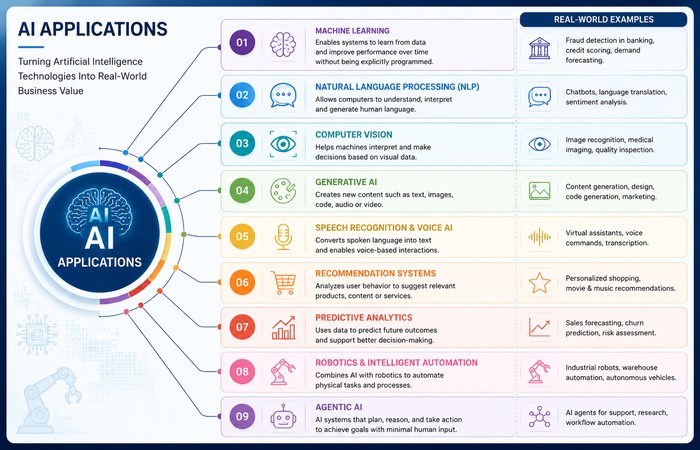
However, Artificial Intelligence is a wide range of methods aimed at providing services that could previously be done by human minds, like learning, identification, language processing, prediction, problem solving and decision support.
A technology-based application of AI is any AI software or other digital product that makes use of one or more of these technologies to address a specific real-world problem.
That problem could be simple.
Filtering spam emails.
Create a system that can detect fraudulent (Chilean) credit card transactions.
Translating languages.
Generating product descriptions.
Or the ‘ultra’ complicated problems: cancer detection from scans; demand forecasting of a global supply chain network; controlling hundreds of autonomous robots in a hyper-modern warehouse.
The important distinction is this:
It is the technology, and AI itself.
The actual implementation of this technology to solve a real world problem is referred to as the applications of AI.
For example:
| AI Technology | AI Application | Real-World Use Case |
| Machine Learning | Fraud Detection System | Banks identify suspicious transactions in real time |
| Computer Vision | Medical Imaging Analysis | Hospitals assist radiologists in detecting abnormalities |
| Natural Language Processing | Customer Support Chatbot | Businesses automate common customer inquiries |
| Generative AI | Content Creation Assistant | Marketing teams generate first drafts of blogs, emails, and advertisements |
| Speech Recognition | Virtual Assistant | Smartphones convert spoken language into actions |
| Recommendation Systems | Streaming Platform | Personalized movie and music recommendations |
| Predictive Analytics | Demand Forecasting | Retailers optimize inventory levels |
Notice something important.
It‘s not that any of these applications are just “interesting” because they are AI.
Each one addresses a quantifiable consumer or business problem.
That‘s why more and more organizations measure the success of an AI project based on operational performance rather than its technical accomplishments.
Questions like:
- Does response time improve?
- Are fewer mistakes made?
- Does customer satisfaction increase?
- Can employees spend more time on higher-value work?
- Is revenue growing?
- Are operating costs decreasing?
In the final analysis it is the lack of ability to write or ‘see’ which makes AI useless.
It‘s useful in that we can provide better decisions to people, do things automatically and repetitively, improve efficiency and reduce risk and also to some extent improve the experience at an even larger scale.
AI Insight
Stanford AI Index Report reports that the rate of AI adoption by large enterprise organizations has continued to increase rapidly worldwide and generative AI is becoming the fastest growing technology investment across industries. The quantity of clients are transitioning from adopters of accelerators & experimentation to utilizing production AI investments toward increased productivity, automated workflows, & assistance to decision.
Traditional Automation vs. Artificial Intelligence
Automation and the artificial Intelligence do not have the same meaning and they do not have the same problems to settle.
Automation in a classical sense is always following the predefined rules. If the rule set remains the same, the result will also always be the same.
Conversely, Artificial Intelligence is a computer based replication of human intelligence built upon learning from data, detecting patterns and modifying its own behavior accordingly. It bases its action on probabilistic computation rather than commands.
Being clear about the nature of these two distinctions enables an organization to select the appropriate technology for the task in hand.
| Traditional Automation | Artificial Intelligence |
| Follows predefined rules | Learns from historical data |
| Static workflows | Continuously improves through training and retraining |
| Performs repetitive tasks | Handles dynamic and changing scenarios |
| Predictable outputs | Probabilistic predictions and recommendations |
| Requires manual rule updates | Adapts as new data becomes available |
| Limited decision-making | Supports complex decision-making |
| Best for structured processes | Best for data-driven and unstructured problems |
Which Should You Choose?
Automating using traditional approaches is still the most effective method for very repetitive rule-based activities like payroll computation, routing invoices, or scheduled backups. AI offers more value when a business has a great deal of data to understand, predict and analyze, identify regularities, quantify possibilities, utilize language, or automate more complicated rule sets.
AI Assistant vs. AI Agent
While the terms AI assistant and AI agent are commonly grouped together as the same definition, the distinction of capability is at a different level.
The only thing an AI assistant does is to fulfill the User‘s demand.
AI agents push this notion further by performing planning, reasoning, interfacing with external tools and executing multi-step workflows with minimal human directions.
| AI Assistant | AI Agent |
| Responds to prompts | Pursues objectives and completes tasks |
| Answers questions | Plans and executes multi-step workflows |
| Requires user input for each action | Can initiate actions within defined permissions |
| Limited memory between interactions | May maintain context and working memory |
| Typically uses a single interaction | Coordinates multiple systems and tools |
| Focuses on information | Focuses on outcomes |
Example
Imagine an employee asks:
Imagine an employee asks:
Develop the sales report for the coming month.
A potential AI assistant could be summarising sales figures if they are provided.
While operating in such a way, an AI agent might check the CRM for data, examine performance trends, compile a chart, put together a presentation, inform the relevant persons, and schedule a review meeting, all automatically within existing policies.
This transition from answering questions to doing work is one of the defining features of contemporary enterprise AI.
Cloud AI vs. Edge AI
To adopt AI, organizations make use of either centralized cloud resources, local edge resources or the integration of the two.
All three approaches have their advantages in respect to performance, privacy, scalability and latency.
| Cloud AI | Edge AI |
| Processing occurs in remote cloud data centers | Processing occurs directly on local devices |
| Virtually unlimited computing resources | Limited by device hardware |
| Easier to update and maintain models | Faster real-time responses |
| Requires internet connectivity for most workloads | Can operate offline or with limited connectivity |
| Ideal for large language models and enterprise AI | Ideal for robotics, autonomous systems, IoT, and smart devices |
| Higher network latency | Lower latency for time-sensitive applications |
| Centralized security and management | Greater control over sensitive local data |
Which Deployment Model Is Best?
Most organizations do not strictly follow one paradigm anymore.
In of themselves, edge and fog-based AI techniques are not sufficient, and they rely upon hybrid architectures. These integrate cloud computational power and enterprise intelligence, with local, edge latency inference closer to source.
The tradeoff here has been between privacy, scalability and the performance..
Foundation Models vs. Fine-Tuned Models
Most of the large AI models are not trained by organizations directly in the first place. Rather, they use the existing foundation models for business-specific applications.
| Foundation Model | Fine-Tuned Model |
| General-purpose knowledge | Optimized for specific domains |
| Trained on massive public datasets | Additional training on targeted organizational data |
| Broad capabilities | Greater expertise in specialized tasks |
| Suitable for many applications | Designed for focused business use cases |
| Lower customization | Higher customization |
Retrieval-Augmented Generation vs. Fine-Tuning
“Researchers will also wonder if they should fine-tune a language model or use Retrieval-Augmented Generation (RAG).
It also is related to the business problem.
| Retrieval-Augmented Generation (RAG) | Fine-Tuning |
| Retrieves current information at runtime | Modifies the model itself through additional training |
| Easier to keep information up to date | Requires retraining when information changes |
| Excellent for enterprise knowledge bases | Better for specialized domain behavior |
| Lower maintenance in many business scenarios | Higher implementation complexity |
| Helps reduce hallucinations using trusted sources | Improves task-specific expertise |
For many enterprise AI use cases RAG represents the optimum trade-off for accuracy, maintainability, and cost.
AI Applications vs. AI Use Cases
These terminologies are also sometimes used interchangeably by the public but they have distinct meanings.
Understanding these distinctions can be a huge help in simplifying the planning of AI projects.
An AI application refers to the software or system itself.
It is the problem the software is solving, i.e., an AI use case Consider it like this.
A navigation app is the application.
Helping drivers avoid traffic is the use case.
The law certainly does no less.
For example:
| AI Application | AI Use Case |
| AI Chatbot | Automating customer support |
| Predictive Analytics Platform | Forecasting product demand |
| Recommendation Engine | Personalizing shopping experiences |
| Medical Image Analysis Software | Assisting disease detection |
| AI Coding Assistant | Accelerating software development |
This is a good point in that one application may support one or more use cases.
For example, a large language model can:
- Answer customer questions
- Summarize documents
- Generate software code
- Translate languages
- Analyze contracts
- Draft emails
- Search enterprise knowledge bases
The underlying technology remains the same.
The business use case changes.
Organizations that understand this distinction tend to develop their AI strategy based first on solving a business challenge.
Why AI Applications Matter More Than Ever
Over the past decade AI has gone from a novel technology to a component within the digital transformation.
Several contemporary trends are accelerating this process:
Cloud computing makes High Performance Computing resources available to an organization regardless of its size..
Open-source machine learning frameworks reduced development barriers.
The big-impact foundation models opened up for AI were with regard to language, images, audio and code.
Meanwhile, organizations generated large quantities of operational data from all of their activities, providing the raw material for many of the applications of the AI systems.
Even more significant is the fact that AI is no longer confined to specialists.
Business analysts utilize AI to aggregate reports.
Developers use coding assistants to help write, code and review software.
AR have long been employed by clinicians in diagnostic imaging..
Retailers forecast demand with machine learning.
Manufacturers monitor equipment health using predictive analytics.
Financial institutions detect fraud in milliseconds.
People are even users of AI dozens of times all day
This widespread usage is the reason why the conversations are now directed much more towards the practical problem:
- Which business problems should AI solve first?
- Which AI technology best fits those problems?
- How can results be measured?
- What governance and security controls are necessary?
- How can organizations scale successful AI deployments responsibly?
Answering those questions requires understanding not only the technology itself but also the growing ecosystem of AI applications across industries—a topic we’ll explore in the next section as we examine the major categories of AI transforming business and everyday life.
Types of AI Applications
Artificial intelligence isn’t a single technology that performs every task equally well. Instead, it consists of several specialized branches, each designed to solve different kinds of problems.
Some AI systems excel at recognizing images. Others understand language, predict future outcomes, generate creative content, or make recommendations based on user behavior. Many of today’s most advanced applications combine multiple AI technologies to deliver a seamless experience.
Understanding these categories makes it easier to evaluate AI solutions and identify the right technology for a specific business challenge.
Below are the major types of AI applications shaping industries in 2026.
1. Machine Learning (ML)
Machine Learning is the foundation of modern artificial intelligence. Instead of following rigid, pre-programmed rules, ML systems learn patterns from historical data and use those patterns to make predictions or decisions when new information becomes available.
For example, an e-commerce platform doesn’t manually program millions of shopping preferences. Instead, a machine learning model analyzes customer behavior—what people view, purchase, ignore, or abandon—and continuously improves its recommendations over time.
Machine learning is especially effective when organizations have large amounts of structured or semi-structured data.
Common Machine Learning Applications
- Fraud detection
- Demand forecasting
- Credit risk assessment
- Predictive maintenance
- Customer churn prediction
- Dynamic pricing
- Sales forecasting
- Inventory optimization
Real-world examples
- Banks detect fraudulent transactions within seconds.
- Retailers forecast seasonal demand before products reach stores.
- Manufacturers identify equipment failures before breakdowns occur.
- Insurance companies estimate claim risks more accurately.
Machine learning remains one of the most mature and widely deployed forms of AI because it consistently delivers measurable improvements in efficiency, accuracy, and operational planning.
2. Generative AI
Generative AI has become one of the fastest-growing areas of artificial intelligence. Unlike traditional machine learning systems that classify or predict information, generative AI creates entirely new content based on patterns learned during training.
Depending on the model, that content may include:
- Articles
- Software code
- Images
- Videos
- Music
- Voice
- Presentations
- Marketing copy
- Product descriptions
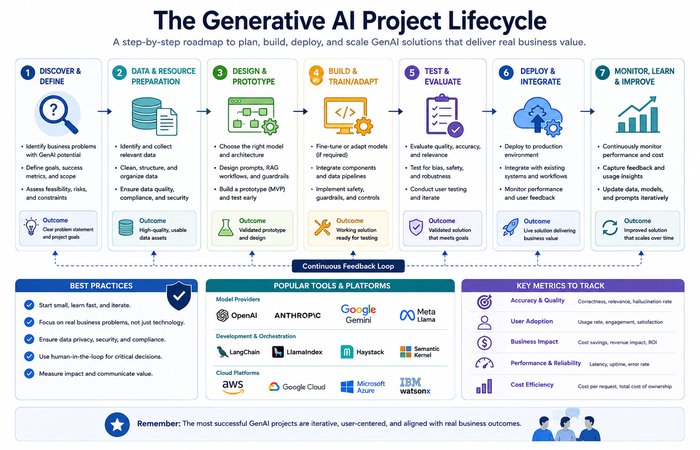
Large Language Models (LLMs) have made generative AI accessible to businesses of every size, allowing employees to automate writing, coding, brainstorming, research, and customer interactions.
Popular Generative AI Applications
- AI writing assistants
- Code generation
- Marketing content creation
- Image generation
- Document summarization
- Customer support automation
- Translation
- Knowledge management
Examples
- Developers use AI coding assistants to accelerate software development.
- Marketing teams create campaign drafts in minutes instead of hours.
- Designers generate concept artwork before refining final designs.
- Customer service teams draft personalized email responses automatically.
While generative AI significantly improves productivity, it isn’t always factually correct. Modern businesses increasingly combine it with retrieval systems, human review, and governance policies to improve reliability.
AI Insight
Generative AI is one of the fastest-growing segments of the AI market. Businesses increasingly use foundation models to assist with content creation, software development, document analysis, customer support, and enterprise search rather than relying solely on traditional automation.
3. Natural Language Processing (NLP)
Natural Language Processing focuses on enabling computers to understand, interpret, and generate human language.
Every day, millions of people interact with NLP without realizing it.
Searching Google, translating a sentence, asking a virtual assistant a question, or chatting with customer support all involve natural language processing.
Modern NLP combines linguistics, machine learning, and deep learning to process text and speech much more naturally than earlier rule-based systems.
Common NLP Applications
- AI chatbots
- Email classification
- Language translation
- Document summarization
- Sentiment analysis
- Spam detection
- Search engines
- Contract analysis
Real-world examples
- Customer support chatbots answer routine questions around the clock.
- Legal firms summarize lengthy contracts in minutes.
- News organizations automatically categorize thousands of articles.
- Businesses analyze customer reviews to identify emerging trends.
NLP has become even more powerful with the rise of transformer-based language models, enabling conversations that feel increasingly natural while supporting multilingual communication across global organizations.
4. Computer Vision
Humans recognize objects almost instantly.
Teaching computers to do the same has taken decades of research.
Computer Vision enables machines to interpret images and videos by identifying objects, people, text, movement, defects, and countless visual patterns.
Advances in deep learning have dramatically improved image recognition accuracy, making computer vision one of the most commercially successful AI technologies today.
Common Computer Vision Applications
- Medical imaging
- Facial recognition
- Quality inspection
- Autonomous vehicles
- Security surveillance
- Optical Character Recognition (OCR)
- Traffic monitoring
- Agricultural crop analysis
Real-world examples
- Hospitals use AI to assist radiologists when interpreting mammograms and CT scans.
- Manufacturing facilities automatically detect product defects during production.
- Warehouses identify damaged inventory using smart cameras.
- Autonomous vehicles continuously analyze surrounding traffic conditions.
According to the U.S. Food and Drug Administration (FDA), the majority of AI-enabled medical devices approved so far are imaging-related, highlighting computer vision’s maturity in healthcare.
5. Speech Recognition and Voice AI
Voice AI converts spoken language into text while increasingly understanding intent, context, and conversational flow.
Early speech recognition systems struggled with accents, background noise, and natural conversation. Today’s models perform significantly better thanks to advances in deep neural networks and transformer architectures.
Popular Voice AI Applications
- Voice assistants
- Call center automation
- Meeting transcription
- Voice search
- Real-time translation
- Medical dictation
- Accessibility tools
Examples
- Doctors dictate patient notes directly into electronic health records.
- Businesses automatically transcribe meetings.
- Smartphones perform voice commands.
- Contact centers route callers without human operators.
Voice AI is also becoming an important component of multimodal AI systems that combine speech, text, images, and video into unified user experiences.
6. Recommendation Systems
Recommendation engines quietly power many of the digital services people use every day.
Rather than presenting identical content to everyone, these systems personalize recommendations based on browsing history, purchases, viewing behavior, interests, demographics, and similar user patterns.
Personalization has become one of the most valuable commercial applications of AI because even small improvements can significantly increase engagement and revenue.
Common Recommendation Applications
- Streaming platforms
- Online retailers
- Social media
- Music services
- News platforms
- Learning platforms
Examples
- Netflix recommends movies based on viewing habits.
- Spotify builds personalized playlists.
- Amazon suggests complementary products.
- YouTube recommends videos likely to keep viewers engaged.
Recommendation systems often combine collaborative filtering, machine learning, deep learning, and reinforcement learning to improve personalization continuously.
7. Predictive Analytics
Predictive analytics uses historical data to estimate future outcomes.
Rather than simply describing what happened, predictive AI estimates what is likely to happen next.
Organizations rely on predictive analytics to improve planning, reduce uncertainty, and make proactive decisions before problems occur.
Common Applications
- Sales forecasting
- Demand prediction
- Inventory planning
- Financial forecasting
- Equipment maintenance
- Customer churn prediction
- Weather forecasting
- Healthcare risk prediction
Examples
- Airlines predict maintenance needs before mechanical failures occur.
- Retailers forecast holiday demand months in advance.
- Banks estimate loan default probabilities.
- Hospitals identify patients at higher risk of complications.
Predictive AI often produces measurable business value because preventing problems is usually far less expensive than reacting after they occur.
8. Robotics and Intelligent Automation
Robotics combines artificial intelligence with sensors, cameras, actuators, and control systems to perform physical tasks in the real world.
Unlike industrial robots that simply repeat pre-programmed movements, modern AI-powered robots adapt to changing environments and make decisions based on what they perceive.
Common Robotics Applications
- Warehouse automation
- Manufacturing assembly
- Autonomous delivery
- Agricultural harvesting
- Surgical assistance
- Inspection drones
- Logistics
- Space exploration
Examples
- Warehouses use autonomous mobile robots to transport inventory.
- Manufacturing robots inspect products while assembling components.
- Agricultural robots monitor crop health.
- Delivery robots transport goods across campuses and industrial sites.
Although humanoid robotics has attracted significant attention, most commercial success today comes from robots designed for specialized industrial tasks rather than general-purpose human-like work.
9. Agentic AI
One of the biggest developments in 2026 is the emergence of Agentic AI.
Traditional AI systems respond to prompts.
Agentic AI goes much further.
Instead of answering a single question, AI agents can plan, reason, execute multiple steps, interact with external software, retrieve information, remember previous interactions, and complete complex workflows with minimal human intervention.
Imagine asking an AI assistant:
“Prepare next week’s sales report.”
Rather than simply generating text, an AI agent could:
- Access CRM data
- Retrieve financial reports
- Analyze sales trends
- Build charts
- Draft executive summaries
- Email stakeholders
- Schedule follow-up meetings
—all within one coordinated workflow.
This represents a major shift from AI assistance toward AI execution.
Emerging Agentic AI Applications
- IT operations
- Customer service automation
- Procurement
- Financial reporting
- Enterprise knowledge management
- HR workflows
- Research automation
- Software development pipelines
However, greater autonomy also introduces greater responsibility.
Organizations deploying agentic AI must establish strong governance, identity management, audit logging, approval workflows, and security controls because these systems increasingly act on behalf of people rather than simply assisting them.
Comparing the Major Types of AI Applications
| AI Type | Primary Purpose | Common Examples |
| Machine Learning | Learn patterns from data | Fraud detection, forecasting |
| Generative AI | Create new content | ChatGPT, image generation, coding assistants |
| Natural Language Processing | Understand language | Chatbots, translation, summarization |
| Computer Vision | Interpret images and video | Medical imaging, quality inspection |
| Speech AI | Process spoken language | Voice assistants, transcription |
| Recommendation Systems | Personalize experiences | Netflix, Amazon, Spotify |
| Predictive Analytics | Forecast future events | Demand planning, maintenance prediction |
| Robotics | Perform physical tasks | Warehouses, manufacturing, logistics |
| Agentic AI | Execute multi-step workflows | Autonomous enterprise assistants |
Why Modern AI Applications Combine Multiple Technologies
The most advanced AI systems rarely rely on just one technology.
Instead, they combine several AI disciplines to solve increasingly complex problems.
Consider an AI-powered customer service platform.
A customer speaks into their phone using Speech AI.
The system converts speech into text.
Natural Language Processing identifies the customer’s intent.
A Large Language Model generates a response.
Machine Learning predicts customer satisfaction.
An AI agent updates the CRM, schedules follow-up tasks, and creates a support ticket automatically.
What appears to be a single AI application is actually multiple AI technologies working together behind the scenes.
This convergence is one of the defining characteristics of modern artificial intelligence and explains why today’s AI systems are capable of handling increasingly sophisticated business workflows.
AI Applications by Business Function
While AI is often discussed by technology type—machine learning, computer vision, or generative AI—organizations rarely deploy AI that way.
Businesses think differently.
Their first question isn’t, “Should we use natural language processing?”
It’s usually:
“Can we reduce customer support costs?”
“Can we improve forecasting?”
“Can we shorten our software development cycle?”
“Can we identify fraud faster?”
Successful AI strategies begin with business objectives rather than technology choices. Once the problem is clearly defined, organizations can determine which AI technologies are best suited to solve it.
Let’s explore how AI is transforming individual business functions.
Business Trend
Research from McKinsey consistently shows that organizations implementing AI across multiple business functions are more likely to report measurable cost savings, revenue growth, and productivity improvements than those using AI in isolated pilot projects.
AI Applications in Customer Service
Customer service remains one of the most mature and valuable AI application areas.
Modern customers expect fast, personalized support across websites, mobile apps, messaging platforms, social media, email, and phone calls. Meeting those expectations using only human agents is becoming increasingly difficult as organizations scale.
AI helps bridge that gap.
Unlike the rule-based chatbots of the past, today’s conversational AI systems understand natural language, maintain context across conversations, retrieve information from company knowledge bases, and even escalate complex issues when human intervention is necessary.
The biggest change over the last two years has been the shift from simple question-answer systems to AI agents capable of completing tasks. Rather than merely explaining how to reset a password, an AI assistant can verify a user’s identity, initiate the reset process, confirm completion, and document the interaction—all within the same conversation.
Common Customer Service AI Applications
- Conversational AI chatbots
- AI voice assistants
- Intelligent ticket routing
- Knowledge base search
- Email response generation
- Customer sentiment analysis
- Self-service support portals
- Automated call summarization
Business Benefits
Organizations implementing AI in customer service commonly report improvements in:
- Faster response times
- Higher first-contact resolution
- Reduced support costs
- 24/7 customer availability
- Improved agent productivity
- More consistent service quality
Importantly, leading organizations aren’t replacing human support teams entirely. Instead, they allow AI to handle repetitive, high-volume inquiries while human agents focus on situations requiring empathy, negotiation, or complex decision-making.
AI Applications in Marketing
Marketing has become one of the largest adopters of generative AI.
Creating personalized campaigns at scale was once impossible without enormous teams. AI has fundamentally changed that equation.
Modern marketing platforms analyze customer behavior, predict purchasing intent, generate content variations, optimize advertisements, personalize email campaigns, and measure campaign performance in real time.
Generative AI has also transformed content production by accelerating first drafts, brainstorming creative ideas, producing social media copy, summarizing research, and localizing campaigns across multiple languages.
However, successful marketing teams increasingly treat AI as a collaborative assistant rather than an autonomous publisher. Human editors remain essential for maintaining brand voice, verifying factual accuracy, and ensuring compliance with advertising standards.
Common Marketing AI Applications
- Content generation
- Search engine optimization (SEO)
- Email personalization
- Customer segmentation
- Advertising optimization
- Predictive lead scoring
- Social media planning
- Campaign performance analysis
Real-world examples
- Online retailers personalize homepage content based on browsing behavior.
- Media companies recommend articles aligned with reader interests.
- Marketing teams generate multiple advertisement variations for A/B testing.
- AI identifies customers most likely to convert before campaigns begin.
Personalization continues to be one of the strongest commercial AI use cases because even small improvements in customer engagement can translate into significant revenue gains.
AI Applications in Sales
Sales teams generate enormous amounts of customer information, making them ideal candidates for AI-assisted decision-making.
Modern sales teams are also using artificial intelligence to make CRM systems more intelligent and actionable. From lead scoring and customer insights to sales forecasting and workflow automation, AI in CRM can help organizations turn customer data into more useful sales and customer-success decisions.
Rather than relying solely on intuition, sales organizations increasingly use predictive analytics to identify promising opportunities, prioritize leads, forecast revenue, and recommend next actions.
Generative AI also reduces administrative work by automatically summarizing meetings, drafting follow-up emails, updating CRM records, and preparing proposals.
Sales professionals spend less time entering data and more time building customer relationships.
Common Sales AI Applications
- Lead scoring
- Sales forecasting
- Opportunity prioritization
- Meeting summaries
- CRM automation
- Proposal generation
- Customer intent prediction
- Revenue forecasting
AI isn’t replacing sales professionals.
It’s helping them make faster, more informed decisions using data that would otherwise be impossible to analyze manually.
AI Applications in Finance
Financial institutions were among the earliest adopters of artificial intelligence, and they remain some of the most sophisticated users today.
Machine learning models continuously analyze millions of transactions to identify suspicious activity in real time. Predictive analytics supports lending decisions, while automation reduces repetitive accounting and compliance work.
Generative AI is increasingly assisting analysts by summarizing financial reports, reviewing contracts, explaining regulatory documents, and preparing executive presentations.
Financial institutions are among the most advanced adopters of artificial intelligence, using it for fraud detection, risk analysis, forecasting, compliance, and customer-facing services. For a deeper look at these applications, see our guide to AI in financial services and how organizations are using AI to analyze and protect financial data.
Common Finance AI Applications
- Fraud detection
- Credit scoring
- Risk assessment
- Financial forecasting
- Expense analysis
- Regulatory compliance
- Automated reporting
- Invoice processing
Case Study: JPMorgan Chase
JPMorgan Chase provides one of the clearest examples of enterprise AI adoption at scale.
Its Contract Intelligence (COiN) platform has automated the review of thousands of commercial credit agreements that previously required extensive manual effort from legal and banking teams.
More recently, the company has deployed internal large language models across a significant portion of its workforce to assist employees with research, documentation, and productivity tasks.
Interestingly, CEO Jamie Dimon has acknowledged that while AI clearly delivers measurable operational benefits, isolating its exact financial contribution remains difficult. That observation reflects a broader reality across many large enterprises: AI adoption is growing faster than organizations’ ability to measure its long-term business impact with precision.
AI Applications in Human Resources
Human Resources is rapidly becoming one of the most AI-assisted business functions.
Recruitment alone involves reviewing thousands of resumes, scheduling interviews, answering candidate questions, and managing documentation.
AI significantly reduces administrative workload.
Today’s HR platforms screen resumes, match candidates to job descriptions, schedule interviews automatically, generate onboarding materials, answer employee questions, and analyze workforce trends.
However, HR also illustrates why responsible AI governance matters.
Research has shown that poorly designed hiring models can unintentionally reinforce historical biases if trained on unbalanced historical data. Organizations therefore increasingly combine AI recommendations with human oversight, fairness testing, transparency requirements, and regular audits.
Common HR AI Applications
- Resume screening
- Candidate matching
- Interview scheduling
- Employee onboarding
- Workforce analytics
- Employee engagement analysis
- Learning recommendations
- HR knowledge assistants
The objective isn’t to let AI make hiring decisions independently but to reduce repetitive administrative work while allowing recruiters to focus on evaluating people rather than paperwork.
AI Applications in Software Development
Few professions have experienced AI adoption as rapidly as software engineering.
Modern coding assistants help developers generate code, explain unfamiliar functions, identify bugs, write documentation, create unit tests, refactor legacy software, and summarize pull requests.
Rather than replacing developers, AI has become an increasingly valuable productivity partner.
Developers remain responsible for software architecture, security, testing, and system design while AI accelerates repetitive programming tasks.
Common Development AI Applications
- Code generation
- Bug detection
- Documentation generation
- Unit testing
- Code review
- API documentation
- DevOps automation
- Infrastructure scripting
Organizations increasingly report faster development cycles, although human review remains essential for security, maintainability, and correctness.
AI Applications in IT Operations
Modern IT environments generate enormous volumes of operational data.
Servers, applications, cloud platforms, security tools, and networking equipment continuously produce logs, alerts, and performance metrics.
AI helps operations teams detect anomalies, identify root causes, prioritize incidents, and automate repetitive maintenance tasks.
As infrastructure grows more complex, AI increasingly acts as an intelligent operational assistant rather than simply another monitoring dashboard.
Common IT AI Applications
- Incident detection
- Log analysis
- Root cause analysis
- Infrastructure monitoring
- Cloud optimization
- Capacity planning
- Automated remediation
- Performance forecasting
This area, often called AIOps (Artificial Intelligence for IT Operations), is becoming increasingly important as organizations expand hybrid cloud and multi-cloud environments.
AI Applications in Cybersecurity
Cybersecurity has evolved into an ongoing race between defenders and attackers—and both sides are using AI.
Security teams deploy machine learning models to detect unusual login behavior, identify malware, analyze network traffic, prioritize vulnerabilities, and respond to threats faster than manual processes allow.
At the same time, cybercriminals increasingly use generative AI to create more convincing phishing campaigns, automate reconnaissance, and develop sophisticated social engineering attacks.
AI hasn’t made cybersecurity easier.
It has simply accelerated both offense and defense.
Cybersecurity is another area where AI has become increasingly important, particularly for detecting anomalies, identifying phishing attempts, monitoring user behavior, prioritizing vulnerabilities, and automating parts of incident response. Our deeper guide to AI in cybersecurity explores how these systems are changing modern security strategies and the challenges organizations still need to address.
Common Cybersecurity AI Applications
- Threat detection
- Malware analysis
- Phishing detection
- Identity verification
- User behavior analytics
- Security Operations Center (SOC) automation
- Vulnerability prioritization
- Incident response
Organizations that integrate AI into security operations often identify and contain threats significantly faster than organizations relying solely on manual investigation. However, AI itself must also be secured because compromised AI systems can introduce entirely new attack surfaces.
AI Applications in Supply Chain and Logistics
Global supply chains involve thousands of variables, including weather conditions, transportation delays, inventory levels, fuel costs, supplier performance, and customer demand.
Traditional planning methods struggle to process this complexity in real time.
AI continuously analyzes incoming data to forecast demand, optimize inventory, recommend shipping routes, predict delivery delays, and improve warehouse operations.
Common Supply Chain AI Applications
- Demand forecasting
- Inventory optimization
- Route planning
- Warehouse automation
- Supplier risk analysis
- Delivery prediction
- Fleet management
- Procurement optimization
Predictive planning has become especially valuable since recent global supply chain disruptions demonstrated how quickly unexpected events can impact operations.
AI Applications in Product Development
Product development increasingly combines customer insights, engineering data, simulation, and market analysis.
AI accelerates this process by identifying customer preferences, generating design alternatives, predicting manufacturing performance, and analyzing user feedback after products launch.
Engineers can evaluate hundreds of design variations in hours rather than weeks, allowing organizations to innovate faster while reducing development costs.
Common Product Development Applications
- Product design optimization
- Customer feedback analysis
- Digital twins
- Simulation
- Prototype generation
- Quality prediction
- Manufacturing optimization
Generative design tools are particularly valuable because they explore design possibilities humans might never consider while still allowing engineers to make final decisions.
AI Across Business Functions: A Quick Overview
| Business Function | Common AI Applications | Primary Benefits |
| Customer Service | Chatbots, AI Agents, Ticket Automation | Faster support, lower costs |
| Marketing | Content Generation, Personalization | Higher engagement, improved conversions |
| Sales | Lead Scoring, Forecasting | Better pipeline visibility |
| Finance | Fraud Detection, Forecasting | Reduced risk, improved accuracy |
| Human Resources | Resume Screening, Workforce Analytics | Faster recruitment |
| Software Development | Coding Assistants, Testing | Increased developer productivity |
| IT Operations | AIOps, Monitoring | Reduced downtime |
| Cybersecurity | Threat Detection, SOC Automation | Faster incident response |
| Supply Chain | Forecasting, Inventory Planning | Better operational efficiency |
| Product Development | Design Optimization, Simulation | Faster innovation |
Why Business Functions Matter More Than Industries
One mistake many organizations make is assuming AI strategies should be built around industries.
In reality, business functions often share the same challenges regardless of sector.
For example:
A hospital, bank, retailer, and manufacturer all operate customer support teams.
Each manages invoices.
Each forecasts demand.
Each recruits employees.
Each analyzes documents.
Each protects sensitive information.
As a result, many AI solutions are transferable across industries even when the products themselves are very different.
Understanding AI by business function helps organizations identify proven use cases before adapting them to their own operational needs.
AI Applications Across Industries
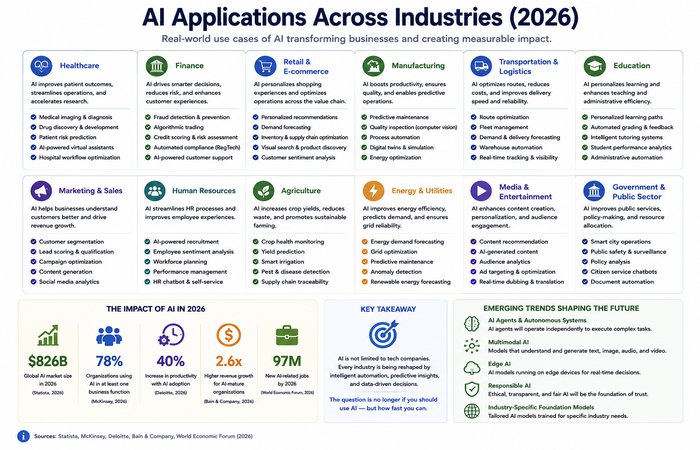
Every industry generates data.
What makes them different is the type of data they produce, the problems they need to solve, and the regulations they must follow.
A hospital deals with medical records and diagnostic images. A bank processes financial transactions. A manufacturer monitors machinery and production lines. A retailer analyzes purchasing behavior and inventory levels.
Although the underlying AI technologies may be similar, their applications vary significantly depending on the industry’s objectives.
Some sectors have been deploying AI successfully for more than a decade. Others are still transitioning from pilot projects to enterprise-wide adoption. Understanding this difference is important because not every AI trend is equally mature.
Let’s explore how artificial intelligence is creating measurable value across major industries today.
AI in Healthcare
Healthcare is one of the fastest-growing AI markets, but it’s also one of the most carefully regulated.
Unlike marketing or retail, mistakes in healthcare can directly affect patient outcomes. That means AI systems must undergo extensive validation before being used in clinical settings.
The most successful healthcare applications today focus on supporting clinicians rather than replacing them.
Medical imaging is perhaps the clearest example.
Deep learning models can analyze X-rays, CT scans, MRIs, and mammograms to help radiologists identify abnormalities more efficiently. These systems don’t make final diagnoses independently. Instead, they provide an additional layer of analysis that assists medical professionals.
Recent randomized clinical studies have demonstrated meaningful improvements in breast cancer screening when AI assists radiologists. At the same time, research also shows that general-purpose conversational AI still struggles with complex, open-ended diagnostic reasoning, reinforcing the importance of clinician oversight.
Healthcare providers are also adopting AI for administrative tasks.
Clinical documentation assistants automatically generate patient notes during consultations. Hospitals use predictive analytics to estimate patient admissions, identify individuals at higher risk of complications, and optimize staff scheduling.
Healthcare is one of the most important areas where artificial intelligence is moving from experimentation into practical deployment. From medical imaging and clinical decision support to patient monitoring and administrative automation, AI in healthcare is changing how medical organizations analyze information, support clinicians, and deliver patient care.
Common Healthcare AI Applications
- Medical image analysis
- Clinical documentation
- Predictive patient monitoring
- Drug discovery
- Personalized treatment planning
- Hospital resource optimization
- Remote patient monitoring
- Medical research assistance
Real-world example
AI-assisted radiology has become one of the most validated healthcare use cases. Hundreds of AI-enabled medical devices have received regulatory clearance for imaging-related applications, reflecting years of clinical testing and real-world deployment.
Industry Snapshot
Healthcare remains one of the most regulated AI sectors. According to the U.S. Food and Drug Administration (FDA), medical imaging represents the largest category of AI-enabled medical devices that have received regulatory authorization, reflecting years of clinical validation and practical deployment.
AI in Financial Services
Few industries process more data—or face greater security demands—than banking and financial services.
Every payment, loan application, insurance claim, investment decision, and online transaction creates information that can be analyzed for patterns.
AI has become indispensable for detecting those patterns faster than humans ever could.
Fraud detection remains one of the industry’s most mature applications. Machine learning models continuously evaluate millions of transactions in real time, identifying unusual behavior within milliseconds.
Risk assessment has also improved significantly.
Instead of relying solely on traditional scoring methods, financial institutions combine historical data, behavioral signals, and predictive analytics to improve lending decisions while managing risk.
Large language models are increasingly supporting internal operations by summarizing financial documents, assisting compliance teams, explaining regulations, and improving employee productivity.
Case Study: JPMorgan Chase
JPMorgan Chase is widely regarded as one of the world’s most advanced enterprise AI adopters.
Its Contract Intelligence (COiN) platform automated the review of commercial credit agreements that previously required extensive manual work by lawyers and loan officers.
The company has also expanded internal AI assistants across thousands of employees to improve research, documentation, and operational efficiency.
What’s particularly noteworthy is the organization’s balanced perspective. Despite substantial investment and measurable productivity improvements, executives have acknowledged that accurately isolating AI’s precise financial return remains challenging—a reminder that AI success depends not only on deployment but also on meaningful measurement.
Common Financial AI Applications
- Fraud detection
- Credit risk analysis
- Regulatory compliance
- Algorithmic trading support
- Customer service automation
- Investment research
- Financial forecasting
- Anti-money laundering (AML)
AI in Retail and E-Commerce
Retailers make millions of customers’ decisions every day.
Which are being watched are what products?
What have been largely abandoned in the shopping carts?
What promotional activities result in sales?
Which shares should each of the stores carry over the month?
It would not make sense to attempt to answer based on any one of the options above. If you were trying to work out this probability and wanted to answer it, it would make much more sense to be able to see all of the above questions and answers them, and work backwards.
AI, through modern rediscovery of retail personalization.
They make recommendations based on your viewing history, purchasing trends, season and the type of customers they are. One way they do this is by displaying relevant deals.
And the personalization doesn‘t stop there.
A retailer can utilize AI in order to manage profits, optimize the levels of prices, predict demand of inventory, and optimize production within the warehouse and to reduce fraud and customer interactions.
Industry surveys found that adoption of AI was still a growing trend among retailers as firms moved from pilot to live.
Common Retail AI Applications
- Product recommendations
- Dynamic pricing
- Demand forecasting
- Inventory optimization
- Customer segmentation
- Visual product search
- Checkout fraud detection
- Supply chain optimization
Real-world example
Amazon‘s recommendation engine is perhaps the most famous instance of business-centric AI. Personalized recommendations now constitute a large portion of Amazon sales and have led the rest of the retail to adopt a personalization approach themselves.
Now retailers are searching for the next step in this evolution the use of chatbots to facilitate shopping online; chatbots will allow consumers to easily compare products, ask questions, and buy items using natural language conversations..
AI in Manufacturing
The media loving large gap in the media, a concept that jumps to the forefront of talent usually lives out scouring manufacturing.
It‘s one of the industries where AI regularly provides a return on investment.
Factory is collecting a huge number of sensor data from the equipment on production lines.
Using the information from the vibration, temperature, and pressure and working conditions, the machines detect any early indicator of possible failure, allowing them to prevent the more expensive breakdowns.
This way of working called predictive maintenance allows organizations to minimize downtime, increase longevity of assets, and better production planning.
The role of computer vision is also becoming more significant.
A camera with a very high sampling rate inspects products for flaws, far more reliably than by human inspection. This results in less expensive, higher quality products because less waste is produced.
Common Manufacturing AI Applications
- Predictive maintenance
- Quality inspection
- Production optimization
- Robotics
- Digital twins
- Supply chain forecasting
- Energy optimization
- Worker safety monitoring
Real-world example
Independent analysis by various organizations such as Siemens, Deliotte and McKinsey has proven that predictive maintenance can effectively minimize equipment failures and prolong lifespan of assets. The advantage is that, unlike many new AI technology trends, predictive maintenance has been proved with years of real operation in industries.
AI in Education
Education is evolving fast with the availability of AI within the hands of students, educators, academic institutions.
Contemporary AI tutors can now answer questions, clarify complex concepts, produce tests, condense study documents, and adapt instruction.
However you need to distinguish between adoption and proven learning outcomes.
We see modules like Khan Academy‘s Khanmigo and Duolingo Max show greater optimism about AI‘s supporting role in education, but until researchers learn to confirm the grades of students aided by these tools over time, interest remains.
That doesn‘t take away from their worth.
According to teachers, they now use AI as a teaching assistant to plan lessons, arrange class materials, decrease administrative work load, and help outside of class.
Students use AI, for brainstorming, for learning languages, for research, for coding, and for studying for exams.
The most effective teaching environments leverage AI as a learning aid, instead of as a substitute for teachers.
Common Education AI Applications
- Intelligent tutoring
- Personalized learning
- Lesson planning
- Automated assessment
- Language learning
- Academic research assistance
- Student engagement analysis
- Administrative automation
AI in Legal Services
Legal professionals process enormous volumes of documents.
Contracts.
Regulations.
Case law.
Discovery materials.
Reviewing these manually consumes significant time.
AI also helps in analysis of the documents in a quick way enabling the legal teams in picking out relevant clauses, drawing up summarizes for lengthy contracts, comparing deals and searching the legal databases at a faster rate.
Recently, take advantage of the power of Generative AI has been used for creating first drafts of legal documents and conducting research however the profession has always been responsible for reviewing the resulting work.
Common Legal AI Applications
- Contract review
- Document summarization
- Legal research
- E-discovery
- Compliance analysis
- Case preparation
- Knowledge management
- Document comparison
Today, a vast majority of law firms consider AI to be a productive device, albeit not a substitute for the professional Legal opinion.
AI in Transportation and Logistics
Transportation networks generate constant streams of operational data.
Vehicle locations.
Traffic conditions.
Fuel consumption.
Weather.
Delivery timetables.
The data points mentioned above feed into AI models that enable continuously re-evaluates those variables to make more accurate routing decisions, delays, fleet utilization and maintenance predictions.
The safety statistics for connected car technologies have also helped drive research on autonomous driving, as explained by (J. Zhao et al 2012).
Although the development of fully driverless vehicles is an ongoing subject of research, driver-assistance features such as lane assistance, cruise control, obstacle detection and intelligent navigation have become progressively more advanced to facilitate safer driving.
Another significant growth area is warehouse logistics.
More and more, autonomous mobile robots are used to carry inventory, with AI intelligent systems manage the warehouse without human operators.
Common Transportation AI Applications
- Route optimization
- Fleet management
- Predictive maintenance
- Autonomous driving assistance
- Warehouse robotics
- Traffic prediction
- Fuel optimization
- Delivery forecasting
AI in Agriculture
It may not seem obvious how agriculture has anything to do with artificial intelligence, but it is actually one of AI‘s fastest expanding where it‘s application.
Today, more and more farms are using drones, visual image analysis, Internet of Things (IoT) sensors and satellite imagery to make sure the plants and animals are doing okay.
While it would be impossible for us to manually decide how much water, fertilizer or pesticide we need to apply to each plant, AI can do this. This is precision farming as it can tell exactly where we need to.
This in turn has increased the productivity and minimized the effect on environment.
Common Agriculture AI Applications
- Crop monitoring
- Yield prediction
- Disease detection
- Precision irrigation
- Livestock monitoring
- Autonomous tractors
- Weather forecasting
- Soil analysis
These technologies are assisting farmers in becoming more knowledgeable decision-makers in a world of increasing uncertainty concerning sustainability and food security.
AI in Government and Public Services
National governments are applying AI to streamline their administration to reach all citizens. For those nations, working with the significantly growing demands shaping their countries with the few limited resources is a challenge.
Applications include:
- Citizen support assistants
- Traffic management
- Emergency response coordination
- Tax fraud detection
- Document processing
- Public health analysis
- Infrastructure monitoring
As government systems often store very sensitive data about individuals, running AI applications in this context generally demands a much higher degree of oversight, openness and responsibility than in most private sector implementations.
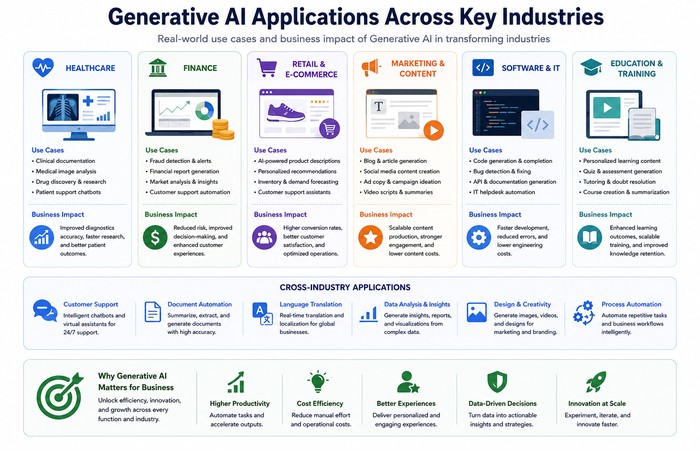
AI Across Industries at a Glance
| Industry | Primary AI Applications | Business Value |
| Healthcare | Medical imaging, patient monitoring | Improved clinical decision support |
| Banking | Fraud detection, risk analysis | Reduced fraud and operational risk |
| Retail | Personalization, forecasting | Higher sales and customer engagement |
| Manufacturing | Predictive maintenance, quality inspection | Lower downtime and higher productivity |
| Education | Intelligent tutoring, lesson planning | Personalized learning experiences |
| Legal | Contract analysis, legal research | Faster document review |
| Transportation | Route optimization, fleet management | Reduced costs and delivery times |
| Agriculture | Precision farming, crop monitoring | Higher yields and sustainability |
| Government | Citizen services, fraud detection | Improved public service delivery |
Key Takeaway
The industries benefiting most from AI are not necessarily the industries adopting the latest innovations.
Good ones are the people working on well-articulated business issues, with quality data and tangible metrics, and robust operational processes.
The application domains of fraud detection, predictive maintenance, recommender systems, and medical imaging have already gained years of validation.
Research in other areas like agentic AI, autonomous robotics and more sophisticated AI tutoring is moving faster but its long-term directions will be largely determined by future technical progress, governance, and evaluation.
Having a clear idea of how these differences are incorporated can guide where to make the strongest investments in AI rather than what is currently fashionable.
Consumer AI Applications: How Artificial Intelligence Is Changing Everyday Life
Artificial intelligence tends to be linked up with big companies, laboratories and billion dollars’ worth of computer geeks.
Most of us use AI dozens, even hundreds of times a day, in our day-to-day lives. We just don‘t think about it.
Those are instructions for unlocking a smartphone with face recognition.
The arrival of directions updating during me.
Watching recommended videos.
Filtering spam emails.
Shopping online.
Requesting future weather conditions from a virtual assistant.
All of these experiences are enabled by various types of artificial intelligence that occur behind the scenes.
In contrast to enterprise AI, which is centered around productivity, efficiency, and operational performance, consumer AI is centered around convenience, personalization, accessibility, and user experience.
Where do consumers experience AI the most?
AI in Smartphones
Today‘s cell phones are now one of the most sophisticated AI empowered devices owned by humans.
Instead of cloud computing, they offer their flagship smartphones with a dedicated AI processor, also called Neural Processing Unit (NPU), to execute AI tasks.
This is of benefit not only in performance of operations, but also in terms of privacy as some private data does not have to venture off the phone.
Common Smartphone AI Features
- Face recognition
- Voice assistants
- Camera enhancement
- Live translation
- Photo organization
- Battery optimization
- Predictive text
- Call screening
- AI-powered search
Similarly, today‘s smart phones automatically combine multiple exposures, analyze scene conditions, eliminate blemishes, control image noise, and improve low-light captures all of which previously needed post-process editing.
AI in Search Engines
More sophisticated search engines have moved well beyond simple keyword matching.
Contemporary AI systems strive to interpret users’ true intention rather than merely recognizing the words users have key-in.
Rather than regurgitating long documents with all the same phrases, AI uses context, intent, geography, previous questions and semantic meaning to produce a more apt response.
Generative AI has brought even more speed to this process.
A number of emerging search tools create summaries, answer hard questions, compare items, explain ideas, and assist in formulating follow-up questions all during one conversation.
Common Search AI Applications
- Semantic search
- AI-generated summaries
- Voice search
- Visual search
- Multimodal search
- Personalized recommendations
Search continues to evolve from simply finding information toward helping users understand and apply it.
AI in Entertainment
Online streaming sites make billions of viewing choices annually.
Instead of delivering the same content catalog to all audiences, the AI constantly assesses the viewings history, length of time spent watching, preferences, navigation, and other biological trends.
Recommendation systems is the most successful application of artificial intelligence to commercial use, since improved recommendations can benefit both customer satisfaction and business.
AI Applications in Entertainment
- Movie recommendations
- Music recommendations
- Personalized playlists
- Content moderation
- Video captioning
- Automatic translations
- Thumbnail optimization
- Audience analytics
The user probably would not ever see these algorithms but it is truly personalization that has set apart modern entertainment.
AI in Online Shopping
Trends of online buying habits over the past decade: Buying for items online has changed a lot over the last decade.
Customers are no longer ‘pressing buttons’ and flicking through the tired, seemingly endless piles of catalogue pages. Instead they are using intelligent recommendation engines, intelligent conversational shoppers, visual search and customized offers.
AI helps retailers answer questions such as:
- Which products should appear first?
- Which discount should this customer receive?
- Which items are frequently purchased together?
- Which customers are likely to return?
This leads to a number of accurate predictions which significantly enhance shopping experience for customers and help retailers boost conversion rates by reducing “shopping cart abandonment”.
AI Shopping Applications
- Personalized recommendations
- Visual product search
- AI shopping assistants
- Dynamic pricing
- Inventory visibility
- Delivery estimation
- Product comparison
- Review summarization
Further down the line, we anticipate the development of ever more powerful intelligent agents that will, for example, handle effective product comparisons for consumers, solicit and negotiate subscription plans, and facilitate transactions with almost no user input.
AI in Digital Productivity
Artificial intelligence has been adopted by all sorts of tools which students, professionals and commercial organizations use for productivity.
The AI is not displacing the traditional office applications it‘s complementing them.
Users can create summaries of lengthy reports, proxy draft emails, bring off presentation, pile notes, make spreadsheets, flop over data, and not to mention translate documents in a flick of a finger without jumping between several apps.
Productivity AI Applications
- Email drafting
- Document summarization
- Presentation generation
- Meeting transcription
- Calendar management
- Task prioritization
- Spreadsheet analysis
- Writing assistance
These can also save time, enabling users to concentrate more on decision-making and creative work.
AI in Healthcare for Consumers
AI has also also been incorporated extensively into consumer healthcare
While diagnosis by a health professional will still be necessary in the future, the AI enables users to keep track of their health in between.
Monitoring everything from heart rate and sleep patterns to activity levels and blood-oxygen content.
Numerous health apps, use annualized observations in informing the label menu..
Consumer Healthcare Applications
- Fitness tracking
- Sleep monitoring
- Medication reminders
- Health coaching
- Symptom guidance
- Emergency detection
- Nutrition recommendations
These tools are designed to support healthier lifestyles rather than replace medical advice.
AI in Transportation
Whether commuting to work or ordering food delivery, consumers increasingly rely on AI-driven transportation systems.
Navigation platforms analyze millions of data points—including accidents, weather, construction, and traffic congestion—to recommend faster routes.
Ride-sharing platforms predict passenger demand, optimize driver matching, and estimate arrival times using machine learning.
Modern vehicles also incorporate AI-powered driver assistance technologies that improve safety and driving comfort.
Transportation Applications
- Navigation optimization
- Traffic prediction
- Ride matching
- Parking assistance
- Driver assistance
- Fuel optimization
- Route planning
Fully autonomous driving remains under active development, but AI-assisted driving has already become a standard feature in many modern vehicles.
AI in Smart Homes
Connected homes increasingly rely on AI to automate routine tasks.
Rather than simply responding to manual commands, smart home systems learn user preferences over time.
Lights adjust automatically.
Thermostats optimize energy consumption.
Security cameras distinguish people from animals.
Voice assistants coordinate connected devices throughout the home.
Smart Home Applications
- Smart lighting
- Energy optimization
- Home security
- Voice control
- Appliance automation
- Occupancy detection
- Air quality monitoring
As edge AI continues improving, more smart home decisions are being processed locally instead of relying entirely on cloud services.
Enterprise AI Applications: Transforming Modern Organizations
While consumers typically experience AI through convenience and personalization, enterprises focus on scalability, operational efficiency, cost reduction, and competitive advantage.
Enterprise AI systems rarely operate independently.
Instead, they integrate with existing business platforms such as:
- Enterprise Resource Planning (ERP)
- Customer Relationship Management (CRM)
- Human Resource Management Systems (HRMS)
- Supply Chain Management (SCM)
- Business Intelligence platforms
- Cloud infrastructure
- Security Operations Centers (SOC)
- Data warehouses
The objective isn’t simply automation.
It’s improving business outcomes across entire organizations.
Enterprise Insight
Many large enterprises are integrating AI directly into existing business software rather than deploying standalone AI applications. This approach allows organizations to enhance familiar workflows while maintaining governance, security, and regulatory compliance.
Enterprise Knowledge Management
Large organizations generate enormous amounts of information.
Policies.
Technical documentation.
Training materials.
Legal contracts.
Research reports.
Finding the right information can consume significant employee time.
Enterprise AI assistants solve this problem by retrieving information from internal knowledge bases using natural language instead of keyword searches.
Employees ask questions conversationally and receive summarized, context-aware answers linked to trusted organizational sources.
This reduces duplicate work while improving knowledge sharing across departments.
AI for Enterprise Decision Support
Executives increasingly rely on AI-powered analytics to support strategic planning.
Rather than reviewing hundreds of reports manually, AI systems summarize trends, identify anomalies, forecast outcomes, and simulate business scenarios.
These systems help leadership teams answer questions such as:
- Which markets are growing fastest?
- Which customers are most profitable?
- Which suppliers introduce operational risk?
- Which products require inventory adjustments?
Decision-support systems don’t replace executives.
They provide faster access to relevant information for better-informed decisions.
Enterprise Workflow Automation
Modern organizations operate thousands of repetitive workflows every day.
Invoices require approval.
Employees submit expense claims.
Procurement teams review purchase requests.
Legal departments evaluate contracts.
Human resources process onboarding documentation.
AI increasingly automates these workflows by combining language understanding, document analysis, business rules, and workflow orchestration.
Instead of employees manually transferring information between systems, AI performs repetitive administrative tasks while routing exceptions to appropriate decision-makers.
AI in Business Intelligence
Business Intelligence platforms increasingly include AI capabilities that help users explore data without requiring advanced technical expertise.
Rather than writing complex database queries, managers can ask questions in plain language such as:
“Which product category experienced the fastest growth last quarter?”
AI retrieves the relevant data, generates visualizations, summarizes findings, and identifies unusual trends automatically.
This democratizes analytics across organizations by making business insights accessible to non-technical users.
AI in Enterprise Collaboration
Collaboration platforms now use AI to improve productivity before, during, and after meetings.
Examples include:
- Automatic meeting summaries
- Action item extraction
- Live transcription
- Language translation
- Intelligent scheduling
- Task recommendations
- Knowledge retrieval
Employees spend less time documenting discussions and more time acting on decisions.
Consumer AI vs. Enterprise AI
Although both rely on similar underlying technologies, their objectives differ considerably.
| Consumer AI | Enterprise AI |
| Personal convenience | Business productivity |
| Personalized experiences | Operational efficiency |
| Entertainment | Revenue growth |
| Daily assistance | Process automation |
| Shopping recommendations | Strategic decision support |
| Smartphone features | Enterprise workflows |
| Voice assistants | AI business agents |
| Smart homes | Digital transformation |
Both markets continue expanding rapidly, but enterprise AI typically requires greater emphasis on governance, security, compliance, scalability, and integration with existing business systems.
The Convergence of Consumer and Enterprise AI
One of the most interesting trends in 2026 is the gradual convergence between consumer and enterprise AI.
Employees increasingly expect workplace software to feel as intuitive as the consumer applications they use every day.
Conversational interfaces, intelligent search, personalized recommendations, AI assistants, and voice interactions are becoming standard expectations across enterprise software.
At the same time, enterprise innovations—such as agentic AI, advanced reasoning models, and multimodal capabilities—are beginning to influence consumer applications.
This convergence is accelerating AI adoption across nearly every industry while redefining how people interact with software itself.
Key Takeaway
Whether it’s helping someone organize family photos on a smartphone or enabling a multinational corporation to automate thousands of business processes, AI applications ultimately serve the same purpose:
They reduce complexity, improve decision-making, and help people accomplish more with less effort.
The difference lies in scale.
Consumer AI focuses on individual experiences.
Enterprise AI transforms entire organizations.
Understanding both perspectives provides a more complete picture of how artificial intelligence is reshaping the modern digital world.
The AI Technology Ecosystem Behind Modern Applications
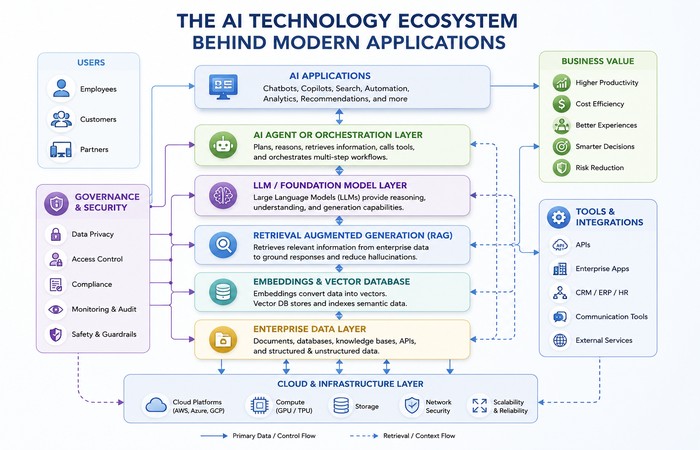
Artificial intelligence applications may look simple on the surface. You ask a chatbot a question, receive a recommendation while shopping online, or watch an AI summarize a meeting in seconds.
Behind those experiences, however, sits a sophisticated ecosystem of technologies working together.
Modern AI applications rarely rely on a single model. Instead, they combine foundation models, retrieval systems, vector databases, orchestration frameworks, and intelligent agents to deliver accurate, scalable, and context-aware experiences.
Understanding these building blocks helps explain why today’s AI systems are far more capable than earlier generations of machine learning software—and why enterprise AI architecture has become just as important as the models themselves.
Foundation Models
Foundation models are large AI models trained on massive datasets that can perform a wide variety of tasks without being built for a single application.
Instead of developing separate AI systems for translation, summarization, coding, and question answering, organizations increasingly start with a foundation model and adapt it to their specific needs.
These models learn general knowledge, language patterns, reasoning abilities, and problem-solving techniques during training, making them highly flexible across industries.
Today’s foundation models support applications such as:
- Content generation
- Customer support
- Code completion
- Language translation
- Image generation
- Knowledge retrieval
- Research assistance
- Business automation
Many modern AI applications build on foundation models rather than training entirely new models from scratch, significantly reducing development time and infrastructure costs.
Large Language Models (LLMs)
Large Language Models (LLMs) are a specialized type of foundation model designed to understand and generate human language.
They are trained on enormous collections of books, articles, websites, code repositories, and other text sources to predict the next word—or token—in a sequence. This seemingly simple objective enables them to answer questions, summarize documents, write software, translate languages, and engage in natural conversations.
Popular LLMs include models developed by organizations such as OpenAI, Anthropic, Google DeepMind, Meta, Mistral AI, Alibaba (Qwen), and DeepSeek.
Common enterprise applications include:
- AI assistants
- Customer support
- Enterprise search
- Document summarization
- Code generation
- Meeting transcription
- Business reporting
- Knowledge management
Despite their impressive capabilities, LLMs are not databases. They generate responses based on learned patterns and may produce incorrect or outdated information if not connected to reliable external knowledge sources.
Small Language Models (SLMs)
While large language models receive most of the attention, many organizations are increasingly deploying Small Language Models (SLMs).
SLMs contain significantly fewer parameters than frontier-scale models but are optimized for specific business tasks.
Rather than attempting to answer every possible question, they focus on narrower domains such as:
- Internal customer support
- Document classification
- Manufacturing operations
- Medical workflows
- Financial reporting
- Edge devices
Because SLMs require less computing power, they often provide:
- Faster responses
- Lower infrastructure costs
- Reduced energy consumption
- Better privacy
- Easier on-premises deployment
For many enterprise workloads, a well-trained SLM can outperform a much larger general-purpose model while costing substantially less to operate.
Retrieval-Augmented Generation (RAG)
One of the biggest limitations of traditional language models is that they rely primarily on information learned during training.
They don’t automatically know your company’s latest policies, customer records, product documentation, or internal research.
Retrieval-Augmented Generation (RAG) solves this problem by combining information retrieval with language generation.
Instead of answering solely from memory, a RAG system first searches trusted knowledge sources—such as enterprise documents, databases, or knowledge bases—and then uses that information to generate a grounded response.
A typical RAG workflow looks like this:
- A user submits a question.
- The system searches relevant documents.
- The most relevant information is retrieved.
- The language model generates an answer using those sources.
- The response is returned with current, context-aware information.
RAG has become one of the most important enterprise AI architectures because it helps reduce hallucinations, improves factual accuracy, and enables organizations to use proprietary knowledge without retraining large models.
Embeddings
Computers don’t naturally understand the meaning of words.
They understand numbers.
Embeddings bridge this gap by converting text, images, or other data into high-dimensional numerical representations that capture semantic meaning.
This allows AI systems to recognize that phrases such as:
- “automobile”
- “car”
- “vehicle”
are closely related, even though they use different words.
Embeddings power many modern AI capabilities, including:
- Semantic search
- Recommendation engines
- Similarity matching
- Enterprise search
- Question answering
- Document clustering
- RAG pipelines
Without embeddings, modern conversational search and retrieval systems would be far less effective.
Vector Databases
Traditional databases search for exact matches.
Vector databases search by meaning.
Instead of asking:
“Find documents containing the word ‘cybersecurity.'”
Vector search can identify documents discussing ransomware, phishing, zero trust, network defense, or endpoint security—even if they don’t contain the exact keyword.
This semantic search capability makes vector databases a core component of many enterprise AI systems.
Popular vector database platforms include Pinecone, Weaviate, Milvus, Chroma, and pgvector.
They are commonly used for:
- Enterprise knowledge search
- AI chatbots
- Recommendation systems
- Document retrieval
- Similarity search
- Retrieval-Augmented Generation
Fine-Tuning
Although foundation models are highly capable, organizations sometimes require AI systems that understand specialized terminology, workflows, or industry-specific knowledge.
Fine-tuning is the process of taking a pre-trained model and further training it on a targeted dataset to improve performance for a specific domain.
Examples include:
- Medical diagnosis support
- Legal document analysis
- Financial reporting
- Scientific research
- Manufacturing quality inspection
Fine-tuning can improve domain expertise, but it also requires careful data preparation, evaluation, and ongoing maintenance.
For many organizations, Retrieval-Augmented Generation offers a more practical alternative because it keeps information current without modifying the model itself.
Prompt Engineering
Modern AI systems are highly responsive to the quality of the instructions they receive.
Prompt engineering is the practice of designing prompts that guide AI models toward more accurate, consistent, and useful responses.
An effective prompt typically provides:
- Clear objectives
- Relevant context
- Specific constraints
- Desired output format
- Examples where appropriate
Enterprise AI applications increasingly use structured prompt templates rather than simple one-line instructions to improve reliability and reduce inconsistent outputs.
Although newer reasoning models require less prompt optimization than earlier generations, thoughtful prompt design remains an important skill for many real-world AI deployments.
AI Agents
Traditional AI systems respond to individual prompts.
AI agents pursue objectives.
An AI agent combines language understanding with reasoning, planning, memory, and tool usage to complete multi-step tasks.
Rather than simply answering a customer’s question, an AI agent might:
- Search internal knowledge bases
- Access CRM records
- Draft a personalized response
- Update customer information
- Schedule follow-up actions
- Notify relevant departments
This ability to coordinate multiple actions makes AI agents one of the fastest-growing areas of enterprise artificial intelligence.
Model Context Protocol (MCP)
As AI systems become more integrated with enterprise software, they need a standardized way to communicate with external tools, databases, and business applications.
The Model Context Protocol (MCP) is an emerging open standard designed to simplify this interaction.
Instead of creating custom integrations for every AI application, MCP provides a common interface through which AI models can securely access external resources such as:
- Business applications
- File systems
- Databases
- APIs
- Knowledge repositories
- Development environments
This approach improves interoperability while reducing integration complexity.
As enterprise AI ecosystems continue to mature, standards like MCP are expected to play an increasingly important role in connecting AI models with the broader software landscape.
Why This Ecosystem Matters
Modern AI applications are no longer powered by a single model working in isolation.
A customer support assistant, for example, might combine a foundation model for language understanding, embeddings for semantic search, a vector database for document retrieval, Retrieval-Augmented Generation for factual responses, AI agents for workflow automation, and standardized protocols to connect with enterprise systems.
Understanding how these technologies work together provides a clearer picture of why today’s AI applications are becoming more capable, more reliable, and better suited for solving complex business problems at scale.
How Different AI Technologies Power Modern Applications
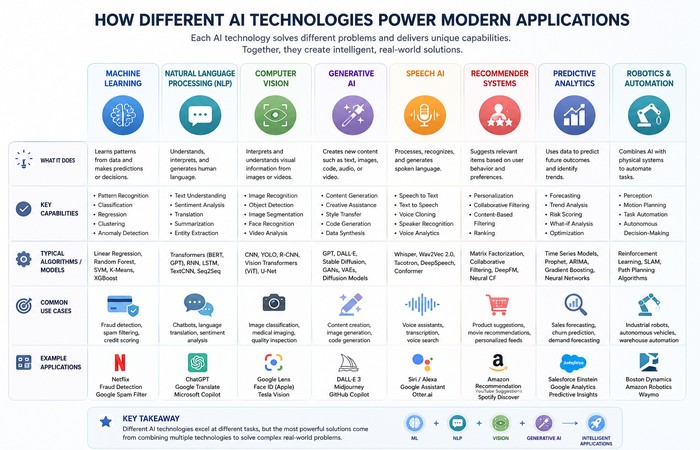
Although AI applications are often categorized by industry or business function, another useful way to understand artificial intelligence is by the underlying technology powering each solution.
Every AI technology has unique strengths.
Some specialize in recognizing images. Others understand language, predict future outcomes, generate new content, or automate complex workflows. Modern enterprise solutions often combine several of these technologies to solve a single business problem.
Understanding which technology fits which application helps organizations select the right AI solution while giving readers a clearer picture of today’s AI landscape.
AI Technologies and Their Typical Applications
| AI Technology | Primary Purpose | Typical Applications | Common Industries |
| Machine Learning | Learn patterns from historical data | Fraud detection, demand forecasting, predictive maintenance, credit scoring, customer churn prediction | Banking, Retail, Manufacturing, Insurance |
| Generative AI | Create new content | Content creation, code generation, document summarization, image generation, marketing copy | Marketing, Software Development, Media |
| Natural Language Processing (NLP) | Understand and process human language | Chatbots, translation, sentiment analysis, document search, contract analysis | Customer Service, Legal, Healthcare |
| Computer Vision | Interpret images and video | Medical imaging, facial recognition, quality inspection, OCR, autonomous vehicles | Healthcare, Manufacturing, Security |
| Speech AI | Understand and generate spoken language | Voice assistants, transcription, call center automation, speech analytics | Telecommunications, Customer Support |
| Recommendation Systems | Personalize user experiences | Product recommendations, movie suggestions, music playlists, content ranking | E-commerce, Streaming Platforms, Social Media |
| Predictive Analytics | Forecast future outcomes | Sales forecasting, inventory planning, financial forecasting, equipment maintenance | Retail, Manufacturing, Finance |
| Robotics & Intelligent Automation | Perform physical or repetitive operational tasks | Warehouse automation, industrial robots, surgical robots, autonomous delivery | Logistics, Manufacturing, Healthcare |
| Agentic AI | Execute multi-step workflows autonomously | AI business agents, procurement automation, IT operations, enterprise assistants, workflow orchestration | Enterprise IT, Finance, HR, Customer Service |
Choosing the Right AI Technology
Not every business problem requires the same type of AI.
For example, a retailer looking to forecast holiday demand would likely benefit from predictive analytics and machine learning. A hospital analyzing MRI scans would rely on computer vision, while a customer support team automating conversations would typically use natural language processing combined with large language models.
Increasingly, organizations are combining several AI technologies into a single application.
A modern enterprise support assistant, for instance, might use:
- Speech AI to convert spoken language into text.
- Natural Language Processing (NLP) to understand customer intent.
- Large Language Models (LLMs) to generate responses.
- Retrieval-Augmented Generation (RAG) to access company knowledge.
- Vector databases to perform semantic search.
- Agentic AI to update CRM records, create support tickets, and trigger follow-up workflows automatically.
Rather than operating independently, these technologies work together to deliver faster, more accurate, and more context-aware experiences.
Which AI Technology Is Best for Your Business?
The best AI technology depends on the problem you’re trying to solve rather than the popularity of the technology itself.
Consider the following guidelines:
| Business Goal | Recommended AI Technology |
| Detect fraud | Machine Learning |
| Forecast demand | Predictive Analytics |
| Automate customer support | NLP + Generative AI |
| Analyze medical images | Computer Vision |
| Personalize shopping experiences | Recommendation Systems |
| Generate reports or content | Generative AI |
| Automate repetitive office workflows | Agentic AI |
| Optimize warehouse operations | Robotics + Machine Learning |
| Enable enterprise knowledge search | LLMs + RAG + Vector Databases |
The most successful AI deployments begin by identifying a clear business objective and then selecting the technology—or combination of technologies—that best addresses that need. As AI platforms continue to mature, hybrid architectures that integrate multiple AI capabilities are becoming the standard for enterprise applications rather than the exception.
AI Tools and Platforms Powering Modern AI Applications

Artificial intelligence applications don’t exist in isolation. Behind every chatbot, recommendation engine, AI coding assistant, or predictive analytics platform is an ecosystem of software frameworks, cloud platforms, hardware accelerators, orchestration tools, and deployment technologies.
Some organizations build AI applications from scratch using open-source frameworks. Others rely on commercial APIs or managed cloud services. Many enterprise deployments combine multiple tools into a single AI workflow.
Understanding these technologies helps explain how modern AI applications are developed, deployed, and maintained.
AI Development Frameworks
Development frameworks provide the foundation for building, training, and deploying machine learning and deep learning models. They simplify model creation, optimization, and experimentation while supporting both research and production workloads.
| Platform | Primary Purpose | Common Applications |
| TensorFlow | End-to-end machine learning framework | Computer vision, NLP, predictive analytics |
| PyTorch | Deep learning framework | Research, LLMs, computer vision, AI model development |
| JAX | High-performance numerical computing | Scientific computing, AI research, model optimization |
TensorFlow remains widely used in production environments, while PyTorch has become the preferred framework for many AI researchers and organizations developing large language models. JAX is increasingly adopted for high-performance machine learning and scientific computing.
Large Language Model (LLM) Providers
Many organizations build AI applications by integrating foundation models through APIs rather than training their own models from scratch.
| Provider | Popular Models | Common Use Cases |
| OpenAI | GPT series | AI assistants, coding, content generation |
| Anthropic | Claude | Enterprise AI, document analysis, reasoning |
| Google DeepMind | Gemini | Search, productivity, multimodal AI |
| Meta | Llama | Open-weight enterprise and research applications |
| Mistral AI | Mistral models | Efficient enterprise AI deployments |
Choosing the right model depends on factors such as reasoning capability, cost, latency, deployment options, privacy requirements, and integration needs rather than simply selecting the largest available model.
AI Infrastructure Platforms
Training and deploying modern AI models requires powerful computing infrastructure capable of handling massive datasets and computational workloads.
| Platform | Primary Role |
| NVIDIA | GPUs and AI accelerators |
| AMD | High-performance AI computing hardware |
| Intel | CPUs and AI acceleration technologies |
| Amazon Web Services (AWS) | Cloud AI infrastructure and managed AI services |
| Microsoft Azure AI | Enterprise AI cloud platform |
| Google Cloud AI | AI development and deployment services |
Cloud platforms increasingly provide pre-built AI services, allowing organizations to deploy sophisticated AI applications without managing their own infrastructure.
AI Orchestration Frameworks
As AI applications become more sophisticated, organizations need tools that coordinate interactions between language models, external data sources, APIs, and enterprise software.
AI orchestration frameworks simplify this process.
| Framework | Primary Purpose |
| LangChain | Build AI workflows and agent-based applications |
| LlamaIndex | Connect LLMs to enterprise data sources |
| Haystack | Develop retrieval and question-answering systems |
These frameworks have become popular for building enterprise AI assistants, Retrieval-Augmented Generation (RAG) systems, and autonomous AI agents capable of completing complex workflows.
Vector Database Platforms
Large language models become significantly more useful when they can retrieve current information from enterprise knowledge bases.
Vector databases enable semantic search by storing embeddings rather than relying solely on keyword matching.
| Platform | Typical Applications |
| Pinecone | Enterprise semantic search and RAG |
| Weaviate | AI-native knowledge retrieval |
| Milvus | Large-scale vector similarity search |
| Chroma | Lightweight vector storage for AI applications |
Vector databases have become a foundational component of many enterprise AI architectures because they improve search relevance and help reduce hallucinations.
AI Deployment and Infrastructure Tools
Building an AI model is only part of the challenge.
Organizations also need reliable deployment, monitoring, and scaling tools that allow AI applications to operate in production environments.
| Technology | Primary Purpose |
| Docker | Package AI applications into portable containers |
| Kubernetes | Orchestrate and scale containerized AI workloads |
| Ollama | Run open-source large language models locally |
Containerization and orchestration technologies have become essential for organizations deploying AI across hybrid cloud, on-premises, and edge environments.
Choosing the Right AI Platform
There is no single “best” AI platform.
The right choice depends on an organization’s goals, technical expertise, infrastructure, regulatory requirements, and budget.
For example:
- Startups often prioritize managed cloud AI services to reduce operational complexity.
- Enterprises frequently combine multiple cloud platforms with internal infrastructure to meet governance and compliance requirements.
- Organizations handling sensitive data may deploy open-source language models locally to maintain greater control over privacy and security.
- Research institutions typically favor flexible open-source frameworks that allow extensive experimentation.
Rather than relying on one technology, modern AI applications often combine development frameworks, foundation models, orchestration tools, vector databases, and cloud infrastructure into a single integrated solution.
Why These Tools Matter
Modern AI applications are powered by an entire ecosystem rather than a single model or platform.
A customer support assistant, for example, might use PyTorch to train a custom model, OpenAI or Anthropic for language generation, LangChain to orchestrate workflows, Pinecone to retrieve company knowledge, Docker to package the application, Kubernetes to scale deployments, and Microsoft Azure or AWS to provide cloud infrastructure.
Understanding how these technologies fit together helps organizations make informed decisions when building, deploying, and scaling AI solutions while providing readers with a practical overview of the modern AI software stack.
Real-World AI Case Studies: Proven Applications That Deliver Measurable Results
One of the biggest challenges in writing about artificial intelligence is separating measurable business outcomes from marketing claims.
Nearly every major technology company promotes AI-powered products. Every week brings another announcement about an AI breakthrough, a billion-dollar investment, or a revolutionary model.
But announcements aren’t the same as production deployments.
The organizations generating the greatest value from AI usually have three things in common:
- They solve a clearly defined business problem.
- They integrate AI into existing workflows instead of treating it as a standalone tool.
- They measure operational outcomes rather than focusing only on the technology itself.
The following examples illustrate where AI has demonstrated meaningful business value across different industries.
Case Study 1: JPMorgan Chase — Enterprise AI at Scale
The financial industry adopted AI earlier than many other sectors because fraud detection, compliance, and risk management all depend on analyzing enormous amounts of data.
JPMorgan Chase has become one of the world’s most frequently cited enterprise AI success stories.
One of its earliest implementations was the Contract Intelligence (COiN) platform, which automated the review of thousands of commercial credit agreements that previously required significant manual effort from legal and banking teams.
Since then, the organization has expanded AI adoption across multiple business functions.
Internal AI assistants now support employees by helping summarize documents, search internal knowledge, assist with software development, improve customer service, and automate repetitive administrative work.
Perhaps the most interesting lesson isn’t the technology itself.
It’s the company’s transparency.
Despite investing billions of dollars in AI, JPMorgan executives have publicly acknowledged that measuring AI’s precise financial contribution remains difficult because AI improvements often overlap with broader organizational transformation.
That’s an important reminder for every business considering AI adoption:
Not every benefit appears immediately on a financial statement.
Many improvements emerge gradually through increased productivity, better customer experiences, lower operational risk, and improved decision-making.
Key takeaway: AI creates the greatest value when integrated into everyday business operations rather than isolated pilot projects.
Case Study 2: Healthcare — AI-Assisted Medical Imaging
Healthcare demands exceptionally high levels of accuracy.
Unlike many business applications, mistakes can directly affect patient outcomes.
As a result, healthcare has focused primarily on AI systems that assist clinicians instead of replacing them.
Medical imaging represents one of the strongest examples.
Modern computer vision systems analyze mammograms, CT scans, MRI images, and X-rays to identify abnormalities that may require additional clinical attention.
Large-scale clinical studies have demonstrated that AI-assisted image analysis can improve detection rates in several imaging scenarios while helping radiologists prioritize urgent cases.
However, these systems function as clinical decision-support tools.
The final diagnosis remains the responsibility of qualified healthcare professionals.
Meanwhile, hospitals are also deploying AI for:
- Clinical documentation
- Patient scheduling
- Predictive resource planning
- Administrative automation
- Medical research support
The industry’s experience highlights an important principle:
AI performs best when augmenting expert judgment rather than attempting to replace it.
Case Study 3: Amazon — Personalization at Massive Scale
Recommendation engines have become one of artificial intelligence’s most commercially successful applications.
Amazon’s recommendation system analyzes browsing history, purchasing behavior, search patterns, product ratings, seasonal trends, and millions of customer interactions to personalize each shopping experience.
Instead of presenting identical storefronts to every visitor, AI continuously adapts product suggestions for individual customers.
The benefits extend beyond convenience.
Personalized recommendations improve product discovery, increase customer engagement, encourage repeat purchases, and help shoppers find relevant products more quickly.
This approach has influenced virtually every major e-commerce platform over the past decade.
Today, recommendation systems are considered foundational technology for modern digital commerce.
Case Study 4: Manufacturing — Predictive Maintenance
One good example through which to make this point is production.
The most craved AI applications aren‘t always that obvious.
When it comes to the bottom line predictive maintenance may not be headline news, but it will always prove money well spent.
Industrial equipment generates continuous streams of operational data, including:
- Temperature
- Pressure
- Vibration
- Motor performance
- Energy consumption
- Production output
The machine learning algorithms will be able to then analyze these signals to look for trends which may potentially fail the machine in the future.
To prevent unlikely equipment failures and interruption of production, maintenance teams plan maintenance activities ahead of time.
The results typically include:
- Reduced downtime
- Longer equipment lifespan
- Lower maintenance costs
- Improved production planning
- Higher operational efficiency
Compared to many other new technologies developed in the last few years, predictive maintenance has been successfully deployed for years now to optimize manufacturing, utilities, transportation and energy processes.
Case Study 5: Retail — Intelligent Personalization
Major retailers now deal with millions of customer transactions each day.
AI enable to make these interactions becomes a tailored shopping.
Retail applications include:
- Product recommendations
- Inventory forecasting
- Dynamic pricing
- Customer segmentation
- Marketing personalization
- Supply chain optimization
Major retailers are building the recommendation engine into a generative AI shopping assistant that can answer questions about products, compare products and help customers complete the purchasing process.
Conversation shopping does not replace search, but actually enhances it by providing another dimension for searching anything.
Case Study 6: Software Development — AI Coding Assistants
The former is that software engineering has used AI the quickest of perhaps any profession.
Developers increasingly use AI coding assistants to:
- Generate boilerplate code
- Explain unfamiliar codebases
- Detect programming errors
- Create documentation
- Write unit tests
- Suggest refactoring improvements
Research consistently shows productivity improvements for routine programming tasks.
However, experienced engineering teams continue reviewing AI-generated code for:
- Security
- Performance
- Maintainability
- Compliance
- Architectural consistency
The lesson is clear.
AI accelerates software development.
It doesn’t eliminate the need for experienced software engineers.
Case Study 7: Cybersecurity — AI vs. AI
Cybersecurity demonstrates both the promise and the challenge of artificial intelligence.
Security teams use AI to:
- Detect anomalies
- Identify phishing attempts
- Prioritize vulnerabilities
- Monitor user behavior
- Investigate incidents
- Automate threat response
At the same time, attackers increasingly use AI to:
- Generate convincing phishing emails
- Create deepfake content
- Automate reconnaissance
- Improve social engineering
- Accelerate malware development
AI hasn’t ended cybersecurity.
It has both sped up the art of offense and the art of defense.
While the majority of organizations that are investing in security deployments with AI see a faster detection and response time for threats, what they are also doing is protecting their own AI infrastructure from abuse.
What These Case Studies Have in Common
Although these organizations operate in completely different industries, their AI strategies share several important characteristics.
They begin with a business problem—not a technology.
They integrate AI into existing workflows.
They maintain human oversight.
They measure operational outcomes.
And they expand gradually after demonstrating measurable success.
Those principles consistently outperform organizations that attempt large-scale AI deployments without clear objectives.
The Rise of Agentic AI
For much of the past decade, AI functioned primarily as an assistant.
You asked a question.
The model answered.
You requested a summary.
It generated one.
Useful? Absolutely.
Autonomous? Not really.
That is beginning to change.
One of the most significant developments in artificial intelligence today is the emergence of Agentic AI.
Rather than responding to individual prompts, AI agents are designed to achieve objectives.
They plan.
Reason.
Use software tools.
Retrieve information.
Interact with external systems.
Adapt based on previous results.
And complete multi-step workflows with limited human supervision.
This represents a fundamental shift in how organizations use artificial intelligence.
Emerging Trend
Many industry analysts predict that AI agents will be the next evolution of enterprise AI. Rather than producing just an answer, AI agents are capable of orchestrating software applications, learning from vast amounts of information, accomplishing process flows, and conducting business with greater self-governance based upon high-level human policies.
Traditional AI vs. Agentic AI
Consider a simple business request.
Traditional AI
“Summarize this customer complaint.”
The model produces a summary.
Task complete.
Agentic AI
“Resolve this customer complaint.”
The AI agent might:
- Read the complaint.
- Search the customer’s purchase history.
- Verify warranty information.
- Generate an appropriate response.
- Update the CRM.
- Schedule a replacement shipment.
- Notify the logistics team.
- Create an internal support ticket.
- Escalate exceptions to a human manager.
The AI performs the entire process instead of just one step.
That distinction is transforming enterprise software.
Where Agentic AI Is Already Being Used
Organizations are starting to deploy AI agents in various functions.
Customer Support
AI agents manage complete support workflows instead of simply answering questions.
IT Operations
Agents detect problems with the infrastructure, restart services, log problems and inform the engineers of a human response required.
Finance
In AI it is used to begin the automation of invoice approval, matching and reporting and even the procurement.
Human Resources
It‘s agents’ job to make appointments for interviews and for the orientation of the new employees. Agents answer employees’ questions and verify documents.
Sales
AI agents can automate the pre-sale activities for example, preparing account research, updating the CRM system, writing proposals, and scheduling follow-ups.
Software Development
Development agents will be integrated with our systems to do the lining of pull requests, running of tests, and the monitoring of deployments, as well as the discovery of bugs in production before our engineers will find them.
Why Agentic AI Matters
The long-term significance of agentic AI isn’t that it produces better text.
It is that it carries out the job.
Today‘s organizations no longer want “smarter” chat bots.
They want digital workers that can effectively perform repetitive operational processes safely and dependably.
This change also has implications that go well beyond productivity.
It changes:
- Software architecture
- Identity management
- Security
- Governance
- Compliance
- Human roles
- Business processes
With additional functions and an increasing number of AI agents working independently it is important that management take precautions such that AI agents operate with prescribed permissions and maintain thorough logs and audits.
With great power comes great responsibility.
AI Infrastructure: The Foundation Behind Every Successful AI Application
When we talk about tech, in general, AI tends to steal the show.
Its infrastructure often doesn‘t.
That‘s a fair assumption. AI models which write stuff, draw pictures, respond to questions, automate workflows. Infrastructure doesn‘t give you flashing demos.
But here‘s the reality:
An AI system is only as strong as its support system.
Even the best language model will not do well, no matter how sophisticated, without high quality data, enough computing resources, secure networking, scalable storage, and a strong deployment pipeline.
A significant reason that most AI projects fail is not because its model its not clever.
They fail because organizations underestimate everything surrounding the model.
Data isn’t available when needed.
Systems can’t scale.
Security controls are incomplete.
Models become outdated.
Users won’t trust because results vary.
Infrastructure has been just as crucial as the AI itself ever since enterprises started transitioning from AI experiments to putting these models into production.
The Core Components of an AI Infrastructure
We can imagine AI infrastructure as an ecosystem making AI applications function consistently outside the lab.
Although architectures differ across organizations, most production AI systems have some common levels of abstraction.
1. Data Collection
The most intuitive starting point of any AI program is data.
No matter how intelligent, if the data is of poorer quality, then the results produced will be worse.
Organizations collect information from many different sources, including:
- Customer interactions
- CRM platforms
- ERP systems
- IoT devices
- Mobile applications
- Business databases
- Websites
- Security logs
- Medical devices
- Manufacturing sensors
It‘s not just about gathering more data.
These are gathering the appropriate, accurate, current and well managed information,.
Eliminating poor data quality still one of the top reasons I I projects underperform.
2. Data Storage
Storage of the data Once the data has been collected it needs to be stored which means another process can begin.
Organizations typically rely on combinations of:
- Data warehouses
- Data lakes
- Cloud object storage
- Distributed databases
- Vector databases
- File systems
Different workloads require different storage approaches.
Structured financial records differ significantly from video files, customer emails, engineering documents, or product images.
Modern AI architectures increasingly combine multiple storage systems depending on the application’s needs.
3. Data Processing
Raw data rarely arrives in a format suitable for AI.
Before models begin learning or generating responses, data usually undergoes extensive preparation.
This includes:
- Cleaning
- Removing duplicates
- Normalization
- Feature engineering
- Labeling
- Transformation
- Validation
- Quality checks
Poor preprocessing often produces poor AI performance regardless of how sophisticated the underlying model may be.
Organizations investing in strong data engineering generally achieve more reliable AI deployments than those focusing only on model selection.
4. Computing Infrastructure
Current AI models require large amounts of computational power.
Not all organizations build foundation models from scratch, however, executing pre-existing models at scale requires significant computational resources.
Common compute resources include:
- CPUs
- GPUs
- TPUs
- High-performance clusters
- Cloud AI accelerators
GPUs are still equally significant, because they are capable of making tens of thousands of calculations at the same time, which is precisely why they are so effective for deep learning calculations.
Interestingly enough, it‘s also worth mentioning that for those very large language models, the training could take in the order of thousands of GPUs running in parallel for weeks or months at a time.
Prediction making after training tends to be computationally cheap, but in an ideal world you would still require it to be low latency and highly reliable.
5. AI Models
The model represents the decision-making component of an AI system.
Different models specialize in different tasks.
Examples include:
- Machine learning models
- Deep neural networks
- Large Language Models (LLMs)
- Vision-language models
- Speech models
- Recommendation engines
- Reinforcement learning systems
Choosing the right model depends on the problem being solved.
Larger models aren’t always better.
In many enterprise environments, smaller specialized models provide lower costs, faster responses, easier deployment, and better privacy.
6. APIs and Application Integration
Most AI systems don’t operate independently.
They interact continuously with existing business software.
Examples include:
- CRM platforms
- ERP systems
- Customer support software
- Financial applications
- Email services
- Cloud storage
- Identity management systems
These systems communicate through Application Programming Interfaces (APIs) which provide a channel for the exchange of information.
If it isn‘t integrated then the AI is an isolated tool and it will not become part of the business.
Enterprise AI Architecture: How Modern AI Applications Work Together
While there is value in understanding individual AI technologies, contemporary enterprise AI systems are seldom used independently.
It takes more than one large language model to be a customer support assistant, a financial copilot, or an enterprise search platform. Many technologies are working behind the scenes to fetch, create, automate and connect to your business systems.
A simplified enterprise AI architecture looks like this:
Business User
↓
Application Interface
↓
AI Agent
↓
Large Language Model (LLM)
↓
Retrieval-Augmented Generation (RAG)
↓
Vector Database
↓
Enterprise Data Sources
↓
Cloud or On-Premises Infrastructure
While there are variations from one organization to another, most enterprise AI platforms tend to have a layered architecture.
So how does each layer enable us to use safe AI applications?
1. Business User
We always start with the user to interact with.
Depending on the organization, this could be:
- A customer asking a support question
- An employee searching company policies
- A financial analyst requesting a report
- A doctor reviewing patient information
- A software developer generating code
- A sales representative preparing a proposal
The user does not work directly with the models of AI, but with requests that go through an app, built for a given business activity.
2. Application Interface
The application layer is the user interface that allows users to interact with the system of AI.
Examples include:
- Customer support portals
- Enterprise search platforms
- Mobile applications
- CRM systems
- ERP software
- Collaboration platforms
- Internal employee assistants
- AI copilots
This is where we control authentication, user permissions, session history, business rules, UX before reaching the AI system.
3. AI Agent
Contemporary enterprise applications are more likely to integrate rather than isolated chatbots.
Unlike conventional chatbots that are limited to producing replies, AI agents have the capability of reasoning over complicated tasks, planning a sequence of actions, and communicating with other software programs.
For example, after receiving a customer request, an AI agent might:
- Search internal documentation
- Retrieve CRM records
- Verify account details
- Generate a personalized response
- Update customer information
- Create a support ticket
- Notify another department
- Schedule follow-up actions
They don‘t just respond to these quick questions, but as a fully operational AI agent, orchestrate entire workflows spanning many different systems of business.
4. Large Language Model (LLM)
The Large Language Model is the core reasoning and language engine of the application.
Its responsibilities typically include:
- Understanding user intent
- Generating natural language responses
- Summarizing documents
- Translating content
- Explaining technical concepts
- Writing code
- Supporting decision-making
However, an LLM alone doesn’t have real-time knowledge of an organization’s internal information.
That’s why enterprise AI applications rarely rely on standalone language models.
5. Retrieval-Augmented Generation (RAG)
Instead of asking the language model to answer entirely from memory, enterprise systems often use Retrieval-Augmented Generation (RAG).
When a user submits a question, the AI system first searches trusted enterprise knowledge sources before generating a response.
Typical information sources include:
- Internal documentation
- Product manuals
- Policies
- Knowledge bases
- Technical documentation
- Customer records
- Research reports
By grounding responses in verified organizational information, RAG significantly improves factual accuracy while reducing hallucinations.
6. Vector Database
The retrieval process depends on semantic search rather than traditional keyword matching.
This is where vector databases become essential.
Instead of storing information alphabetically or by exact words, vector databases store numerical representations called embeddings that capture the meaning of text.
When someone searches for:
“How do I secure cloud workloads?”
the system can retrieve documents discussing:
- Zero Trust
- Identity management
- Cloud security
- IAM
- Network segmentation
even if those exact words weren’t used in the original query.
This semantic understanding makes enterprise AI search considerably more effective than conventional document search.
7. Enterprise Data Sources
Enterprise AI is only as valuable as the information it can access.
Behind every intelligent assistant sits a network of business systems containing operational knowledge.
Common enterprise data sources include:
- Customer Relationship Management (CRM) platforms
- Enterprise Resource Planning (ERP) systems
- Data warehouses
- Business intelligence platforms
- HR systems
- Financial systems
- Product documentation
- Cloud storage
- Knowledge management platforms
- Internal APIs
Rather than replacing these systems, AI connects them into a unified conversational experience.
8. Cloud or On-Premises Infrastructure
The entire architecture runs on computing infrastructure capable of supporting AI workloads at scale.
Organizations may deploy AI using:
- Public cloud platforms
- Private cloud infrastructure
- Hybrid cloud environments
- On-premises data centers
- Edge computing devices
Infrastructure provides:
- Compute resources
- Storage
- Networking
- Security
- Identity management
- Monitoring
- Scalability
- Disaster recovery
Choosing the appropriate deployment model depends on factors such as latency, privacy requirements, regulatory obligations, and operational costs.
Infrastructure Insight
Training modern foundation models often requires thousands of specialized GPUs working together over extended periods. As a result, organizations increasingly rely on cloud infrastructure, distributed computing, and AI accelerators to support large-scale AI workloads efficiently.
How These Layers Work Together
Imagine an employee asks an internal AI assistant:
“Summarize our cybersecurity policy and list the required password standards.”
Here’s what happens behind the scenes:
- The employee submits the request through the company’s AI application.
- The application verifies the employee’s identity and permissions.
- An AI agent determines which internal knowledge sources are required.
- The RAG system retrieves the latest cybersecurity policy from the enterprise knowledge base.
- A vector database identifies the most relevant documents using semantic search.
- The Large Language Model analyzes the retrieved information and generates a concise summary.
- The application displays the answer and may include links to the original policy documents for verification.
Although the interaction appears almost instantaneous, multiple AI components collaborate to deliver a response that is current, context-aware, and grounded in trusted organizational information.
Why Modern Enterprise AI Uses Layered Architectures

Early AI applications often relied on standalone machine learning models that performed a single task.
Modern enterprise AI systems are fundamentally different.
They combine specialized technologies into modular architectures where each layer has a clearly defined responsibility.
This layered approach offers several advantages:
- Improved factual accuracy through Retrieval-Augmented Generation
- Better scalability as organizations grow
- Easier integration with existing business software
- Stronger governance and security controls
- Reduced hallucinations through trusted enterprise data
- Greater flexibility to upgrade individual components without redesigning the entire system
As organizations continue adopting AI at scale, this architecture has become the foundation for enterprise copilots, AI assistants, intelligent search platforms, customer service automation, and next-generation agentic AI systems.
Cloud AI vs. Edge AI
One of the biggest architectural decisions organizations face is where AI processing should occur.
Should requests be processed in centralized cloud infrastructure?
Or should they run locally on edge devices?
Both approaches offer distinct advantages.
Cloud AI
Cloud AI processes information inside remote data centers.
Users send requests over the internet, AI performs computation remotely, and results are returned to the application.
Advantages
- Virtually unlimited scalability
- Easier model updates
- Lower hardware requirements
- Centralized management
- Access to large foundation models
Common Applications
- Enterprise AI assistants
- Cloud analytics
- Customer service platforms
- Business intelligence
- Large language models
- Image generation
Cloud computing remains the preferred deployment model for many enterprise AI workloads because it provides flexibility and elastic computing resources.
Edge AI
Edge AI performs processing directly on local devices.
Instead of sending data to remote servers, inference occurs closer to where data is generated.
Examples include:
- Smartphones
- Industrial robots
- Autonomous vehicles
- Medical equipment
- Security cameras
- Smart factories
- IoT sensors
Advantages
- Lower latency
- Improved privacy
- Reduced bandwidth usage
- Offline operation
- Faster real-time decisions
For applications requiring immediate responses—such as collision avoidance in vehicles or quality inspection on manufacturing lines—edge AI often provides significant advantages.
Many organizations now adopt hybrid architectures, combining cloud and edge computing to balance performance, scalability, and privacy.
Retrieval-Augmented Generation (RAG)
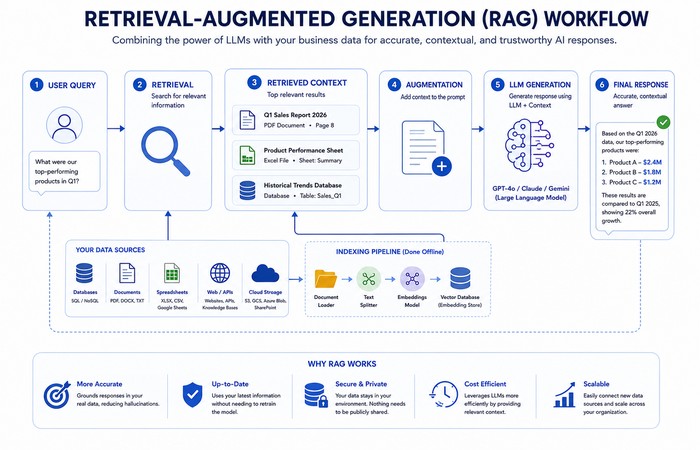
One limitation of large language models is that their knowledge is fixed at the time they are trained.
They don’t automatically know:
- Your company’s policies
- Internal documentation
- Current inventory
- Private research
- Recent reports
- Customer records
Retrieval-Augmented Generation (RAG) addresses this limitation.
Instead of relying solely on model memory, RAG retrieves relevant information from trusted data sources before generating a response.
A typical workflow looks like this:
- User asks a question.
- AI searches trusted enterprise documents.
- Relevant information is retrieved.
- The language model generates an answer using those documents.
- The response reflects current organizational knowledge rather than outdated training data.
RAG has become one of the most important enterprise AI architectures because it improves:
- Accuracy
- Transparency
- Freshness of information
- Enterprise knowledge access
- Hallucination reduction
For many organizations, RAG provides greater business value than training entirely new language models.
Vector Databases
Traditional databases search for exact matches.
Vector databases search by meaning.
Instead of asking:
“Find documents containing the word ‘cybersecurity.'”
Vector search asks:
“Find documents discussing ransomware, phishing, zero trust, or network security—even if the exact keyword isn’t present.”
This capability enables semantic search, which powers many modern AI assistants.
Popular enterprise AI systems increasingly rely on vector databases to retrieve relevant documents before generating responses.
They’re now considered a foundational component of many Retrieval-Augmented Generation architectures.
AI Model Deployment
Building an AI model is only one step.
Deploying it reliably is another challenge entirely.
Organizations must consider:
- Scalability
- Monitoring
- Model versioning
- Security
- Latency
- Availability
- Disaster recovery
- Continuous updates
Production AI environments increasingly adopt MLOps (Machine Learning Operations), applying principles similar to DevOps for managing AI throughout its lifecycle.
MLOps helps organizations:
- Automate deployments
- Monitor model performance
- Detect model drift
- Retrain models
- Manage experimentation
- Ensure reproducibility
Without operational discipline, even highly accurate AI models gradually become less effective as business conditions change.
Why Data Quality Matters More Than Model Size
One of the biggest misconceptions surrounding artificial intelligence is that larger models automatically produce better outcomes.
In practice, data quality often matters more.
Organizations with:
- Clean data
- Reliable governance
- Consistent labeling
- Accurate documentation
- Well-defined business objectives
frequently outperform organizations using much larger AI models trained on inconsistent information.
Many successful AI deployments achieve impressive results not because they use the newest model, but because they build strong data foundations.
Key Takeaway
Artificial intelligence doesn’t exist in isolation.
Behind every chatbot, recommendation engine, fraud detection platform, or AI assistant is a sophisticated infrastructure responsible for collecting data, processing information, running models, securing systems, and delivering reliable results.
As organizations scale AI adoption, infrastructure is becoming a competitive advantage rather than simply an IT concern.
Businesses that invest in data quality, modern architectures, secure integrations, and operational excellence consistently achieve better long-term outcomes than those focused solely on acquiring larger AI models.
AI Standards, Governance, and Responsible Development
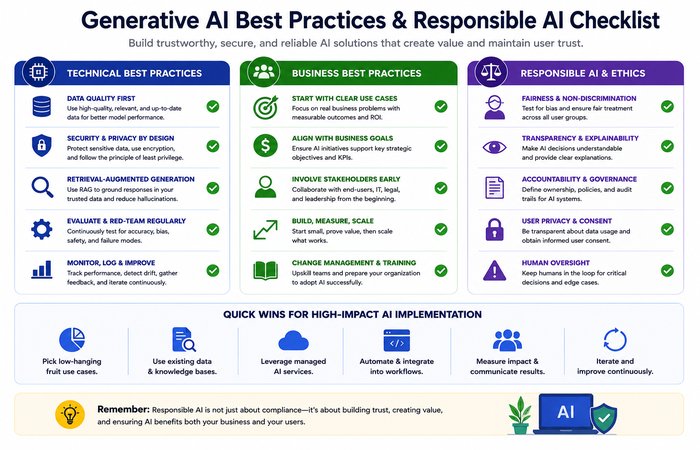
As artificial intelligence becomes more deeply integrated into business operations, technical performance is only part of the equation.
Organizations must also ensure that AI systems are secure, transparent, reliable, and aligned with legal and ethical expectations.
Poor governance can introduce risks ranging from inaccurate predictions and biased outcomes to data privacy violations, regulatory penalties, and reputational damage. As a result, responsible AI is no longer viewed as an optional best practice—it’s becoming a core requirement for enterprise AI adoption.
To help organizations deploy AI responsibly, governments, standards bodies, and international organizations have introduced frameworks that provide guidance on risk management, governance, transparency, and accountability.
While these frameworks differ in scope and legal status, they share a common goal: helping organizations build AI systems that people can trust.
Governance Snapshot
AI governance has become a strategic priority for organizations worldwide. Frameworks such as the NIST AI Risk Management Framework, ISO/IEC 42001, the OECD AI Principles, and the EU AI Act are helping organizations build AI systems that are more transparent, accountable, and trustworthy.
NIST AI Risk Management Framework (AI RMF)
The NIST AI Risk Management Framework (AI RMF), developed by the U.S. National Institute of Standards and Technology, provides voluntary guidance for identifying, assessing, and managing AI-related risks throughout the system lifecycle.
Rather than prescribing specific technologies, the framework encourages organizations to integrate risk management into every stage of AI development—from planning and data collection to deployment, monitoring, and continuous improvement.
The framework is organized around four core functions:
- Govern – Establish policies, accountability, and organizational oversight.
- Map – Understand the context, intended use, and potential risks of an AI system.
- Measure – Evaluate system performance, fairness, robustness, security, and reliability.
- Manage – Monitor identified risks and implement appropriate mitigation strategies.
Although the AI RMF is voluntary, it has become an influential reference for organizations seeking a structured approach to trustworthy AI.
ISO/IEC 42001
ISO/IEC 42001 is the world’s first international management system standard specifically designed for artificial intelligence.
Published jointly by the International Organization for Standardization (ISO) and the International Electrotechnical Commission (IEC), it provides a framework for establishing, implementing, maintaining, and continually improving an Artificial Intelligence Management System (AIMS).
Instead of focusing on individual AI models, ISO/IEC 42001 emphasizes organizational governance by encouraging businesses to define clear responsibilities, document AI processes, manage risks, monitor performance, and continuously improve AI operations.
Key objectives include:
- Strengthening AI governance
- Improving risk management
- Supporting regulatory compliance
- Increasing organizational transparency
- Encouraging continuous improvement
For enterprises adopting AI at scale, ISO/IEC 42001 provides a structured foundation for responsible AI management across multiple business functions.
EU AI Act
The EU AI Act is the European Union’s comprehensive regulatory framework for artificial intelligence. It introduces a risk-based approach, recognizing that not all AI systems present the same level of potential harm.
Under this model, AI applications are categorized according to their level of risk:
- Unacceptable Risk – AI systems considered incompatible with fundamental rights, such as certain forms of manipulative or exploitative AI, are prohibited.
- High Risk – Systems used in areas such as healthcare, education, employment, law enforcement, and critical infrastructure are subject to strict requirements related to safety, transparency, documentation, human oversight, and risk management.
- Limited Risk – Applications with lower potential impact, such as many conversational AI systems, are generally required to meet transparency obligations, including informing users when they are interacting with AI.
- Minimal Risk – Most everyday AI applications, such as spam filters or recommendation systems, face few additional regulatory obligations.
Although the EU AI Act is European legislation, its influence extends globally because many organizations develop AI systems for international markets.
OECD AI Principles
The OECD AI Principles, adopted by the Organisation for Economic Co-operation and Development and endorsed by many governments worldwide, provide internationally recognized guidance for trustworthy artificial intelligence.
Unlike regulations, the OECD Principles are not legally binding. Instead, they establish widely accepted recommendations that encourage responsible AI development while supporting innovation.
The principles emphasize that AI systems should:
- Benefit people and society.
- Respect human rights and democratic values.
- Operate transparently where appropriate.
- Be robust, secure, and safe throughout their lifecycle.
- Include clear accountability for organizations deploying AI.
Many national AI strategies and corporate governance programs draw on these principles when developing internal policies for responsible AI.
Common Principles Across AI Governance Frameworks
Although these frameworks originate from different organizations, they consistently emphasize several shared principles.
| Principle | Why It Matters |
| Transparency | Users should understand when and how AI influences important decisions. |
| Accountability | Organizations remain responsible for AI outcomes and governance. |
| Fairness | AI systems should be evaluated to reduce bias and discriminatory outcomes. |
| Privacy | Personal and sensitive data should be collected, stored, and processed responsibly. |
| Security | AI systems should be protected against cyber threats, unauthorized access, and misuse. |
| Human Oversight | People should remain involved in high-impact decisions involving healthcare, finance, employment, legal services, and public safety. |
| Reliability | AI systems should be tested, monitored, and continuously improved throughout their lifecycle. |
These principles help organizations balance innovation with responsible deployment while building greater confidence among customers, employees, regulators, and business partners.
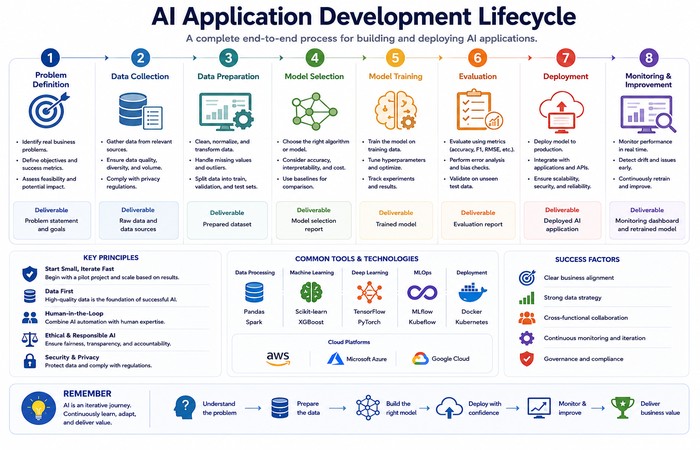
Why AI Governance Matters for Every Organization
Responsible AI isn’t just a concern for governments or multinational corporations.
Organizations of every size increasingly rely on AI to support customer service, marketing, recruitment, software development, financial analysis, and operational decision-making. As these systems become more capable—and in many cases more autonomous—the need for structured governance grows alongside them.
Implementing recognized standards and governance frameworks helps organizations:
- Reduce operational and regulatory risk.
- Improve the reliability and consistency of AI systems.
- Protect sensitive business and customer data.
- Build trust with employees, customers, and stakeholders.
- Prepare for evolving regulatory requirements.
- Scale AI initiatives with greater confidence.
Ultimately, successful AI adoption isn’t measured solely by model accuracy or automation. Long-term success depends on deploying AI that is technically effective, operationally reliable, and governed in a way that aligns with organizational objectives and societal expectations.
Measuring AI Success: From Experimentation to Business Value
Deploying an AI application is only the beginning.
The more important question comes afterward:
Did it actually improve the business?
This is where many AI initiatives struggle.
An AI chatbot might answer thousands of customer questions every day.
A coding assistant might generate millions of lines of code each month.
A recommendation engine might process billions of interactions annually.
Those numbers sound impressive.
But activity alone doesn’t prove value.
The organizations seeing the greatest return from AI focus less on usage statistics and more on measurable business outcomes.
Instead of asking:
“How many prompts did employees submit?”
They ask:
- Did customer satisfaction improve?
- Did operational costs decrease?
- Were support tickets resolved faster?
- Did downtime decline?
- Did fraud losses fall?
- Did employee productivity increase?
- Did revenue grow?
Ultimately, successful AI projects are measured by business impact—not by how often the technology is used.
Benefits of AI Applications
Artificial intelligence has evolved far beyond automating repetitive tasks. When implemented thoughtfully, it helps organizations make better decisions, improve customer experiences, reduce operational costs, and unlock entirely new ways of working.
However, the greatest benefits rarely come from AI alone.
They come from combining AI with high-quality data, well-designed workflows, and skilled people.
Let’s examine the areas where AI consistently creates measurable business value.
1. Increased Productivity
One of AI’s most immediate benefits is its ability to automate routine work.
Employees spend a surprising amount of time on repetitive activities such as searching for information, preparing reports, entering data, responding to common questions, scheduling meetings, and reviewing documents.
AI significantly reduces this administrative workload.
Instead of replacing employees, it allows them to spend more time on work that requires creativity, strategic thinking, relationship building, and complex decision-making.
Examples include:
- Software developers generating boilerplate code
- Marketing teams drafting campaign content
- Customer support agents receiving suggested responses
- HR teams automating interview scheduling
- Finance departments processing invoices faster
Even small productivity improvements can create substantial value when multiplied across thousands of employees.
2. Better Decision-Making
Modern organizations generate far more information than humans can realistically analyze.
AI helps transform that information into actionable insights.
Rather than manually reviewing hundreds of spreadsheets or reports, decision-makers can use AI to identify:
- Emerging trends
- Customer behavior patterns
- Operational bottlenecks
- Sales opportunities
- Financial risks
- Supply chain disruptions
This enables organizations to make faster, more informed decisions based on evidence rather than intuition alone.
Importantly, AI supports decision-making—it doesn’t replace executive judgment.
3. Improved Customer Experience
Customers increasingly expect personalized, responsive, and always-available services.
AI helps organizations meet those expectations.
Examples include:
- Personalized recommendations
- Intelligent search
- AI-powered customer support
- Faster response times
- Multilingual communication
- Personalized marketing
- Proactive notifications
Rather than providing identical experiences to every customer, AI allows businesses to adapt interactions based on individual preferences and behavior.
4. Operational Efficiency
Operational efficiency remains one of AI’s strongest business cases.
Across industries, AI reduces:
- Manual processing
- Human error
- Equipment downtime
- Administrative overhead
- Response times
- Inventory waste
Manufacturers optimize production.
Hospitals improve scheduling.
Retailers forecast demand more accurately.
Banks detect fraud faster.
These improvements often produce measurable financial returns because they optimize existing processes rather than creating entirely new ones.
5. Greater Scalability
Hiring additional employees isn’t always the only way to support growth.
AI allows organizations to manage increasing workloads without expanding headcount at the same rate.
For example:
A customer support team handling 10,000 inquiries per month may eventually need additional staff.
With AI automating routine questions, the same team can often support significantly higher volumes while maintaining service quality.
This doesn’t eliminate human roles.
Instead, it enables organizations to scale more efficiently.
6. Stronger Risk Management
AI continuously monitors operational data for unusual behavior.
This capability has become particularly valuable in areas such as:
- Fraud detection
- Cybersecurity
- Financial compliance
- Equipment monitoring
- Healthcare
- Supply chain management
Rather than waiting for problems to become obvious, AI identifies subtle warning signs early enough for organizations to respond proactively.
7. Continuous Learning
Unlike traditional software that behaves exactly the same every day, many AI systems improve over time.
As more high-quality data becomes available, models can be retrained to improve accuracy, adapt to changing conditions, and support evolving business needs.
Organizations treating AI as an ongoing capability rather than a one-time project typically achieve greater long-term value.
Choosing the Right AI Strategy
Artificial intelligence has matured to the point where organizations no longer ask whether they should adopt AI. The more important question is how to adopt it effectively.
Not every business needs to build its own AI models, and not every process benefits from automation. Successful AI initiatives begin by identifying high-value opportunities, selecting the appropriate implementation approach, and measuring results against clear business objectives.
The following decision frameworks can help organizations make more informed AI investment decisions.

Should You Build or Buy AI?
One of the first strategic decisions organizations face is whether to develop AI solutions internally or purchase existing platforms from technology vendors.
There is no universal answer.
The right approach depends on factors such as business requirements, available expertise, regulatory obligations, budget, and long-term strategic goals.
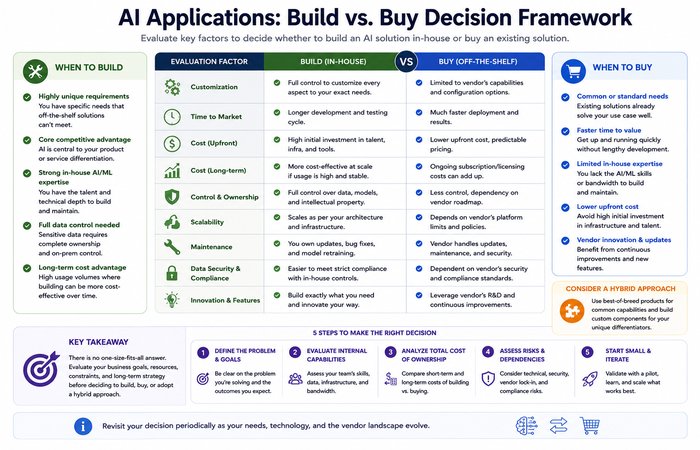
Build vs. Buy AI
| Consideration | Build AI In-House | Buy an AI Solution |
| Deployment Speed | Longer implementation time | Faster deployment |
| Initial Investment | Higher development cost | Lower upfront investment |
| Customization | Extensive customization | Limited to vendor capabilities |
| Control | Full ownership of models and data | Vendor-managed platform |
| Maintenance | Internal responsibility | Managed by provider |
| Scalability | Depends on internal infrastructure | Typically built into the platform |
| Data Privacy | Greater control over sensitive information | Depends on vendor architecture and policies |
| Technical Expertise | Requires experienced AI teams | Lower technical barrier |
When Building AI Makes Sense
Developing an AI solution internally is often the better choice when:
- Your organization has unique business processes.
- Competitive advantage depends on proprietary AI capabilities.
- Sensitive data cannot leave internal environments.
- Existing commercial solutions don’t meet operational requirements.
- Long-term customization is a strategic priority.
Examples include large financial institutions, healthcare providers, defense organizations, and technology companies building AI into their own products.
When Buying AI Makes Sense
Purchasing an existing AI platform is often the better approach when:
- Rapid deployment is a priority.
- Internal AI expertise is limited.
- Standard business processes are being automated.
- Budget constraints favor subscription-based services.
- The organization prefers managed cloud services.
Many small and medium-sized businesses successfully adopt AI using commercial platforms for customer support, marketing automation, document processing, and productivity without building custom models.
Which AI Application Should You Implement First?
Organizations often try to automate everything at once.
That’s rarely the best strategy.
Successful AI adoption usually starts with one clearly defined business problem, demonstrates measurable value, and then expands gradually across additional departments.
Before investing in an AI initiative, evaluate whether the process meets the following criteria.
AI Readiness Checklist
High-volume process
Does the task occur frequently enough for automation to deliver meaningful value?
Examples include customer inquiries, invoice processing, document classification, and report generation.
Repetitive workflow
Is the process performed repeatedly using similar steps?
AI performs best when supporting structured, repeatable activities rather than highly unpredictable work.
High-quality data
Is reliable, accurate, and well-governed data available?
Poor data quality remains one of the leading causes of unsuccessful AI projects.
Clearly defined success metrics
Can the business outcome be measured?
Examples include:
- Faster response times
- Lower operational costs
- Reduced errors
- Higher customer satisfaction
- Increased productivity
- Improved revenue
Without measurable objectives, it’s difficult to determine whether an AI initiative has actually succeeded.
Manageable regulatory requirements
Does the application operate in a relatively low-risk environment?
Organizations often begin with lower-risk processes such as:
- Knowledge search
- Internal productivity
- Marketing content
- Customer self-service
- Report summarization
Higher-risk applications involving healthcare, employment, lending, legal advice, or public safety generally require more extensive governance, testing, and human oversight.
Characteristics of High-Value AI Use Cases
The most successful AI projects tend to share several common characteristics.
| Characteristic | Why It Matters |
| Large volumes of data | AI performs better when sufficient, high-quality data is available. |
| Repetitive workflows | Automation produces greater efficiency gains. |
| Clear business objectives | Success can be measured using defined KPIs. |
| Predictable decision patterns | AI models learn more effectively from consistent processes. |
| Strong executive support | Leadership commitment improves adoption and long-term success. |
| Available domain expertise | Subject matter experts help validate AI outputs and improve reliability. |
Organizations should prioritize projects that satisfy several of these characteristics before expanding AI adoption into more complex business areas.
A Practical Roadmap for AI Adoption
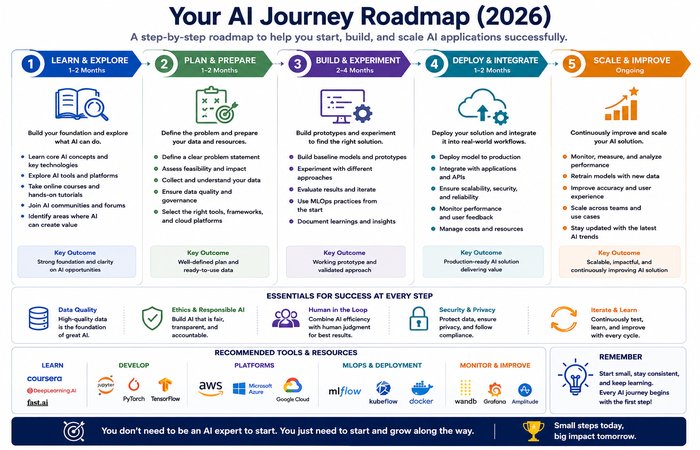
Rather than attempting large-scale transformation immediately, many organizations achieve better results by following a phased implementation approach.
Phase 1: Identify Opportunities
Evaluate repetitive, data-driven processes that consume significant employee time or create operational bottlenecks.
Phase 2: Run a Pilot Project
Deploy AI within a limited business function or department to validate technical performance and business value before wider adoption.
Phase 3: Measure Business Outcomes
Track meaningful metrics such as productivity improvements, customer satisfaction, cost savings, accuracy, and operational efficiency rather than focusing solely on AI usage.
Phase 4: Strengthen Governance
Establish policies covering security, privacy, model monitoring, human oversight, and regulatory compliance before expanding AI across the organization.
Phase 5: Scale Responsibly
After demonstrating measurable value, integrate AI into additional workflows while continuously monitoring performance and retraining models as business requirements evolve.
Key Takeaway
Successful AI adoption isn’t determined by using the newest model or the largest language model.
It’s determined by selecting the right problem, implementing the right technology, using high-quality data, and measuring results against clear business objectives.
Organizations that begin with focused, high-impact use cases typically achieve faster returns, lower implementation risk, and stronger long-term adoption than those attempting organization-wide AI transformation from the outset.
Challenges and Limitations of AI Applications
Artificial intelligence offers tremendous opportunities, but it’s not a universal solution.
Understanding its limitations is just as important as understanding its strengths.
Organizations that ignore these challenges often struggle to move beyond pilot projects.
Data Quality
AI learns from data.
If that data is incomplete, inconsistent, outdated, or biased, the resulting predictions will also be unreliable.
A sophisticated model cannot compensate for poor-quality information.
This is why many organizations invest heavily in data governance before expanding AI initiatives.
Hallucinations and Accuracy
Generative AI systems occasionally produce responses that sound convincing but are factually incorrect.
These errors—often called hallucinations—can occur because language models predict plausible text rather than verifying facts in real time.
For low-risk tasks such as brainstorming or drafting, hallucinations may be manageable.
For healthcare, finance, legal services, or engineering, organizations typically combine AI with trusted knowledge sources, human review, or retrieval systems to improve reliability.
Bias and Fairness
AI models can unintentionally reflect biases present in historical data.
Examples include:
- Hiring recommendations
- Loan approvals
- Insurance assessments
- Facial recognition
- Predictive policing
Responsible organizations regularly evaluate AI systems for fairness, transparency, and unintended discrimination.
Human oversight remains essential.
Privacy and Security
AI applications often process sensitive information.
This may include:
- Medical records
- Financial data
- Customer information
- Intellectual property
- Internal business documents
In order to achieve this, the organizations have to establish strict security controls, encryption, identity and access policies in place to secure the data and the AI systems.
Furthermore, they are increasingly demanding explanations of the way the AI will deal with individual data..
Integration Challenges
Deploying the model into a new business environment (i.e. Into an end-user application) can be less straightforward than it may initially seem.
Organizations frequently encounter challenges involving:
- Legacy software
- Data silos
- Incompatible systems
- Workflow redesign
- Change management
The most successful AI projects are those where the businesspeople, information technologists, and the data scientists work very closely.
Skills Gap
It is very clear that there is a demand for AI skills.
Organizations often struggle to recruit professionals with experience in:
- Machine learning
- Data engineering
- AI security
- Model governance
- Prompt engineering
- MLOps
- Responsible AI
Perhaps one of the most prevalent themes throughout the discussion was that of training of existing employees, which appears to be the way forward in attempts to shorten this difference.
Responsible AI and Governance
As AI is developing faster, more important than anything governance is to be responsible of it.
Before 2006 the most advanced AI‘s were only able to provide advice.
Modern AI agents can perform actions.
That changes everything.
Organizations must ensure that AI systems are responsible, secure and transparent.
Responsible AI generally focuses on several principles:
Transparency
The first thing can be understood that people should be aware of the usage of artificial intelligence.
Accountability
Organizations are still accountable for the results of AI.
Responsibility cannot be entirely offloaded to algorithms.
Privacy
It‘s important that the private information stays safe through the whole of the life cycle of AI.
Fairness
The models must be checked for bias, as well as any second order discrimination.
Security
The same security protections perhaps even stronger that are employed for vital business systems must also be used for AI systems.
Human Oversight
In high-impact decisions where there are broad consequences in the areas of health, employment, finance or the law, humans should have the rights of significant review and approval.
It is not a matter of governance or not anymore.
It‘s going to be a fundamental requirement for enterprise AI adoption.
How to Choose the Right AI Use Cases
Not all problems have to be solved with artificial intelligence.
The best AI projects typically share several characteristics.
Start with Business Objectives
Avoid asking:
“Where can we use AI?”
Instead ask:
“Which business problem are we taking the longest to resolve, making the least money off or causing our customers the most annoyance?“
Prioritize High-Volume Work
The highest potential for AI is in automating routine and data hungry processes.
Examples include:
- Document processing
- Customer support
- Forecasting
- Quality inspection
- Fraud detection
- Knowledge retrieval
Ensure High-Quality Data
AI cannot perform reliably in the absence of data that it can trust.
Organizations should evaluate:
- Data availability
- Data quality
- Governance
- Ownership
- Privacy requirements
before selecting AI solutions.
Measure Results
Every AI initiative should include measurable success metrics.
Examples include:
- Response time
- Customer satisfaction
- Revenue growth
- Cost reduction
- Error rates
- Productivity improvements
- Downtime reduction
Clear metrics help organizations distinguish meaningful business improvements from temporary excitement around new technology.
Future Trends Shaping AI Applications
The field of artificial intelligence is constantly evolving and growing more and more sophisticated.
In the coming years, a number of trends will influence the future of AI adoption.
Agentic AI
AI systems will increasingly complete entire workflows rather than individual tasks.
Digital coworkers capable of planning, reasoning, and coordinating business processes are expected to become more common across enterprise software.
Multimodal AI
Future AI systems will understand and generate combinations of:
- Text
- Images
- Video
- Audio
- Documents
- Structured data
This will create more natural interactions between humans and machines.
Smaller Specialized Models
While frontier models continue growing, many organizations are deploying smaller, task-specific models that offer lower costs, faster responses, improved privacy, and easier deployment.
Edge AI Expansion
With ever growing power of AI-chips more processing will take place on local devices than cloud.
This will enhance privacy, reduce latency and facilitate the implementation of AI applications in several areas such as healthcare, manufacturing, transportation & smart cities.
Stronger AI Regulation
A greater number of new laws are being adopted in relation to AI safety, privacy, copyright and responsibility; as well as new laws regarding transparency of AI.
The present that they put into effect now, will be their future compliance.
The Future of AI Applications: What to Expect Beyond 2026
How the world of AI is developing has certainly progressed more rapidly than many other technologies. Starting from traditional machine learning algorithms to image recognition or forecast prediction, we have moved on to intelligent systems with reasoning, generating, interfacing with other softwares and taking the journey through the entire business pipeline.
The next wave of AI will not be defined by one defining breakthrough but instead by multiple happening in tandem: more powerful models, improved infrastructure, more robust governance, and greater incorporation into products and business systems.
Although it is impossible to foresee the future, there are numerous signs helping to define the future of AI implementation. This list indicates the key tendencies, which may affect technology strategies and long-term investments.
Looking Ahead
In the future, analysts believe that AI systems will grow more and more multimodal. They will be able to comprehend image, text, audio, video, structured data, and sensor data within a unified workflow. This will lead to the proliferation of AI in domains such as health care, manufacturing, education, scientific research, and enterprise software.
Near-Term Outlook (2026–2028): AI Becomes a Core Business Capability
The year to come is seeing AI shift from discrete productivity tools to becoming embedded in the enterprise software stack, customer experience and business operations.
AI Agents Become Mainstream
One of the most exciting developments will be the proliferation of intelligent AI agents which can plan, reason, and complete complex multi-step tasks.
Unlike traditional assistants that simply answer questions, AI agents will increasingly:
- Coordinate workflows across multiple business applications.
- Retrieve information from enterprise knowledge bases.
- Complete repetitive administrative tasks.
- Monitor business processes and recommend actions.
- Collaborate with both employees and other AI agents.
I believe many organization‘s will see the shift from AI as conversational assistant to AI as operating collaborator across finance, HR, IT, customer support, procurement and software engineering.
Multimodal AI Becomes the Default
The next generation of AI systems will not be underpinned by text..
Multimodal AI models will increasingly process and generate combinations of:
- Text
- Images
- Audio
- Video
- Documents
- Code
- Sensor data
This means that rather than having to upload multiple files or multitask between (software) programs.
This will be of enormous importance in advancing support to customers, education, medicine, engineering, accessibility and creatively.
Enterprise AI Copilots Expand Across Every Department
AI copilots will eventually be a standard feature in enterprise software.
Rather than replacing employees, these systems will assist with day-to-day work by:
- Summarizing meetings.
- Drafting emails and reports.
- Generating software code.
- Analyzing business data.
- Preparing presentations.
- Automating documentation.
- Surfacing relevant knowledge.
Rather than using separate AI applications, employees will more and more use AI directly within the business applications they are using already.
Edge AI Accelerates Real-Time Intelligence
However, cloud AI will still be vital for training big models at scale, enterprise analytics, but it will be pouring more AI inferences to come in nearer to the data sources.
Edge AI enables intelligent decision-making directly on:
- Smartphones
- Industrial equipment
- Autonomous vehicles
- Medical devices
- IoT sensors
- Smart cameras
- Wearable technology
Local processing helps to reduce latency, enhance privacy, state bandwidth and makes AI equipment work nicely in case there‘s no web connection.
Robotics Becomes More Intelligent
Industrial robotics will extend past low-level automation.
Future robots will increasingly combine:
- Computer vision
- Reinforcement learning
- Speech recognition
- AI planning
- Sensor fusion
Thanks to these progress, our robots will be able to adapt themselves to the evolution of the environment instead of executed strict guided sequences:
Investments are likely to translate into positively effected sectors like manufacturing, logistics, healthcare, agriculture and warehouse automation.
Medium-Term Outlook (2028–2032): AI Becomes an Organizational Decision Partner
As algorithms and systems improve over time, organizations will probably progress from simple task automation to decision support and automated management at a scale.
Autonomous Enterprises
I anticipate a large number of organizations to be in the process of migrating to autonomic business processes.
AI won‘t be automating tasks individually, instead, automating entire workflows between teams.
Examples include:
- Procurement systems that negotiate supplier contracts.
- Finance platforms that identify budget anomalies and recommend corrective actions.
- HR systems that coordinate recruitment and onboarding.
- Supply chains that continuously optimize inventory and logistics.
- Customer service platforms that resolve routine issues with minimal human intervention.
Supervision by the human will still be necessary (especially on strategic, legal and high level decision).
Scientific AI Accelerates Research
AI is already supporting researchers in protein folding, materials science, climate models and drug design.
Future AI systems are expected to play an even greater role by:
- Generating research hypotheses.
- Simulating complex experiments.
- Identifying hidden relationships within large datasets.
- Accelerating pharmaceutical development.
- Supporting climate and environmental research.
Instead of replacing scientists, computers will probably team up with researchers as high-powered research partners, handling information at an unlimited rate.
AI-Driven Software Engineering
The trend will be for software development to move from being an AI-assisted programming task to an AI-supported software engineering task.
Future AI systems may increasingly:
- Generate production-ready code.
- Detect security vulnerabilities before deployment.
- Write automated tests.
- Optimize application performance.
- Refactor legacy systems.
- Maintain technical documentation.
- Assist with system architecture and design reviews.
Technical judgment, architecture advice, and quality assurance, for example, will continue to be delivered by developers, while increasing amounts of programming work will be off-loaded to machines.
Personalized Healthcare
There is an anticipation that Healthcare may become more personalized as society, under moral guidance, may appreciate and make more good use of AI.
Progress in predictive analytics, genomics, wearables, and medical imaging may help provide healthcare providers with:
- Detect diseases earlier.
- Tailor treatments to individual patients.
- Continuously monitor chronic conditions.
- Predict health risks before symptoms appear.
- Improve clinical decision support.
Given the personal nature of the information and the high-stakes decisions that will be made, these applications will remain subject to validation, regulation and clinician participation.
Long-Term Outlook (Beyond 2032): Human-AI Collaboration at Scale
From a longer-term perspective, it‘s clear that AI will eventually become more fully incorporated into research, engineering, robotics, education, and daily work, smartly.
While the rate of advancement is still unpredictable, there are many existing long-term trends that the community and business are focusing on.
General-Purpose Robotics
The next generation of robots will be widely adaptable into a range of environments.
Instead of being designed for a single task, they may eventually assist with:
- Manufacturing
- Warehousing
- Healthcare support
- Disaster response
- Agriculture
- Construction
- Domestic assistance
Reliable general purpose robots will also continually need to improve perception, reasoning, manipulation, safety, power/energy efficiency.
AI-Assisted Scientific Discovery
Perhaps one of the greatest potential uses of AI will be in scientific research.
The system could possibly also be used to speed up future developments. A computer could examine the immense number of facts in the universe, make proposals of possible hypotheses that researchers should investigate, determine experiments that could be carried out, and uncover unexpected trends.
Potential areas include:
- New medicines
- Advanced materials
- Renewable energy
- Climate science
- Space exploration
- Quantum computing
Machines will not be able to replace human researchers but will complement human researchers.
Human-AI Collaboration
Humans vs. Machines is not the future of AI..
Rather, in the coming years, we will see more and more emphasis placed on the partnership between human users and intelligent systems.
Employees may routinely collaborate with AI to:
- Analyze information.
- Generate ideas.
- Automate repetitive work.
- Support complex decisions.
- Improve creativity.
- Increase productivity.
Success in anything is ensured by combining the best aspects of the human and the technological.
Physical AI
A relatively new frontier is the physical integration of advanced AI models to robots, autonomous machines, industrial equipment, as well as through connected environnement.
Reasoning with the world Physical AI Unlike software-only AI, Physical AI enables intelligent agents to understand, reason about, and affect their environment.
Potential applications include::
- Autonomous factories
- Intelligent warehouses
- Smart cities
- Self-optimizing energy systems
- Precision agriculture
- Autonomous transportation
- Advanced healthcare robotics
As sensing problems, robot technology and AI models develop in parallel, physical AI will play a more and more significant role in future innovations.
Looking Ahead
It will not be a single technology or model that defines the future of AI applications. Rather it will be a synergy of more powerful foundation models, intelligent agents, multimodal systems, robotics, edge computing, and responsible governance.
For organizations, long-term achievement is not to be found in acquiring any new and exciting AI feature, but on identifying the technologies that solve real business problems, integrating them responsibly, and maintaining strong oversight as these systems become more capable.
The organizations that thrive in the coming decade are unlikely to be those chasing every AI trend. They will be the ones that combine human expertise, trusted data, sound governance, and practical AI implementations to deliver measurable value at scale.
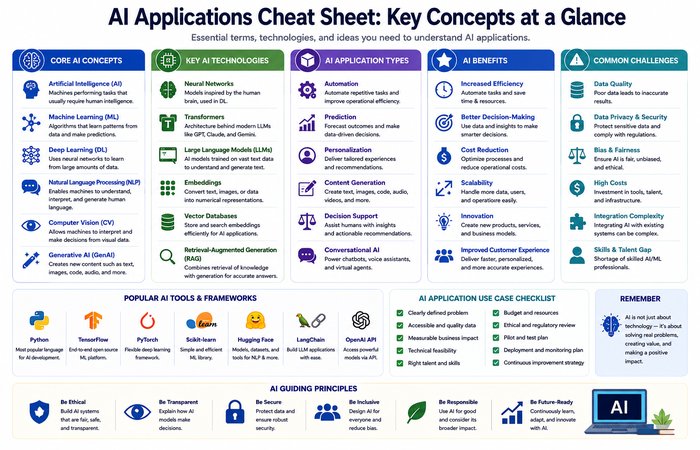
FAQs
Q1. What are AI applications?
A: AI applications are software systems that use artificial intelligence technologies—such as machine learning, natural language processing (NLP), computer vision, and generative AI—to perform tasks that typically require human intelligence. These applications can analyze data, recognize patterns, generate content, automate workflows, make predictions, and support decision-making. Common examples include virtual assistants, fraud detection systems, recommendation engines, medical imaging tools, AI chatbots, and autonomous vehicles.
Q2. What are the most common AI use cases?
A: Some of the most common AI use cases include:
- Customer service chatbots
- Fraud detection
- Product recommendations
- Predictive maintenance
- Medical image analysis
- Language translation
- Content generation
- Demand forecasting
- Voice assistants
- Intelligent document processing
Many organizations combine several of these use cases into larger AI-powered business workflows.
Q3. What industries use AI the most?
A: AI has been adopted across nearly every industry, but some sectors have embraced it more rapidly than others.
Industries with significant AI adoption include:
- Healthcare
- Financial services
- Retail and e-commerce
- Manufacturing
- Transportation and logistics
- Telecommunications
- Education
- Agriculture
- Government
- Software development
The specific applications vary depending on business objectives, regulatory requirements, and available data.
Q4. What’s the difference between AI and machine learning?
A: Artificial intelligence is the broader field focused on building systems capable of performing tasks associated with human intelligence.
Machine learning is a subset of AI that enables computers to learn patterns from data instead of relying solely on predefined rules.
In simple terms:
- Artificial Intelligence is the overall discipline.
- Machine Learning is one of the technologies used to build AI systems.
Not every AI system uses machine learning, but most modern AI applications do.
Q5. What is Agentic AI?
A: Agentic AI refers to AI systems capable of planning, reasoning, interacting with software tools, and completing multi-step workflows with limited human supervision.
Unlike traditional AI assistants that primarily answer questions, AI agents can retrieve information, execute business processes, update records, communicate with other systems, and coordinate complex tasks while operating within predefined permissions and governance policies.
Q6. What is Retrieval-Augmented Generation (RAG)?
A: Retrieval-Augmented Generation (RAG) combines large language models with external knowledge sources.
Instead of relying only on information learned during training, a RAG system retrieves relevant documents from trusted databases or knowledge repositories before generating a response.
This approach improves accuracy, reduces hallucinations, and enables AI systems to answer questions using current organizational information.
Q7. What is an example of an AI application?
A: A recommendation system used by an online retailer is a common example of an AI application.
It analyzes customer behavior, purchase history, browsing activity, and product preferences to recommend items that are most relevant to each shopper.
Other examples include AI chatbots, virtual assistants, medical imaging software, predictive maintenance platforms, and autonomous warehouse robots.
Q8. Is ChatGPT an AI application?
A: Yes.
ChatGPT is an AI application powered by a large language model (LLM). It uses natural language processing and generative AI to answer questions, summarize information, write content, assist with coding, and support many other language-based tasks.
Many organizations also build their own AI applications using similar language models integrated with proprietary business data and workflows.
Q9. Which companies are leading AI development?
A: Many technology companies are investing heavily in artificial intelligence.
Some of the leading organizations include:
- OpenAI
- Anthropic
- Google DeepMind
- Microsoft
- NVIDIA
- Meta
- Amazon Web Services (AWS)
- IBM
- Oracle
- Salesforce
- Adobe
In addition to these companies, many startups and research organizations continue advancing AI across specialized domains.
Q10. What are enterprise AI applications?
A: Enterprise AI applications are AI-powered systems designed to improve business operations.
Common examples include:
- Enterprise search
- Customer support automation
- Financial forecasting
- Document intelligence
- AI copilots
- IT operations
- HR automation
- Procurement assistants
- Business intelligence
- Workflow automation
These systems typically integrate with existing enterprise software rather than operating independently.
Q11. How do AI agents work?
A: AI agents combine several technologies, including large language models, planning, memory, tool integration, and workflow orchestration.
Rather than simply generating responses, they can retrieve information, access databases, call APIs, complete multi-step tasks, and interact with enterprise software to achieve specific objectives.
Most enterprise AI agents operate under predefined permissions and include human oversight for high-impact decisions.
Q12. What are foundation models?
A: Foundation models are large AI models trained on massive datasets that can be adapted for many different applications.
Instead of being designed for a single task, they provide general capabilities such as language understanding, reasoning, coding, image generation, and translation.
Organizations often build specialized AI applications by adapting foundation models rather than training entirely new models from scratch.
Q13. Can small businesses benefit from AI?
A: Absolutely.
Cloud-based AI services have made advanced AI capabilities accessible to organizations of all sizes.
Small businesses commonly use AI for:
- Customer support
- Email marketing
- Content creation
- Sales automation
- Accounting assistance
- Appointment scheduling
- Data analysis
Many AI solutions require little or no custom development, making adoption more affordable than in the past.
Q14. What are the biggest risks of AI applications?
A: While AI offers significant benefits, organizations should also consider potential risks.
These include:
- Inaccurate outputs
- Hallucinations
- Data privacy concerns
- Security vulnerabilities
- Algorithmic bias
- Regulatory compliance
- Lack of transparency
- Overreliance on automation
Strong governance, human oversight, and continuous monitoring help reduce these risks.
Q15. What’s the future of AI applications?
A: The future of AI is expected to include more autonomous AI agents, multimodal systems, edge AI, robotics, personalized healthcare, enterprise copilots, and AI-assisted scientific discovery.
Rather than replacing people, future AI applications are likely to work alongside humans by automating repetitive tasks, improving decision-making, and supporting increasingly complex workflows.
Q16. What is the difference between generative AI and predictive AI?
A: Generative AI creates new content such as text, images, code, audio, or video based on learned patterns.
Predictive AI analyzes historical data to estimate future outcomes, such as customer demand, equipment failures, fraud risk, or sales forecasts.
Many organizations combine both approaches within the same business application.
Q17. Do AI applications require internet access?
A: Not always.
Many AI applications run in the cloud and require an internet connection, but Edge AI enables models to operate directly on local devices such as smartphones, industrial equipment, and autonomous systems.
Running AI locally can improve privacy, reduce latency, and support offline operation.
Q18. How do businesses measure AI success?
A: Organizations typically evaluate AI initiatives using business-focused metrics rather than technical metrics alone.
Common measures include:
- Productivity improvements
- Customer satisfaction
- Revenue growth
- Cost reduction
- Faster response times
- Lower error rates
- Reduced downtime
- Return on investment (ROI)
Successful AI projects are measured by business outcomes, not simply by how frequently AI is used.
Q19. Can AI replace human workers?
A: AI is better viewed as a tool that augments human capabilities rather than replacing people entirely.
It excels at repetitive, data-intensive tasks, while humans remain essential for strategic thinking, creativity, ethical judgment, leadership, and complex decision-making.
Many organizations are redesigning roles so employees work alongside AI instead of competing with it.
Q20. How should organizations get started with AI?
A: The best approach is to begin with a clearly defined business problem rather than adopting AI for its own sake.
Organizations should:
- Identify a high-value use case.
- Assess data quality and availability.
- Choose the appropriate AI technology.
- Run a small pilot project.
- Measure business outcomes.
- Strengthen governance and security.
- Scale successful implementations gradually.
Starting with focused, measurable projects usually delivers faster results and lower implementation risk than attempting organization-wide AI transformation from the outset.
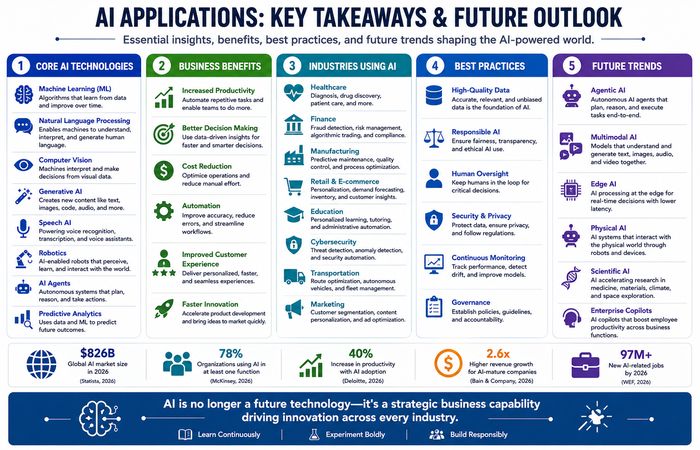
Related AI Guides
Artificial intelligence is a broad field that includes specialized technologies, industry applications, and enterprise implementation strategies. If you’d like to explore these topics in greater depth, the following guides provide detailed explanations, practical examples, and real-world use cases.
Core AI Technologies
- Guide to Generative AI – Learn how foundation models, large language models (LLMs), image generation, and enterprise generative AI applications are transforming modern businesses.
https://www.computertechreviews.com/guide-to-generative-ai/ - Natural Language Processing (NLP) Guide – Discover how AI understands, interprets, and generates human language for chatbots, translation, search, and enterprise knowledge management.
https://www.computertechreviews.com/natural-language-processing-guide/ - Guide to Computer Vision – Explore how computer vision enables image recognition, object detection, medical imaging, quality inspection, and autonomous systems.
https://www.computertechreviews.com/guide-to-computer-vision/ - Machine Learning Resource Center – Learn the fundamentals of supervised learning, unsupervised learning, deep learning, predictive analytics, and modern machine learning applications.
https://www.computertechreviews.com/category/ai-emerging-technology/machine-learning/
Industry-Specific AI Applications
- AI in Healthcare – Explore how artificial intelligence supports medical imaging, predictive diagnostics, hospital operations, clinical decision support, and personalized patient care.
https://www.computertechreviews.com/ai-in-healthcare/ - AI and the Healthcare Industry – Learn how healthcare organizations are adopting AI to improve patient outcomes, streamline workflows, and accelerate medical innovation.
https://www.computertechreviews.com/ai-and-the-healthcare/ - AI in CRM – Discover how AI enhances customer relationship management through predictive analytics, sales automation, customer segmentation, and personalized engagement.
https://www.computertechreviews.com/ai-in-crm/ - The Future of AI-Driven Cybersecurity – Learn how artificial intelligence is transforming threat detection, incident response, malware analysis, and modern cyber defense strategies.
https://www.computertechreviews.com/exploring-the-future-of-ai-driven-cybersecurity/
AI Applications and Emerging Technologies
- Text-to-Image AI – Understand how AI models generate realistic images from text prompts and how these technologies are used across creative and commercial industries.
https://www.computertechreviews.com/text-to-image-ai/ - DALL·E: Modern AI Image Generation – Explore OpenAI’s DALL·E model, its capabilities, practical applications, limitations, and commercial use cases.
https://www.computertechreviews.com/dall-e-modern-ai-image-generation/ - Midjourney Complete Guide – Learn how Midjourney generates high-quality AI artwork and compare it with other leading text-to-image models.
https://www.computertechreviews.com/midjourney-complete-guide-to-the-ai-image-generator/ - Stable Diffusion AI Image Generation – Discover how Stable Diffusion works, why it’s popular among developers, and how organizations deploy open-source image generation models.
https://www.computertechreviews.com/stable-diffusion-ai-image-generation/
Enterprise AI and Automation
- The Last Mile of Generative AI – Explore the practical challenges of deploying generative AI in production, from integration and governance to scalability and enterprise adoption.
https://www.computertechreviews.com/the-last-mile-of-genai/ - How LLMs and Voice Cloning Power Today’s AI Companions – Learn how large language models, speech synthesis, and conversational AI combine to create intelligent digital assistants.
https://www.computertechreviews.com/how-llms-and-voice-cloning-power-todays-ai-companions/ - Using Conversational AI to Automate Inbound and Outbound Calls – Discover how conversational AI is transforming customer service, sales, and contact center automation.
https://www.computertechreviews.com/using-conversational-ai-to-automate-inbound-and-outbound-calls/ - Beginner’s Guide to Chatbots – Understand how modern chatbots work, the technologies behind them, and the best practices for deploying conversational AI.
https://www.computertechreviews.com/beginners-guide-to-chatbots/ - AI in Financial Services — Learn how financial organizations use AI for fraud detection, risk analysis, financial data, and automation.
- AI in Cybersecurity — Understand how AI helps detect threats, identify anomalies, automate security operations, and respond to attacks.
Key Takeaway
Organizations consistently achieving the greatest value from AI focus less on adopting the newest models and more on solving clearly defined business problems with reliable data, measurable objectives, and responsible governance. Successful AI implementation depends as much on people, processes, and strategy as it does on technology
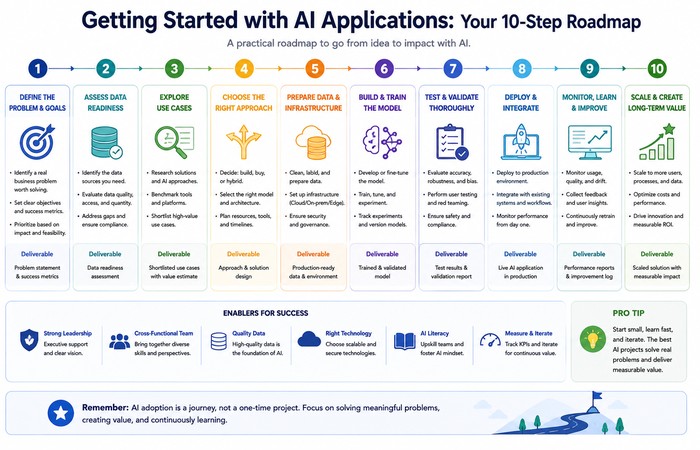
Conclusion
Artificial intelligence has entered a new phase
It’s no longer defined by isolated experiments or impressive demonstrations. Instead, it’s becoming a practical layer woven into everyday software, business operations, and consumer experiences.
From fraud detection and medical imaging to software development, predictive maintenance, customer support, and intelligent search, AI applications are creating measurable value across nearly every industry. At the same time, emerging technologies such as agentic AI, multimodal models, and edge intelligence are expanding what AI systems can accomplish while raising new expectations around governance, security, and accountability.
The organizations succeeding with AI aren’t necessarily those using the largest models or the newest tools. They’re the ones solving clearly defined problems, building on reliable data, integrating AI into existing workflows, measuring outcomes carefully, and maintaining appropriate human oversight.
As AI continues to evolve, one principle remains constant: technology alone doesn’t create value—thoughtful implementation does.
For businesses, developers, students, and decision-makers alike, understanding how AI applications work—and choosing the right use cases—will be far more important than chasing every new trend. Those who combine innovation with responsible deployment will be best positioned to benefit from the next generation of artificial intelligence.