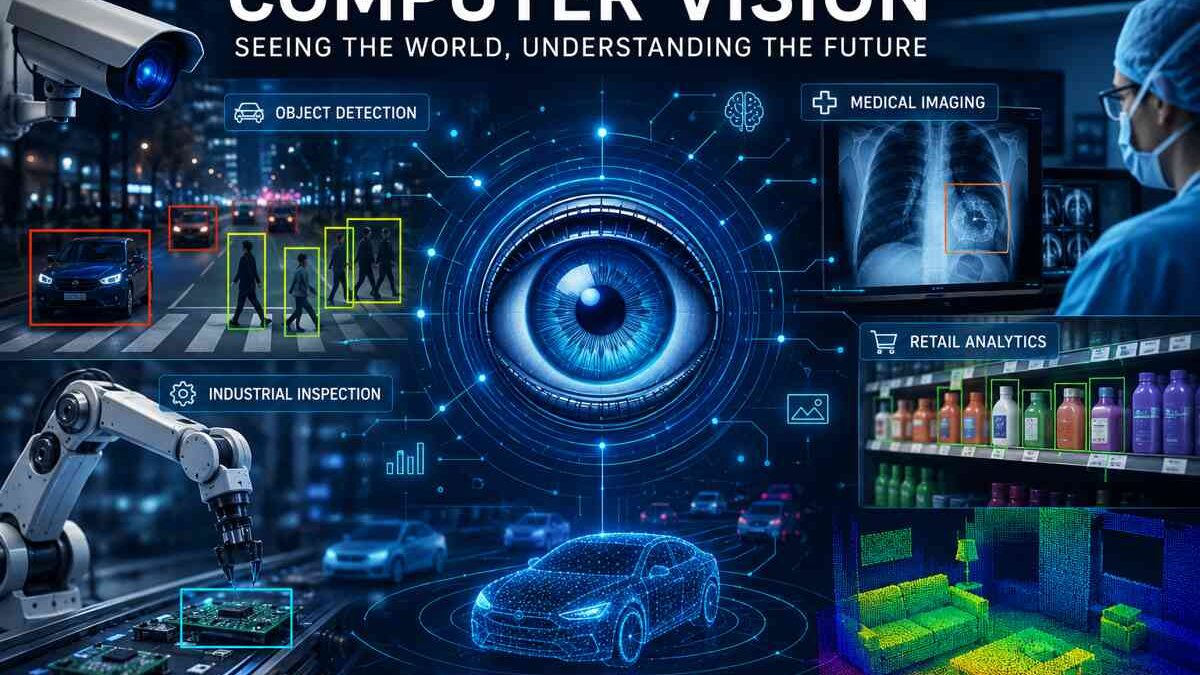

This Article is a part of
Computer Vision Resource Center
Starting from Image Classification and Object Detection to Embodied AI, World Models and Vision Language-Action Systems
The field of computer vision has silently emerged as one of the world‘s most powerful technologies. Computer vision now guides surgical robots through tasks that human fingers cannot perform. It helps autonomous vehicles read intersections in milliseconds. It allows a warehouse system to spot a defective component on a conveyor belt moving at full speed — without a single human looking at a screen.
And yet, if you searched for “computer vision” two years ago, most guides would greet you with a diagram of edge detection and a paragraph about ImageNet. That era is over.
In 2026, computer vision is no longer a standalone discipline concerned with labeling pixels. It has evolved into the perceptual backbone of embodied intelligence — the sensory layer through which AI systems understand, model, and physically interact with the real world. The question practitioners are asking is no longer “can this system identify a cat?” It is: “can this system understand what happens when that object moves, and what physical action should follow?”
This guide answers that question in full. Whether you are a developer evaluating architectures for an edge deployment, a researcher tracking the frontier of Vision-Language-Action models, or a CTO deciding how to build a visual AI pipeline that will hold up through the next three years — this is the resource built for that decision.
We will move systematically from foundational concepts through cutting-edge architectures, covering the CNN-versus-ViT debate with actual performance tradeoffs, the unification of segmentation tasks through Mask2Former and SAM 2, the rise of spatiotemporal world models through JEPA, the embodied AI revolution through VLA models, and the implementation ecosystem you need to build production-ready systems. We will also address what most guides skip entirely: bias, privacy vulnerabilities, and governance — because in 2026, these are not optional considerations. They are prerequisites for deployment.
Table of Contents
Computer Vision Quick Overview
| Topic | Explanation |
| Technology Type | Artificial Intelligence |
| Main Purpose | Helping machines understand images/videos |
| Uses | Healthcare, cars, security, retail, robotics |
| Core Techniques | Machine Learning, Deep Learning, CNNs, Transformers |
| Popular Tools | OpenCV, PyTorch, TensorFlow |
What Is Computer Vision? Definition, Scope, and Why It Matters More Than Ever
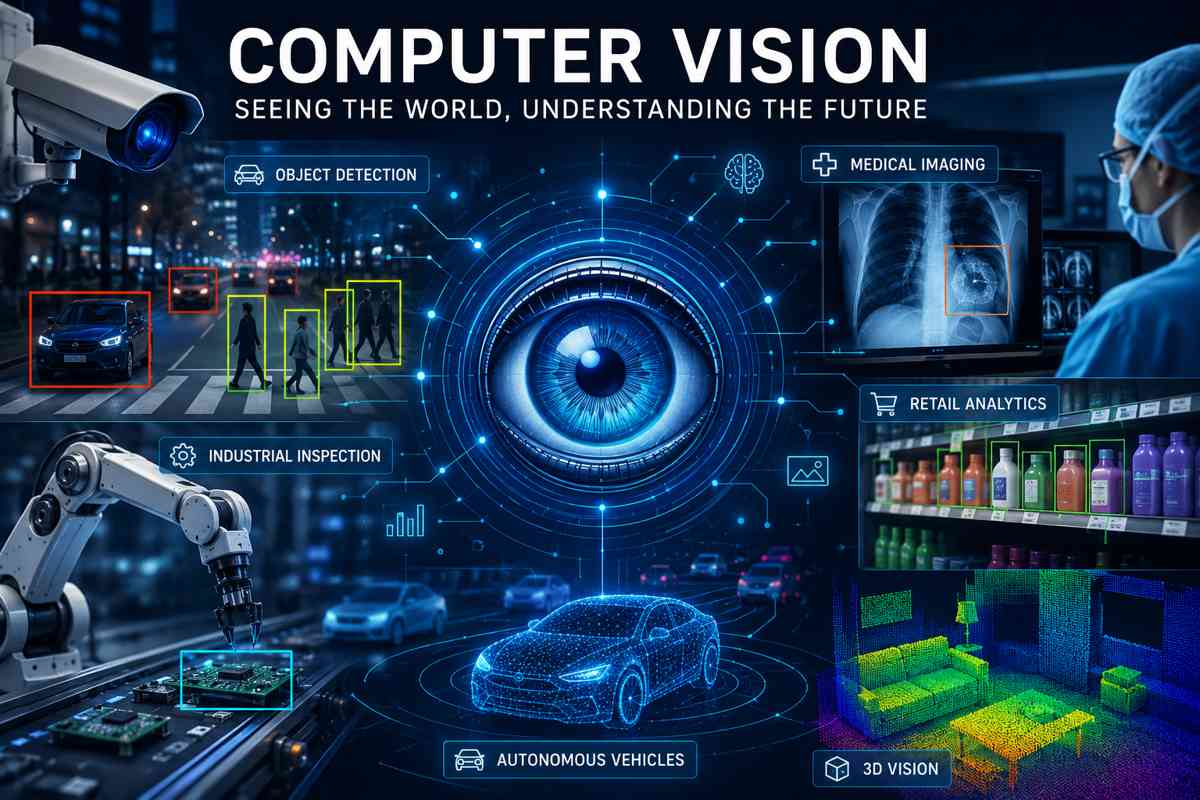
In the realm of AI, computer vision is the study of how to instill machines with the ability to see, understand and process visual information in the form of what we see as images, video, depth information or 3D point clouds something that would match, then exceed human vision.
The term was coined in the 1960s when MIT researchers developed programs capable of recognizing items in photographs, but progress was slow due to limitations in computational power and lack of a large database of trained data. The modern era begun in 2012, in which the deep convolutional neural network so-called AlexNet triumphant the ImageNet Large Scale Visual Recognition Challenge by such a huge gap, everyone could tell that this was the future. That moment triggered the deep learning revolution in vision.
Presently, computer vision is at the crossroad of various converging disciplines: deep learning, robotics, natural language processing and so called embodied AI. It is no longer just about understanding images For example how to think about images in context, over time and against physical action.
Computer Vision vs Artificial Intelligence vs Machine Learning
| Technology | Role |
| AI | Makes machines intelligent |
| Machine Learning | Allows systems to learn patterns |
| Deep Learning | Uses neural networks |
| Computer Vision | Allows AI to understand visual information |
How Computer Vision Works: The Core Processing Pipeline
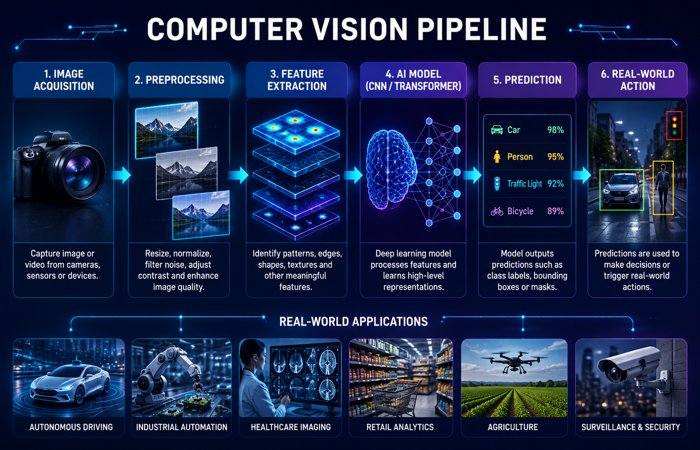
At its most fundamental level, a computer vision system follows a pipeline:
- Image Acquisition — Visual data enters the system through a camera, sensor array, LiDAR unit, or synthetic generator. The quality, resolution and format of this input effects every decision made hereafter.
- Preprocessing — Raw images are then normalized, re-sampled and augmented. Images may also be stored in a different color space. They are processed for noise reduction, equalized and adjusted for contrast.
- Feature Extraction — The model can find meaningful trends in the image. In traditional systems, these features are hand-crafted by engineers using algorithms such as SIFT or HOG. In modern deep learning systems, the network learns features automatically from data.
- Model Inference — The extracted features pass through a trained neural network — CNN, Vision Transformer, or hybrid — which produces an output: a class label, bounding box coordinates, a segmentation mask, an action token, or a latent embedding.
- Post-processing and Output — These raw predictions are cleaned up using techniques such as the use of the NMS for object detection, or the use of conditional random fields for segmentations. The final output can then be sent into other systems such as to a display, decision engine, robotic actuator, or another model.
Computer Vision vs. Human Vision: A Critical Distinction
Human vision is context-aware by default. When you glance at a kitchen counter, you instantly understand which objects are movable, which surfaces are hot, and what spatial relationships exist between items — all without conscious effort. This understanding is grounded in years of physical experience with the world.
Traditional computer vision systems had no such grounding. They recognized objects in isolation, without understanding physical context, causality, or temporal continuity. This is the core limitation that researchers in 2026 are actively solving — through world models, spatiotemporal architectures, and embodied AI systems that learn from physical interaction rather than static image datasets.
Types of Computer Vision
Image Recognition
Image recognition according to Stamatopoulos et al. (2012) is the task of naming the primary object and/or class of an image. The purpose is for a system to get the ‘feel’ of what objects appear in an image e.g. a tiger, a vehicle, a skyscraper, or a human face. It is arguably the most fundamental and most popular task in computer vision as only the identities need to be identified.
Object Detection
Object detection takes things a step further, moving beyond just table detection to label multiple objects within the same image. It identifies multiple objects within an image and places a box around each one. This method is most often used for security and surveillance, driverless cars, retail analytics and smart cameras.
Image Segmentation
Segmentation is a process of partitioning an image into multiple segments of smaller, meaningful regions based on the pixel values. Unlike with detection, where bounding boxes are used, further refinement of segmentation is achieved by outlining objects or regions. Segmentation is predominantly applied in auto-medical imagining, self-driving and industrial inspection.
Facial Recognition
Facial recognition recognizes or authenticates a person by analyzing the unique characteristics of a person‘s face. This is now used in unlocking of phone, roll call, security check, access control, etc. It matches the facial structure of a person with data stored earlier.
OCR
OCR or Optical Character Recognition, is a technology to recognize text within an image, scanned document or screen shot. From images or scanned documents its output is converted into an editable text, about which OCR is use today in many areas such as document digitization, invoice processing, form extraction and data entry automation etc.
Motion Analysis
Motion is the analysis of movement in images or video frames. The motion analysis can determine the way objects or person are moving. It has the ability of following the direction, velocity, gesture or activity of the object or person over a period of time. This technique is used mainly for sports information analysis, traffic observation, surveillance and action identification.
3D Vision
3D vision enables machines to infer depth, shape and arrangement of objects in the environment. It combines information from multiple images, sensors or cameras to generate a three-dimensional representation of scenes and objects. It has applications in robotics, augmented reality, driver-less cars and 3D reconstruction.
To put it in layman terms, image recognition is to figure out what we see in an image, object detection to figure out where the object located in the image, segmentation to high pixel level accuracy and others to provide additional functionalities such as face recognition, reading texts, tracking motion, depth analysis. You realize computer vision has become a fundamental AI technology now.
The Core Tasks of Computer Vision: A Complete Taxonomy
Before examining architectures and frontier models, it is essential to establish a clear map of what computer vision systems are actually asked to do. These tasks form a hierarchy of increasing complexity, and modern systems are increasingly designed to handle multiple tasks within a single unified framework.
Image Classification
The most foundational task. Given an input image, the model will classify it as one or more of a predefined set of classes. For example, a chest x-ray classification model might classify a image as “pneumonia detected” or “no finding”. Classification models output a probability distribution across the classes, but no info about where in the image the signal resides.
Representative models: ResNet, EfficientNet, Vision Transformer (ViT-B/16), SigLIP 2
Object Detection
Detection is essentially classification that also determines the location of the object. By drawing a box around the object in an image, detections answer both “what is it?” and “where is it?.” Today detectors work at very high frame rates and recognize dozens of different object categories.
Representative models: YOLOv10, DETR, Deformable DETR, RT-DETR
Semantic Segmentation
Instead of localizing an object with a box, semantic segmentation labels pixels according to the object within the box. In a street scene, each pixel covering the road would be labeled “road”, each pixel of the sky label “sky” and every pixel of a pedestrian label “person” – though separate pedestrians would all have the same label.
Representative models: DeepLabV3+, SegFormer, Segmenter
Instance Segmentation
Instance segmentation pushes the task of semantic segmentation even more by segmenting one instance from the next. That same street scene, each pedestrian would be given a different mask, even if they overlay each other. This is a much more difficult task computationally and involves a model reasoning about object contours with occlusion.
Representative models: Mask R-CNN, SOLOv2, SOLO
Panoptic Segmentation
Panoptic segmentation integrates semantic segmentation and instance segmentation into one semantically and instance-aware prediction. Every pixel prediction is the class label as in semantic segmentation, and an instance id if an instance is predicted.
This is the most complete and demanding form of scene understanding, and it is now the standard for autonomous driving perception systems.
Representative models: Mask2Former, Panoptic FPN, OneFormer
Image Generation and Reconstruction
Generative computer vision refers to the problem of generating new images by sampling from distributions that models have learned, building (re-)construction of corrupted inputs, or generating photo-realistic scenes from (layouts) text. This area has seen explosive growth through diffusion models and is now deeply integrated into data augmentation pipelines for other vision tasks.
Representative models: Stable Diffusion 3.5, DALL-E 3, Imagen 3
Video Understanding and Temporal Tracking
Video tasks extend image-level understanding into the temporal domain. Video classification, action recognition, multi-object tracking, and video panoptic segmentation all require models to maintain consistency across frames — a fundamentally harder problem than single-image analysis because objects move, occlude each other, and change appearance over time.
Representative models: SAM 2, Video-K-Net, DEVA
The Architectural Paradigm Shift: CNNs vs. Vision Transformers
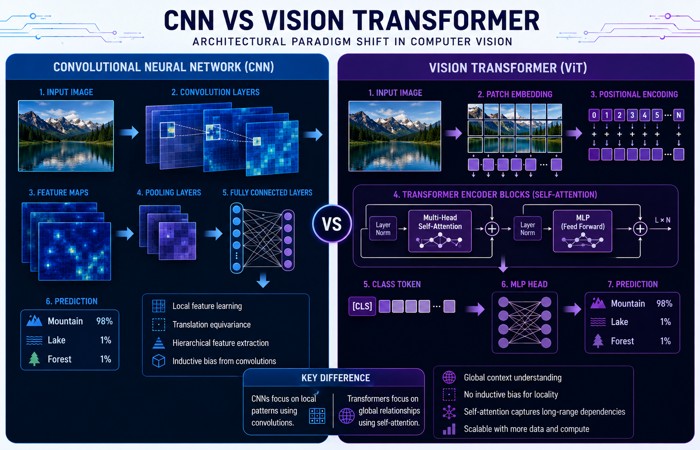
Of all the technical debates in modern computer vision, the choice between Convolutional Neural Networks and Vision Transformers carries the highest stakes for deployment decisions. This is not an academic argument. The architecture you choose determines your compute budget, your data requirements, your inference latency, and ultimately your system’s commercial viability.
How Convolutional Neural Networks Work
CNNs process images through a series of learnable convolutional filters. The screen each filter roams over the image looking for a particular type of local pattern an edge of a certain angle, a color gradient, a type of texture pattern. A hierarchy emerges as you lay on top of one another a number of convolutional layers: A shallow layer recognizes the most basic features drops of shadow, colorful blobs, edges & corners, color gradients. The middle layers recognize pieces of objects wheels, eyes, noses. The deepest layers recognize the most complex semantics the entire visage.
The translational nature of this hierarchy has an important architectural property called translation equivariance: if the object moves in the frame, the feature map will translate similarly, and this is handled by applying the learned filters. This built-in geometric prior makes CNNs extraordinarily sample-efficient — they can learn from relatively small datasets because they do not need to re-learn that a dog in the upper-left corner and a dog in the lower-right corner are both dogs.
The limitation of this design becomes apparent in tasks requiring global context. A CNN in its early layers cannot “see” the relationship between a pedestrian on the left side of the frame and a vehicle approaching from the right. That understanding only emerges in the deepest layers, after the receptive field has grown large enough — by which point spatial resolution has been dramatically reduced.
Where CNNs still win in 2026:
- Edge and mobile deployments where inference speed is critical
- Medical imaging tasks with limited labeled data
- Real-time video processing on low-power NPUs
- Applications where models must be deployed on existing CNN-optimized hardware
How Vision Transformers Work
The Vision Transformers (ViT) proposed by Google in their groundbreaking 2020 paper “An Image is Worth 16×16 Words” apply a completely different principle; instead of working on top of pixels to extract local information via filters, ViTs break up the input image into a grid of non-overlapping patches (usually 16×16 pixels each) which are then fed to the network as a sequence of tokens in the same way words are in a sentence.
These patch tokens pass through a Transformer encoder that applies global self-attention: every patch attends to every other patch simultaneously, computing a weighted representation of the entire image at every layer. This means a ViT understands long-range dependencies from the very first layer — the relationship between a shadow and the object casting it, or the way a background context changes the interpretation of a foreground object.
The cost of this global reasoning is significant. Self-attention scales with quadratic complexity O(N²) relative to the number of patches. A high-resolution image divided into small patches generates a very large sequence, making full self-attention computationally prohibitive without architectural modifications.
February 2025 brought an important development here. Google released SigLIP 2, which addressed several longstanding ViT bottlenecks by implementing dynamic resolution and tiling — allowing the model to handle variable-resolution inputs without the fixed-scale limitations that plagued earlier architectures. SigLIP 2 also introduced a global-local loss combined with masked prediction to capture fine-grained local semantics, partially closing the gap between ViTs and CNNs on texture-sensitive tasks.
Where Vision Transformers excel in 2026:
- Tasks requiring complex scene understanding and long-range context
- Large-scale pretraining scenarios with hundreds of millions of images
- Multi-modal architectures that need to align visual and linguistic representations
- High-accuracy object detection and segmentation when compute is not constrained
Head-to-Head Comparison: The Decision Framework
| Core Mechanism | Local hierarchical filters, translation equivariant | Patch-based tokens with global self-attention |
| Data Requirements | Efficient — performs well on small datasets | High — requires large-scale pretraining to shine |
| Inference Speed | High — optimized for mobile and edge NPUs | Lower — quadratic complexity limits high-res speed |
| Context Understanding | Builds global context gradually through depth | Immediate global scene reasoning from layer one |
| Training Stability | High — stable with standard optimizers | Requires careful learning-rate warmup and regularization |
| Best Use Cases | Edge, real-time, limited data, medical imaging | Cloud inference, complex scenes, multimodal systems |
| Hardware Fit | CNN-optimized NPUs, mobile accelerators | High-VRAM GPUs, data center accelerators |
The honest answer is that neither architecture is universally superior. The right choice depends on three variables: your dataset size, your inference hardware, and whether your task requires global semantic reasoning or localized pattern detection.
The Hybrid Solution: DETR and Deformable DETR
The industry has not waited for one architecture to definitively defeat the other. Instead, practitioners have converged on hybrid models that use CNNs for what they do best — efficient local feature extraction — and Transformers for what they do best — global relational modeling.
DETR (Detection Transformer), introduced by Facebook AI Research, exemplifies this approach. A ResNet backbone extracts a rich feature map from the input image with CNN efficiency. This feature map is then flattened and passed through a Transformer encoder-decoder, where a fixed set of learned object queries attend to global image features. The decoder outputs bounding boxes and class labels simultaneously, eliminating the need for hand-crafted components like anchor boxes and Non-Maximum Suppression.
Deformable DETR improved on this by addressing the quadratic attention bottleneck. Rather than computing attention across the entire feature map, Deformable DETR uses sparse, multi-scale attention that focuses on a small set of key sampling points — typically four per query. This reduces computational complexity dramatically while maintaining the global reasoning capability of the Transformer decoder. The result is a model that is significantly faster than standard DETR, especially on high-resolution inputs, while achieving comparable or better detection accuracy.
Universal Segmentation: Mask2Former, SAM 2, and the Panoptic Paradigm
Segmentation has undergone a quiet revolution. Where earlier systems required separate specialized pipelines for semantic segmentation, instance segmentation, and panoptic segmentation — each with its own architecture, training procedure, and inference logic — 2025-2026 has seen these tasks unified into single, general-purpose frameworks.
Understanding the Panoptic Framework: Stuff vs. Things
The panoptic paradigm is built on a conceptual distinction between two types of visual content:
“Stuff” refers to amorphous, uncountable regions that lack clear boundaries between instances: sky, road, grass, water. You cannot count individual “roads” in a scene — the road is a continuous region.
“Things” refers to distinct, countable object instances: a car, a pedestrian, a chair. Each instance can be individually identified and tracked.
Previous approaches handled these separately. Semantic segmentation handled stuff well but merged all pedestrians into a single class. Instance segmentation handled things well but ignored background regions. Panoptic segmentation unifies both: every pixel in the image receives a semantic class label, and every “thing” pixel additionally receives a unique instance identifier. This gives downstream systems — autonomous vehicles, surgical robots, warehouse automation — a complete, non-ambiguous map of the scene.
Mask2Former: The Universal Segmentation Framework
Mask2Former represents the current standard for unified segmentation. Its central innovation is treating all segmentation tasks as a query-based mask classification problem, regardless of whether the task is semantic, instance, or panoptic.
The architecture has three principal components:
The Pixel Decoder processes the backbone feature maps at multiple resolutions, generating pixel-level features that capture fine spatial detail. This multi-scale design ensures that small objects are not lost during the encoding process.
The Transformer Decoder operates on a set of learned object queries. Each query is responsible for predicting a single segment in the output, and the model learns to associate queries with specific objects or regions through training. The key innovation here is masked attention: rather than allowing each query to attend to the entire feature map (which introduces noise from irrelevant regions), masked attention constrains each query’s attention to the predicted foreground region of its associated mask. This produces sharper boundaries and prevents background clutter from degrading object representations.
The Hungarian Matching Loss during training ensures that each predicted mask is matched to a single ground-truth annotation using optimal assignment, making training stable even with variable numbers of objects per image.
The consequence of this design is that a single Mask2Former model, trained once, can perform semantic, instance, and panoptic segmentation without architectural modification — simply by changing the training objective. This eliminates the need for three separate pipelines, significantly reducing engineering complexity in production deployments.
SAM 2: Promptable Spatiotemporal Segmentation
Meta’s Segment Anything Model 2 (SAM 2), released in mid-2024 and continuing to evolve through 2025, extended the promptable segmentation concept into the temporal domain. Where the original SAM operated on single images, SAM 2 can track and segment any object across an entire video sequence — and do so in real time at 44 frames per second.
The architecture is built around a streaming memory system. As the model processes each video frame, it stores feature representations of previously segmented frames in a memory bank — implemented as a FIFO (first-in, first-out) queue that retains both recent frames and the original prompt frame. A memory attention module retrieves these stored representations when processing new frames, using temporal cues to resolve ambiguities that would be impossible to handle from a single frame — most importantly, occlusion.
When an object disappears behind another object and re-emerges, SAM 2 uses the memory bank to maintain the correct object identity and resume tracking without requiring a new prompt. When no video context is present and the memory bank is empty, SAM 2 reverts to standard single-image segmentation mode, making it a truly unified model for both image and video tasks.
SAM 2 was trained on the SA-V dataset: 35.5 million masks across 50,900 geographically diverse videos — a scale chosen specifically to ensure that the model’s tracking capabilities generalize across diverse environmental conditions, lighting scenarios, and object categories.
| U-Net | Semantic (medical) | Symmetric encoder-decoder with skip connections | None — single frame |
| Panoptic FPN | Semantic + Instance | Dual decoders (Mask R-CNN + Semantic head) | Requires post-hoc frame matching |
| Mask2Former | Universal (Panoptic/Instance/Semantic/Video) | Query-based masked attention | Video panoptic queries for temporal continuity |
| SAM 2 | Promptable Image + Video | Streaming memory bank + memory attention | Real-time spatiotemporal tracking at 44 FPS |
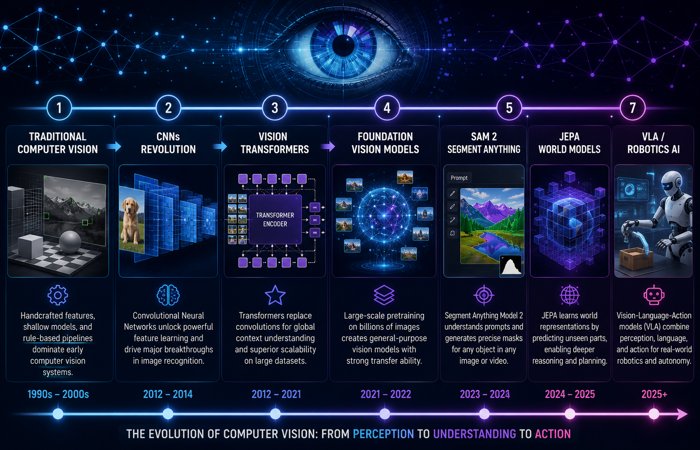
Beyond Static Images: Spatiotemporal World Models and JEPA
Real-time segmentation gives a system the ability to perceive. But perception alone is not enough for intelligent physical action. A robot that can perfectly segment a coffee mug still cannot reliably pick it up if it has no model of how the mug will respond to being grasped — how it will slide, tip, or shift depending on where it is gripped.
This is the gap that world models are designed to fill. Rather than simply labeling what is in a scene, world models predict what will happen next — how the scene will evolve given a particular action or observation. And the leading framework for building such models in 2026 is JEPA.
Why Generative Pixel Reconstruction Falls Short
Before explaining JEPA, it is worth understanding what it is designed to replace.
Generative models — including diffusion-based video generators — are trained to reconstruct images at the pixel level. Given a masked or corrupted input, the model learns to regenerate the missing pixels. This sounds like it should build rich world understanding, but it has a fundamental flaw: most of what happens at the pixel level is irrelevant to planning.
Consider a scene of grass moving in the wind. A generative model must devote enormous compute to reconstructing the precise position of every blade of grass in every frame — information that is essentially random noise from a planning perspective. Whether the grass bends left or right tells the robot nothing about how to navigate the path through it. Generative pixel reconstruction wastes compute on high-frequency details that carry no semantic or physical meaning.
Yann LeCun has argued forcefully that this is a fundamental architectural mistake — that systems trained on pixel prediction will never develop the kind of common-sense physical understanding that biological agents develop through observation and interaction. His alternative is JEPA.
JEPA Explained: Predicting in Latent Space
Joint Embedding Predictive Architecture (JEPA) reframes the learning objective entirely. Instead of predicting pixels, JEPA predicts abstract representations of future states in a learned latent space.
The mechanics work as follows: given an input (an image region, a video segment, or a 3D point cloud), a context encoder produces a latent embedding of the visible context. A predictor network then attempts to predict the latent embedding that a separate target encoder would produce for a masked or future region. The training signal is the distance between the predicted embedding and the target embedding — not pixel-level reconstruction error.
This design has a critical implication. The latent space is learned to capture only the structural and semantic properties of the scene that are relevant to the prediction task. High-frequency noise — the random motion of leaves, the flicker of a light source — does not affect the latent embedding and therefore does not generate training signal. The model learns to ignore it automatically.
The result is a world model that focuses its representational capacity on exactly what matters for planning: the positions, identities, and relationships of objects, and how these change over time.
The JEPA Roadmap: 14 Milestones of an Expanding Framework
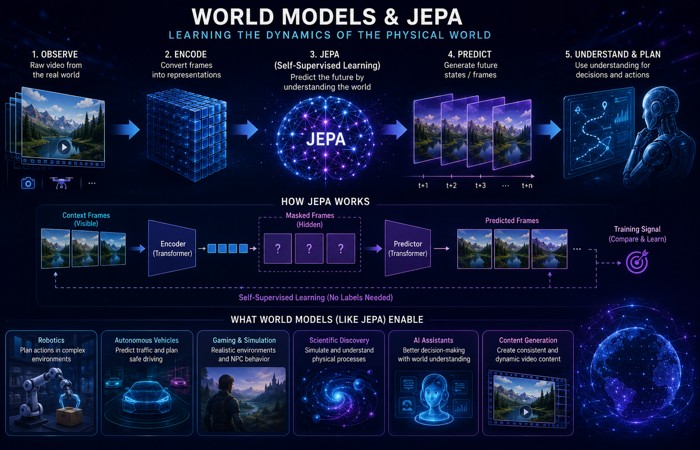
What began as a theoretical proposal has evolved into a rich and rapidly expanding research program. The following 14 milestones document the progression of JEPA from a single image-level model to a general framework for spatiotemporal and embodied intelligence:
I-JEPA — The foundational implementation. Learns semantic image representations by predicting masked patch embeddings from context. Outperforms contrastive methods on linear probe evaluations without using any data augmentation.
MC-JEPA — Jointly captures motion and content from video. Uses a modified ConvNeXt-T stem to process optical flow alongside appearance features within the same JEPA objective.
V-JEPA — Extends latent prediction to spatiotemporal video regions. The model learns to predict future video patches in embedding space rather than pixel space, building temporal world models.
Audio-JEPA — Generalizes the JEPA objective to audio spectrogram representations, enabling self-supervised audio understanding using the same predictive framework.
Point-JEPA — Applies JEPA to 3D point cloud data, learning geometric features that support downstream tasks in 3D object recognition and scene understanding.
3D-JEPA — Advances 3D scene semantics within the latent space, extending the framework to full volumetric scene representations.
ACT-JEPA — Bridges perception and control by incorporating continuous action sequences into the prediction target, enabling the model to predict both future states and the actions that produce them.
V-JEPA 2 — Integrates visual subgoals into the planning framework, enabling zero-shot trajectory planning: the model can predict a sequence of intermediate visual states between a current observation and a goal state.
LeJEPA — Introduces SIGReg (Sketched Isotropic Gaussian Regularization), an objective that prevents representational collapse in the latent space without requiring negative samples or momentum encoders.
Causal-JEPA — Employs object-centric masking to learn causal physical dynamics. By masking individual objects and predicting their future states, the model learns which objects causally influence which others.
V-JEPA 2.1 — Integrates dense predictive losses that improve performance on spatial understanding benchmarks, addressing V-JEPA 2’s relative weakness on tasks requiring fine-grained spatial precision.
LeWorldModel — An end-to-end world model that operates directly from pixel inputs, learning to plan by constructing and querying internal latent representations without requiring explicit symbolic state representations.
ThinkJEPA — Combines world models with a semantic deliberation pathway, enabling extended multi-step reasoning over long planning horizons — analogous to System 2 thinking applied to visual planning.
H-JEPA — Introduces hierarchical, multi-timescale predictions. High-level predictions span longer time horizons with coarser granularity; low-level predictions handle fine-grained short-term dynamics. This mirrors the hierarchical temporal structure of biological planning systems.
Vision as Action: Embodied AI and Vision-Language-Action Foundation Models
The JEPA framework provides the internal world model that enables intelligent planning. But planning only matters if it can be translated into physical action. This translation is the domain of Vision-Language-Action (VLA) models — the systems that 2026 now considers the frontier of applied computer vision.
What Are VLA Models?
A VLA model is a neural architecture that takes visual inputs and natural language instructions simultaneously, and outputs motor control signals — the precise, continuous movements required to physically interact with the world. Rather than separating perception, language understanding, and control into three distinct systems with hand-designed interfaces, VLA models learn all three jointly from data, allowing them to generalize across novel instructions and environments in ways that modular systems cannot.
The challenge this introduces is significant. Language models operate at a rate of a few tokens per second. Physical robotic control requires actuation at 50 Hz or higher to maintain stability. Bridging this frequency gap while preserving the reasoning capabilities of the language backbone is one of the central engineering problems in embodied AI today.
The Frontier Models: A Technical Comparison
RT-2 (Google DeepMind)
RT-2 adapts large vision-language models — specifically PaLM-E and PaLI-X — for robotics through a technique called action-as-token discretization. Rather than treating robot actions as continuous numerical values, RT-2 represents them as strings of text tokens appended to the language model’s existing vocabulary. The model then generates actions the same way it generates language — through next-token prediction.
This approach allows RT-2 to inherit the full reasoning and generalization capabilities learned during web-scale pretraining. In evaluation, RT-2 demonstrates emergent behaviors — the ability to follow instructions it was never explicitly trained on — by leveraging the semantic understanding encoded in the VLM backbone.
OpenVLA (7B Parameters)
OpenVLA is the leading open-source VLA model and an important milestone for democratizing embodied AI research. It fuses two visual encoders: DINOv2 for rich spatial features (understanding object positions and 3D structure) and SigLIP for semantic features (understanding object identities and categories). These are combined with a Llama 2 7B language backbone.
The critical finding from OpenVLA’s evaluations is its parameter efficiency: it outperforms Google’s RT-2-X — a significantly larger closed model — on multi-object manipulation tasks, while being seven times more parameter-efficient. This efficiency enables rapid adaptation through LoRA (Low-Rank Adaptation) on a single consumer-grade GPU, a capability we will explore in depth in the implementation section.
NVIDIA GR00T
NVIDIA’s GR00T system adopts a dual-architecture approach designed to bridge the frequency gap between language-level reasoning and physical control:
- System 2 (Vision-Language Module): Processes visual inputs and language instructions through a Cosmos-Reason2-2B backbone (built on Qwen3-VL). This module handles high-level planning and instruction interpretation.
- System 1 (Action Execution Module): A diffusion transformer head that takes System 2’s output and generates continuous action sequences at high frequency. Rather than discretizing actions into tokens, System 1 denoises continuous action trajectories — a process that produces smoother, more physically realistic movements than token-based approaches.
The onboard processing for GR00T runs on the NVIDIA Thor T5000 module, powered by the Blackwell GPU architecture, which provides 2,070 FP4 AI teraflops — sufficient for real-time inference of both the planning and control modules simultaneously on the robot itself.
Physical Intelligence Pi0
Pi0 addresses the high-frequency control challenge through conditional flow matching. Rather than using the multi-step denoising process of standard diffusion models (which introduces latency), flow matching learns to model direct velocity fields from current state to target state. This produces smooth, continuous trajectories without the iterative refinement overhead, enabling control at up to 50 Hz — the frequency required for stable bimanual manipulation tasks.
| Feature | OpenVLA (7B) | Octo (93M) | NVIDIA GR00T | Physical Intelligence Pi0 |
| Backbone | Llama 2 + DINOv2/SigLIP | Multimodal Transformer | Cosmos-Reason2-2B (Qwen3-VL) | PaliGemma VLM Transformer |
| Action Representation | Discretized 256-bin tokens | Continuous (DDPM diffusion) | Continuous relative EEF | Continuous Flow Matching |
| Control Frequency | Low (~5–10 Hz) | Moderate (~10–30 Hz) | High-frequency continuous | Up to 50 Hz |
| Open Source | Yes | Yes | No | No |
| Fine-tuning on Consumer GPU | Yes (LoRA, RTX 4090) | Partial | No | No |
| Reference Hardware | WidowX manipulators | Lab robotic arms | Thor T5000 / Blackwell GPU | ALOHA, DROID, bimanual rigs |
Democratizing VLA Models: LoRA Fine-Tuning on Consumer Hardware
The 7-billion-parameter scale of models like OpenVLA would seem to require enterprise-grade infrastructure. In practice, Parameter-Efficient Fine-Tuning (PEFT) techniques have made it possible to adapt these models on hardware accessible to individual researchers and small teams.
LoRA (Low-Rank Adaptation) works by freezing all original model weights and inserting small, trainable rank-decomposition matrices into each Transformer layer’s attention projections. Because the rank of these matrices is much smaller than the full weight matrices, the number of trainable parameters drops dramatically. When fine-tuning OpenVLA with LoRA, only approximately 1.4% of the total 7 billion parameters are updated — yet the resulting model achieves task-specific performance comparable to full fine-tuning on the target distribution.
4-bit quantization complements LoRA by reducing the memory footprint of the frozen base model. Loading a 7B-parameter model in full 32-bit floating point requires approximately 28 GB of GPU memory. With 4-bit quantization (using libraries like BitsAndBytes), this drops to roughly 4–5 GB with negligible performance degradation on most manipulation tasks, making inference feasible on a single RTX 4090 with 24 GB of VRAM.
The practical implication: a robotics research team or startup with access to a single workstation GPU can now fine-tune a frontier-class VLA model on their specific robot morphology and task distribution within hours, then serve it at inference without cloud infrastructure.
Agentic Vision: Computer Use and Desktop Navigation
A parallel development to physical robotics has emerged in the domain of agentic computer vision — systems that use visual perception to navigate and interact with digital environments rather than physical ones.
Models like Claude Opus 4.5 and GLM-4.6V implement what is being called “computer use” — the ability to take screenshots as raw visual inputs, interpret the state of a desktop environment or web interface, and output precise mouse and keyboard actions to complete multi-step tasks. Rather than converting the screen to text via accessibility APIs (which loses visual layout information), these models treat the screenshot as a direct function argument and operate on the visual representation natively.
This positions computer vision as the core sensing modality for software agents: systems that can use any digital tool a human can use, simply by seeing the screen. The implications for automation — in testing, data entry, research, and administrative workflows — are significant and already entering production deployments in 2026.
The Computer Vision Implementation Ecosystem in 2026
Understanding architectures is necessary but not sufficient. Building real systems requires selecting the right tools, understanding their tradeoffs, and knowing which combination suits your deployment environment.
OpenCV: The Foundation of Real-Time Processing
OpenCV (Open Source Computer Vision Library) remains the most widely deployed computer vision library in production systems, despite being over two decades old. Its longevity is a function of its reliability, its deep integration with hardware acceleration APIs, and the sheer breadth of its feature set.
In 2026, OpenCV is primarily used for preprocessing pipelines — camera calibration, image normalization, color space conversion, morphological operations — and for tasks where millisecond-level latency is required and deep learning inference is not. Its C++ core with Python bindings makes it suitable for both embedded systems and server-side preprocessing in hybrid pipelines where OpenCV handles raw frame ingestion and a deep learning model handles inference.
OpenVINO: Optimized Inference on Intel Hardware
Intel’s OpenVINO (Open Visual Inference and Neural Network Optimization) toolkit is the standard deployment path for vision models targeting Intel CPUs, integrated GPUs, and Vision Processing Units (VPUs) — including the Intel Movidius Myriad X found in edge AI accelerators.
OpenVINO converts trained models from PyTorch, TensorFlow, or ONNX format into an optimized Intermediate Representation that takes advantage of Intel-specific instruction sets (AVX-512, AMX) and dedicated inference engines. For deployment scenarios where NVIDIA GPUs are not available — industrial edge devices, embedded systems, PC-based vision applications — OpenVINO can deliver three to five times the throughput of unoptimized inference on the same hardware.
PyTorch, Hugging Face, and the Research-to-Production Pipeline
PyTorch remains the dominant framework for computer vision research and model training. Its dynamic computational graph, extensive ecosystem of vision-specific libraries (torchvision, PyTorch Lightning, TIMM), and native support for distributed training make it the default choice for developing new models.
Hugging Face Transformers has become the standard interface for deploying pre-trained vision models. The library hosts weights for ViT, Mask2Former, SAM 2, OpenVLA, and hundreds of other models under a consistent API, with built-in support for 4-bit quantization, LoRA, and model conversion to ONNX. For teams moving from research prototype to production deployment, Hugging Face significantly reduces the engineering overhead of serving large vision models.
Simple Computer Vision Example Using Python and OpenCV
import cv2
image = cv2.imread(“image.jpg”)
gray = cv2.cvtColor(
image,
cv2.COLOR_BGR2GRAY
)
cv2.imshow(
“Computer Vision Output”,
gray
)
cv2.waitKey(0)
cv2.destroyAllWindows()
Cloud vs. Edge: The Deployment Decision Framework
| Factor | Cloud Deployment | Edge Deployment |
| Latency | Higher — network round-trip adds 50–200ms | Lower — inference happens locally |
| Privacy | Data leaves device — compliance risk | Data stays on device — GDPR/HIPAA friendly |
| Cost at Scale | High — inference API costs accumulate | High upfront — hardware investment |
| Model Size | Unconstrained — full-precision large models | Constrained — quantization and pruning required |
| Best For | Batch processing, complex reasoning tasks | Real-time robotics, medical devices, retail kiosks |
The trend in 2026 is toward hybrid architectures: a lightweight edge model handles time-sensitive inference locally, while a larger cloud model handles complex reasoning, model updates, and edge cases that fall outside the local model’s confidence threshold.
Advantages and Limitations of Computer Vision
Advantages
- Automates visual inspection: Computer vision can analyze images and videos automatically, reducing the need for manual checking and saving time in tasks like quality control and surveillance.
- Works continuously: It can operate 24/7 without fatigue, making it useful for factories, security systems, traffic monitoring, and other real-time applications.
- Detects patterns humans miss: Computer vision can identify subtle patterns, defects, or changes that may be difficult for people to notice, especially in large amounts of visual data.
- Improves decision making: By converting visual information into useful insights, it helps businesses and systems make faster and more accurate decisions.
- Increases efficiency: It speeds up processes such as inspection, monitoring, and analysis, which improves productivity across many industries.
Limitations
- Requires quality data: Computer vision systems depend on large, clear, and properly labeled datasets. Poor data can lead to inaccurate results.
- Can fail in unfamiliar environments: Changes in lighting, angle, background, or object appearance can reduce performance if the system was not trained for those conditions.
- Bias risk: If the training data is unbalanced, the model may perform better in some situations than others, leading to unfair or incorrect outcomes.
- High computational requirements: Advanced computer vision tasks often need powerful hardware, large storage, and strong processing capability.
- Not always perfectly reliable: In complex real-world settings, the system may still make mistakes, so human supervision is sometimes necessary.
Trustworthy Computer Vision: Bias, Privacy, and Governance
The most technically sophisticated computer vision system can cause serious harm if deployed without adequate attention to fairness, privacy, and safety. In 2026, these are not compliance checkboxes — they are engineering requirements that determine whether a system can legally operate in most major markets.
The Accuracy Gap: Demographic Disparities in Facial Recognition
The Gender Shades project and subsequent audits have documented a persistent and troubling disparity in facial recognition system performance across demographic groups. Error rates for dark-skinned women have reached as high as 34.7% in commercial systems, compared to 0.8% for light-skinned men — a 100x false match differential that has resulted in documented wrongful outcomes including false arrests and incorrect benefit denials.
This disparity is not a function of any single technical failure. It results from compounding factors: training datasets that overrepresent lighter-skinned faces, evaluation benchmarks that do not stratify performance by demographic subgroup, and deployment decisions made without demographic testing on representative populations. All three must be addressed simultaneously to close the gap.
Privacy Vulnerabilities: Parameter Reverse-Engineering
A less widely discussed but technically serious vulnerability affects any computer vision model trained on private data. Research has demonstrated that deep networks are susceptible to model inversion attacks: given access to a trained model’s weights, an attacker can reconstruct images that approximate the training data — including faces, medical scans, or proprietary documents that were never intended to be accessible.
The risk is proportional to the model’s capacity and the sensitivity of the training data. High-capacity models like large ViTs memorize more training examples and are therefore more vulnerable to inversion. Mitigations include differential privacy during training (adding calibrated noise to gradients to prevent memorization), federated learning (training on data that never leaves the device), and synthetic data substitution (replacing sensitive real datasets with high-fidelity synthetic equivalents).
The VERA-V Attack: Vision-Language Model Jailbreaking
A specific threat to vision-language models is documented in the VERA-V framework. VERA-V uses variational inference to identify subtle visual perturbations — imperceptible to humans — that, when introduced into the visual encoder’s input, cause the model to bypass its safety alignments and produce outputs that would otherwise be blocked.
This is an adversarial attack that operates at the perceptual layer, before the language model’s safety filters can engage. It represents a fundamental vulnerability in current VLM safety architectures and is an active area of research in 2026.
Mitigation Strategies and the EU AI Act
| Vulnerability | Mitigation Strategy | Implementation |
| Demographic bias | Stratified evaluation + diverse training data | Audit before deployment across all demographic groups |
| Privacy / model inversion | Differential privacy + synthetic data | Apply during training; validate with inversion attacks |
| VERA-V jailbreaking | Visual adversarial training | Include adversarial examples in fine-tuning data |
| Domain shift degradation | Tempora dynamic entropy scheduling | Apply during test-time adaptation |
| Raw data privacy (edge) | On-device processing | Deploy on Jetson AGX Thor T5000 accelerators |
The EU AI Act, which classifies real-time biometric systems and high-risk AI applications as requiring mandatory conformity assessments, makes these mitigations legally binding for any organization deploying computer vision systems in the European market. Privacy-by-design is not a best practice in 2026 — it is a compliance requirement.
Research Priority Distribution
Understanding where the field is directing its attention helps practitioners prioritize:
| Ethical Priority | Primary Concern | Current Research Attention |
| Robustness | Out-of-distribution collapse, domain shifts | 31.2% |
| Fairness | Demographic accuracy disparities | 31.0% |
| Safety | System failures, adversarial attacks (VERA-V) | 13.2% |
| Transparency | Black-box architectures, explainability | 8.9% |
| Privacy | Parameter inversion, scraped training data | 5.76% |
Computer Vision in the Real World: Industry Applications
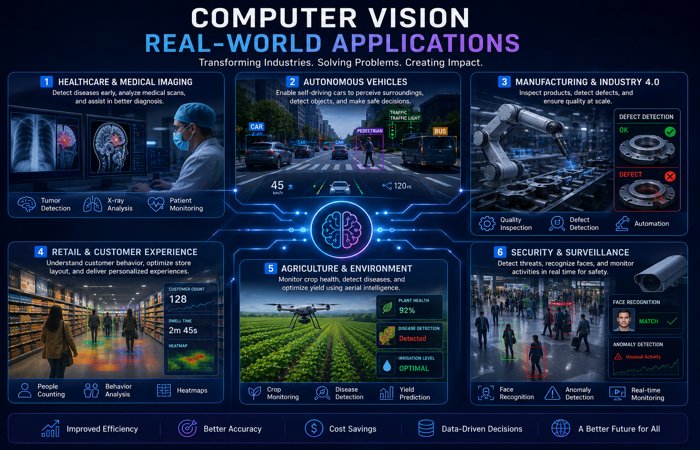
The architectural advances described throughout this guide do not exist in isolation. They are being deployed today, solving real problems across multiple industries. Three sectors where computer vision is delivering measurable impact deserve specific attention — because they illustrate the range of technical requirements these systems must meet.
Computer Vision in Retail
With the advent of the digital camera, the modern retail shop has become perhaps the most prolific application area for computer vision. Today we are seeing in shop systems that perform ‘instantaneous’ inventory management (through shelf-monitoring cameras), cashless purchasing (by use of overhead cameras and re-identification), as well as theft detection (by anomaly detection using behavior not stored personal images).
The trend toward edge-deployed, privacy-preserving solutions is most strong in the retail segment, owing to the adoption of privacy laws on consumers in several countries. Computer vision applications in retail stand as one of the most mature and commercially active segment providing ROI that has quickly sped up enterprise adoption.
Computer Vision in Healthcare
Medicine has arguably become one of the highest-stakes application for visual AI very rapidly. Radiology AI systems are already improving detection of lung nodules, diabetic retinopathy and skin lesions with sensitivities at or above that of expert radiologists in laboratory settings. Surgical robotics systems can currently assist providing augmented guidance in minimally-invasive surgeries through real-time tissue segmentation as well as tracking of surgical tools.
The technical requirements here are different from other areas: models need to run on high-resolution 2D and 3D medical images (DICOM, whole-slide pathology images), excel at reducing the falsely negative rate to a minimum, and generate reliable confidence scores for clinicians to rely on. Computer vision in healthcare will be covered in depth in our dedicated guide — a detailed exploration of the specific architectures, regulatory requirements, and clinical validation processes required for medical-grade deployment.
Automatic Image and Video Captioning
One of the most practically impactful applications of multimodal vision models is automatic image and video caption generation. Modern captioning systems use vision-language architectures to generate natural language descriptions of visual content at scale — enabling accessibility for visually impaired users, automated metadata generation for media archives, and multimodal search indexing.
The technical progression here has been remarkable. Early captioning systems produced rigid, template-like descriptions. Current systems like GPT-4o and Gemini 1.5 Pro generate nuanced, contextually aware captions that describe not just what is in an image but the relationships, emotions, and implied narrative — capabilities that rest directly on the vision encoder advances described throughout this guide.
Autonomous Vehicles
Computer vision is another major component in autonomous vehicles as it provides the car with a core understanding of the conditions of the road as they are happening. The car‘s systems use the computer vision capabilities to spot signs, spot pedestrians and also to see where the lanes of the road are so it can dynamically adapt as traffic conditions change.
Examples:
- Lane detection.
- Pedestrian recognition.
- Traffic sign detection.
Manufacturing
Computer vision has many applications in manufacturing it is used for quality control, reducing operator error, and to increase efficiency in production. It is used to find faults, monitor the assembly process and help enable predictive maintenance, that is the detection of early stages of problems in equipment to enable the new equipment to be service before damage.
Examples:
- Defect detection.
- Predictive maintenance.
- Quality inspection.
Security
Today, Computer vision is an essential part of many security systems that are used to observe surroundings automatically and recognize strange behavior. It can scan live video stream, watch for abnormalities, follow movement and be used for surveillance analysis in public places, workplace or restricted zones, making reactions faster and increasing overall safety.
Examples:
- Anomaly detection.
- Surveillance analytics.
Agriculture
In agriculture, computer vision has been used in helping farmers to monitor their plantation more accurately and manage in large scale. It can automatically identify the disease and monitor the images of plants from drones, camera or even satellite. This enables farmers to respond faster and increase outcomes.
Examples:
- Crop monitoring.
- Disease detection.
Sports
Computer vision and sports is the use of computer vision in sports to track players and their movements. Use cases include tracking during a game, calculating speed and location. As well as player performance stats for coaches and analysts.
Examples:
- Player tracking.
- Performance analytics.
Augmented Reality
ARI leverages computer vision along with simultaneous localization and mapping to reinterpret the physical environment in virtual space and determined how the app-related content is best positioned in those real-world settings. The AR system allows for object mapping and space tracking which allows the AR content to remain fixed relative to real-world objects and over time.
Examples:
- Object mapping.
- Spatial tracking.
Computer vision is applied in a variety of different industries to enhance and streamline visual data understanding and storage. It can be used in areas as diverse as automated cars, production lines, security, farming, sport and augmented realities.
Future of Computer Vision: What Comes Next
The trajectory is clear. Computer vision in 2026 is converging toward three simultaneous developments that will define the field through the rest of the decade.
The Unification of Perception and Action — The boundary between visual AI and robotic AI is dissolving. VLA models are making it increasingly unnatural to think of “computer vision” and “robot control” as separate disciplines. The next generation of systems will be trained end-to-end from visual inputs to physical outputs, with world models providing the internal simulation layer that makes this possible without requiring exhaustive real-world training data.
Efficiency at Every Level — The field is moving toward smaller, faster, more parameter-efficient models that retain the reasoning capabilities of large-scale systems. Techniques like LoRA, quantization, distillation, and sparse attention are not just research curiosities — they are the engineering tools that make advanced computer vision deployable on real hardware in real environments. The RTX 4090 fine-tuning of OpenVLA is a preview of what becomes standard practice.
First-Class Need for Privacy and Safety Regulatory pressure from the EU AI Act and the similar legislation being proposed in other geographies is ensuring that bias auditing, differential privacy, and adversarial robustness are no longer optional “nice to haves”, but rather mandatory engineering requirements. Having these baked into your development flow from the outset will set you apart from far outstripping any advantages gained by patching them in at deploy time..
The systems being built today — the JEPA world models, the VLA pipelines, the universal segmentation frameworks — are early-stage implementations of a much larger vision: artificial agents that perceive the physical world with the completeness, continuity, and causal understanding that biological vision achieves naturally. Being a practitioner, you can tell that this gap between current systems and that goal is closing faster than most of us would have expected two years ago.
Related Computer Vision & AI Guides
Want to explore Computer Vision beyond the basics? These related guides cover core Computer Vision technologies, real-world applications, AI models, robotics, infrastructure, and the wider AI ecosystem.
Core Computer Vision
- Image Recognition — Learn how AI systems identify and classify objects, people, scenes, and visual patterns.
- Object Detection — Understand how Computer Vision models locate and identify objects within images and video.
- Facial Recognition — Explore how AI systems detect, verify, and identify faces.
- OCR & Document AI — Learn how Computer Vision extracts text and structured information from documents, images, and scanned files.
- Automatic Image and Video Caption Generation — Discover how AI systems turn images and video into natural-language descriptions.
- Image Annotation & Labeling — Learn how images are labeled and prepared for training Computer Vision models.
Computer Vision Applications
- Retail Computer Vision — Explore how Computer Vision is transforming retail through inventory monitoring, customer analytics, loss prevention, and automated operations.
- Benefits of Computer Vision in Retail — Discover the major business benefits and practical applications of Computer Vision in retail.
- Computer Vision in Healthcare — Learn how visual AI is being applied to medical imaging, patient monitoring, diagnostics, and healthcare workflows.
- Medical Imaging AI — Explore how AI analyzes medical images to support modern radiology and clinical workflows.
- AI Diagnostics in Healthcare — Understand how artificial intelligence is being used to support diagnostic processes.
- Autonomous Vehicles Vision — Learn how Computer Vision helps autonomous vehicles understand roads, vehicles, pedestrians, and traffic environments.
- Manufacturing Vision AI — Discover how visual AI supports automated inspection, defect detection, quality control, and manufacturing operations.
- Video Analytics — Explore how AI analyzes video for object tracking, activity recognition, monitoring, and anomaly detection.
AI, Machine Learning & Deep Learning
- Machine Learning Guide — Understand the machine-learning concepts that provide the foundation for many modern Computer Vision systems.
- Neural Networks — Learn how neural networks recognize patterns and power modern deep-learning applications.
- Natural Language Processing Guide — Explore the language-processing technologies that increasingly work alongside Computer Vision in multimodal AI.
- Generative AI Guide — Understand the broader generative AI ecosystem and its growing relationship with visual AI.
Generative & Multimodal AI
- Text-to-Image AI — Learn how generative AI models create images from natural-language prompts.
- DALL·E — Explore modern AI image generation and how text prompts can be transformed into visual content.
- Midjourney — Discover how Midjourney generates and transforms AI-created images.
- Stable Diffusion — Understand diffusion-based image generation and the role of Stable Diffusion in modern visual AI.
Robotics, Agents & Physical AI
- AI Agents and Automation — Learn how AI agents combine perception, reasoning, tools, and automation to perform complex tasks.
- AI-Powered Robotics and IoT Systems — Explore how Computer Vision provides the perception layer for robots, autonomous machines, and connected devices.
- The Last Mile of Generative AI — Discover how AI capabilities move from models and prototypes into real-world systems and workflows.
AI Infrastructure & Deployment
- AI Infrastructure, Data Pipelines and Vector Databases — Understand the compute, storage, networking, data pipelines, and infrastructure required to run modern AI systems.
- What Is Vector Search? — Learn how vector search and embeddings support semantic retrieval, RAG, and multimodal AI applications.
- Edge Computing — Explore how AI inference can run closer to cameras, sensors, robots, and other connected devices.
AI Applications & Business Use Cases
- AI Applications and Real-World Use Cases — Explore how AI is being deployed across healthcare, finance, retail, manufacturing, cybersecurity, CRM, and other industries.
- AI in Healthcare — Explore the broader AI healthcare ecosystem beyond Computer Vision.
- AI in CRM — Learn how AI is being used for customer intelligence, sales, automation, and customer experience.
- AI-Driven Cybersecurity — Discover how AI is being applied to threat detection, security analytics, and security operations.
FAQs About Computer Vision
Q1: In what way are Vision Transformers (ViTs) different than CNNs for object detection tasks Q1 ks?
A: CNNs utilize local receptive fields and hierarchically arranged filters to extract spatial features, thus one can make sense efficiently with relatively small data set and are suitable for edge hardware. Vision Transformer (VIT) tokenize the image into a sequence of patch tokens and then adopt the global self-attention scheme from the first layer, resulting in much more effective long-range dependency modeling but significantly more training data and compute. For object detection specifically, hybrid models like Deformable DETR — which use CNN backbones for feature extraction and Transformer decoders for global reasoning — currently offer the best tradeoff between accuracy and efficiency.
Q2: What is the role of action discretization in models like OpenVLA and RT-2?
A: Action discretization maps continuous robot control signals — such as 6-DOF end-effector positions — into discrete tokens added to a language model’s vocabulary. This allows VLA models to treat physical actions like text generation: the model predicts the next action token the same way it predicts the next word. The benefit is that the model takes advantage of the reasoning and generalization ability of the language backbone. The drawback is that the discretization brings quantization error and constrains the control frequency, and that is why for high-frequency manipulation the continuous action representation (diffusion heads, flow matching) become more and more attractive.
Q3: What makes the SAM 2 more a one framework for image and video segmentation?
A: SAM 2 uses a streaming memory bank that stores feature representations of previously processed frames. When processing video, this memory bank enables temporal tracking — maintaining object identity through occlusions and appearance changes. When no video context is available and the memory bank is empty, SAM 2 operates identically to a standard image segmentation model. This unified architecture eliminates the need for separate image and video segmentation pipelines.
Q4: How does JEPA solve the high-frequency noise problem in generative vision models?
A: Generative models trained on pixel reconstruction must model every detail in every frame, including irrelevant high-frequency variation like moving grass or flickering lights. Unlike JEPA which trains a predictor to recover latent embeddings abstract representations that contain only the structure and semantic content of a scene BEBE‘s use of latent embeddings means high-frequency noise is no longer systematic, and so the model can ignore it, using its capacity for a physically meaningful representation of the scene‘s structure.
Q5: Is it possible to fine-tune extensive VLA models using standard consumer hardware?
A: Yes, with the right techniques. By utilizing LoRA (Low-Rank Adaptation) the Open VLA 7 billion parameters only need around 1.4% to be modified in the fine-tuning process, this slashes the memory requirements. When paired with 4-bit quantization via the open source BitsAndBytes libraries, the whole model is able to be loaded and trained on a single RTX 4090 GPU with 24 GB of VRAM. This makes frontier class VLA fine-tuning available to individual researchers and small teams without cloud infrastructure.
Q6: What makes video panoptic segmentation more challenging than standard image segmentation?
A: Video panoptic segmentation requires maintaining pixel-accurate temporal consistency across entire sequences. Models must label background regions (stuff) consistently despite camera motion and lighting changes, while simultaneously tracking individual foreground objects (things) through movement, partial occlusion, and appearance variation — without switching instance identifiers when objects re-enter the frame. This is one of the most difficult task in computer vision due to the computational cost of this consistency between numerous frames together with the real time constraint in many applications.
Conclusion
Computer vision in 2026 is a discipline in rapid, fundamental transformation. The core points to carry forward from this guide:
- The CNN vs. ViT choice is now a strategic deployment decision, not an academic preference. Match the architecture to your data constraints and hardware environment.
- Universal segmentation frameworks like Mask2Former have replaced fragmented multi-pipeline architectures. One model, one training procedure, three segmentation tasks.
- SAM 2 has made promptable real-time video tracking practical, with a unified architecture that handles both static images and video sequences.
- JEPA represents the foundational shift from perception to world modeling — from describing what is in a scene to predicting what will happen next.
- VLA models are closing the gap between visual AI and physical robotics, with consumer-accessible fine-tuning making frontier-class systems available to teams without enterprise infrastructure.
- Ethics, bias, and privacy are not optional. The demographic accuracy gap, model inversion vulnerabilities, and regulatory requirements under the EU AI Act make trustworthy AI a technical prerequisite for deployment.
The field is moving from machines that see, to machines that understand, predict, and act. The systems, architectures, and frameworks described in this guide are the building blocks of that transition — available today, evolving rapidly, and already reshaping every industry they touch.
Explore the full Computer Vision cluster on computertechreviews.com, including our dedicated guides on computer vision applications in retail, automatic image and video caption generation, and the forthcoming deep-dive on computer vision in healthcare.