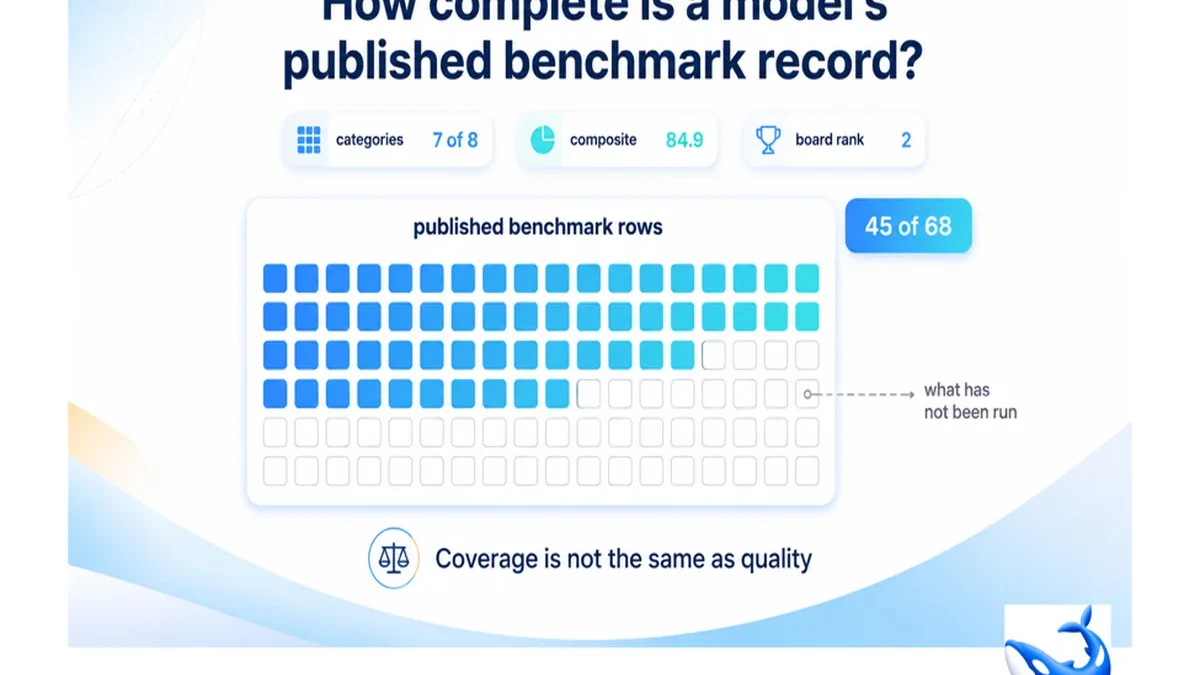

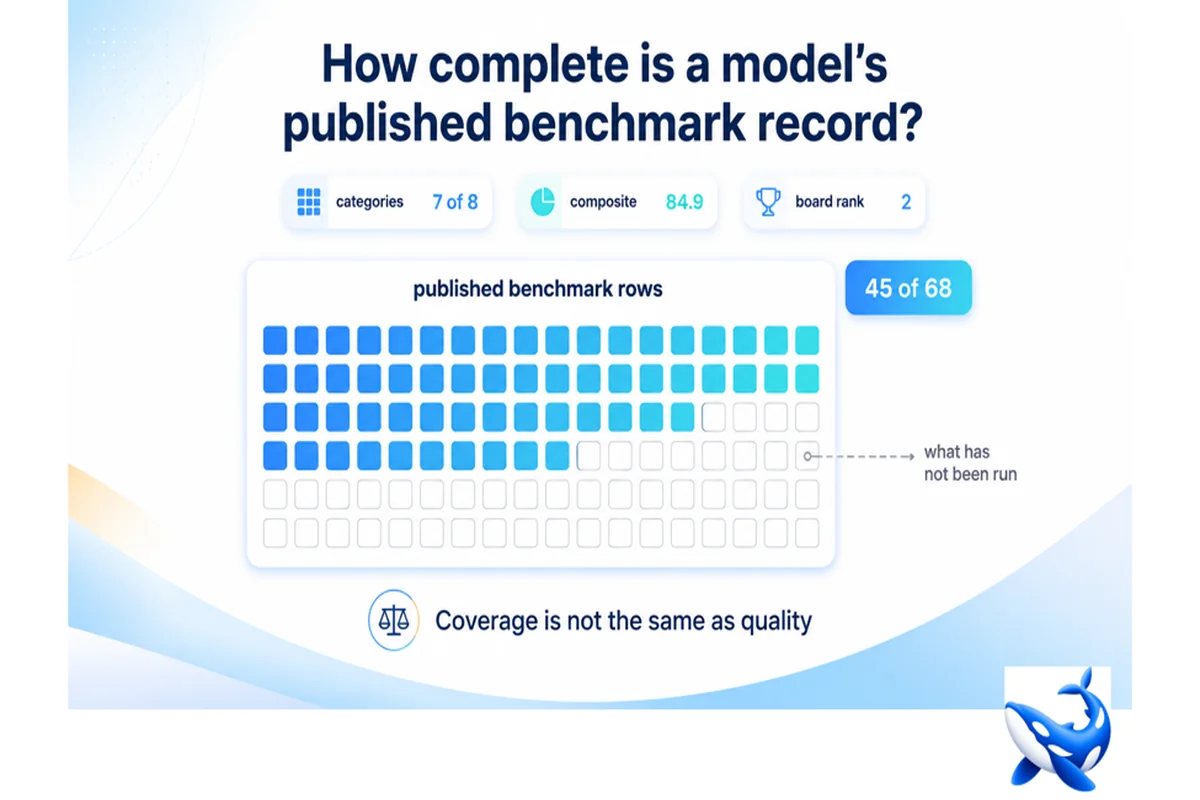
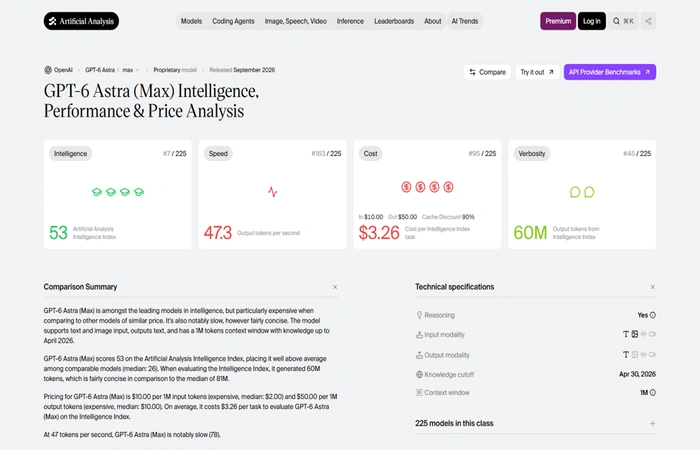
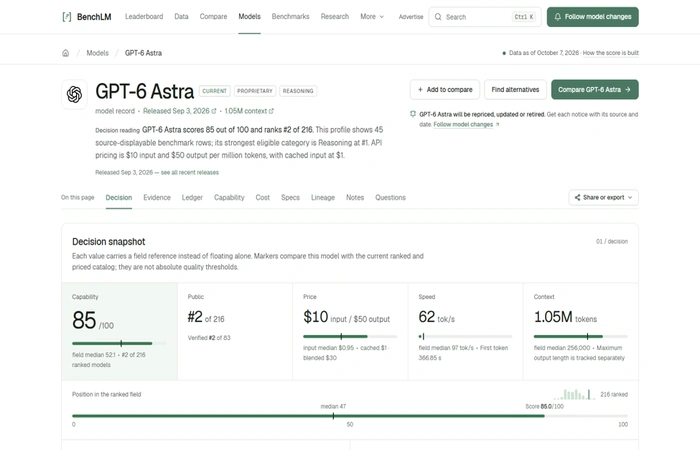
The GPT-6 Astra benchmarks record is the thickest of the four models in this comparison, and the most useful thing about it is its shape rather than its scores. On the independent coverage board read 2026-10-07, GPT-6 Astra publishes 45 of 68 benchmark rows across 7 of 8 categories, with a composite score of 84.9 and a board rank of 2. On the independent evaluation harness, read the same day and measured with the model running at its Max reasoning setting, it scores 52.67 on the Intelligence Index and 96.06% on GPQA — the only GPQA row any of the four subjects carries.
Coverage and quality are different claims, and nearly every benchmark argument on the internet confuses them. Astra’s record is strong on both, but the two are strong for different reasons and they fail in different ways.
Table of Contents
What “45 of 68” is actually counting
The number is a count of *published rows* on a coverage board, not a count of tests passed and not a percentage. The board tracks a fixed catalogue of benchmarks; a model’s coverage is how many of them somebody has run and published a figure for. Astra sits at roughly two thirds of the catalogue.
That framing matters because it is easy to read “45 of 68” as a score of 66%, which is the wrong number entirely. The composite score is a separate figure — 84.9 — computed over the rows that exist. The two numbers answer different questions: one is *how much is known*, the other is *how well it did on what is known*.
Understanding these benchmark results also requires a broader understanding of how machine learning systems learn patterns, process data, and generate predictions. Our complete guide to machine learning provides an introduction to the concepts behind these systems, while our guide to neural networks explains one of the core architectures used in modern AI models.
Put the four subjects side by side and the difference is stark:
| (benchlm.ai, read 2026-10-07) | rows published | categories | composite | rank |
| GPT-6 Astra | 45 of 68 | 7 of 8 | 84.9 | 2 |
| Claude Opus 5.5 | 53 of 73 | 8 of 8 | 86.39 | 1 |
| GPT-6.1 Sol | 14 of 31 | 4 of 8 | 81.46 | 6 |
| Grok 4.7 | 8 of 26 | 3 of 8 | — | not ranked |
Read the table by column, not by row. On coverage Astra is second. On score it is second. But the *margin* differs: the model above it holds eight more rows and a full category sweep, while the two below it are working from records a third and a sixth the size. Astra is not simply “the model in the middle” — it is the model whose record is complete enough that a comparison against it is meaningful for both neighbours, which is not true in either direction.
The scores, with the setting attached
Here is the harness detail, and the detail is not optional.
Artificial Analysis measures reasoning models at a specific effort setting, and the setting changes the number. For Astra that setting is Max, the top rung of the ladder, read 2026-10-07:
| metric (Artificial Analysis, 2026-10-07, Max) | GPT-6 Astra |
| Intelligence Index | 52.67 |
| GPQA | 96.06% |
| Terminal-Bench 4.0 | 59.1% |
| SciCode | 56.5% |
| MMMU-Pro | 86.88% |
| HLE | 54.7% |
| LCR | 80.7% |
| omniscience | 43.40 |
| GDPval | 1541.89 |
Two of those rows are worth more than the rest.
The first is GPQA at 96.06%. It is the only GPQA figure on the board for any of the four models here — Sol, Grok 4.7 and Claude Opus 5.5 carry no row there at all. If your work involves graduate-level science questions, Astra is the only model in this set with a published number at all, which is a statement about evidence rather than about ability.
The second is Terminal-Bench 4.0 at 59.1%, because it is the row that most directly supports the vendor’s own description of the model. OpenAI calls Astra its flagship “for complex reasoning and coding”. A shell-shaped agent benchmark is the closest public proxy to that claim, and 59.1% is the figure the other three should be judged against. It also sits next to a 56.1% for the mid-tier model in the same family — a three-point gap that is smaller than the gap in price.
These coding and reasoning evaluations are part of a wider ecosystem of AI applications. For example, developing a custom NLP pipeline involves processing and interpreting language data, while computer vision in retail businesses demonstrates how AI models can be evaluated for visual recognition tasks. In other specialized fields, artificial intelligence in finance and AI in healthcare show why task-specific performance matters beyond a single benchmark score.
Where the record is thin
A model with 45 rows is not a model with no gaps. Astra’s coverage is uneven across categories, and the shape of the unevenness is more actionable than the headline count.
The board reports coverage by category, and Astra reaches 7 of 8 of them. That single missing category is the one to look for before trusting an aggregate: an unrepresented category is a class of work where nobody has published a number, so a claim that the model is “strong across the board” is doing more work than the data supports in exactly one place.
There is a second kind of gap, and it is subtler. Two models can have similar row counts while covering different categories, and a category with one row is not the same as a category with six. The composite score folds all of it into a single number, which is why the composite is the least informative figure on the page and the one most often quoted.
The practical rule: check that your category is covered before you check the score. If your workload is agentic shell work, you want the Terminal-Bench row. If it is diagram or screenshot reading, you want MMMU-Pro. If it is long-context retrieval, you want LCR. A high composite built from somebody else’s categories tells you nothing about yours.
Benchmark coverage also depends on the data and infrastructure supporting an AI workload. Our guide to the role of big data in AI-driven decision-making explores the importance of data in intelligent systems. For organizations building broader automated workflows, hyperautomation and the benefits of AI and cloud technology provide additional context on deploying AI across business operations.
Reading a benchmark table without being fooled
Four habits, in the order they will save you from a bad decision.
Find the effort setting first. Every number in the harness table above is a Max-setting number. That is the expensive configuration, and the one that flatters a reasoning model on hard tasks. A model measured at a lower rung will look worse at reasoning-heavy work for reasons that have nothing to do with the model — Grok 4.7, in this same comparison set, is measured at Xhigh rather than Max. Any table that stacks these models without naming the settings is comparing configurations, not models.
Separate the record’s size from its contents. Astra’s 45 rows and Claude Opus 5.5’s 53 rows are close enough that the coverage gap is not decisive on its own — eight rows out of a catalogue in the seventies. Where two records are close in size, the gap between ranks 1 and 2 on a composite is frequently smaller than the spread between two runs of the same model on the same harness, and neither source publishes a run-to-run variance figure, so the ordering between them should be read as a tie with a rounding error rather than a result.
Treat every third-party score as dated. These readings are from 2026-10-07. Evaluation harnesses are re-run, and re-scored, and figures move without any announcement — which is a subject for a later article in this series, and the reason every number here carries its read date rather than just its source.
Distrust a score with no row count next to it. A composite of 84.9 means something different at 45 rows than it would at 8. Whenever you see a model ranked on a benchmark site, ask how many rows the ranking was computed from; the answer is frequently not on the page you are reading.
Model evaluation is only one part of putting AI into production. Businesses must also consider how models connect with customer-facing applications and how generative systems behave in real-world environments. Explore AI in CRM, the last mile of generative AI, and the future of AI-driven cybersecurity to learn more about these deployment challenges.
The takeaway
GPT-6 Astra carries the second-largest benchmark record of the four models here — 45 of 68 rows across 7 of 8 categories, a composite of 84.9 and a rank of 2 — and the second-highest score, both read 2026-10-07. On the independent harness at its Max setting it scores 52.67 on the Intelligence Index, with the only GPQA row in the set at 96.06% and a Terminal-Bench 4.0 figure of 59.1% that is the fairest public test of the vendor’s “complex reasoning and coding” description.
The honest reading is that Astra’s record is good enough to make a decision from and too thin to make it from a composite alone. Check the category, check the effort setting, check the row count, and check the date — in that order. Four habits are the difference between quoting a number and understanding it.
OrcaRouter carries GPT-6 Astra at list rate with no markup, so the harness numbers above can be reproduced against your own traffic on the same key rather than argued about from a leaderboard.