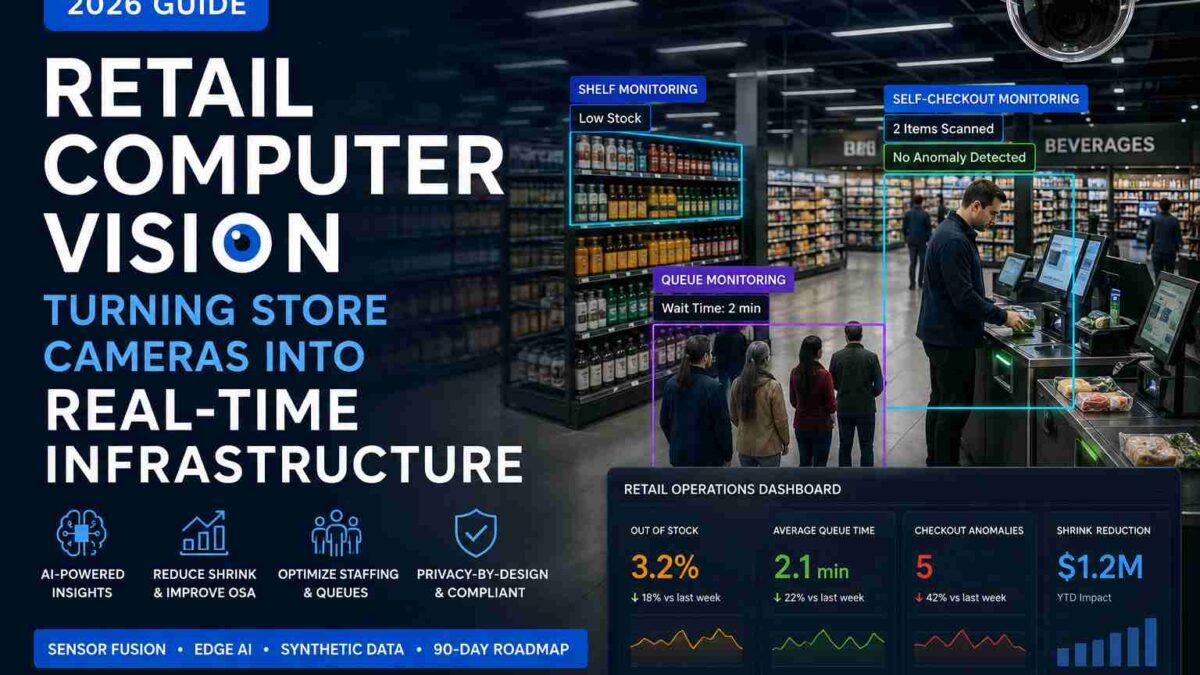

This Article is a part of
Computer Vision Resource Center
Walk into just about any mid-size grocery store or big box place these days, and you‘ll be on camera in about four seconds. That part hasn’t changed in twenty years. What has changed is what happens to the footage after it’s recorded.
For most of retail history, a camera was a recording device. Something reviewed after a theft, a slip-and-fall, or a customer complaint — footage that existed to answer “what happened” hours or days after the fact. That model is dying, and not because retailers suddenly care more about security. It’s dying because the same camera hardware, paired with modern vision models, can now answer a much more valuable question in real time: “what’s happening right now, and what should we do about it?”
That shift matters because the numbers behind it are enormous. The last full NRF National Retail Security Survey the 2022 results, which are the most recent year NRF has released comprehensive shrink figures for put overall retail shrink at just over $112 billion, an increase from nearly $94 billion the prior year. While NRF has not provided a comprehensive update beyond this estimates from third-party sources vary from just under $90 billion to over $130 billion based on differing methodologies each of the stories will ultimately lead to the same place— the combined cost of empty shelves and overstocked backrooms — and IHL Group’s 2025 research puts the global figure at $1.77 trillion, with $415 billion of that in North America alone and $690.9 billion worldwide attributable to empty shelves specifically. That’s the on-shelf-availability problem this guide spends a lot of time on.
This is a deep dive into how retail computer vision actually gets built and deployed in 2026: what separates a pilot that dies in committee from one that scales to a thousand stores, why cameras alone consistently underperform, and how to do all of it without triggering a class action. It’s part of our broader Computer Vision Resource Center, which covers the underlying architectures — CNNs, Vision Transformers, segmentation models — in technical depth. If you’re newer to the topic and want the high-level version first, our earlier piece on the benefits of computer vision in retail is a good starting point. This piece picks up where that one leaves off — less “why should I care,” more “how do I actually ship this.”
Key Takeaways
If you‘re short on time, here‘s what you need to know about retail computer vision in 2026:
* Retail computer vision makes the store‘s existing security cameras intelligent. Rather than just recording things, the AI will be able to monitor video feeds in real-time, identify problems and then automatically act. * Cameras alone just aren‘t sufficient for accuracy at the enterprise level. More recent implementations use a combination of computer vision and other sensor technology, such as weight sensing, RFID and IoT devices, in a techniques called sensor fusion. This greatly enhanced the accuracy of product identification while decreasing the number of false positives.
* Edge AI is now the mode of deployment. With store-level processing of video data, there is reduced latency, decreased cloud bandwidth usage and instantaneous action for use-cases such as self-checkout or queue management.
* Privacy-by design is now a business requirement, and not a choice. Major retailers are now adopting solutions like skeletal pose estimation, anonymized analytics, and edge processing to ensure they comply with BIPA, GDPR or the EU AI Act.
Retail computer vision enables real, tangible business outcomes. Companies employ AI to lower shrink, increase on-shelf availability, better staff, speed checkout lines, and enhance efficiency in thousands of stores.
* Winners will be integration not AI. The best implementations will tightly couple computer vision solutions with POS systems, inventory management solutions, workforce management solutions, and store operations (e.g., tampering with the workflow, rather than just delivering a report).
* Synthetic data is driving more AI adoption. From digital twins to Synthetic Computer Vision (SCV) retailers can get to thousands of train any products much faster than the time needed to make and label images by hand.
* Experiencing, has moved beyond pilot development. Leading global retailers, including Walmart, Kroger, Amazon and Carrefour are deploying Vision technology in live retail settings worldwide for labor free inventory tracking, checkout fraud detection, and Customer insights.
Bottom line: Retail computer vision as a security technology will be replaced by a strategic operational platform by 2026 driven by AI, Edge and Intelligent Automation to deliver faster decisions, better customer experiences and increased profitability for retailers.
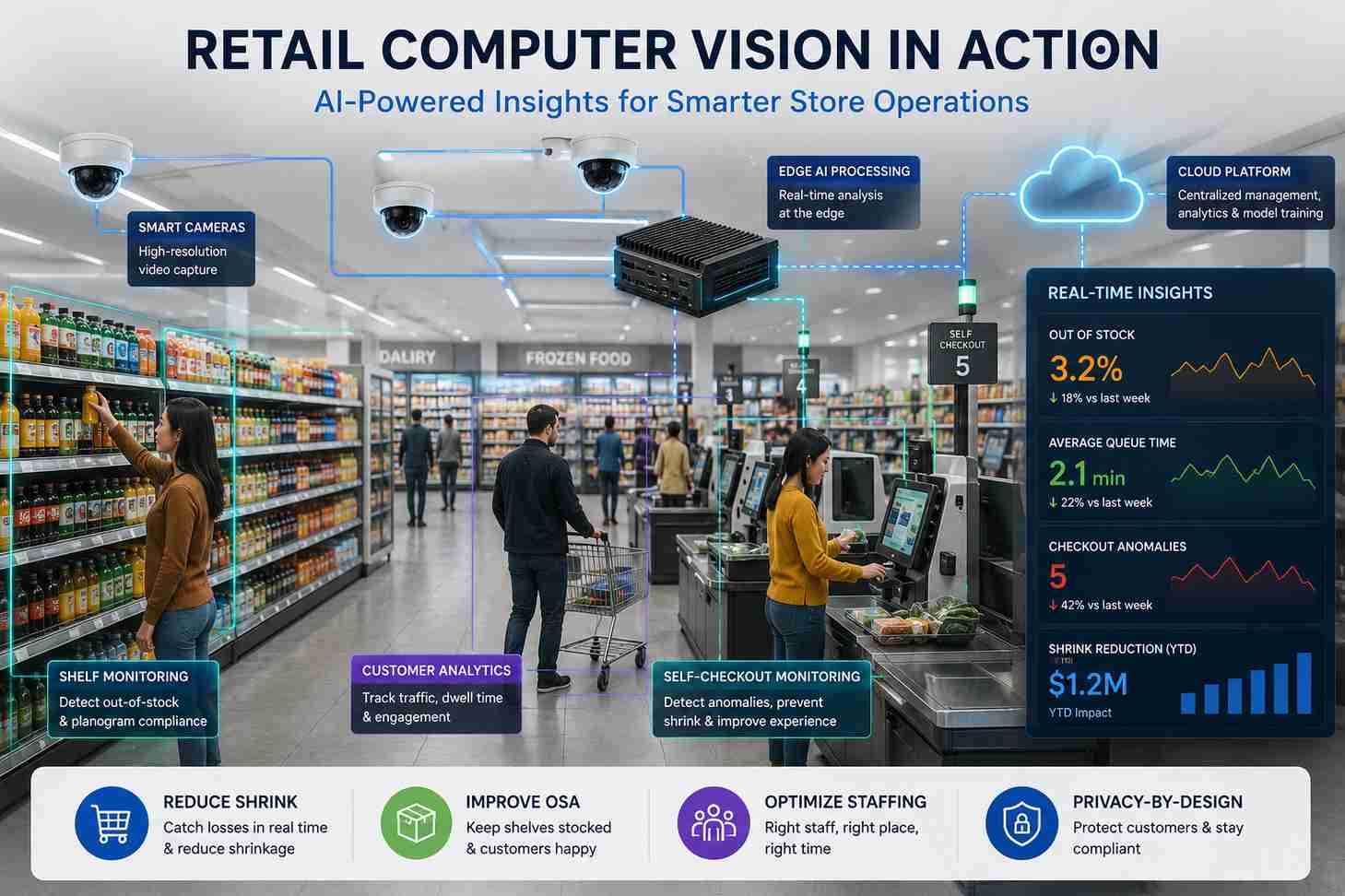
Table of Contents
Retail Computer Vision Market in 2026
Retail computer vision has moved well beyond pilot projects. What began as an application of AI for security cameras, has become a key operational technology across inventory management, self-checkout, queue optimization and loss prevention. As labor prices rise, inventory discrepancies persist and a greater focus on the customer experience is demanded.
Industry specialists estimate that the worldwide retail computer vision market reached a value of approximately USD 2.44 billion in 2025, and increasing at a CAGR 22.8%, predicted to be risen over USD 12.5 billion by 2033. The total market value for Computer Vision General, Non-retail is predicted to be valued at USD 28.2 billion in 2026 because of innovations in robotic process automation, edge AI, multimodal foundation models, cheaper AI hardware, etc.
Several trends are fueling this growth:
* This allows stores and malls to perform instant analysis without piping the video in the cloud.. Optimization of the Self check out has been one of the focused investment areas for many retailers looking to curtail their shrink and deliver a better customer experience.
* Tracking inventory will be moving from the infrequent manual checks to real-time shelf monitoring with AI.
* Fulfilling even more stringent regulation is made possible through privacy-preserving computer vision/pose estimation and anonymized analytics for the retailers.
2026 Retail Computer Vision Market Snapshot
| Metric | 2026 Outlook |
| Retail computer vision market (2025) | USD 2.44 billion |
| Expected CAGR (2025–2033) | 22.8% |
| Projected retail CV market by 2033 | USD 12.53 billion |
| Global computer vision market (2026) | USD 28.2 billion |
| Fastest-growing deployments | Shelf monitoring, self-checkout, queue analytics, inventory automation |
| Leading adoption regions | Asia-Pacific, North America |
While estimates differ a little across research houses due to their specific definitions and approaches, retail computer vision is generally seen as one of the fastest-growing enterprise AI spaces.
Major Retailers Deploying Computer Vision
Retail computer vision is no longer limited to experimental innovation labs. Many of the world’s largest retailers now use AI-powered vision systems in production environments.
| Retailer | Primary Computer Vision Applications |
| Walmart | Shelf monitoring, inventory analytics, AI-assisted operations |
| Kroger | Self-checkout loss prevention using Everseen’s computer vision platform |
| Amazon | Just Walk Out technology, cashierless checkout, inventory tracking |
| Morrisons (UK) | AI-powered self-checkout monitoring across hundreds of stores |
| Tesco | Store analytics and intelligent queue management initiatives |
| Carrefour | Smart shelf monitoring and inventory optimization projects |
These deployments do not displace workers. Instead they are being increasingly designed to eliminate repetitive visual jobs detecting empty shelves, locating scanning mistakes, observing checkout lines and, in real-time, sounding a siren to inform store staff which lets employees spend more time in front of customers and on higher value operational activities. Recent deployments of these AI-powered self-checkout supervisors, including Morrisons’ nationwide roll-out, demonstrate that computer vision is now a proven operational technology and not an experimental piloting exercise.
Retail Computer Vision at a Glance
| Question | Short Answer |
| What problem does it solve | Converts passive camera footage into real-time operational triggers — restocking, loss prevention, queue routing |
| Core technical challenge | Single-camera vision fails on occlusion and visually similar SKUs; needs sensor fusion |
| Fastest-growing bottleneck fix | Synthetic Computer Vision (SCV) for SKU onboarding, replacing manual image labeling |
| Where processing happens | Increasingly on-site (edge), not in the cloud, to cut latency and bandwidth cost |
| Biggest compliance risk | Biometric privacy statutes (BIPA) and the EU AI Act’s transparency and risk-tier rules |
| Realistic deployment timeline | 60–90 days from pilot to first-wave store rollout, if scoped correctly |
Beyond Passive Security: Turning In-Store Cameras Into Real-Time IoT Sensors
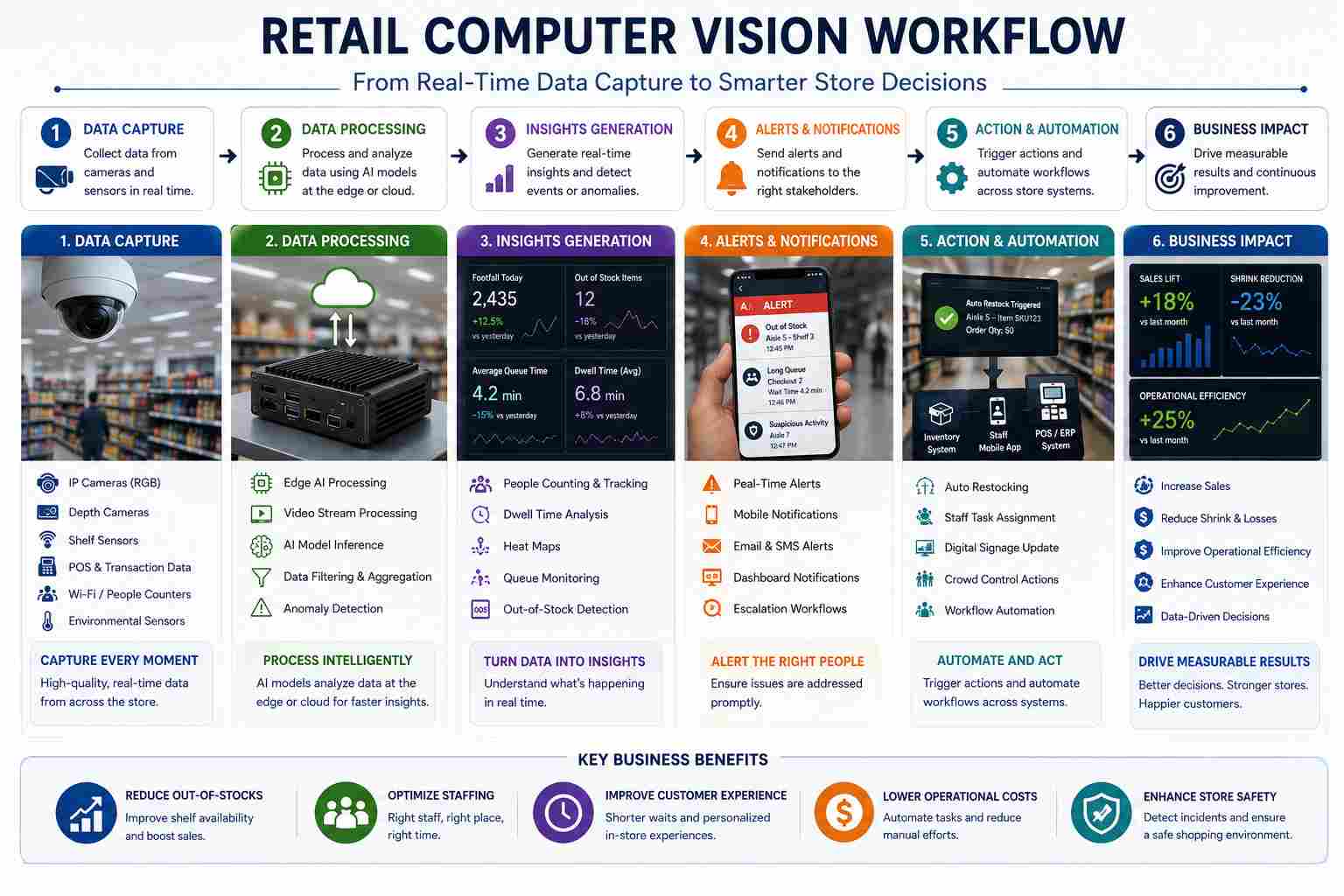
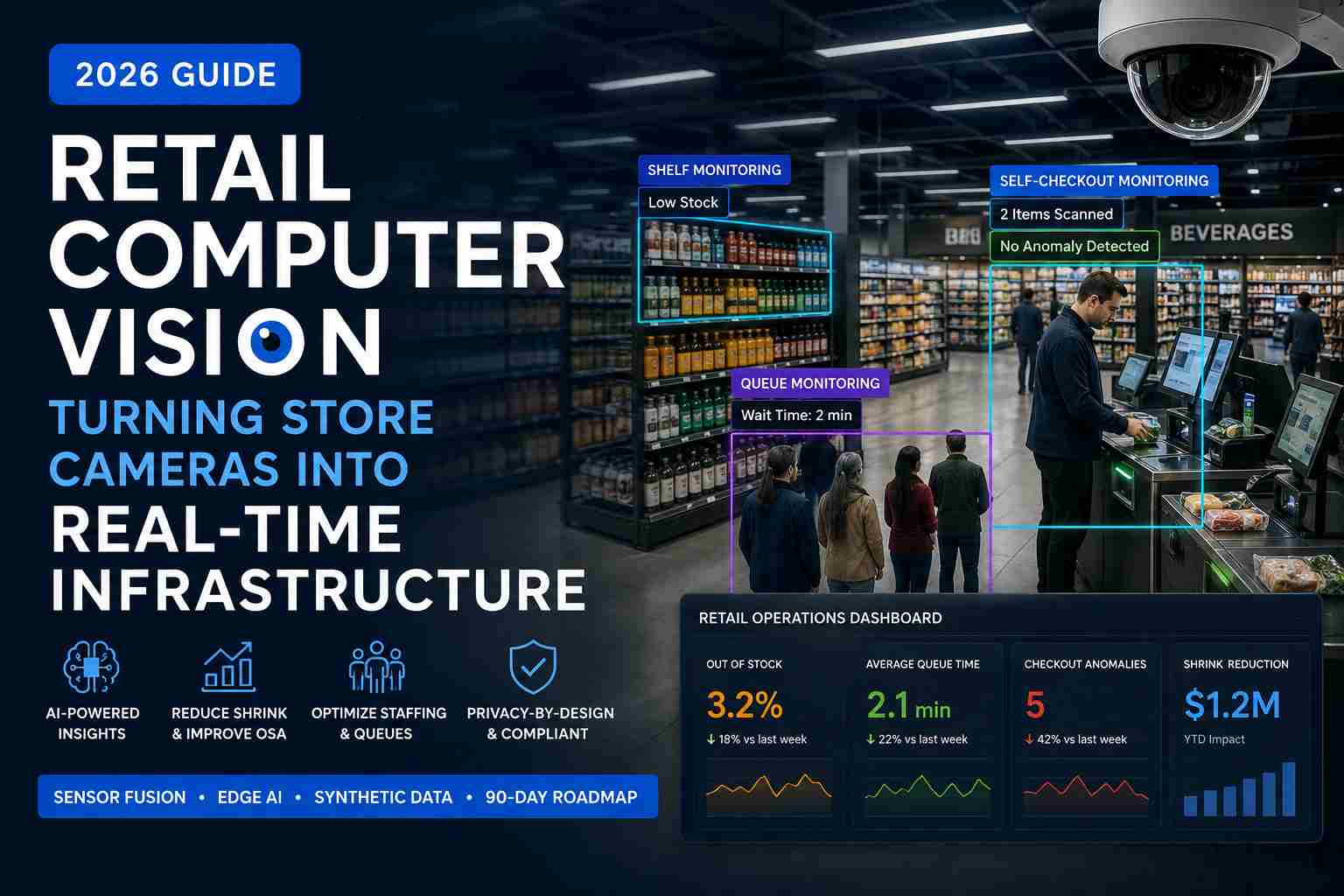
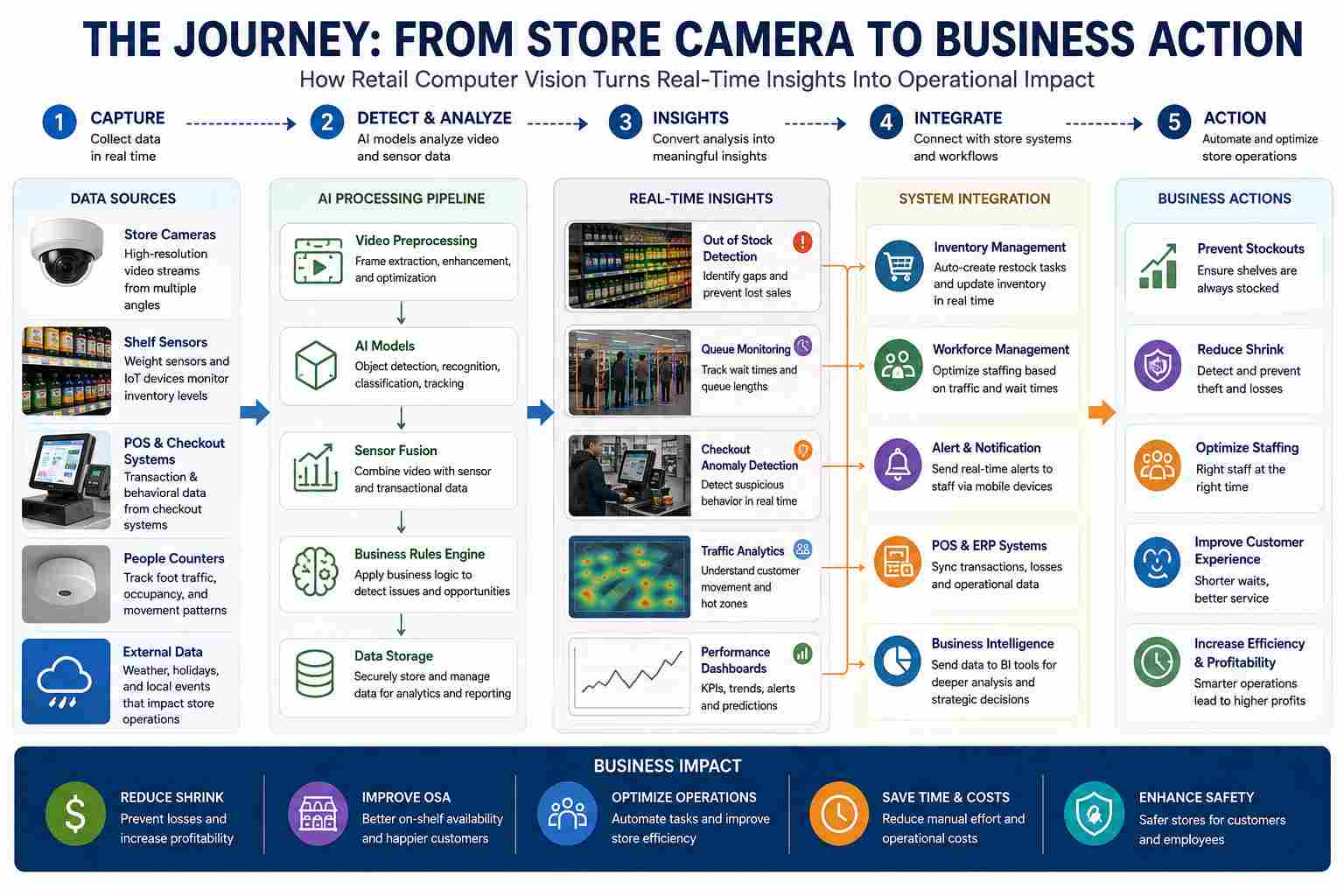
Moving from “security camera” to “IoT sensor” was a manageable technical leap. The hardware barely changes. What changes is the software layer sitting between the camera and a human — and whether that layer is allowed to act on what it sees.
A traditional CCTV setup pipes video to a monitor or a hard drive. Someone has to be watching, or someone has to go looking, for the footage to matter. A computer vision layer instead runs continuous inference against that same feed: is the shelf empty, is an item being concealed, is a checkout line six people deep. The moment one of those conditions is true, the system doesn’t wait for a person to notice — it fires an event.
That single distinction — event-driven versus review-driven — is why so many early retail computer vision pilots under delivered. Retailers bolted vision models onto existing camera infrastructure, built a dashboard, and called it done. The dashboard showed a shelf gap in aisle 7. No one even glanced at the dashboard until the next day. The gap was staring at everyone all day. The sale left with the customer who couldn‘t find what they were looking for.
Traditional CCTV vs. Retail Computer Vision
Most retail outlets already have a vast CCTV infrastructure, but standard surveillance systems are too primitive and tend only to record events rather than respond to them. Today‘s retail computer vision makes use of the very same CCTV cameras and applies intelligent computer generated responses.
The comparison shown below shows how AI enabled computer vision is different from traditional CCTV for few common activities in retail.
| Retail Task | Traditional CCTV | Retail Computer Vision |
| Theft Detection | Reviews footage after an incident occurs | Detects suspicious activity in real time and triggers immediate alerts |
| Shelf Monitoring | Employees manually inspect shelves | AI continuously detects empty shelves, misplaced products, and planogram violations |
| Queue Monitoring | Staff visually estimate queue lengths | AI counts customers, measures wait times, and recommends opening new checkout lanes |
| Inventory Management | Periodic manual audits and stock counts | Continuous inventory visibility using computer vision, sensor fusion, and shelf analytics |
| Self-Checkout Monitoring | Employee watches multiple checkout lanes | AI detects missed scans, barcode errors, and unscanned items automatically |
| Customer Behavior Analysis | Limited manual review of recorded footage | Tracks anonymous shopper movement, dwell time, and in-store traffic patterns |
| Alerts & Notifications | Requires someone to monitor video feeds | Automatically creates tasks, notifications, or workflow actions based on detected events |
| Processing Speed | Reactive—minutes or hours after an event | Real-time inference with edge AI, typically within milliseconds |
| Operational Insights | Historical footage for investigations | Live operational intelligence that supports immediate decision-making |
| Scalability | Monitoring becomes difficult as camera counts increase | AI analyzes hundreds of camera streams simultaneously with minimal human intervention |
Key takeaway: Traditional CCTV answers the question, “What happened?” Retail computer vision answers “What’s happening right now, and what action should we take?” That’s why leading retailers increasingly view computer vision as an operational platform rather than just a security system.
Action Over Analytics: Why Dashboards Aren’t the Point
The retailers actually getting ROI from this technology have mostly stopped building dashboards as the end product. Instead, a shelf-gap detection doesn’t populate a report — it opens a ticket directly in the store’s existing task-management system (the kind of workforce tools retailers already use for scheduling and task routing) and assigns it to the nearest available associate, with a photo attached and a location tag. No human reviews the video first. The video is the input; the task is the output.
This is sometimes described as “agentic” retail AI, and the label is reasonably earned. It’s the difference between a system that reports a problem and one that closes the loop on it. The technical requirements are modest — most of this runs on rules layered over standard detection models — but the organizational requirement is bigger: your store operations software has to be able to receive machine-generated tasks, and your associates have to trust them enough to act without double-checking. That second part, in our experience, is the harder one to solve.
The Real Money: High-ROI Applications in Shelf, Checkout, and Queue Management
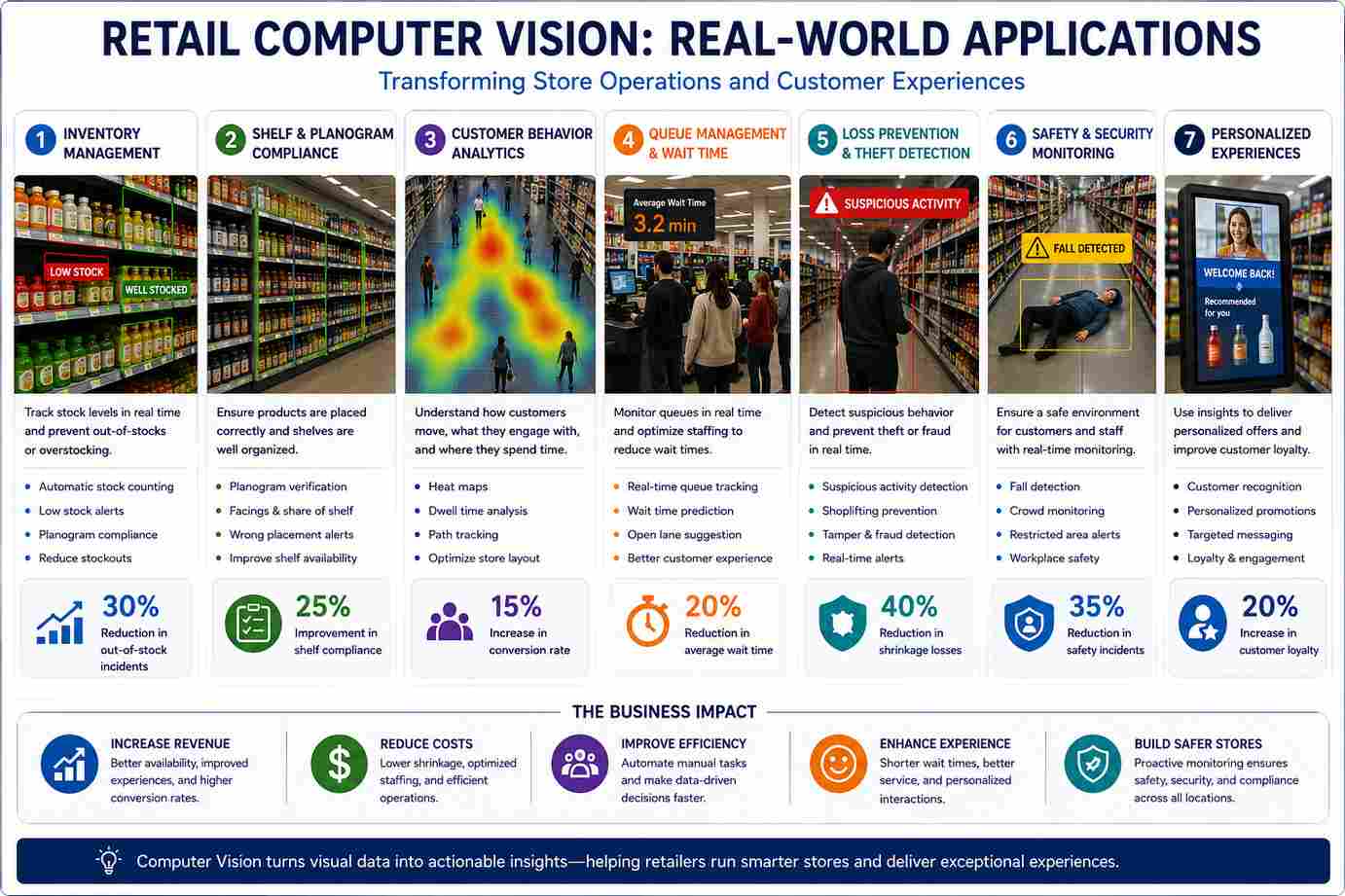
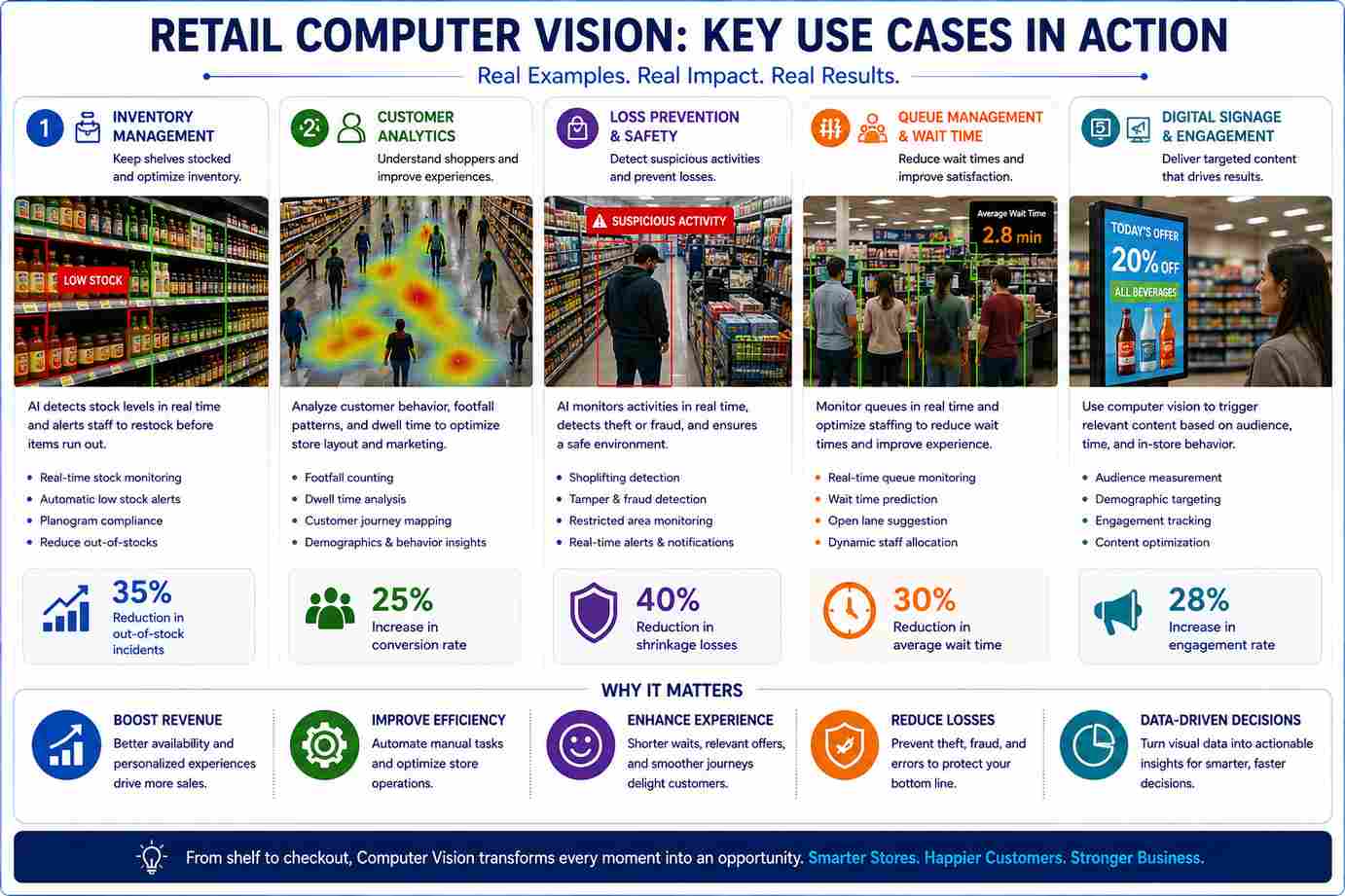
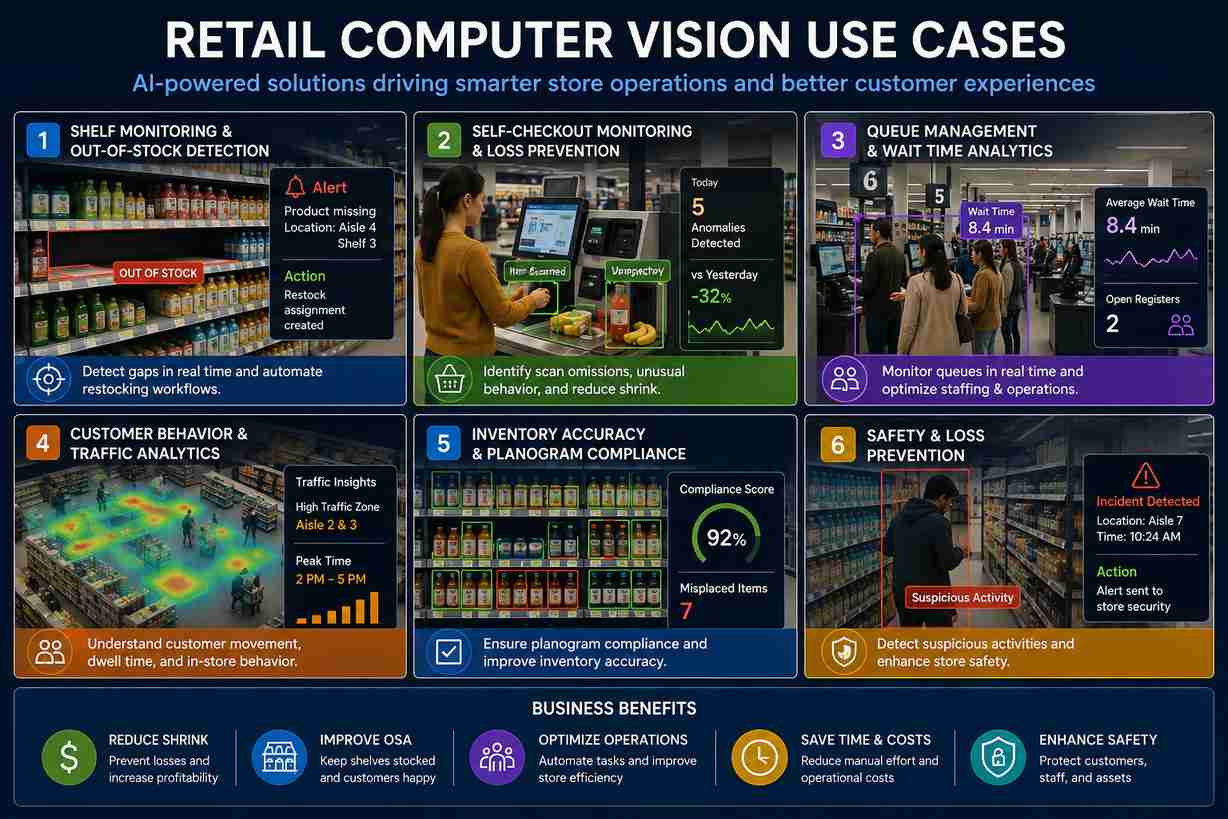
Not every computer vision use case pays for itself at the same speed. Three applications consistently show up first on retailers’ deployment roadmaps, and for good reason — they map directly onto line items a CFO already tracks.
On-Shelf Availability
Shelf-monitoring camera, robot makes periodic camera shots, examines images with missing or misplaced face and wrong facing to report violations. Since empty shelf space is the single largest contributor to the $690.9 billion in out-of-stock losses pinpointed in 2025 by IHL Group, even marginal improvement in the gap-to-restock metric translates into real revenue. The detection framework itself relies heavily on the identical object detection techniques in practice in computer vision at large; the retail-specific contribution primarily pertains to planogram matching and confidence thresholds tailored for busy, low-light aisle environments.
Checkout Loss Prevention
This is the use case with the clearest, most independently documented ROI trail. Everseen started deploying its visual-AI system to Kroger self-checkout lanes in 2020 aiming for 2,500 store coverage. However, the latest trade reports indicate the current live footprint is already over 1,700 Kroger-domiciled outlets including Harris Teeter, with cameras stationed above each autonomous self-checkout kiosk monitoring for unscanned goods and irregularity scanning. According to reporting in Chain Store Age, more than 75% of self-checkout errors at those stores are now resolved by the customer themselves, without an employee stepping in — a meaningful reduction in both shrink and staffing load at once.
It’s also worth a quick reality check here: not every camera-based checkout bet has paid off as cleanly. Amazon closed all 72 of its Amazon Go and Amazon Fresh stores in early 2026, folding the real estate into its Whole Foods and delivery strategy. Just Walk Out — the fully cashierless technology that made Amazon Go famous — didn’t die with it; Amazon continues licensing it to third-party stores, stadiums, and arenas. But the fact that Amazon’s own flagship stores couldn’t make the economics work is a useful data point: fully autonomous, vision-only checkout is a much harder problem at scale than assisted, human-in-the-loop loss prevention like Kroger’s.
Queue Management
The least glamorous of the three, and often the easiest to justify. Overhead or entrance-facing cameras count people, estimate dwell time in the queue, and trigger a lane-opening alert or a staffing prompt once a threshold is crossed. It doesn’t require identifying anyone — just counting shapes and tracking how long they stay in a defined zone — which makes it one of the lower-risk entry points into retail computer vision from a privacy standpoint.
Why Cameras Alone Fail: Sensor Fusion and the FAIM Framework
Ask anyone who has actually run a camera-only shelf or checkout system what breaks it, and you’ll get the same two answers: occlusion and lookalikes. A shopper’s hand blocks the shelf at exactly the moment they pick something up. Two products — full-fat and fat-free yogurt, say — look nearly identical from a ceiling-mounted camera’s angle. Vision models, no matter how well trained, are working with incomplete information in both cases.
The fix that’s held up under real-world testing is sensor fusion: combining the camera feed with a second, independent signal — most commonly a shelf-mounted weight sensor. A 2020 research paper out of Carnegie Mellon, AiFi Research, UC Merced, and Stanford — “FAIM: Vision and Weight Sensing Fusion Framework for Autonomous Inventory Monitoring in Convenience Stores” — is still the most-cited demonstration of why this works. The researchers built a real-world test shelf with 85 items across 33 unique SKUs, deliberately modeled on a 7-Eleven layout, and fused three independent probability streams: the magnitude of a detected weight change, the physical location of that change cross-referenced against the known shelf layout, and a vision-based classifier watching the customer’s hand. Combined through a weighted linear model, the fused system hit 92.6% item-identification accuracy — roughly double the accuracy of vision-only self-checkout systems reported at the time.
The takeaway isn’t that every retailer needs weight-sensored shelving. It’s that a single modality — vision, weight, RFID, whatever — has a ceiling, and that ceiling shows up fastest in exactly the SKU categories that matter most: near-identical variants, small high-theft items, and anything routinely handled and put back. Fusion isn‘t a nice-to-have add-on; for those categories, it‘s the make-or-break distinction between a usable system and an unusable system.
The Synthetic Data Shortcut: Solving the SKU Onboarding Bottleneck
Here’s a problem that doesn’t get enough attention in retail AI pitches: before a vision model can recognize a product, someone has to teach it what that product looks like — from every angle, under different lighting, next to other products, half-obscured, with last quarter’s packaging redesign. Multiply that by a mid-size grocery chain’s SKU count, which routinely runs into the tens of thousands, and manual image collection and labeling becomes the single biggest bottleneck in the entire pipeline. It’s slow, it’s expensive, and it’s perpetually out of date the moment a brand refreshes its packaging.
Synthetic Computer Vision (SCV) sidesteps the problem by not using real photographs at all for the bulk of training data. Instead, it builds a 3D digital twin of a product’s packaging — usually from the brand’s own artwork files — and renders that model against thousands of simulated lighting conditions, angles, and background clutter combinations programmatically. Neurolabs, one of the more established vendors in this space, publishes onboarding figures on its own site of well under a minute per new SKU via its capture app, with recognition accuracy in the mid-90s from the first day a product goes live, and full-catalog deployment inside roughly four weeks. Those are vendor-reported numbers rather than independently audited ones, so treat them as directionally representative of what SCV makes possible rather than a guaranteed outcome for any given retailer — but the underlying mechanism (digital twins replacing manual photo shoots) is well established and not exclusive to any one vendor.
The knock-on effect worth planning for: SCV also solves the packaging-refresh problem that quietly breaks a lot of static image-recognition systems. A digital twin can be re-rendered the moment new artwork exists, rather than waiting for someone to walk the aisles with a camera again.
Top Retail Computer Vision Vendors in 2026
The retail computer vision landscape has accelerated significantly in the last two years. Today’s market leaders have unique solutions for self-checkout, autonomous shopping, shelf analytics, synthetic training data, and edge AI infrastructure. Though differentiated by focus area each provides the same promise: translating images into live operational intelligence.
Here are some of the top companies leading the retail computer vision market in 2026.
| Vendor | Primary Focus | Best For | Key Technologies |
| Everseen | Self-checkout loss prevention | Grocery stores, supermarkets, big-box retailers | Computer vision, anomaly detection, real-time checkout monitoring |
| AiFi | Autonomous shopping | Convenience stores, stadiums, airports | Cashierless checkout, sensor fusion, AI-powered store automation |
| Trigo | Frictionless retail | Large supermarket chains | Ceiling-mounted cameras, inventory tracking, autonomous checkout |
| Standard AI | Store analytics and automation | Retail chains and department stores | Customer movement analytics, inventory visibility, operational insights |
| Neurolabs | Synthetic Computer Vision (SCV) | Retailers with large SKU catalogs | Synthetic data generation, digital twins, AI model training |
| NVIDIA Metropolis | AI infrastructure platform | Enterprises building custom vision applications | Edge AI, GPU acceleration, intelligent video analytics |
Vendor Comparison
| Vendor | Shelf Monitoring | Self-Checkout | Inventory Analytics | Synthetic Data | Edge AI Support |
| Everseen | ✓ | 5 Stars | ✓ | — | ✓ |
| AiFi | ✓ | 5 Stars | ✓ | — | ✓ |
| Trigo | ✓ | 5 Stars | 5 Stars | — | ✓ |
| Standard AI | 4 Stars | ✓ | 5 Stars | — | ✓ |
| Neurolabs | ✓ | — | 5 Stars | 5 Stars | — |
| NVIDIA Metropolis | Platform | Platform | Platform | Platform | 5 Stars |
Choosing the Right Platform
There isn’t a single “best” retail computer vision platform—only the one that best fits your deployment goals.
* At the self checkouts: Everseen is one of the best established solutions, used in thousands of stores.
* Cashierless shopping experiences: AiFi and Trigo focus on the creation of cashier less retail experiences, where users enter, walk around and exit without the need to go through a traditional checkout process.
* Store analytics and operational optimization: Classical AI is concerned with determining how customers move around stores, optimizing store layouts, and maximizing operational efficiency.
* Fast SKU onboarding: Neurolabs leverages Synthetic Computer Vision to help accelerate training of AI models on new products by substantially decreasing time and cost.
* Developing a bespoke computer vision solution: NVIDIA Metropolis delivers the edge ai architectures, SDKs and GPU acceleration for deployment at scale in enterprise.
Tip: In most cases large chain retailers will have a number of vendors. Instead, they combine multiple technologies—for example, NVIDIA Metropolis for edge processing, Neurolabs for synthetic training data, and Everseen or Trigo for retail-specific applications—to create an integrated computer vision ecosystem tailored to their operational needs.
Retail Computer Vision Platform Comparison
Choosing a retail computer vision platform is a function of your goals, present systems and scale. Some of the systems listed here are intended for autonomous checkout, others for inventory tracking, artificial data production, or as edge AI platforms. The comparison below highlights the strengths of today’s leading retail computer vision platforms.
| Solution | Best For | Cloud Deployment | Edge Deployment | Self-Checkout Support | Shelf Monitoring | Inventory Analytics | Autonomous Shopping |
| Everseen | Loss prevention at self-checkout | ✓ | ✓ | 4 Stars | ✓ | ✓ | — |
| AiFi | Autonomous convenience stores | ✓ | ✓ | 4 Stars | ✓ | ✓ | 5 Stars |
| Trigo | Large supermarket automation | ✓ | ✓ | 4 Stars | 5 Stars | 5 Stars | 5 Stars |
| Standard AI | Store analytics and customer insights | ✓ | ✓ | ✓ | 4 Stars | 5 Stars | ✓ |
| Neurolabs | SKU recognition and synthetic training data | ✓ | Limited | — | 5 Stars | 5 Stars | — |
| NVIDIA Metropolis | Custom AI infrastructure and edge computing | Hybrid | 5 Stars | Platform | Platform | Platform | Platform |
Which Platform Should You Choose?
Every retailer has different operational priorities, so the ideal platform depends on your specific use case.
| Business Goal | Recommended Solution |
| Reduce self-checkout shrink | Everseen |
| Build a cashierless retail experience | AiFi or Trigo |
| Improve shelf availability | Trigo or Neurolabs |
| Gain customer traffic and behavior insights | Standard AI |
| Accelerate AI model training for thousands of SKUs | Neurolabs |
| Develop a custom enterprise computer vision platform | NVIDIA Metropolis |
Key Buying Considerations
Before selecting a retail computer vision platform, evaluate the following factors:
* Deployment model: Supports cloud, on the edge or hybrid processing?
* Integration: Does it integrate with your current POS system, inventory management, workforce management and ERP systems?
* Scalability: Has it been proven at hundreds or thousands of stores?
* Privacy compliance can it underlie anonymized analytics, privacy-by-design and must be ibrations?
* Hardware compatibility: Will it be compatible with your current IP cameras, or needs it special sensors?
* AI capabilities: Must include object detection, SKU recognition, planogram checking, queue observation, and instant alert.
Expert tip: Most enterprise retailers do not buy one single “all-in-one“ package. Instead, they prefer a layered architecture: NVIDIA Metropolis (Edge AI infrastructure), Neurolabs (synthetic training data), Everseen and Trigo (retail-focused CV applications). This offers much more flexibility, scalability, and ROI in the long run.
Edge-First Architecture: Why On-Site Processing Beats the Cloud
Streaming raw video from every camera in a store to a cloud data center for processing sounds simple until you do the math on bandwidth. A single mid-resolution security camera can generate several gigabytes of footage a day; multiply that by dozens of cameras per store and hundreds or thousands of stores, and cloud egress and inference costs stop being a rounding error. Latency compounds the problem — a network round trip typically adds somewhere in the 50–200 millisecond range, which is tolerable for a nightly analytics report and completely unworkable for a real-time loss-prevention alert that needs to reach an associate before the customer reaches the door.
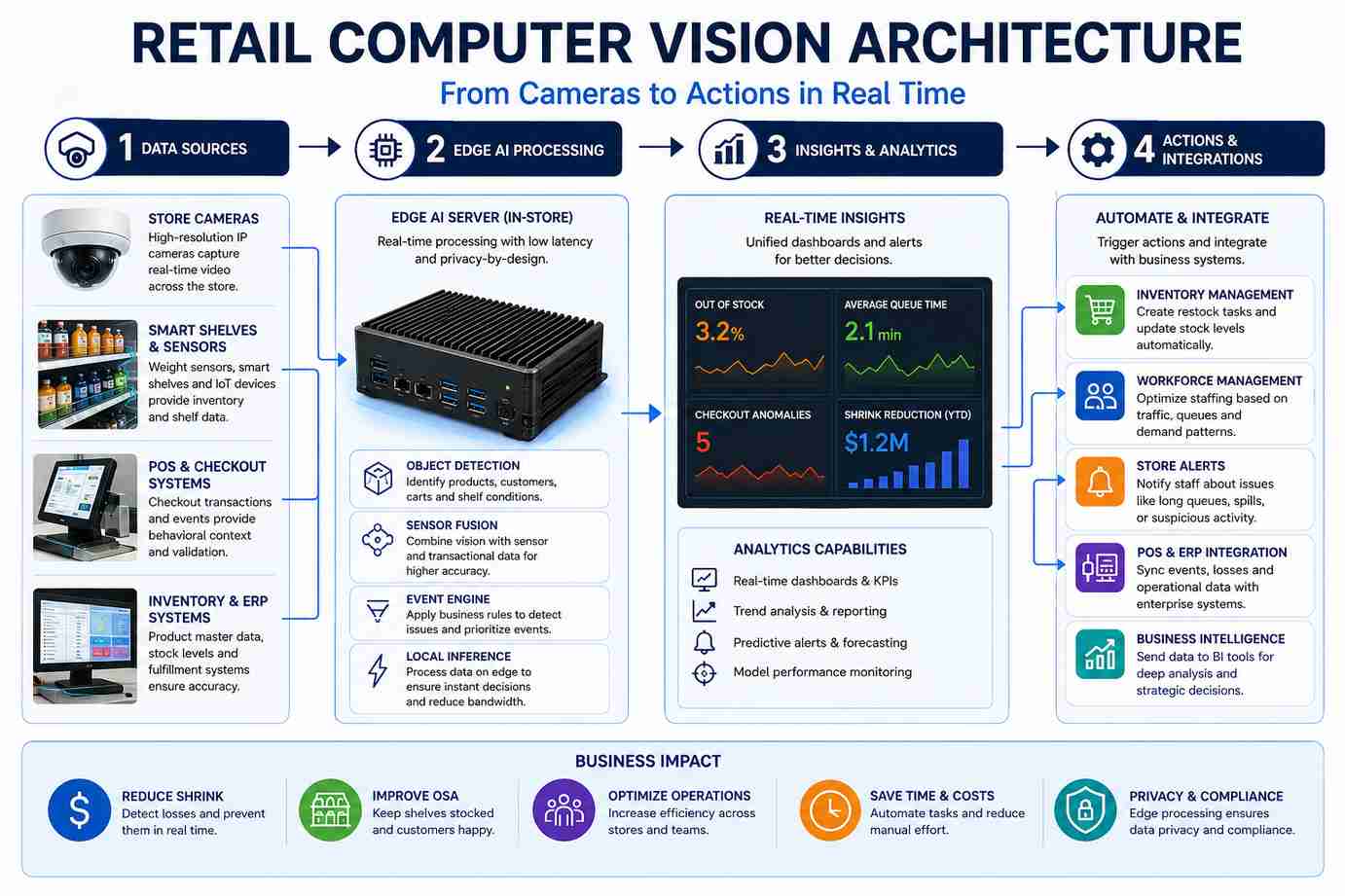
The industry’s answer, and the one most new retail deployments are standardizing on, is edge-first hybrid processing: a compact GPU server — commonly built around NVIDIA’s Jetson line for smaller footprints or T4/L4-class cards for a store with heavier compute needs — sits physically in the store and handles time-sensitive inference locally. Only compressed events, metadata, or flagged clips get sent upstream to the cloud, where slower, heavier reasoning (trend analysis, model retraining, cross-store comparisons) happens. Independent measurements of this pattern in retail video analytics have shown latency drops from roughly 480ms down to around 260ms — a 45.8% cut — alongside a 60% reduction in bandwidth use, which tracks with what most vendors in this space report directionally, even if exact figures vary by store format and camera count.
For deeper background on why this architecture pattern has become standard well beyond retail, our guide to how edge computing is revolutionizing business covers the infrastructure side in more depth.
Beating Model Drift With Periodic On-Site Retraining
Edge deployment solves latency and bandwidth. It doesn’t solve a quieter problem: model drift. A vision model trained on a store’s layout in March starts losing accuracy the moment that store resets its planogram, swaps out lighting fixtures, or the season changes and product mix shifts. Static models — trained once, deployed forever — degrade in exactly the environments retail computer vision is meant to serve, because those environments never stop changing.
The pattern that’s emerging to handle this is periodic adaptation: the edge system continuously filters incoming frames, buffers a rolling set of high-confidence “normal” examples from its own recent inference, and — during off-peak overnight hours, when compute is otherwise idle — runs a lightweight local retraining pass against that buffered data. It’s not full retraining from scratch; it’s a targeted recalibration that nudges the model back toward accuracy for that specific store’s current conditions, without shipping raw footage back to a central data center. On modern edge hardware this kind of incremental retraining cycle can realistically run in well under an hour, which is short enough to complete overnight without touching daytime inference capacity. This is still an emerging engineering pattern more than a standardized product feature — worth building into your architecture requirements from day one rather than bolting on later, since retrofitting retraining infrastructure onto an already-deployed fleet is considerably more disruptive.
The underlying model architectures — how CNNs and newer approaches learn and update from data in the first place — are covered in more technical depth in our piece on how neural networks are accelerating research and innovation.
Privacy-by-Design: Meeting BIPA, GDPR, and EU AI Act Requirements Without Killing the Use Case
Biometric privacy law is the one single biggest reason that retail computer vision projects get shut down or on hold after the pilot stage, and it deserves a clear answer to instead of any vague caveats.
The Illinois Biometric Information Privacy Act (BIPA) is the keenest edge here, with statutory damages of $1000 per inadvertent violation, $5000 per intentional or reckless violation and (the crux) no necessity to demonstrate damages, so even a “technical procedural lapse” like lack of notice or consent alone may suffice. The 2024 amendment (Illinois SB 2979) limited the exposure a little, asserting 2024) “that a person violating this paragraph shall be deemed to have committed a single violation regardless of the number of times the person scans, accepts, receives or otherwise obtains the biometric identifier or biometric information of the same individual using the same method of collection.”. Retailers operating in Illinois, or collecting data from Illinois residents anywhere, need to treat this as a hard compliance requirement, not a background risk.
The practical fix that lets retailers keep the operational benefit without the biometric exposure is skeletal pose estimation. Rather than storing or analyzing raw facial imagery, the system extracts a small set of body keypoints — shoulders, elbows, wrists, hips, typically 15 to 17 points — and reduces every shopper in frame to a moving stick-figure skeleton. Shoplifting and browsing behavior get modeled as spatial-temporal patterns in those coordinates (a reach toward a shelf followed by a hand-to-pocket motion, for instance) rather than as a stored image of a person’s face. Raw video is discarded at the edge; only the anonymized coordinate stream persists. It’s a meaningfully different data-protection posture than the kind of biometric capture our facial recognition guide covers, and it’s the approach most retail vision vendors have converged on specifically to stay outside BIPA’s most aggressive interpretation.
On the EU side, the EU AI Act’s risk-tier framework — which our pillar guide covers in full, including the mitigation strategies required for each tier — classifies most retail shelf and checkout monitoring as limited or high risk depending on whether biometric categorization is involved, not as an outright prohibited use. The requirement that actually catches retailers off guard is Article 50’s transparency rule: if a system uses generative AI for anything customer-facing — a virtual try-on, synthetic on-model product imagery, an AI styling assistant — the retailer has to clearly disclose that the content is artificially generated. That requirement sits closer to our generative AI guide than to the shelf-monitoring side of this piece, but it’s easy to miss if your compliance review only covers the security-camera use cases and skips the customer-facing generative features running in parallel.
Retail Computer Vision Technology Stack
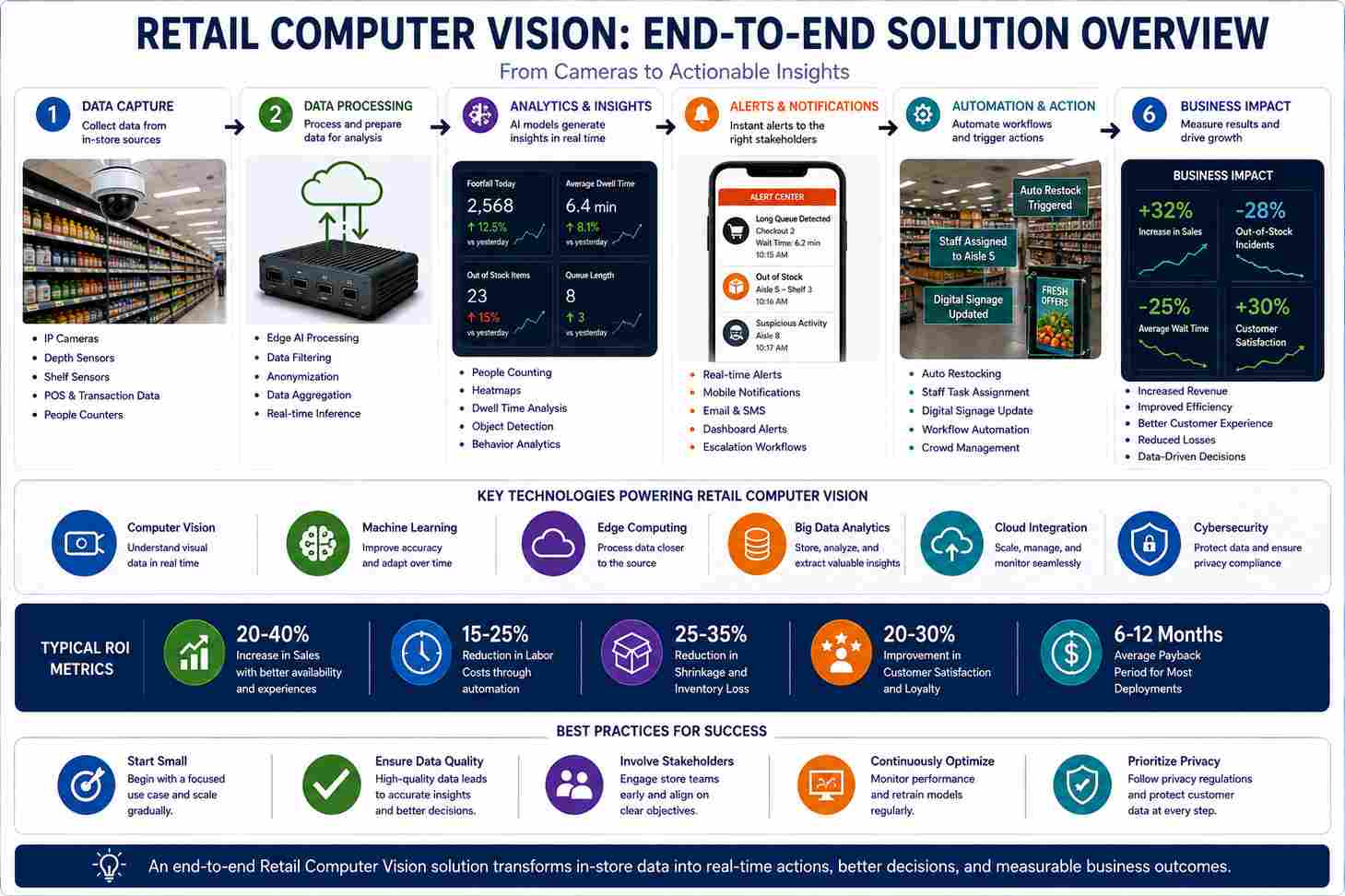
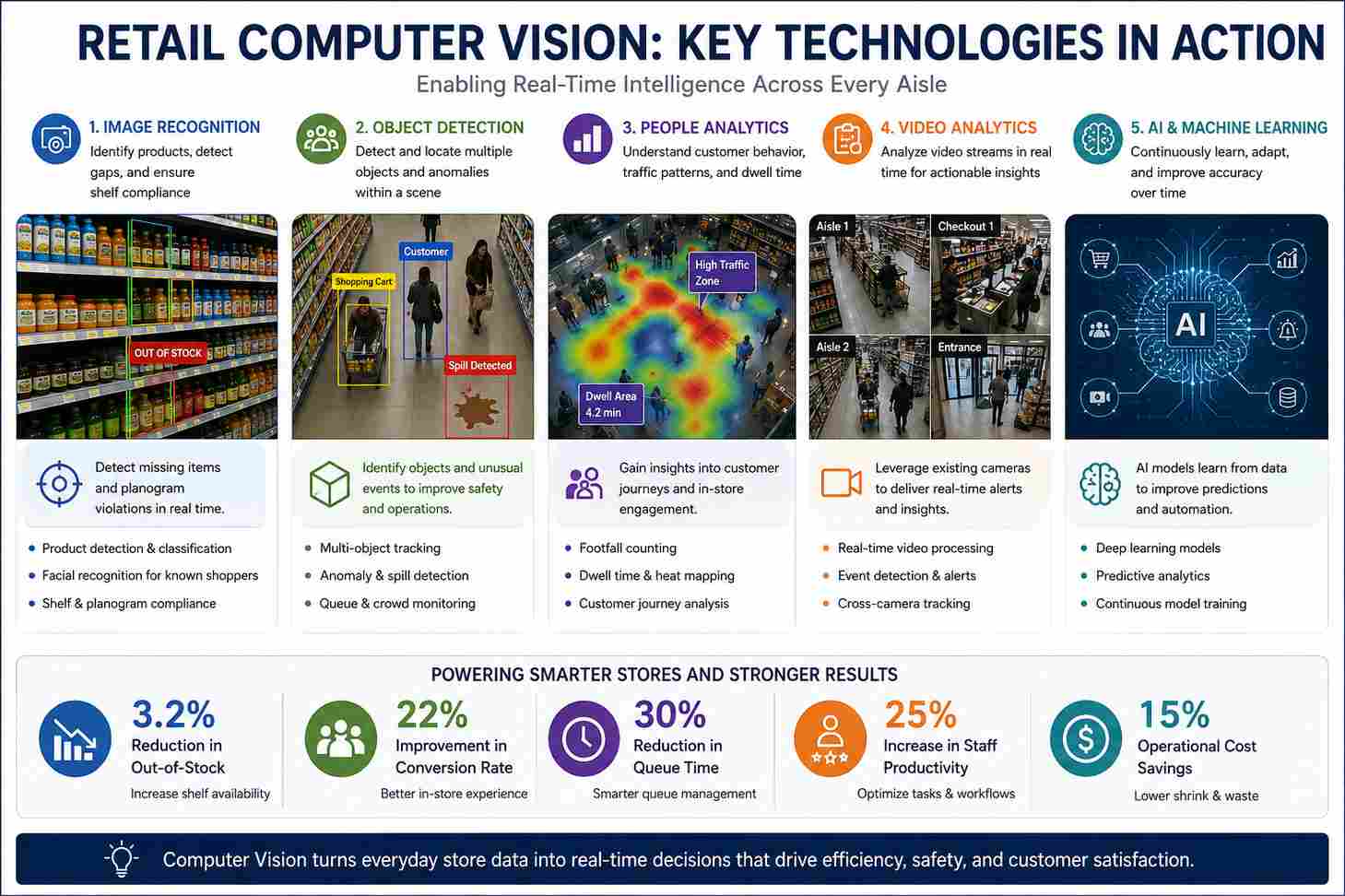
Behind every successful retail computer vision deployment is a carefully integrated technology stack. Instead of using one AI model, current solutions pull together cameras, edge computing, ML models, sensors, cloud and business applications to provide live operational intelligence. This overview shows how these elements fit together so retailers can build scalable future-proof solutions.
Core Technology Stack
| Layer | Example Technologies | Purpose |
| Cameras | IP Cameras, Depth Cameras, 3D Cameras, Fisheye Cameras | Capture high-resolution video streams for AI analysis |
| AI Models | YOLOv11, Vision Transformers (ViTs), Segment Anything Model (SAM), Mask R-CNN | Detect products, customers, shopping carts, queues, and shelf conditions |
| Edge Hardware | NVIDIA Jetson AGX Orin, NVIDIA T4/L4 GPUs, Intel OpenVINO, Google Coral TPU | Perform real-time AI inference inside stores with minimal latency |
| Sensors | Weight Sensors, RFID Readers, LiDAR, Smart Shelves | Improve detection accuracy through sensor fusion and inventory verification |
| Databases | PostgreSQL, Redis, MongoDB, TimescaleDB | Store inventory events, AI metadata, system logs, and analytics data |
| Cloud Platforms | Microsoft Azure, Amazon Web Services (AWS), Google Cloud Platform (GCP) | Centralized model management, analytics, reporting, and fleet administration |
| Visualization & Dashboards | Microsoft Power BI, Grafana, Tableau, Kibana | Monitor KPIs, store performance, inventory health, and AI system metrics |
| Integration APIs | POS Systems, ERP Software, Workforce Management, Inventory Management Systems | Connect AI detections directly to existing retail workflows and business applications |
How the Technology Stack Works
It‘s not just an independent array of technologies, but more of a combined platform in the case of a retail computer vision platform.
- Cameras continuously capture video from shelves, checkout lanes, entrances, and store aisles.
- The AI is scanning each frame sequentially, identifying customers, the products, the shopping basket, queue and any suspicious behavior
- The edge AI hardware will perform the detection on-site thus reducing bandwidth requirements, and enables real-time response.
- Sensor like Weight Plates, RFID reader checks for the AI predicted result, increasing the accuracy with sensor fusion.
- Databases store detection events, operational metrics, and historical analytics for reporting and model improvement.
- Cloud platform consolidates data from several many stores, retrains AI models and united monitoring.
- Store managers can see how much stock they have on hand, how well they are doing at the checkout, how long people are queuing, and the store KPI‘s using dashboards.
- Call a Business API that automatically fires off anything from a call to create restocking tasks, inform staff about checkout anomalies, update inventory on paper records or even notify the store manager.
Why an Integrated Stack Matters
The most successful use of retailers with high ROI has been to embed the computer vision rather than utilize it as a standalone application. Insights are fed direct into retail systems such as inventory management, staff rostering itself checkouts and enterprise reporting, stopping human intervention and enabling a faster response time. In this way, computer vision can add value not just as an analytics tool, but also a core platform.
Best Practice: Architect your system with modular, API-first components. Changing an AI Model, adding new sensors or moving from one pilot store to hundreds can be achieved with minimal re-architecting.
The 90-Day Deployment Roadmap
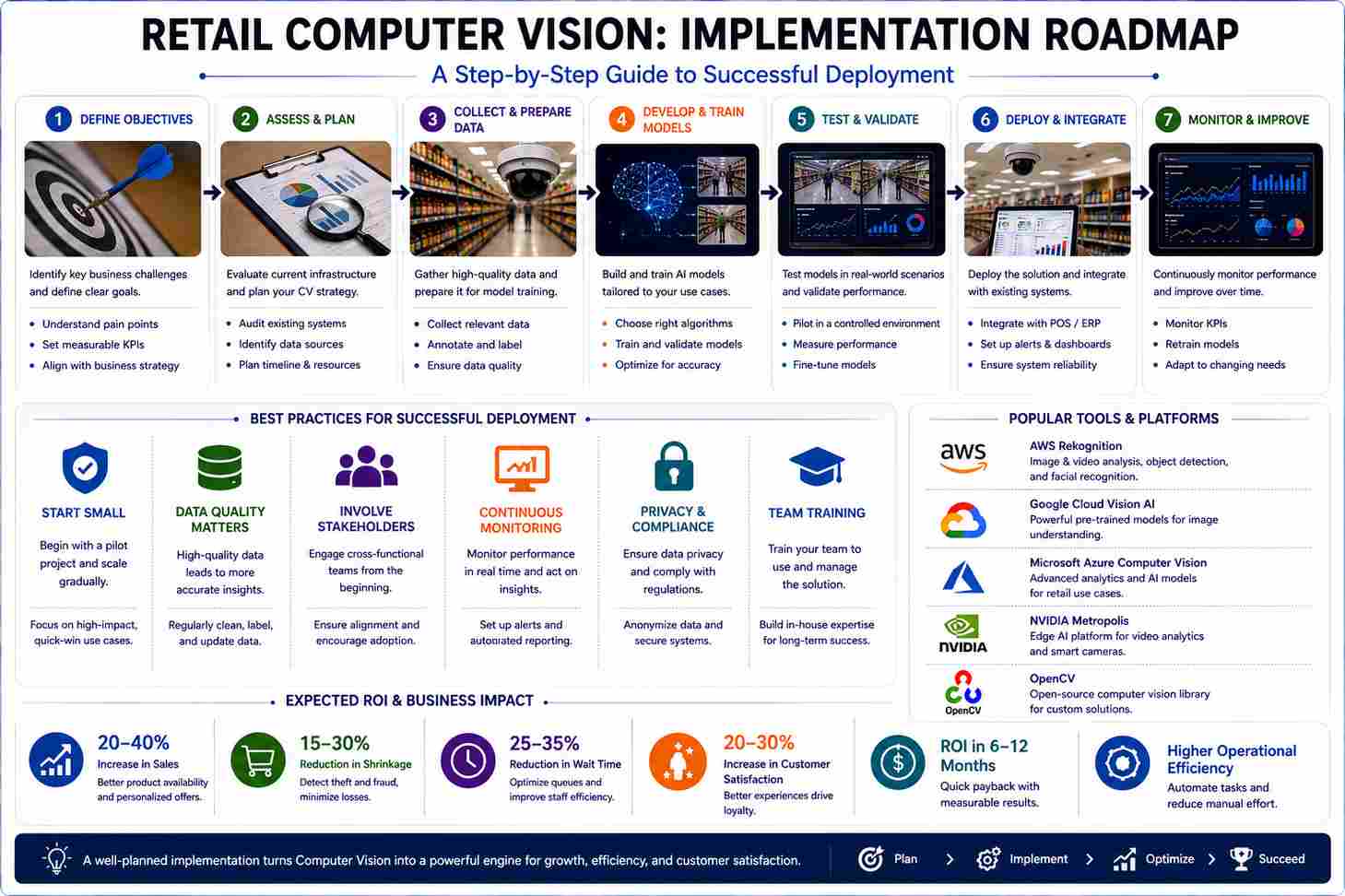
Most failed retail computer vision rollouts don’t fail on the technology. They fail on sequencing — trying to solve compliance, hardware, and organizational buy-in all at once, in one store, with one team. A staged rollout based on MACH principles (Microservices, API-first, Cloud-native, Headless – meaning bits of the ecosystem communicate through APIs rather than being wired together) allows you to change vendors or correct a bad assumption without having to bring down the entire stack.
Days 1–30: Audit and narrow pilot. Map every camera and sensor already in place against what you actually need. Pick one use case — shelf availability is usually the lowest-risk starting point — and one or two stores. Confirm your privacy posture (pose estimation, not raw facial capture) before a single frame of production data gets collected.
Days 31–60: Add fusion and close the loop. If checkout loss prevention is in scope, this is where weight sensors or a second modality get layered in rather than shipped later as an afterthought. This is also when the dashboard-to-task-routing integration should go live — connect detections directly into your existing workforce management tool so associates are acting on machine-generated tasks, not analysts reviewing footage.
Days 61–90: Scale the fleet and train the retraining pipeline. Roll out to the next wave of stores using the same edge hardware profile validated in the pilot. Stand up the periodic on-site retraining cycle now, before drift becomes visible, rather than waiting for accuracy complaints from store managers three months in.
FAQs
Q1: How does sensor fusion combine camera feeds and shelf weight plates to monitor inventory?
A: The system triggers on a detected weight change, then computes three separate probabilities — one from the size of the weight change, one from where on the shelf it occurred relative to the known planogram, and one from a vision-based classifier watching the shopper’s hand. Combining the three through a weighted model, as demonstrated in the FAIM research from CMU and Stanford, resolves ambiguity that any single signal would miss on its own.
Q2: What’s the real difference between skeletal pose estimation and standard camera surveillance?
A: Standard surveillance stores and analyzes raw video of identifiable people, which is exactly what triggers BIPA and GDPR biometric-data obligations. Pose estimation extracts anonymized body keypoints at the edge and discards the raw footage, so behavior gets modeled as coordinate movement rather than as footage of a recognizable individual.
Q3: Does Synthetic Computer Vision replace real-world image data entirely?
A: Not entirely, but it removes the bulk of the manual labeling burden. SCV vendors typically still validate against a smaller set of real shelf images to confirm the digital-twin-trained model performs correctly under real lighting and clutter conditions — it’s a major acceleration of onboarding, not a total substitute for real-world validation.
Q4: Do retailers need new camera hardware to start with computer vision?
A: Usually not for a pilot. The vast majority of shelf-monitoring and queue-management use cases will run on existing IP security cameras with sufficient resolution so the main investment tends to be in the edge compute layer (a GPU server in store) rather than replacing otherwise functioning cameras.
Q5: What actually happens to a retailer that ignores BIPA compliance?
A: Since BIPA does not require actual injury, a mere procedural violation such as collecting biometric data without proper written notice and consent is grounds for statutory damages of between $1,000 and $5,000 per violation. With large shopper volumes, that exposure scales fast, which is exactly why pose-estimation-based approaches have become the default rather than the exception for anything customer-facing.
Q6: How much does a retail computer vision system cost?
A: The cost of a retail computer vision deployment varies depending on store size, camera infrastructure, AI capabilities, and deployment model. A small pilot project may require only edge computing hardware and software licenses, while enterprise rollouts across hundreds of stores involve additional investments in cloud services, integration, and ongoing AI model management. Most vendors are now offering a subscription based pricing model to make it easier to roll out on a smaller scale initially.
Q7: Can small retailers use retail computer vision?
A: Yes. Now retail computer vision is not just the domain of the big supermarket chains or multinational retailers. Small and medium sized businesses can now afford to run AI-enabled shelf monitoring, queue analytics or self-checkout monitoring using their existing IP cameras or inexpensive edge AI devices. Cloud platforms and managed AI services have brought the cost and complexity of adoption many notches lower.
Q8: Which AI models are most commonly used in retail computer vision?
A: Most current retail applications of computer vision are not based on a single algorithm but multiple AI models. Object detection models such asYOLOcan detect both products and shoppers, Vision Transformers(ViTs)can enhance image classification, segmentation models such as Segment Anyhing(SAM)andMask R-CNNserve to segment individual products from complex shelf environments. Results from many enterprise applications are based on custom deep learning models designed specifically for retail inventory management and checkout.
Q9: How accurate is retail computer vision?
A: Detection accuracy is affected by camera quality, illumination, likeness of products, training of model, etc. Good enterprise systems usually at 90+% accuracy, especially when computer vision is used in conjunction with either weight sensor or RFID or sensor fusion method etc. Model retraining and synthetic data generation help higher the detection accuracy.
Q10: Does retail computer vision require new cameras?
A: Not necessarily. Most retail computer vision platforms are designed to work with existing IP security cameras, allowing retailers to leverage their current infrastructure. However, certain advanced applications—such as autonomous checkout, 3D product recognition, or depth estimation—may benefit from specialized hardware, including depth cameras, LiDAR sensors, or smart shelf technologies.
Q11: Can retail computer vision integrate with existing retail software?
A: Yes. Contemporary retail computer vision platforms are designed with API-first architecture that already hook into an existing POS system, inventory management platform, ERP solution, workforce management tools, and business intelligence dashboards. It is through this connection that detections (AI-based) automatically kick off work orders, inventory updates, or checkouts.
Q12: Is retail computer vision compliant with privacy regulations?
A: It can be when designed with privacy-by-design principles. Most retailers mitigate compliance risks by running video on edge devices, anonymizing customer information through skeletal pose estimation, reducing data retention, and ensuring regulatory compliance across the board (e.g., GDPR, EU AI Act, Illinois BIPA). However, compliance laws are region and type-dependent.
Q13: What are the biggest challenges when deploying retail computer vision?
A: A well-trained model is not the only factor of a winning deployment, contrary to popular belief. There are a many challenges associated with deployment across the retail landscape including camera locations, variations in store lighting, cross-category similarity, store re-layouts, integration with legacy systems, adoption by employees and persistent retraining of models. Those organizations which adopt edge AI, sensor fusion and a continuous retraining strategy are better equipped to face some of these challenges.
The Future of Retail Computer Vision
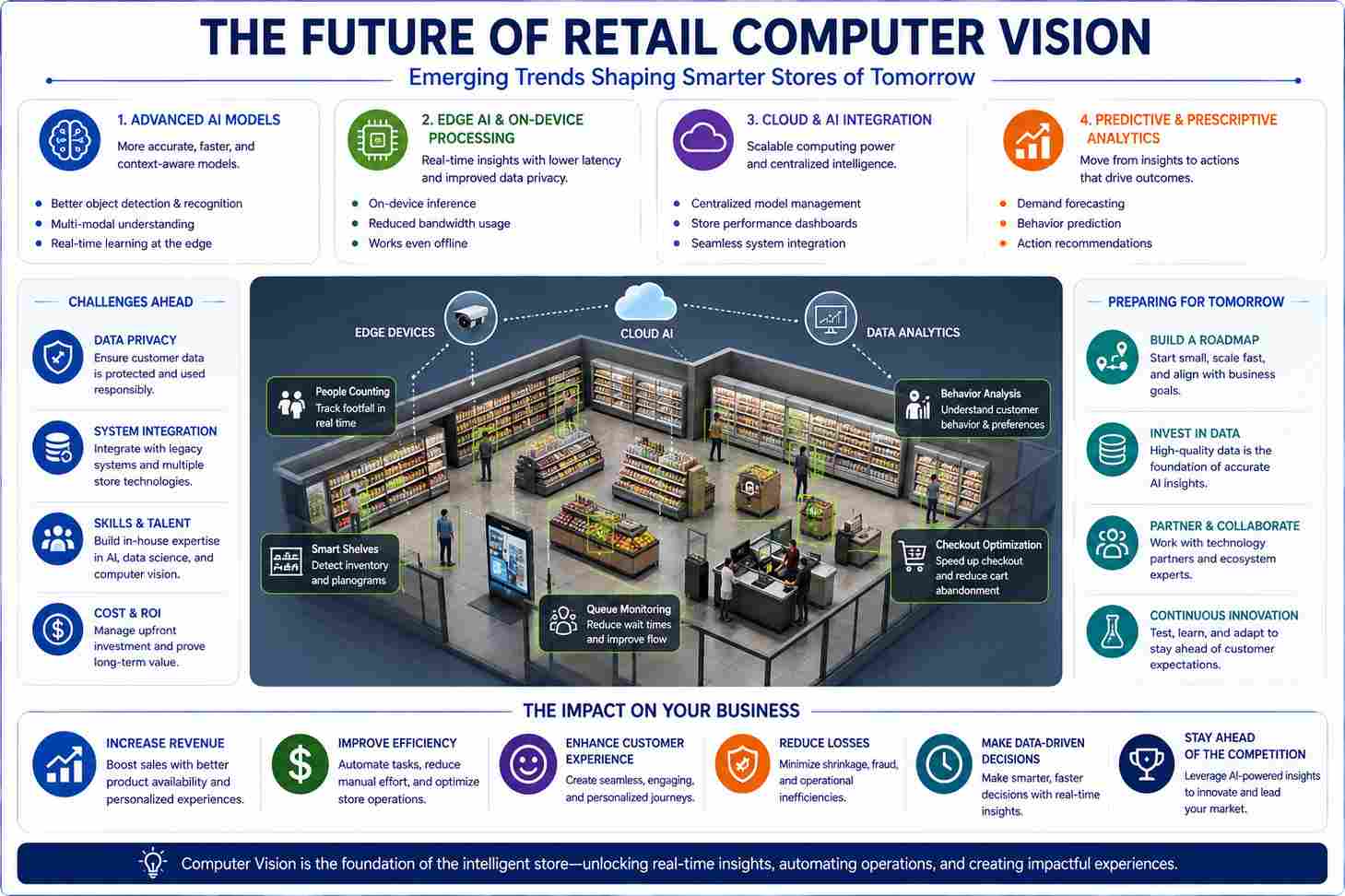
Retail computer vision is evolving rapidly, spurred by generative AI, multimodal foundation models, robotics, and edge computing. While current computer vision systems can accurately complete specific tasks such as product identification, shelf monitoring, and reduction of checkout shrink, next generation retail AIs will be less about perception, and more about independent decision-making and operation. Retailers who first invest in a scalable, AI-first retail infrastructure will be the best poised to capitalize on the coming wave of retail automation.
Vision-Language Models Will Make AI More Context-Aware
While classic computer vision work recognizes what something is, it does not do well at explaining the importance of an event. Vision-language models (VLMs) integrates image understanding with natural language reasoning, enabling AI to describe visual events, provide explanation, and excel at all sorts of insight.
By enabling a VLM to identify which product is missing from a shelf rather than just that it‘s empty, it could also communicate the potential lost sales, why the product is missing, and what the ideal response should be. Such a richer understanding of the context will greatly increase the usefulness of retail AIs to store managers and operations teams.
Multimodal AI Will Combine Multiple Data Sources
Cameras are just the beginning for retail AI. Multimodal systems will fuse these real-time data sources ranging from video feeds, RFID tags, weight scales, POS transaction data, inventory data, customer footfalls and IoT devices to create a holistic picture.
These systems will not only analyze individual events but will also cross reference different sets of information together, at the same time, to gain more accurate results with fewer false alarms. An example of this would be a camera observing a shelf gap, which is checked against the weight sensors and stored inventory levels in order to create a restock order.
AI Agents Will Automate Retail Operations
Retailers are moving from being driven by AI based analytics to driven by AI based action. Autonomous AI agents are able to observe operations in real-time, identify problem situations and decide on their priority, access workforce management systems and proactively trigger operational flows.
In the future, an AI agent may automatically:
- Create restocking tasks when shelves become empty.
- Notify employees about unusually long checkout queues.
- Detect pricing discrepancies and alert store managers.
- Recommend staff reallocations based on real-time customer traffic.
- Schedule overnight inventory verification using autonomous robots.
Instead of simply reporting problems, AI agents will increasingly help solve them.
Foundation Models Will Reduce Custom AI Development
Today’s retail computer vision solutions often require retailers to train models for specific products, store layouts, and operational scenarios. Foundation models are changing that by providing large pre-trained vision models capable of adapting to new environments with minimal additional training.
As these models continue to improve, retailers will spend less time collecting labeled datasets and more time configuring AI systems for their unique business requirements, reducing deployment time and accelerating return on investment.
Digital Twins Will Enable Smarter Store Optimization
Digital twins are increasingly vital to the enterprise retail strategy. They allow retailers to create a virtual model of a physical store and then which can be used to.:
They can be used together with real-time computer vision data to optimize performance on the fly, and help retailer pinpoint throughput bottlenecks, optimize store layouts, and predict store performance more reliably.
Robotics and Computer Vision Will Work Together
Retail robotics is expected to become increasingly integrated with computer vision over the coming years. There are already autonomous shelf-scanning robots, inventory drones and warehouse robots using computer vision for navigation and product detection.
In the future, retail transactions will probably be facilitated by a research-decimated robotic-automated system with integrated advanced Vision/AI technologies to:
- Continuous shelf inspections.
- Automated inventory counting.
- Warehouse picking and sorting.
- Store replenishment verification.
- Autonomous stockroom management.
These systems do not intend to substitute human workers; instead they want to automate standard functions and operations tasks, enabling the team to concentrate on giving a better customer service.
Looking Ahead
Retail computer vision is moving away from isolated AI solutions towards advanced operational platforms leveraging vision, language, edge, automation and enterprise software. As foundation models, AI agents, digital twins and robotics become more and more refined, retailers will have operational solutions that not only discover operational issues but do understand context, propose solution and execute mundane workflows.
Looking Ahead: In five years, the most competitive retailers won‘t just be armed with more cameras. They will be running ecosystems of AI, where computer vision, multimodal AI, autonomous agents, robotics, and digital twins work together to deliver more prompt, intelligent, and efficient retail.
The Bottom Line
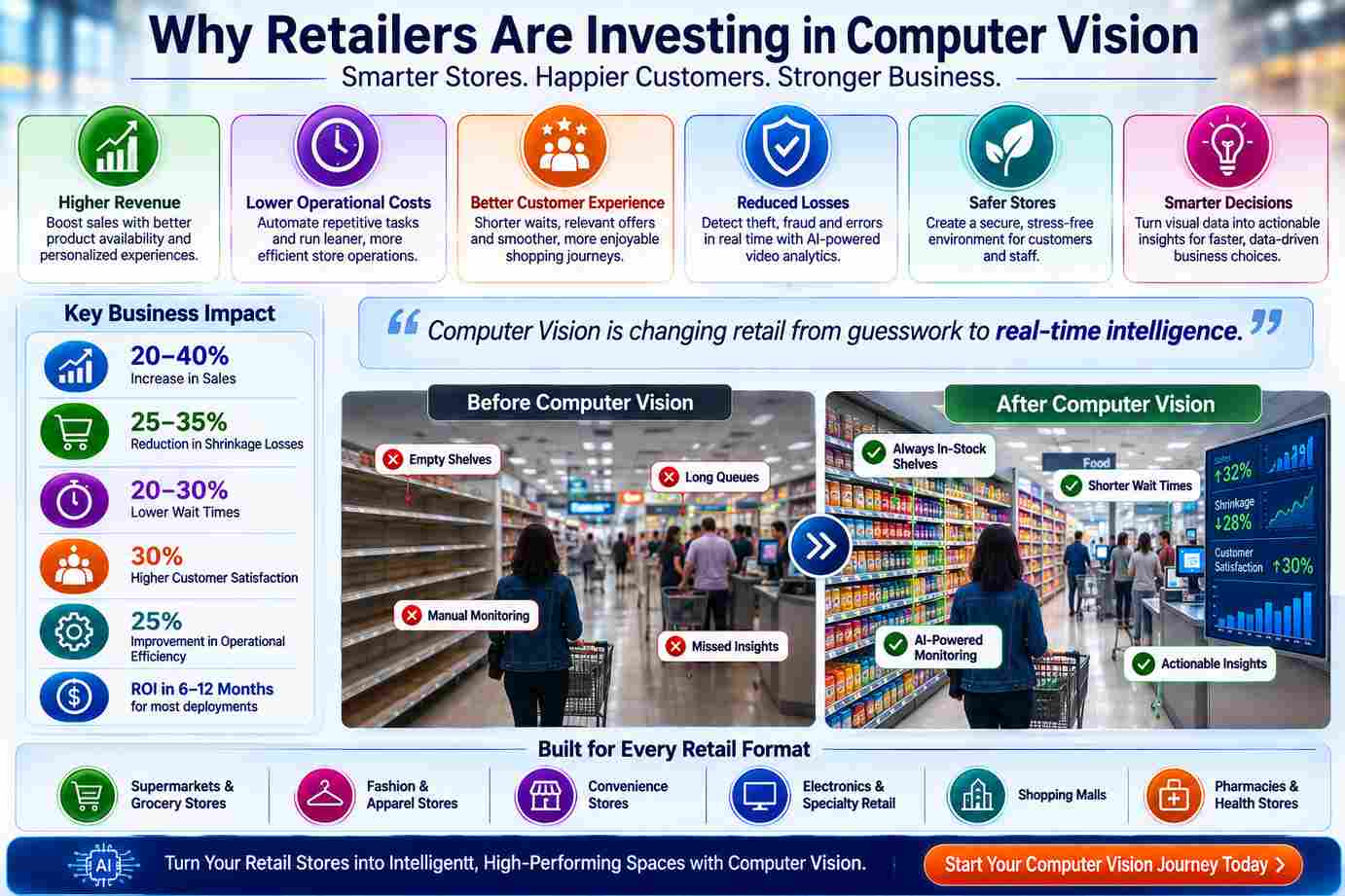
The retailers pulling ahead here aren’t the ones with the most cameras or the fanciest dashboard. They’re the ones who treated computer vision as operational infrastructure from the start — fused sensors where a single signal wasn’t reliable enough, processed data at the edge instead of paying the cloud tax, built in privacy protection instead of retrofitting it after a demand letter, and, most importantly, wired detections directly into action instead of a report nobody reads until the next morning. That last part is the whole point. A system that can see a problem but can’t act on it is just a more expensive camera.
Related Guides
- Computer Vision: The Complete Technical Guide — the full architecture deep dive this piece builds on, covering CNNs, Vision Transformers, and world models
- The Benefits of Computer Vision in Retail Businesses — the beginner-friendly overview of retail use cases
- Object Detection Explained — the underlying technique behind shelf and checkout monitoring
- Image Recognition Explained — the core technology behind SKU-level product recognition
- Facial Recognition Explained — for contrast against the privacy-preserving pose estimation covered above
- How Edge Computing Is Revolutionizing Business — more on the infrastructure pattern behind on-site processing
- How Neural Networks Are Accelerating Research and Innovation — background on how these models learn and adapt
- A Perfect Guide About Machine Learning — foundational ML concepts referenced throughout
- Generative AI Guide — relevant to the EU AI Act Article 50 disclosure requirements for AI-generated retail content
- Automatic Image and Video Caption Generation — related multimodal vision-language technology
- OCR and Document AI — relevant for price-tag and label-scanning applications
- Autonomous Vehicles and Computer Vision — another real-time, safety-critical application of the same core techniques
- Computer Vision in Healthcare — a look at how the same underlying technology is deployed in a very different high-stakes industry