
This Article is a part of
Robotics & IoT AI Resource Center
Computer Vision for Robotics
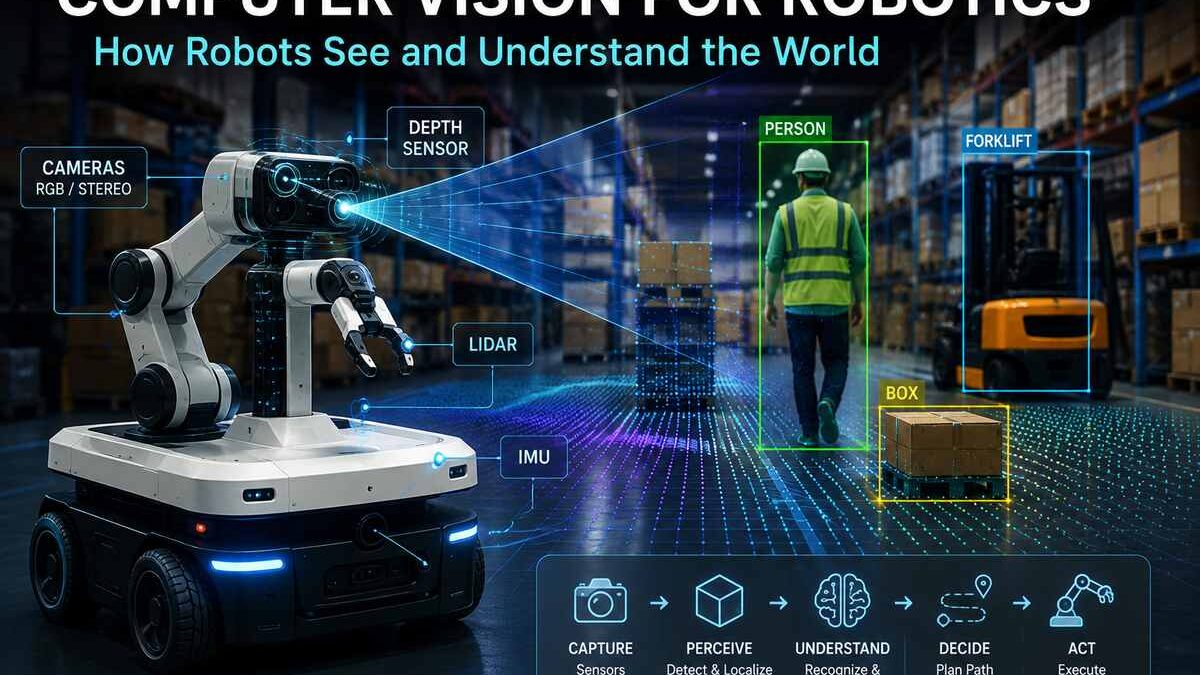
A robot has motors, wheels, an arm and mass amounts of computing power. None of that helps much if it can’t tell what is around it.
With the aid of robot cameras, depth sensors, and the new computer vision software, however it all becomes possible, it can tell when there is a box in view, or a person who is about to cross in front of it, as well as work out distances to what it sees, detect moving objects, and use all that information to decide what to do.
That‘s the potential of Computer Vision to robotics.
But robotic vision isn’t simply Computer Vision copied from a phone or a photo app. The output eventually has to influence a physical machine. A missed detection isn’t just an ugly image. In some task it could be making the robot pick up the wrong objects, bump something, or pause when it is not supposed to.
This is the combination of all the parts in the system.
Table of Contents
What Is Computer Vision for Robotics?
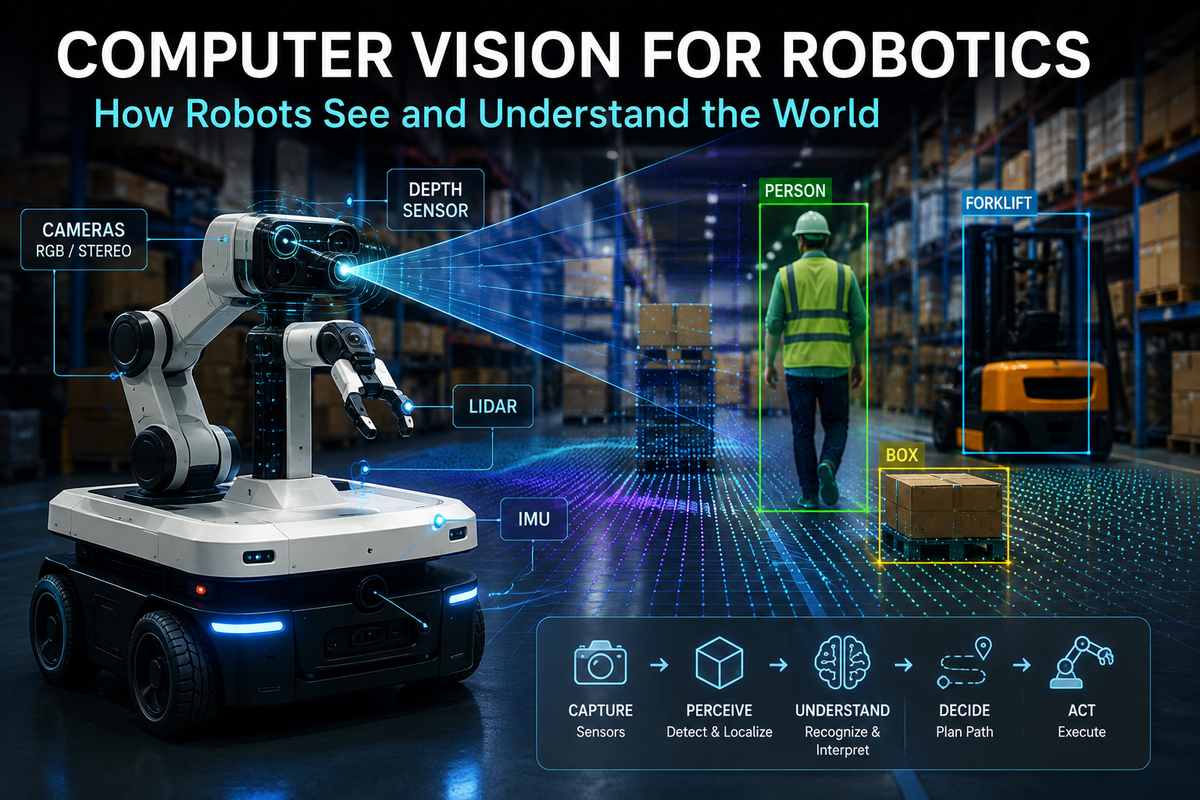
Computer Vision for robotics is the processing of cameras, depth sensors, vision algorithms and AI models to assist robots in understanding their environment.
The basic pipeline looks something like this:
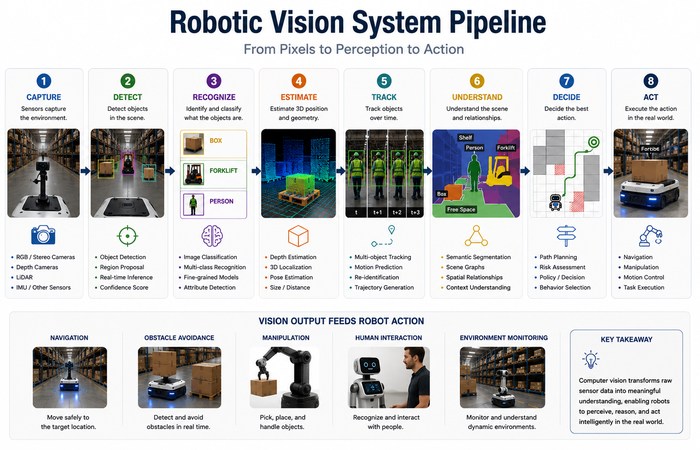
Capture → Detect → Recognize → Estimate → Track → Understand → Act
For instance a warehouse robot could take a photo, locate a pallet, calculate its position, follow it as the robot moves, find out if the path is free, and then send to the navigation or manipulation system.
That last part matters.
Computer Vision is not normally used directly to control a robot’s motors. Instead it supplies information which is used by other robotics systems in navigation, planning and control.
See for a more detailed overview of AI Robotics Fundamentals guide and how AI robots integrate perception, decision making, planning and control.
Robot Vision vs. Computer Vision vs. Machine Vision
The latter two may seem to be similar to the first, but these three are not perfect synonyms:
Machine vision is primarily used to refer to automatic visual inspection and measurement, often in a market where the lighting conditions are strictly controlled, as in industry. For example, a camera may be used to inspect a product for blemishes or check to see if a part is correctly aligned.
Computer Vision goes further. It encompasses techniques for extracting useful information from images and video, such as recognition, tracking, detection, classification and segmentation.
Robot vision which utilizes those same functions in machines that have extra physical interaction with the environment.
This is the key difference. A photo application can classify an image and be finished. A robot needs to turn that visual information into something physically useful.
How Robotic Vision Systems Work
A typical robotic vision system has several stages.
1. Capture
Cameras and other sensors collect information about the environment.
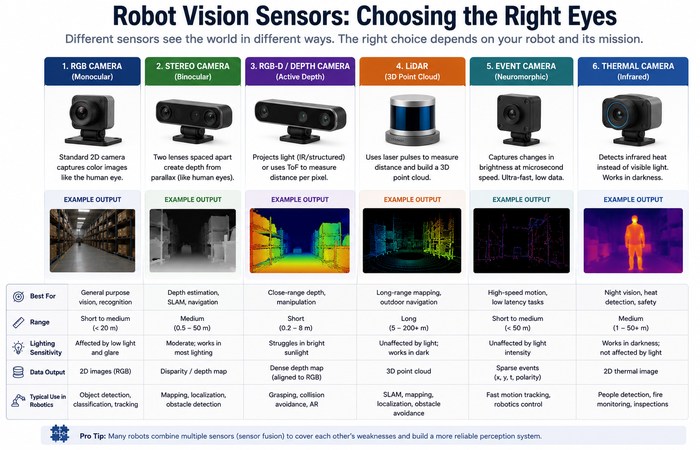
Depending on the robot, this could include:
- RGB cameras
- Stereo cameras
- RGB-D cameras
- Time-of-flight depth cameras
- LiDAR
- Event cameras
- IMUs and other complementary sensors
No single sensor is perfect. Lighting, reflections, occlusion, motion and calibration errors can all affect the data.
2. Perception
The system processes those measurements to identify useful features.
That could mean detecting a person, recognizing a package, estimating depth or identifying an obstacle.
3. Estimation
The robot then needs to estimate things such as object position, distance, movement and its own state.
This is where Computer Vision starts connecting with robotics disciplines such as localization and sensor fusion.
4. Tracking
Instead of treating every video frame as a completely new scene, tracking algorithms associate objects across frames.
That allows a robot to follow a person, monitor a moving package or keep track of an object while its camera moves.
5. Action
The resulting information can be passed to navigation, manipulation or control systems.
In other words:
Vision answers “What is happening?”
Robotics decides “What should I do about it?”
Object Detection for Robots
Object detection answers two questions at once:
What is the object?
and
Where is it?
A robot might detect a box, person, pallet, vehicle or tool and receive a bounding box describing its location in the image.
Contemporary real-time detectors like the YOLO family are prevalent due to their convenient compromises of accuracy, speed and deployment feasibility. Future Ultralytics models will include prediction as well as detection, segmentation, classification, pose estimation and tracking.
For robotics, detection confidence and latency matter just as much as raw accuracy. A model that performs beautifully in a benchmark may still be unsuitable if it cannot process incoming sensor data quickly enough on the robot’s hardware.
We’ll cover Object Detection for Robots in much greater detail in its dedicated sub-cluster.
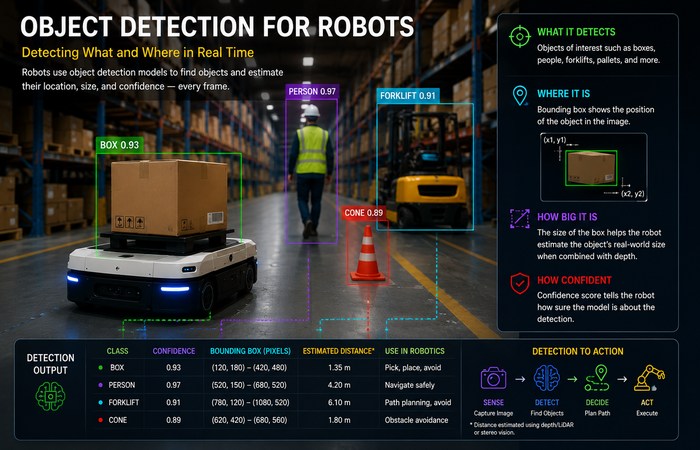
Image Recognition for Robots
Detection and recognition aren’t quite the same thing.
Detection:
“There is a box here.”
Recognition/classification:
“This is a particular type of box.”
That distinction is useful in the areas of warehouses, manufacturing, agriculture and service robots.
A package sorting robot for example is faced with the difficult task of differentiating between many alike looking packages before having to choose exactly which one its gripper should pick up.
Contemporary vision framework are able to merge classification, detection and segmentation rather than each task being totally distinct.
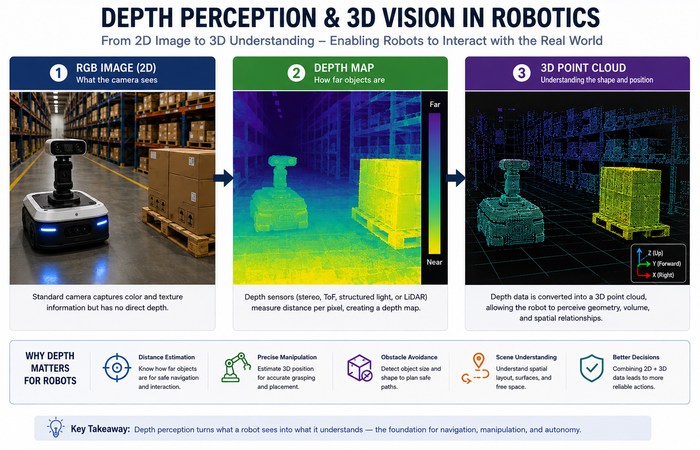
Depth Perception and 3D Vision
A typical RGB camera describes to a robot the appearance of a thing. It doesn’t directly provide the complete 3D geometry of the scene.
That’s where depth sensing becomes valuable.
Robots can obtain depth information through technologies such as:
- Stereo vision
- Time-of-flight cameras
- Structured-light systems
- LiDAR
- Learned monocular depth estimation
LiDAR is useful if you require geometric data for larger environments, whereas depth cameras can provide dense data over large areas for close operations.
You don‘t always have to choose between the two. You can use from a few robot systems providing that sensors they use if their advantages compensate.
Calibration is critical, too. Camera distortion, inaccurate sensor alignment and timing differences can introduce errors that later affect perception and localization.
Our future Depth Perception and 3D Vision sub-cluster can go much deeper into point clouds, stereo geometry, depth estimation and 3D reconstruction.
Visual Object Tracking
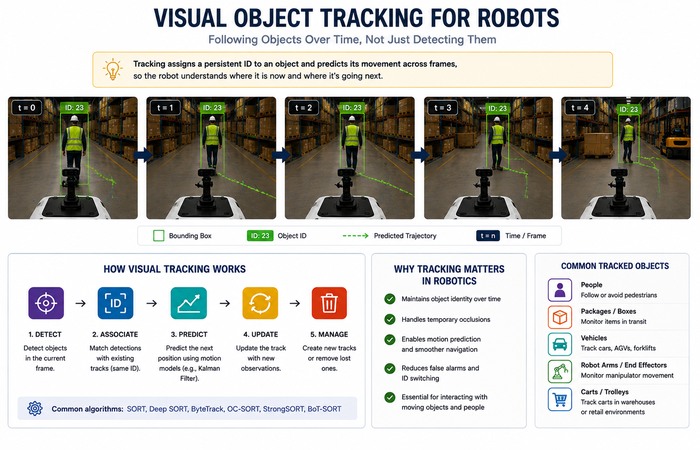
Detection tells a robot where an object is now.
Tracking helps it understand where that object is going.
That’s useful when a robot needs to:
- Follow a person
- Track a vehicle
- Monitor a moving package
- Follow an object during manipulation
- Maintain an object’s identity across video frames
Modern vision frameworks support dedicated tracking workflows, allowing detection and temporal tracking to work together.
For robots, tracking is particularly important because both the camera and the objects in its view may be moving at the same time.
Scene Understanding
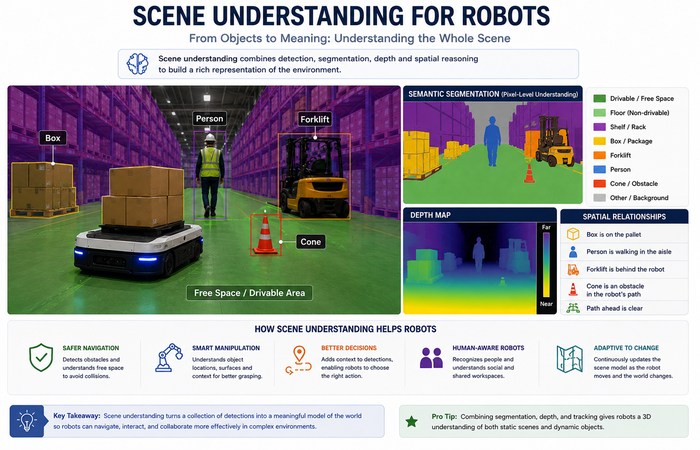
Finding individual objects isn’t enough for many robotic tasks.
Imagine a robot looking at a kitchen.
It needs more than:
“Cup detected. Table detected. Person detected.”
It probably requires the ability to comprehend the cup sits on the table, the person stands next to them and the space behind them is blocked.
That’s the idea behind scene understanding.
The above are just a few of the methods available for extracting context out of the data, with other methods including semantic segmentation, instance segmentation, depth estimation and spatial reasoning that can make a single detection contain much more information about the rest of the scene.
So how is this relevant to manipulation and navigation? Very simply.
Robot Perception: More Than a Camera
Computer Vision is one part of robot perception.
A capable robot may combine:
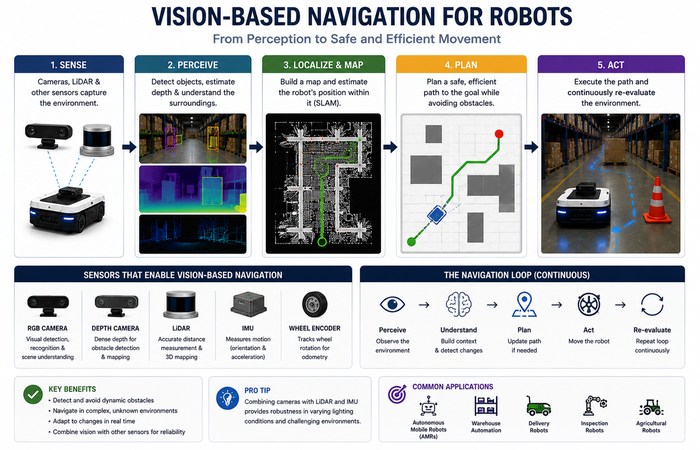
Camera + LiDAR + IMU + wheel encoders + force sensors + other measurements
The resulting system can be more reliable than one relying on a single sensor.
For example, a camera might recognize an obstacle while LiDAR provides useful geometric information. An IMU can provide motion measurements, while wheel encoders contribute odometry.
The process of combining these sources is generally called sensor fusion.
And this is where Computer Vision connects directly to your next robotics cluster: Robot Navigation & Autonomy.
Vision-Based Navigation
Vision can help robots identify obstacles, landmarks, free space and navigable regions.
A mobile robot can use visual information to support localization, mapping and navigation. Camera-based approaches can also be combined with LiDAR and inertial measurements when the application requires greater robustness.
One important distinction: Visual SLAM specifically refers to SLAM systems that use visual information to estimate motion and construct a map. LiDAR-based systems are generally described as LiDAR SLAM rather than Visual SLAM.
We’ll leave the deep dive into SLAM, localization, mapping, path planning, obstacle avoidance and sensor fusion for the dedicated Robot Navigation & Autonomy cluster.
Running Computer Vision at the Edge
Here’s the practical headache: a vision model can be accurate and still be useless on a robot if it’s too slow.
Robots often operate under strict limits on:
- Power
- Size
- Weight
- Compute
- Thermal capacity
- Network connectivity
That’s why edge inference is so important.
Developers can use techniques such as quantization, pruning and model optimization to reduce computational requirements. Frameworks such as TensorRT can optimize inference for NVIDIA hardware, while edge platforms such as NVIDIA Jetson are specifically designed for local AI workloads including computer vision.
The goal isn’t simply maximum accuracy.
It’s finding a useful balance between accuracy, latency, power consumption and reliability.
Challenges of Computer Vision in Robotics
Robotic vision still has plenty of difficult problems.
Lighting changes can confuse cameras. Transparent and reflective objects can cause depth sensors trouble. Occlusion can hide important parts of an object. Motion can introduce blur. A model trained in one environment may perform differently in another.
Then there’s the biggest difference between robotics and ordinary image recognition:
the prediction has consequences in the physical world.
A false positive in a photo search is annoying.
A false detection during robotic manipulation can cause a failed grasp or an unsafe action.
That’s why testing, redundancy, monitoring and appropriate safety mechanisms matter just as much as model accuracy.
Where Computer Vision for Robotics Is Heading
The field is moving toward systems that combine vision with language, action and other sensor modalities.
Vision-Language-Action models are one example. Instead of treating perception and physical action as completely isolated stages, these systems attempt to connect visual observations and natural-language instructions with robot actions.
That direction overlaps with Physical AI and embodied robotics, which we’ll cover separately rather than cramming everything into this article.
What is less visible, but still evident, is the macro trend: The nature of object motion itself is changing as robots evolve from simply recognizing objects to producing more nuanced representations of their surroundings and interacting with them.
FAQs
Q1: What is Computer Vision in robotics?
A: It is the implementation of, as well as the combination of, cameras, depth sensing and artificial intelligence algorithms to allow robots to understand and view the physical world.
Q2: What is the difference between Computer Vision and robot vision?
A: Computer Vision is the broader technology. Robot vision applies it to machines that must use visual information for physical interaction, navigation or manipulation.
Q3: Do robots need depth cameras?
A: Not always. Robots are also able to use stereo cameras, Lidar, time-of-flight sensors and other methods to get their depth information. Which method to use is dependent on the environment and task the robot will be used in.
Q4: Can robots use Computer Vision without AI?
A: Yes. Traditional image-processing and feature-based methods remain useful for controlled tasks. Deep learning has become widely used for more complex and variable visual environments.
Q5: Why do robots use edge AI?
A: Local inference offers benefits in terms of latency, for shortening computing times; reducing reliance on network connection and keeping sensor data on the device. Already in the NVIDIA framework the Jetson ecosystem is ready for local AI and Computer Vision workloads.