
Table of Contents
Introduction: Why This Moment Is Different
Get ten people to define “Robotics and IoT AI” and you‘ll get ten different answers. A few years ago, this phrase was just a tag in a slide deck sensors talking to a dashboard in a cloud, robot arms repeating the same six moves over and over. That‘s not what is shipping in 2026, and that isn‘t what this guide will cover.
Not so long ago, a robot: would have activated a predefined set of instructions; would have executed monotonous activities over and over again, and at the first sign of the unknown, would have either terminated or broken down. IoT devices weren‘t very different instead, might have read data from sensors, pushed information to a cloud, and waited for an operator or some other system to tell them what to do.
Artificial intelligence changed that equation, and that change has outpaced most of what the tech industry has written about it.
Already today, AI based robots can identify objects, process spoken commands, identify damages on production lines, move through warehouses, help surgeons, supervise plantations, work safely in collaboration with humans all of that in real time, at the edge, without the need to send each decision to a far-away data center. Billions of interconnected IoT sensors constantly provide them with live data and enable them to constantly adapt to dynamically changing contexts, instead of simply executing predetermined scripts.
What is really cracking in 2026 is that there are three hot subjects (AI, IoT, and robotics) that previously belonged to separate departments that have coalesced around the same design problem: how to invent sensors in a machine that understand the world (determining what is real and what is not) and almost immediately make physical decisions.
Or maybe it‘s being called “Connected Robotics” this represents a pretty different animal from the AIoT of a few years ago. AIoT was about sensing and messaging. Connected Robotics closes the loop all the way through to a physical action — which means the stack now has to include real hardware constraints (power, heat, latency), new classes of foundation models that output motor commands instead of text, interoperability standards that most coverage barely mentions, and a regulatory environment that’s being actively rewritten while you build.
This guide covers the full picture: the fundamentals of how these systems work, the edge hardware doing the heavy lifting, the Vision-Language-Action models enabling natural language robot control, the industries where deployment is most mature, the middleware architecture nobody outside robotics forums pays close enough attention to, and the EU AI Act deadline that’s considerably messier than most reporting suggests.
Let’s start with the fundamentals.
What Is Robotics & IoT AI?
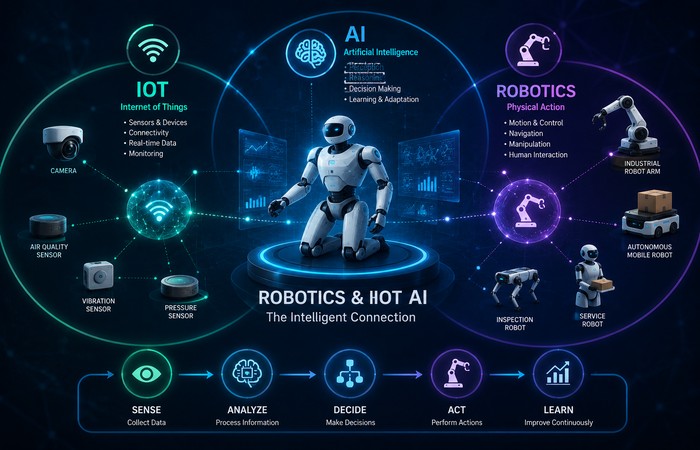
Robotics & IoT AI combines the mightiness of these 3 technologies in a single intelligent system.
Artificial Intelligence (AI) may offer abilities to learn, reason, forecast, plan and make decision. Contemporary robotic systems are heavily depending on Machine Learning algorithms which enhanced ability to make decisions over time learned from data rather than a rule-based approach (Coradesai et al., 2011). Instead of predefined instructions, AI system receives data, recognize patterns, learns and makes forecasts.
IoT, short for Internet of Things, is about connecting sensors, machines and devices to get insight on data in real-time. If your AI is the brain, IoT is the nervous system – constantly sensing the physical world using cameras, LiDAR, radar, GPS, RFID readers, temperature, humidity, pressure, accelerometers, gyroscopes, vibration sensors, air quality sensors and a myriad of other things.
Robotics takes the decisions made by AI and implements it in the real world moving, lifting, checking, carrying, building and interacting with humans and the environment.
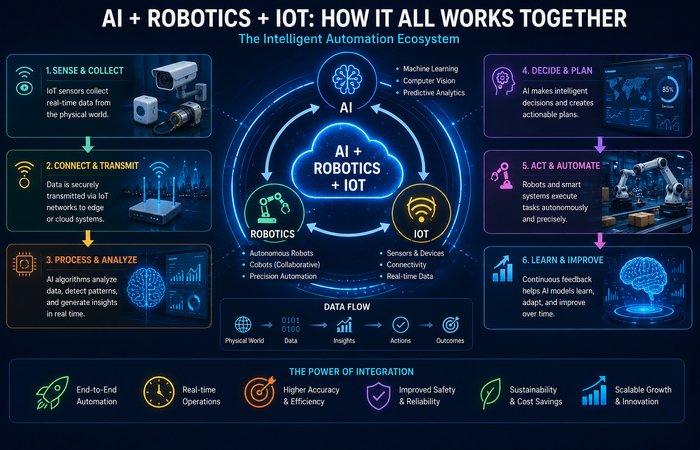
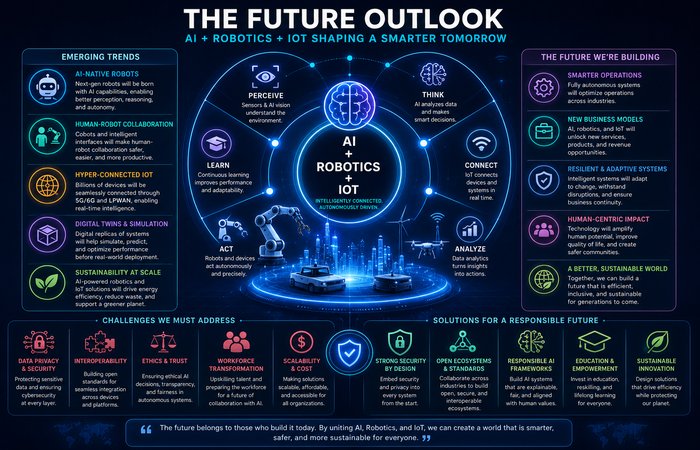
Individually the two technologies are solving different problems. Together the two can provide an completely autonomous system that can sensor its environment, analyze the data, make decisions and take action with as little human intervention as possible. The continuous intelligence loop functions as follows:
Sense → Analyze → Make a Decision → Act → Learn
We encapsulate this loop as what defines the difference between today connected robotics with traditional automation. A traditional robot simply comes to a halt when it encounters an obstacle and expects someone to intervene. An AI equipped AMR detects the obstacle, figures an alternative path on the fly within a fraction of a second and resumes its task. A traditional irrigation system operate on predetermined time schedules irrespective of the state of the soil. An intelligent agricultural robot reads live soil moisture data and modulates the water stream flawlessly.
That adaptive behavior — responding intelligently to a changing world rather than executing fixed rules — is the core promise of Robotics & IoT AI.
Traditional Robotics vs AI Robotics vs Connected Robotics
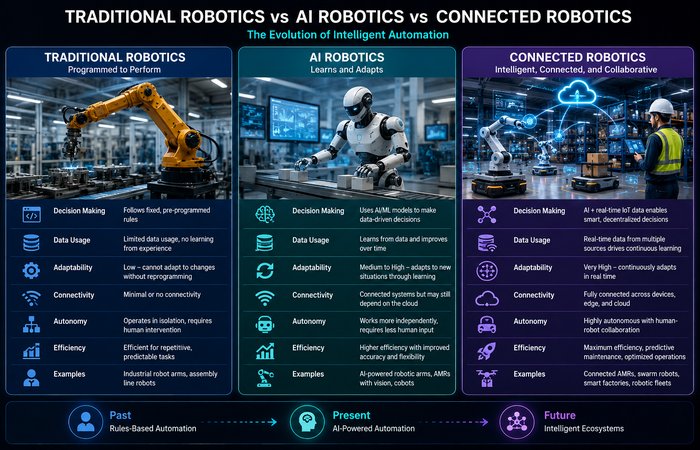
| Feature | Traditional Robotics | AI Robotics | Connected Robotics (Robotics & IoT AI) |
| Decision Making | Follows fixed, pre-programmed rules | Learns from data and adapts to new situations | Learns, collaborates, and continuously optimizes using shared real-time data |
| Connectivity | Usually standalone systems | May connect to cloud platforms | Fully integrated with IoT devices, cloud services, and enterprise systems |
| Learning Ability | No learning capability | Improves through machine learning and AI models | Continuously learns from connected sensors, robots, and operational feedback |
| Data Source | Predefined instructions | Historical and real-time data | Continuous IoT sensor streams, AI models, cloud analytics, and edge devices |
| Communication | Limited or isolated | Supports limited data exchange | Real-time communication between robots, sensors, edge devices, and cloud platforms |
| Adaptability | Limited; struggles with unexpected changes | Adapts to changing environments | Coordinates across multiple connected systems and adapts autonomously |
| Latency | Immediate for fixed tasks only | Depends on AI processing location | Uses Edge AI and Cloud AI for fast, intelligent decision-making |
| Typical Applications | Assembly lines, welding, packaging | Quality inspection, autonomous navigation, predictive maintenance | Smart factories, autonomous warehouses, healthcare, agriculture, smart cities, logistics |
| Intelligence Level | Rule-based automation | Intelligent automation | Autonomous connected ecosystem with perception, reasoning, and coordinated action |
| Best Suited For | Repetitive, predictable tasks | Complex decision-making within individual systems | Large-scale intelligent automation across interconnected environments |
The Three Pillars in Detail
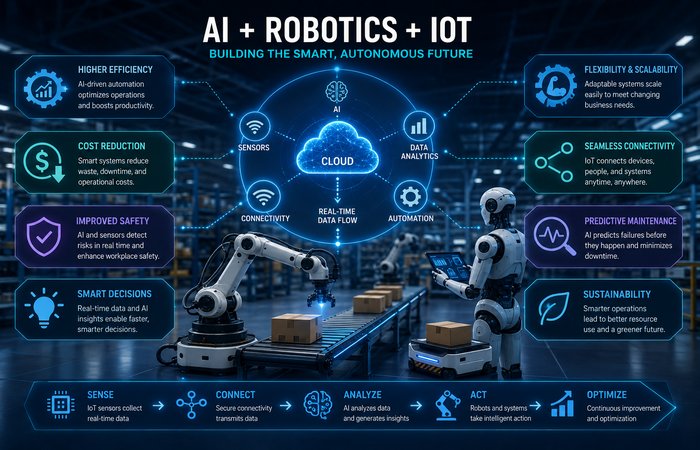
Artificial Intelligence: The Decision Engine
For different use cases, AI in robotics will employ machine learning, deep learning, computer vision, natural language processing, reinforcement learning, generative AI, large language models, or the newer Vision-Language-Action models described in detail later on in this guide. The more operational data they can eat, the better they get.
The Internet of Things: The Sensing Infrastructure
Typical IoT sensor types deployed in robotics & connected systems are; cameras (visual object recognition), LiDAR (dynamic mapping of environment), radar (detection of obstacles in poor visibility conditions), GPS (navigating outdoor spaces), IMU‘s (tracking orientation & movement), ultrasonic (near-by proximity detection), Force & torque (low force manipulation) RFID readers (tracking of inventory), environmental sensors (temperature, humidity, vibration, pressure, air pollution, etc). AI is pointless without the internet of things, as it has no tangible environment to work with. Surely this is where the sensor layer comes into play providing the ambience.
Robotics: The Physical Workforce
There is a large and varied range of contemporary robots, classified by application or sector; there is a multitude of industrial robotic arms, autonomous mobile robots (AMRs), automated guided vehicles (AGVs), surgical robots, agricultural robots, surveillance drones, warehouse robots, humanoids and service or delivery robots. The difference between the smart robot and its previous generation does not lie in the precision; they adapt their movements according to an environment and ensure safety of human as opposed to the traditional robot performing the same moves within a cage.
The Architecture: How the Three Technologies Work Together
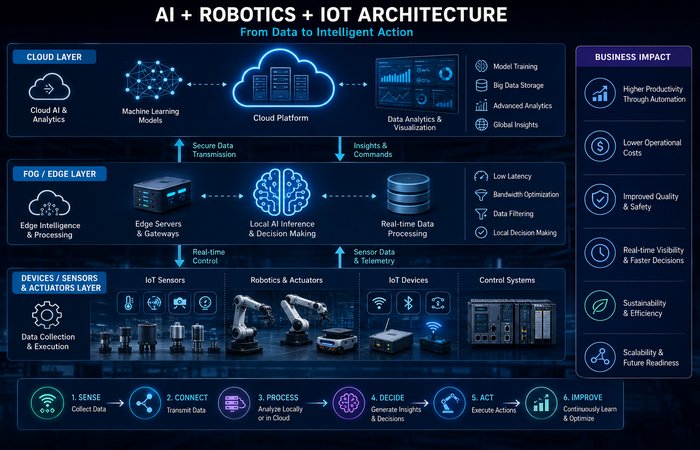
The practical operation of these systems requires an intimate understanding of the architecture which comprises perception, communication, intelligence, action and learning. This architecture is being collectively termed Connected Robotics and is the foundation of many of the Industry 4.0 projects being deployed all around the world.
At its core, the workflow runs:
Perception → Communication → Intelligence → Decision → Action → Continuous Learning
Layer 1: Perception — Understanding the Physical World
A robot making a decision, before it can decide, needs an accurate representation of its environment. An autonomous warehouse robot does not just “look” at the shelves, rather he fuses, camera images, LiDAR, wheel encoders and proximity sensors measurements to create a continuously updated 3-D representation of its environment. The more types of sensors used, the more information the AI has to interpret the scene.
Layer 2: Communication — Connecting Everything
Gathering the data is only beneficial if that data is delivered to the appropriate systems in a timely and secure manner. Today‘s deployments utilize numerous different communication protocols depending upon the requirements: Ethernet and Industrial Ethernet for dependable wire connections; Wi-Fi 6 and Wi-Fi 7 for high-throughput wireless; 5G private networks for high-density, low-latency deployments; Bluetooth Low Energy for short-range device interfacing; Zigbee, Thread and LoRaWAN for energy-efficient IoT devices; MQTT for lightweight messaging; OPC UA for industrial M2M messaging.
A smart farm covering thousands of acres could use LoRaWAN to connect the machines due to its long range and low power capability. Inside a factory, a robotic assembly line could use Industrial Ethernet to synchronize all other machinery with sub-millisecond accuracy. The choice of connectivity technology shapes what’s possible in terms of latency, reliability, and scale.
Layer 3: Intelligence — Where AI Makes Decisions
On arrival, AI turns sensor readings into intelligent choices. Using computer vision, models determine which items on a manufacturing conveyor are defective. Using machine learning, models forecast the likely timestamps of motor failures. Using reinforcement learning, models allow autonomous robots to share discoveries about faster navigation. Using large language models, technicians give natural language orders – Inspect Conveyor Line Three and report abnormal motor temperatures – with the machine understanding the semantics rather than the syntax.
Layer 4: Action — Translating Decisions into Movement
Robots execute what the intelligence layer decides. Robotic controllers continuously receive updated instructions while monitoring sensor feedback to ensure movements remain safe and accurate. With these new forms of automation however the process is not repeating the same actions in exactly the same manner each time, but the process modifies its operations as the surroundings alter the machine redirects its path to accommodate a new obstacle; adjusts the amount of pressure at which it grasps something due to the object being heavier or lighter; or switches the sequence of assembly steps if an assembly is found in a different location.
Layer 5: Learning — Continuous Improvement
Every completed task generates new operational data. It also gives the AI models an area nearby in which to calibrate the navigation strategies, motion planning, energy planning, object recognition, predictive maintenance models, fleet control, and human robot interaction. The loops of feedback keep robotics a dynamic, learning intelligent system and not just a static automation. The example given is if the warehouse robot regularly gets caught in massive traffic jams at the loading docks at noon every day the AI system could automatically suggest alternate routing schemes or schedules in order to avoid the issue.
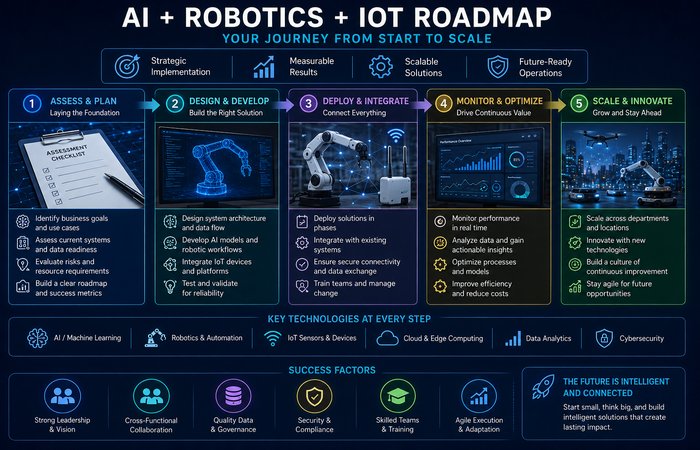
Edge AI vs. Cloud AI: Where Should Intelligence Live?
One of the most consequential architectural decisions in any Robotics & IoT AI deployment is where AI processing should happen. The answer in 2026 is almost always: both, in a carefully designed hierarchy.
Edge AI
Edge AI runs in the robot itself or on edge hardware in the immediate vicinity. Advantages include extremely low latency, evolved decision-making speed, improved privacy, bandwidth savings, seamless operation in the event of poor internet connection. Edge AI is essentially essential when the application is timing sensitive and highly reliable self-driving cars, surgical robotics, factory robots, drone navigation, cobots, industrial safety. If you need a robot to stop in milliseconds without crashing into a worker, you can‘t wait for a cloud round-trip.
Cloud AI
Cloud platforms provide virtually unlimited computing power for tasks that aren’t time-critical. Common cloud workloads include training AI models, running long-term analytics, managing robot fleets, operating digital twins, generating enterprise dashboards, running predictive maintenance across multiple facilities, and deploying software updates across thousands of connected robots simultaneously.
The Edge–Fog–Cloud Architecture
As deployments become more complex, a three-tier architecture has emerged as the standard approach. The edge layer sits on the robot itself and handles sensor processing, motor control, and obstacle avoidance, vision inference, and emergency safety decisions— responses within milliseconds. The fog layer is the direct (local) coordination center for fleet coordination, local analytics, factory-wide optimization, filtering data, load balancing from multiple robots, etc., where there is no need to route all of the information to a faraway cloud server it reduces latency and bandwidth cost while increases resilience. The cloud layer delivers enterprise-scale intelligence including AI model training, aggregated analytics, and predictive maintenance across multiple plants, business intelligence dashboards, software update, digital twins, long-term compliance reports.
Get this wrong and you have your robot either not able to respond quickly enough to avoid a hazard, or carrying too much computation all the way to the edge at a considerable cost. Most of the engineering debates in this field trace back to this one architectural question.
The Hardware Doing the Heavy Lifting: Jetson Thor and Edge Compute
None of the above works without silicon that can run large multimodal models locally, in real time, without a rack of GPUs and a data center power bill. That’s the gap NVIDIA’s Jetson Thor family was built to fill, and the actual specifications matter for understanding what a robot can and cannot do in practice.
| Module | Peak AI Compute (FP4, sparse) | GPU | Memory | Networking |
| Jetson T5000 | 2,070 TFLOPS | 2,560-core Blackwell, 96 Tensor Cores | 128GB LPDDR5X | 4x 25GbE |
| Jetson T4000 | 1,200 TFLOPS | 1,536-core Blackwell, 64 Tensor Cores | 64GB LPDDR5X | 3x 25GbE |
| Jetson T3000* | up to 865 TFLOPS | 1,536-core Blackwell | 32GB LPDDR5X | 25GbE |
| Jetson T2000* | up to 400 TFLOPS | 1,024-core Blackwell | 16GB LPDDR5 | 10GbE |
The flagship module, the T5000, delivers up to 2,070 FP4 teraflops of sparse AI compute, built on a Blackwell-architecture GPU with 2,560 CUDA cores and 96 fifth-generation Tensor Cores, paired with 128GB of LPDDR5X memory and a 14-core Arm Neoverse-V3AE CPU. The T4000 scales that down to 1,200 TFLOPS with a 1,536-core GPU and 64GB of memory — still enough to run 7B–30B parameter models locally without needing to phone home. Both modules run in a 40–130W power envelope depending on configuration, and NVIDIA’s figures put them at roughly 7.5x the AI performance and 3.5x the energy efficiency of the previous-generation Jetson AGX Orin. The developer kit has been shipping since August 2025 at $3,499.
*The T2000 and T3000 are recently announced mainstream modules sitting below the T4000/T5000 tier, with final specifications and pricing expected to firm up ahead of their scheduled early-2027 availability.
This compute headroom is what makes running a Vision-Language-Action model on the robot itself practical rather than theoretical. It’s also what’s let fields like surgical robotics move from mechanical teleoperation — a surgeon’s hand movements mechanically scaled down — toward systems that reason about the surgical field in real time. Virtual Incision has already built its surgical robotics work around this class of edge compute. NVIDIA’s early Jetson Thor adopters reportedly include Amazon Robotics, Caterpillar, Meta, Figure, Agility Robotics, and Boston Dynamics — a mix spanning warehouse logistics, heavy equipment, and humanoid platforms that signals this is not a single-industry bet.
Choosing Hardware: The CET Framework
A more practically useful way to think about hardware selection than raw TFLOPS figures is the CET framework — Cost, Energy, and Time. Instead of asking which chip has the highest benchmark number, the question becomes: which platform hits your latency requirement at the lowest energy draw and the lowest per-unit cost, for your specific model and task? A lightweight model like SmolVLA running on a mid-tier module can outperform an expensive rig running a bloated architecture, if the task doesn’t require the additional headroom. A $6,000 humanoid running a well-tuned small model can be more commercially viable than a $50,000 platform running a model that’s oversized for the job.
Physical AI and Embodied Intelligence
Physical AI: From Understanding to Interacting
Traditional AI has become remarkably good at understanding text, generating images, writing code, and answering questions. But understanding information isn’t the same as interacting with the physical world. Physical AI focuses on that next step — enabling a machine to pick up fragile objects, navigate crowded environments, open doors, assemble products, inspect infrastructure, assist surgeons, harvest crops, or safely collaborate with people.
Traditional AI thinks. Physical AI thinks and acts.
To accomplish this, robots combine computer vision to understand surroundings, machine learning to recognize patterns, motion planning algorithms to calculate safe movements, sensor fusion to integrate data from multiple sensor types simultaneously, reinforcement learning to improve performance through experience, and edge AI for real-time decision-making — all running together within a continuous feedback loop.
Embodied AI: Intelligence That Learns Through Doing
Embodied AI takes the physical AI concept a step further. Humans don’t learn solely by reading books — we learn by interacting with the world, touching objects, walking, observing consequences, making mistakes, and adapting. Embodied AI applies the same principle to robots. Rather than relying only on pre-programmed rules, robots that learn through embodied experience improve by interacting with real environments. Every movement generates feedback that helps the AI refine future decisions. A household robot learning to load a dishwasher may initially struggle with different plate sizes or unexpected utensil arrangements. Over time, as it encounters more scenarios, its grasping strategy and motion planning become increasingly reliable.
This capacity to continuously improve through physical experience is one of the defining characteristics of next-generation robotics, and it’s why the data that feeds these systems has become the primary competitive differentiator — not the model architecture itself.
System 1 and System 2: How Robots Think Fast and Slow
Borrowed loosely from the psychology of human decision-making, this framing has become one of the more useful ways to describe robot cognition, and it maps directly onto the edge-fog-cloud architecture above.
System 2 is the slow, deliberate reasoning layer — a vision-language model figuring out what task to do next, parsing an instruction like “clear the table but leave the mug,” and planning a sequence of steps. This is high-level goal interpretation and task sequencing.
System 1 is the fast layer: high-frequency, low-level visuomotor control that translates that plan into actual joint movements, dozens or hundreds of times per second, without waiting for the slower reasoning loop to catch up. This is where the physics of real-world manipulation happens — reacting to unexpected surface friction, adjusting grip force when an object shifts, stopping before a collision.
Decoupling the two matters because they have fundamentally different latency and reliability requirements. You don’t want a robot’s gripper to freeze mid-grasp because the language model upstream is still reasoning about what to do next. Most of the more credible humanoid and manipulation platforms shipping today build in some version of this split, even if they don’t always use the System 1/System 2 label for it.
Vision-Language-Action Models: Teaching Robots to Understand Human Instructions
One of the most significant advances in modern robotics is the emergence of Vision-Language-Action (VLA) models — the technology that lets a robot take an instruction in plain language, look at a scene through a camera, and output an actual physical trajectory instead of just a text response.
Vision-Language-Action models combine computer vision with Natural Language Processing (NLP), allowing robots to understand spoken or written instructions before translating them into physical actions.
The Problem with Traditional Robot Programming
Traditional robots required highly structured, step-by-step instructions: move forward, stop, rotate 45 degrees, pick object, move back. Every instruction had to be carefully defined in advance. The moment conditions deviated from what was programmed, the robot failed.
Asking a conventional robot to “organize this table” is a request it cannot interpret. Which objects belong together? Where should they be placed? What if something is missing or in an unexpected position? Traditional programming becomes impractical the moment instructions need to accommodate real-world variability.
How VLA Models Work
VLA models like RT-2, GR00T, and π0 solve this by creating a shared embedding space — visual input and language input get projected into the same representational framework, and an action decoder translates that combined representation into motor commands rather than a sentence.
The process combines three forms of intelligence:
Vision: The robot observes its surroundings using cameras and depth sensors, identifying objects, people, shelves, obstacles, tools, and workstations. Many of these capabilities are powered by Computer Vision, enabling robots to recognize objects, inspect products, interpret environments, and safely navigate dynamic workplaces.
Language: Natural language models interpret human instructions by understanding intent rather than matching exact command syntax. An instruction like “bring me the wrench” triggers a sequence of decisions — identify the correct tool, determine its location, plan a safe route to reach it, grasp it securely, deliver it to the user.
Action: Motion planning software converts those decisions into precise motor movements. The robot doesn’t just know what to do — it knows how to do it safely in its current environment.
This combination enables far more flexible, adaptive, and collaborative robotic behavior than traditional programming approaches allow. Users can issue instructions like “pick up the blue container on the second shelf,” “inspect the damaged package,” “move all empty pallets near the loading dock,” or “deliver these supplies to Operating Room 4” — and have the robot interpret and execute those instructions without requiring manual programming of every possible scenario.
The Data Engine Problem
The hard problem in VLA development isn’t model architecture at this point — it’s data. Training a VLA well enough that it generalizes to a kitchen counter it’s never seen requires an enormous number of grounded, physically accurate trajectories, and unlike training a language model on scraped internet text, you can’t just crawl the web for robot demonstration data.
Real-world datasets like Open X and DROID provide authenticity — true friction, true contact dynamics — but scaling them means scaling human labor, which is slow and expensive by definition. Purely synthetic datasets like SynGrasp-1B solve the scale problem but run into the well-known sim-to-real gap: a robot trained entirely in a physics simulator often fumbles when the real world doesn’t behave quite like the simulation predicted. An approach called SimplerEnv has gained traction specifically because it optimizes for something more useful than photorealism — ranking consistency, meaning a model’s relative performance across tasks in simulation reliably predicts its real-world performance. That’s a more honest evaluation metric than visual fidelity alone.
Several distinct data-generation strategies have emerged in parallel:
- Video-to-data approaches retarget ordinary human videos into robot-compatible training data through inpainting and world models
- Hardware-assisted approaches like ALOHA and the GoPro-equipped UMI gripper use cheap teleoperation rigs to collect real “in the wild” demonstrations without requiring full lab infrastructure
- Generative approaches like MimicGen and RoboGen use large language models to invent plausible tasks and write simulation code to generate them automatically, or use diffusion models to synthesize visual variations of real footage
The honest summary of where this field stands: model size stopped being the moat. The bottleneck shifted to whoever has the better data engine — the pipeline that keeps producing grounded, diverse, physically valid training data without requiring an army of human demonstrators for every new task. If you’re evaluating vendors or platforms in this space, asking about the data pipeline is a more revealing question than asking about model parameter counts.
ROS 2 and the Middleware Layer: The Infrastructure Nobody Talks About Enough
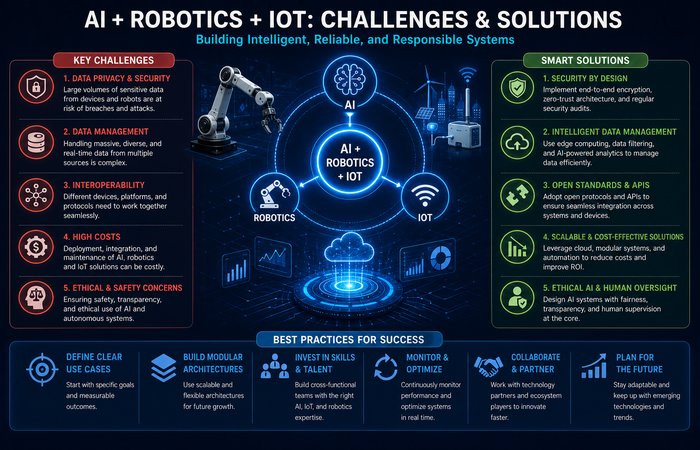
Building intelligent robots involves many independent software components — one program processes camera images, another controls robotic arms, another handles navigation, yet another manages speech recognition. Without a common communication framework, integrating all these systems would be expensive, slow, and fragile.
Robot Operating System 2 (ROS 2)
Despite its name, ROS 2 isn’t a traditional operating system like Windows or Linux. It’s an open-source robotics middleware — a framework that allows different software components to communicate efficiently. It has become the de facto standard for modern robotics development and is widely used in both research environments and commercial deployments.
ROS 2 helps developers connect sensors, coordinate robot movements, share data between software modules, integrate AI models, manage multiple robots, and build scalable systems. Frameworks like Nav2, which handles autonomous navigation, and the many fleet coordination stacks built on top of ROS 2 are what most production robotic deployments are running today.
The Interoperability Problem
Factories often deploy robots from multiple vendors alongside equipment from different generations, each using proprietary communication protocols. Without standardized middleware, integrating everything becomes expensive and time-consuming — effectively a “Tower of Babel” problem where incompatible systems can’t exchange information despite all being technically sophisticated.
Middleware frameworks like ROS 2, industrial communication standards like OPC UA, and interoperability protocols provide a common language that allows different robots, sensors, and enterprise systems to exchange information reliably. As organizations expand automation across multiple facilities, interoperability becomes just as important as AI model performance.
What’s Pushing at ROS 2’s Limits
There’s active research exploring the boundaries of what ROS 2 can do. A middleware proposal called Meta-ROS, published in early 2026, claims up to 30% higher throughput and lower message latency than ROS 2 by building on newer communication protocols like Zenoh and ZeroMQ rather than ROS 2’s DDS foundation. Worth being clear about, though: this is a research proposal, not an adopted industry standard. ROS 2 is what’s running in production fleets today, and it will stay that way for a while yet.
Matter and the Consumer IoT Side
On the consumer and smart-home side of IoT, Matter is doing the equivalent coordination job — a shared protocol letting AI agents or home hubs control devices from different manufacturers locally, over IP, without routing through each vendor’s proprietary cloud. That local-first design is what keeps latency and privacy exposure down for anything approaching agentic home control. One important deadline worth knowing: starting in 2026, all Matter certification testing is required to go through the Connectivity Standards Alliance’s own Interop Test Lab rather than the older certification pathway — a real bar for any product team planning a launch this year.
Robotics & IoT AI by the Numbers
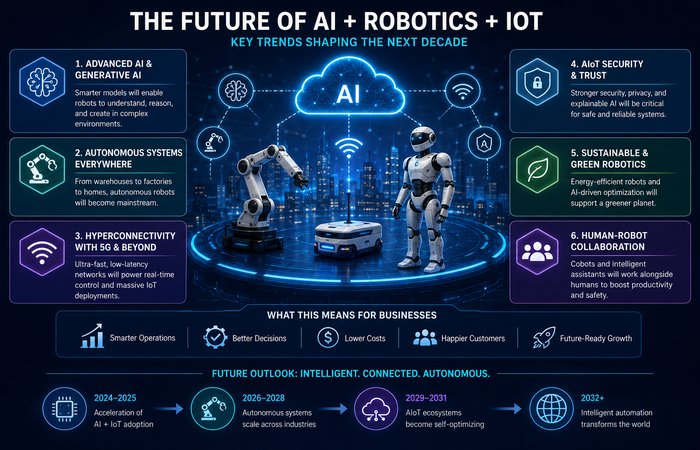
The rapid convergence of robotics, artificial intelligence, and IoT is supported by measurable growth across manufacturing, industrial automation, and edge computing. While individual market forecasts vary because analysts use different definitions and methodologies, the overall direction is clear: intelligent, connected robotics is expanding rapidly across industries.
Key Industry Statistics (2025–2026)
| Statistic | Latest Figure | Why It Matters |
| Industrial robots installed worldwide (2024) | 542,000 units | Annual robot installations have remained above 500,000 for four consecutive years, highlighting sustained global investment in automation. |
| Industrial robots operating worldwide | 4.66 million units | The global operational robot fleet reached a record high in 2024, growing approximately 9% year over year. |
| Asia’s share of global robot installations | 74% | Asia continues to dominate industrial robotics adoption, driven primarily by manufacturing expansion and automation investments. |
| China’s share of new industrial robot installations | 54% | China remains the world’s largest robotics market, installing approximately 295,000 industrial robots during 2024. |
| India’s industrial robot installations (2024) | 9,100 units | India recorded its highest-ever annual robot installations, reflecting increasing automation across automotive and manufacturing sectors. |
A Note on Market Forecasts
Forecasts for the broader AI robotics, service robotics, and Robotics & IoT AI markets often differ significantly between research firms because they include different categories of products and services. Some reports focus only on industrial robots, while others include service robots, autonomous vehicles, healthcare robotics, AI software platforms, and IoT infrastructure.
Rather than relying on a single market-size estimate, it’s more useful to focus on the consistent long-term trends:
- Industrial robot deployments continue to reach record levels.
- AI is becoming a standard capability in new robotic systems rather than an optional feature.
- Edge AI hardware is enabling more real-time decision-making directly on robots.
- Connected robotics is expanding beyond manufacturing into healthcare, agriculture, logistics, retail, and smart cities.
- Governments and regulators are introducing new AI governance frameworks, making compliance an increasingly important part of robotics system design.
Real-World Applications Across Industries
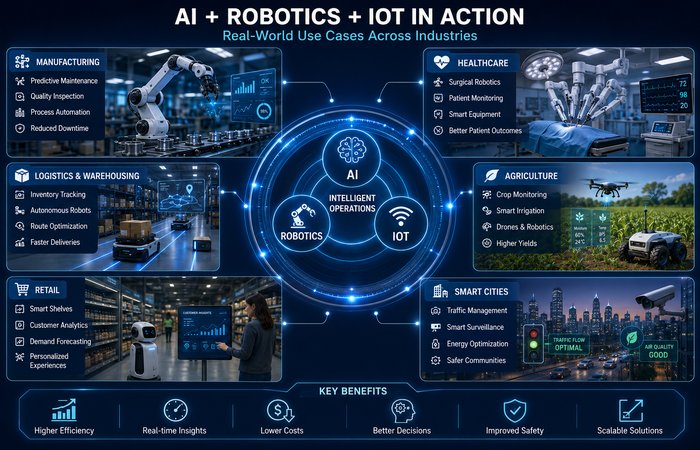
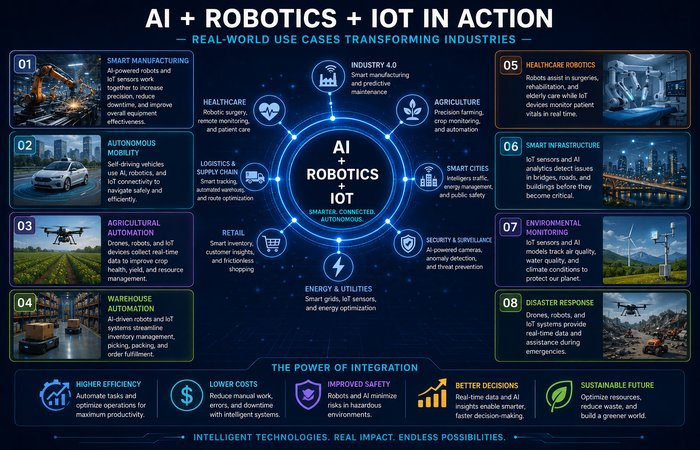
The true value of Robotics & IoT AI isn’t found in research labs — it’s found in solving real business problems. What makes these systems different from traditional automation is their ability to adapt. Rather than simply repeating programmed tasks, AI-powered robots continuously analyze sensor data, learn from experience, and respond to changing environments.
Smart Manufacturing and Industry 4.0
Manufacturing has become one of the largest adopters of Robotics & IoT AI. Modern factories no longer rely on isolated machines — they operate as connected production ecosystems where robots, sensors, AI software, and manufacturing systems communicate continuously.
IoT sensors installed across production equipment monitor temperature, vibration, pressure, machine speed, power consumption, tool wear, and product quality. AI analyzes this data in real time to detect abnormalities before they become failures. Industrial robots handle repetitive tasks like welding, assembly, painting, packaging, material handling, and quality inspection. Computer vision systems inspect finished products with a level of consistency and speed that manual inspection cannot match at scale.
An automotive factory assembling electric vehicles, for example, can use robotic arms equipped with AI-powered vision systems to verify weld quality in real time while vibration sensors monitor production equipment for early signs of bearing failure. If AI predicts a potential issue, maintenance teams receive alerts before an unexpected shutdown occurs — the approach known as predictive maintenance, which reduces unplanned downtime, improves equipment utilization, and extends the lifespan of critical machinery.
Intelligent Warehousing and Logistics
The rapid growth of e-commerce has transformed warehouses into highly automated distribution centers. Unlike traditional Automated Guided Vehicles (AGVs) that follow fixed routes, modern Autonomous Mobile Robots (AMRs) use AI, computer vision, LiDAR, and real-time mapping to navigate dynamically. Typical applications include inventory transportation, goods-to-person picking, order fulfillment, shelf scanning, cycle counting, package sorting, and loading assistance.
Computer vision also supports identity verification and intelligent security systems through technologies like Microsoft Facial Recognition, which demonstrates how AI can recognize and verify individuals in real-world applications.
IoT sensors track inventory locations while AI determines the most efficient routes for every robot based on current demand and warehouse traffic — evaluating robot locations, battery levels, congestion, order priority, and shelf accessibility simultaneously to assign tasks to the robot most likely to complete them efficiently. This continuous optimization improves throughput without requiring additional floor space.
The combination of connected sensors and intelligent analytics is transforming industrial automation. Learn how AI and Machine Learning enhance IoT applications to enable predictive maintenance, anomaly detection, and real-time operational insights.
Healthcare and Intelligent Medical Robotics
Healthcare is moving beyond robotic-assisted surgery toward fully connected clinical environments. Instead of focusing solely on mechanical precision, hospitals are integrating AI, robotics, medical imaging, and IoT devices into unified systems that support diagnosis, treatment, monitoring, and post-operative care.
Medical robotics increasingly relies on advanced imaging and AI-assisted diagnostics. Explore how Computer Vision is transforming healthcare through intelligent image analysis, disease detection, and clinical decision support.
Surgical video has emerged as the richest data layer in an operating room — it captures context that motion-tracking data alone cannot — but it’s only valuable if it’s interoperable, which means tying it to standards like ICD-11 for classification, SNOMED CT for terminology, and HL7/DICOM for data exchange between systems. Real-time processing enables things like flagging a retained surgical instrument or an unexpected anatomical risk during the procedure itself, not after.
The vendor landscape has been moving fast, and market size estimates vary considerably depending on which analyst firm and definition of “surgical robotics” you use — 2026 estimates range from roughly $9 billion to well over $13 billion, with most firms projecting double-digit compound growth through the early 2030s regardless of the baseline figure.
Intuitive Surgical’s da Vinci 5 remains the dominant soft-tissue platform and the company is expanding into cardiac programs. Medtronic’s Hugo is expanding into ambulatory surgery centers and, following FDA clearance of its Stealth AXiS navigation system in February 2026, into spine and cranial procedures. Stryker’s Mako continues broadening its orthopedic footprint.
And in one of the more revealing strategic moves of the year, Karl Storz — having acquired Asensus Surgical in 2024 — announced in June 2026 that it’s discontinuing the Senhance robot and the in-development Luna platform entirely, retiring the Asensus brand, and folding its software, clinical data, and AI expertise into Karl Storz’s broader R&D organization. That’s a fairly explicit bet that standalone mechanical robotics platforms are a weaker long-term position than owning the data and imaging layer across an entire operating room.
Beyond surgery, hospitals are deploying autonomous service robots that transport medications, laboratory samples, and medical supplies throughout facilities while avoiding staff, patients, and equipment. Connected medical devices continuously collect patient information — heart rate, oxygen saturation, blood pressure, temperature — and AI analyzes these readings to identify potential complications earlier than traditional monitoring allows.
Precision Agriculture and Smart Farming
Agriculture is becoming increasingly data-driven. Farmers now combine robotics, IoT sensors, drones, satellite imagery, and AI analytics to improve crop yields while reducing water, fertilizer, and pesticide usage. IoT sensors continuously monitor soil moisture, temperature, humidity, nutrient levels, and weather conditions. AI combines these measurements with satellite imagery and historical data to determine exactly where irrigation or treatment is needed.
Instead of watering an entire field uniformly, an AI-powered irrigation system identifies dry zones and supplies water only where necessary — reducing water consumption while maintaining healthier crops. Computer vision systems mounted on agricultural robots identify weeds and apply herbicide treatment with precision that traditional spraying methods cannot match. Specific yield and cost-savings figures quoted in marketing materials vary enough by farm, crop, and region to be treated as directional rather than universal, but the underlying efficiency gains are consistent across deployments.
Retail and Smart Stores
Retailers use Robotics & IoT AI for shelf inventory monitoring, autonomous floor cleaning, automated checkout, warehouse fulfillment, demand forecasting, personalized recommendations, loss prevention, and customer behavior analysis. Autonomous inventory robots patrol store aisles using cameras and computer vision to identify empty shelves, pricing errors, or misplaced products. IoT-enabled shelves automatically detect inventory changes and notify warehouse systems when replenishment is needed.
Retail automation also benefits from intelligent image analysis. Read more about the benefits of Computer Vision in retail businesses, including shelf monitoring, customer analytics, and automated inventory management.
Smart Cities and Urban Infrastructure
Cities are becoming increasingly connected through millions of IoT devices embedded in transportation systems, utilities, public infrastructure, and environmental monitoring networks. Traffic cameras, road sensors, and connected traffic lights collect continuous data about vehicle flow. AI adjusts signal timing dynamically to reduce congestion during peak hours. Inspection robots examine bridges, tunnels, pipelines, and utility infrastructure — identifying cracks, corrosion, or structural defects without exposing workers to hazardous environments.
Energy, Utilities, and Infrastructure Inspection
Autonomous drones equipped with thermal cameras detect overheating electrical components before failures occur. Ground robots inspect confined spaces that would otherwise require human entry. IoT sensors continuously monitor equipment health while AI predicts maintenance needs based on operational trends across power plants, wind farms, solar installations, and oil and gas infrastructure. This proactive approach minimizes unexpected outages and reduces maintenance costs.
Construction and Infrastructure Development
AI-powered drones generate highly detailed 3D maps that project managers use to compare actual construction progress against digital building models. IoT sensors installed on heavy machinery monitor engine health, fuel consumption, and maintenance requirements. Applications span autonomous surveying, bricklaying robots, concrete inspection, equipment monitoring, progress tracking, safety compliance, and drone-based site mapping.
Defense, Disaster Response, and Public Safety
Autonomous drones provide aerial situational awareness during natural disasters, chemical spills, explosive ordnance disposal operations, and search and rescue missions. Ground robots inspect unstable buildings or hazardous environments before emergency personnel enter. Real-time sensor data combined with AI-driven analysis improves decision-making during rapidly evolving situations where seconds matter.
Consumer Robotics
Robot vacuum cleaners, robotic lawn mowers, smart home security robots, window-cleaning robots, companion robots, and automated pet feeders all use cameras, proximity sensors, computer vision, and AI algorithms to navigate homes, avoid obstacles, and learn user preferences. Many integrate with broader smart home ecosystems through voice assistants and mobile apps. As edge AI hardware becomes more powerful and affordable, consumer robots are expected to handle increasingly sophisticated household tasks.
Who Is Actually Building This
Naming names matters here because the “who” tells you almost as much as the technology does.
NVIDIA’s early Jetson Thor adopters reportedly include Amazon Robotics, Caterpillar, Meta, Figure, Agility Robotics, and Boston Dynamics — a spread across warehouse logistics, heavy equipment, and humanoid platforms that signals this isn’t a single-industry wager.
On the humanoid side specifically, Unitree’s R1 has become the industry’s reference point for how fast pricing can move. At $5,900, it undercuts Unitree’s own G1 by roughly two-thirds and sits nowhere near the $90,000 territory of Unitree’s flagship H1 or the $20,000–$50,000 range quoted for platforms like Tesla’s Optimus, Figure’s Figure 02, or Apptronik’s Apollo. Unitree filed pre-IPO paperwork with Chinese regulators the same month the R1 launched, which makes clear the pricing move was as much a market-positioning play as a technical one.
The Karl Storz consolidation described in the healthcare section above — absorbing Asensus, retiring an entire hardware line, and betting on the data and software layer instead — is probably a preview of what happens across the wider industry as smaller robotics hardware players discover that owning the intelligence and imaging layer is a more defensible position than owning a mechanical arm that a larger company can eventually out-manufacture.
Regulation Is Now Part of the Architecture: The EU AI Act in 2026
This is the section most coverage of this space gets wrong by being a few months out of date. Getting it right matters because it changes what “compliant” actually means depending on when you’re reading this — and because building compliance in from the start is substantially cheaper than retrofitting it after the fact.
The EU AI Act entered into force on August 1, 2024, and has been phasing in obligations ever since. Prohibitions on unacceptable-risk AI systems — social scoring, subliminal manipulation, and similar practices — have applied since February 2, 2025, carrying penalties up to €35 million or 7% of global turnover, whichever is higher. Obligations for general-purpose AI (GPAI) providers, along with the governance infrastructure to enforce them, took effect August 2, 2025.
August 2, 2026 was set as the date the Act’s most consequential machinery becomes enforceable: full obligations for high-risk AI systems listed in Annex III, plus transparency requirements under Article 50 for chatbots and synthetic content — with penalties up to €15 million or 3% of turnover for high-risk non-compliance. That date remains technically binding as of this writing. But it is very much in flux.
A “Digital Omnibus” simplification package reached a provisional political agreement between EU institutions on May 7, 2026, and the European Parliament voted in March 2026 to support pushing the high-risk deadline back to December 2, 2027 for standalone systems and August 2, 2028 for high-risk AI embedded in already-regulated products. Formal adoption of that delay had not occurred at the time this was written, which means any team building toward compliance right now needs to plan for both possibilities rather than assuming the extension is locked in.
| Date | What Happens |
| Aug 1, 2024 | Act enters into force |
| Feb 2, 2025 | Prohibited-practice bans apply — already in force, unaffected by later changes |
| Aug 2, 2025 | GPAI provider obligations and governance bodies apply — already in force |
| Aug 2, 2026 | High-risk Annex III obligations legally due — may shift to Dec 2, 2027 pending formal Digital Omnibus adoption |
| Aug 2, 2027 | Full compliance for GPAI models already on the market before Aug 2025 |
For robotics specifically, the practical requirements include Article 112’s monitoring of energy-efficient GPAI development (which is exactly why chip vendors lead with efficiency-per-watt figures rather than raw throughput in their marketing), and the general requirement that anything classified as high-risk needs documented risk management across the system’s lifecycle, human oversight built into the design, technical documentation, and logging of autonomous decisions. These aren’t requirements that can be bolted on at the end of a development cycle — they need to be designed in from the start. That’s true whether the enforcement deadline is next month or eighteen months from now.
Emerging Trends Through 2030 and Beyond
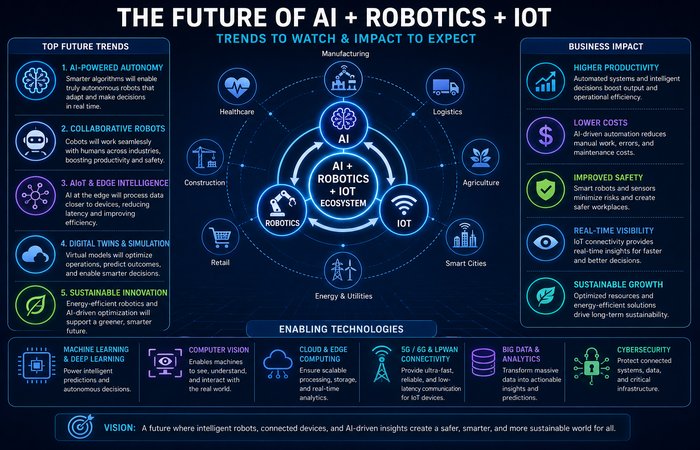
Several developments are worth tracking as the field continues to evolve.
Foundation models for robotics are maturing rapidly. Rather than training separate models for every task and environment, the field is moving toward large, general-purpose models that can be fine-tuned for specific applications — similar to how large language models transformed natural language processing. This shift will accelerate the pace at which new robotic capabilities can be deployed. Many of these robotic reasoning systems build upon advances in Generative AI, where foundation models learn to process text, images, audio, and increasingly physical interactions.
Human-robot collaboration is deepening. Collaborative robots — cobots — are increasingly designed not just to work safely near humans but to actively coordinate with them, understanding context, anticipating needs, and adapting behavior based on what nearby humans are doing. This goes beyond collision avoidance into genuine task sharing.
Digital twins are becoming standard infrastructure for complex robotic deployments. A digital twin — a continuously updated virtual replica of a physical system — allows organizations to simulate changes, test new configurations, and train AI models in a safe environment before deploying changes to live systems. As sensor costs fall and simulation fidelity improves, digital twins are moving from expensive enterprise investments to standard deployment tooling.
5G and Wi-Fi 7 private networks are enabling new deployment patterns for robotic systems that require both mobility and reliable low-latency connectivity — scenarios where neither fixed Ethernet nor standard Wi-Fi was adequate.
Autonomous mobile robots in public spaces — hospitals, airports, retail environments, city streets — are expanding as navigation AI, obstacle avoidance, and human-robot interaction capabilities improve. This expansion will also accelerate regulatory scrutiny beyond the EU AI Act into national and local frameworks.
FAQs
Q1: What is the actual difference between AIoT and Connected Robotics?
A: AIoT is about sensing and communication — devices collecting data and talking to each other or to a cloud service. Connected Robotics takes it a step further and wraps it all in a physical action: perception feeds cognition, cognition makes a decision, and a set of actuators implement it. This happens as a fractal circle rather than a pipeline. The difference isn‘t just semantic – it influences the architecture, latency requirements, safety considerations, and the regulatory category an application inhabits.
Q2: How is VLA modeling enable a robot to follow the spoken or typed instruction?
A: A vision-language-action model not only takes as input image and language individually, but also projects both into a common embedding, which is then used to predict an action decoder that, instead of producing a sentence, predicts a physical trajectory a series of motor commands. The robot hasn‘t merely heard what you said; it‘s heard what physical actions your words imply.
Q3: What hardware do you require for real-time robot control at the edge?
A: It depends heavily on the model being run. For serious multimodal reasoning on-device, you’re generally looking at something in the Jetson Thor class — the T4000 for lighter workloads, the T5000 when you need the full 2,070 TFLOPS for heavier VLA backbones. The newer, lower-cost T2000 and T3000 modules cover lighter workloads at lower price points. The CET framework — Cost, Energy, Time — is a more useful guide to selection than raw TFLOPS comparisons.
Q4: I‘m not sure whether we need to separate System 1 and System 2. What is the point of the division?
A: It isolates two jobs with totally different time-for-response demands (slow, normal, human-like task planning in System 2 and fast, ongoing, low-level motor control in System 1.) Keeping them far apart prevents a robot‘s body from getting held up waiting on a language model to think through the subsequent action, which is a requirement for safe, high-performance behavior rather than a software architecture preempt.
Q5: What does the EU AI Act actually require for a high-risk robotic system right now?
A: Documented risk management across the system’s lifecycle, human oversight built into the design, technical documentation, and logging of autonomous decisions — with the important caveat that the exact enforcement date for these full obligations is currently uncertain due to the pending Digital Omnibus delay. Teams should prepare on the original Augusdt26 date as well as the suggested contingency date of December 2027 until the delay is formally enacted.
Q6: How simulators & real data engines tackling the problem of paucity of physical data?
A: By combining generative simulation, internet-scale video retargeting, and low-cost real-world data collection rigs rather than relying on any single source. The goal isn’t more data for its own sake — it’s data that’s diverse enough and physically grounded enough that a model trained on it actually transfers to real environments it’s never encountered before. Approaches like Simpler Env focus specifically on making simulation evaluation rankings predictive of real-world performance, which is a more useful optimization target than visual realism.
Q7: Why does middleware matter as much as the AI models themselves?
A: Because a system of sophisticated components that can’t communicate reliably with each other produces worse outcomes than a simpler system with clean interoperability. ROS 2 is what allows a planning system built by one team to hand off seamlessly to a low-level control system built by another. As multi-site automation proliferation with mixed-vendor facilities expands, the interoperability infrastructure is becoming one of the most important factors determining how much actual value the AI models could provide.
Q8: How does Physical AI differ from Embodied AI?
A: Physical AI is a general term for Ai systems that perceive and act in the physical world, a term that includes the hardware, the sensory machinery and the software of that interaction. Embodied Ai is more narrowly defined, to mean how robots learn better through physical interaction, based on the theory that intelligence arises through exploration of an environment, not just pre-training on datasets. These two terms are often used to refer to the same thing, but the Embodied Ai usage specifically invokes the paradigm of learning by doing.
Conclusion: The Companies Pulling Ahead
Building a real position in Robotics & IoT AI right now means treating hardware, models, interoperability, and regulatory posture as one integrated design problem — not four separate workstreams. The architectural choices made at the beginning (where does intelligence live, what does the data pipeline look like, how does the system get audited) determine what can actually be shipped, at what cost, and in which markets.
This shift from automation based on rules to automation based on reasoning from “how do we code every possible case?” to “how do we instruct our robots to deal with something they‘ve never seen before?” is the core of what this entire guide is about. It is occurring in various fields at different rates, but in the same direction.
The companies pulling ahead in 2026 aren’t the ones with the single flashiest demo. They’re the ones whose data pipeline, edge hardware, middleware architecture, and regulatory posture are all pointed in the same direction at the same time — and who built compliance in from day one rather than treating it as a checkbox at the end.
References & Further Reading
The technologies surveyed in this guide will change, update and evolve very quickly. The below companies, standards bodies, professional resources and market intelligence sources will offer trusted information, technical documentation, market analysis and regulators updates for Robotics, Artificial Intelligence, the Internet of Things (‘IoT’) and intelligent automation.
- International Federation of Robotics (IFR) – Global statistics, annual reports, and market insights on industrial and service robotics deployments worldwide.
- NVIDIA Robotics – Official resources covering Jetson edge AI platforms, Isaac robotics software, Physical AI, Vision-Language-Action models, and autonomous robotics development.
- Robot Operating System (ROS 2) Documentation – Online documentation, tutorials, APIS and other forum for various middleware for build the modern robotic with ROS 2.
- European Union AI Act – Official legislation, regulation and guidance relating to the European Union AI governance, high-risk artificial intelligence systems, transparency obligations and EU compliance requirements.
- Connectivity Standards Alliance (CSA) – Official information and documentation on the Matter standard for interoperability, smart home connectivity, certification programs and compatibility of the IOT devices.
- IEEE Robotics & Automation Society – Research, technical articles, conferences, new trends in robotics, automation, artificial intelligence, intelligent systems.
Note: Robotics & IoT AI is a very fast-evolving area, the hardware, OS, AI model, standards of interoperability, and regulation requirements may change with time. Please refer to the official documentation of the standards organizations listed above for current technical specifications and regulation guidance.
Related AI & Robotics Guides
Eager to learn more about the key enabling technologies of intelligent automation? Read these ‘how it works’ guides to the technology that make it possible artificial intelligence, machine learning, computer vision, natural language processing, IoT & AI.
- Complete Guide to Generative AI – Find out how generative AI, foundation models, and multimodal systems are transforming today‘s software, business, and smart robotics.
- Machine Learning Guide – Manual grasp the algorithms and approaches that allow robots to learn from data, improve their performance and make intelligent decisions.
- Complete Guide to Computer Vision – Learn about how computer vision helps robots see, and how the technology itself works.
- Natural Language Processing Guide – Discover more about how NLP enables robots and intelligent agents to understand, interpret and generate human speech.
- AI Agents & Automation Guide – Discover the impact of autonomous AI Agents on business processes, enterprise automation and next-generation intelligent systems.
- How Computer Vision is changing Healthcare – See how the power of intelligent imaging and robotics is transforming diagnosis, surgery and keeping people healthy.
- How computer vision benefits to the retail business – Learn how computer vision can enable the retailers to manage inventory, measure the customers’ behavior and. enable decision making at the shelf by facilitating smart store operations and self-service checkouts.
- AI and Machine Learning in IoT Applications – Discover how AI & machine learning applications are supported by IoT solutions through connected devices for predictive maintenance, analytics & automation.
- Microsoft Facial Recognition Explained – Know what facial recognition is. How does AI powered identity verification work? What can you use it for in different situations?