
This Article is a part of
Robotics & IoT AI Resource Center
AI Robotics Fundamentals
Actually any robot that is frozen by whatever unexpected thing it encounters isn‘t necessarily malfunctioning. It could just be that it‘s pre-programmed in to a system that can‘t cope with much unpredictability.
Classical robots have tended to be fantastic at performing repeatable tasks: go here, insert this, weld that joint, and do it again. But AI enabled robotics switches the game up. Rather than definitively specifying instructions robot can now utilize sensors, machine learning, perception, planning and feedback in order to solve tasks that haven‘t been pre-programmed.
This doesn‘t imply that current robots have “mind” like humans. They don’t. What they can do is estimate what is happening, weigh possible actions, and respond to changing conditions.
This guide covers the fundamentals behind that process and forms part of our broader Robotics and IoT AI guide.
Table of Contents
What Is AI Robotics?
AI robotics, which involves the use of the physical robot along with augmented techniques from AI that allow the robot to sense the world using sensors, interpret that sensor data, make decisions, plan, and adapt its behavior.
A conventional industrial robot could be executing a tightly scripted program. An AI-enabled robot can combine that deterministic control with learned perception or decision-making.
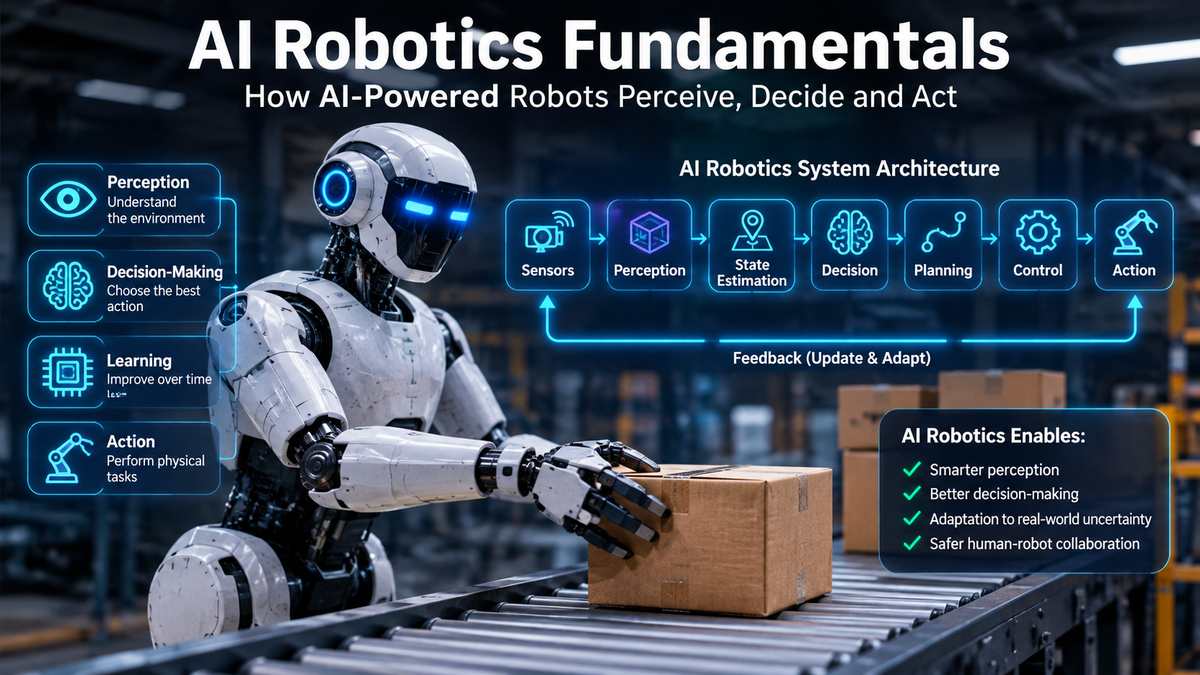
A simplified AI robotics loop looks like this:
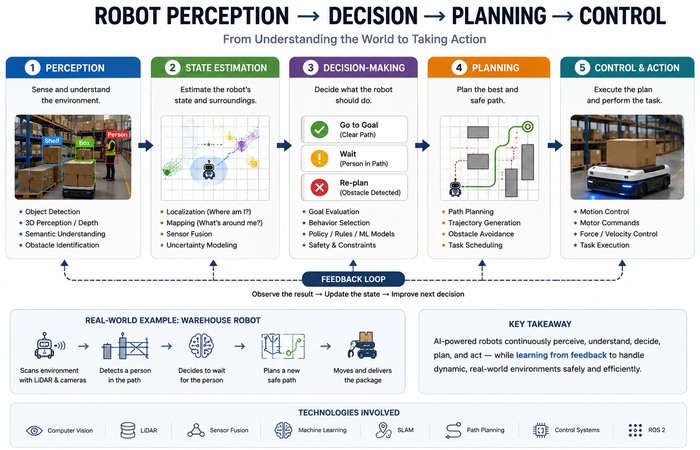
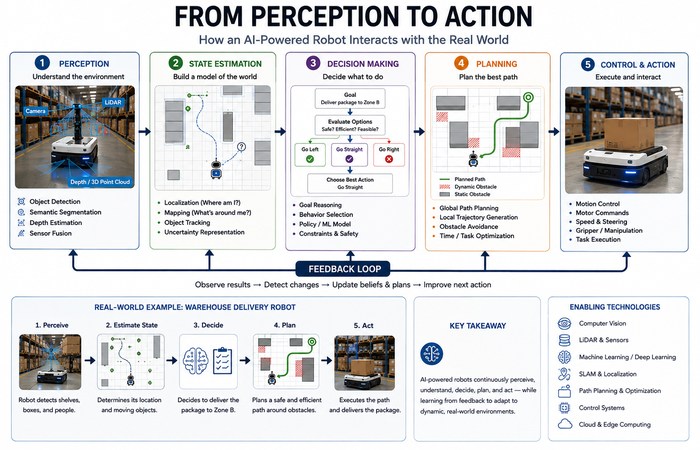
Sensors → Perception → State Estimation → Decision → Planning → Control → Action → Feedback
What matters most is the last step. The robot won’t just do something once and then never again. Sensors will tell the system what just happened all the time, so it can refine its mental picture of the world and try something else next time.
And this is an aspect of modern robotics to be found interesting. And, honestly, that’s also what makes it difficult.
AI Robotics vs. Traditional Robotics
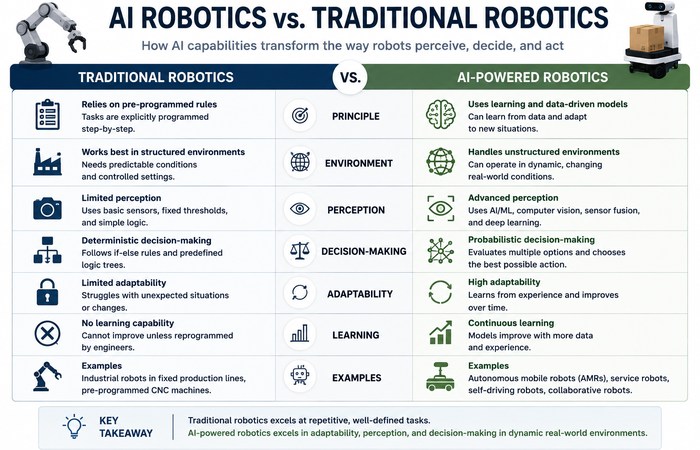
The distinction isn’t as simple as “old robots use rules and new robots use AI.” Real systems often combine both.
| Traditional Robotics | AI-Powered Robotics |
| Relies heavily on predefined rules | Can incorporate learned models |
| Works best in predictable environments | Can handle more variable conditions |
| Explicitly programmed behavior | Machine-learned perception or policies may be used |
| Deterministic control is common | Probabilistic estimates may influence decisions |
| Limited adaptation | Can adapt to changing inputs within defined limits |
A modern robot may therefore use a neural network to recognize an object, a probabilistic estimator to determine its position, a planner to choose a path, and conventional control software to move the motors safely.
AI doesn’t replace robotics engineering. It becomes another layer in the stack.
How AI-Powered Robots Work
1. Sensing
The robot starts by collecting information.
That could be provided by the on-board computer from the data of a camera, LiDAR, radar, microphone, inertial measurement unit (ImU), wheel sensors, force sensors or whatever other sources it is equipped with.
No sensor is perfect. Cameras can be affected by lighting. Wheel odometry can drift. LiDAR can have difficulty with certain surfaces or very small objects.
2. Perception
Raw sensor readings alone are not very informative.
There is a wide variety of applications possible to which the models trained can be applied; for example, identifying objects in an image, classifying or recognizing scenes, estimating depth and motion tracking. Other algorithms combine information from several sensors.
This is where robotics begins to overlap heavily with Computer Vision. Our dedicated Computer Vision guide goes deeper into those techniques.
3. State Estimation
The robot needs an internal estimate of what’s happening.
Where am I? How fast am I moving? Which direction am I facing? Where are relevant objects?
Given that the sensor measurements are always in error, robots usually make probabilistic representations of the measurements unlike assuming all measurements are precise.
4. Decision-Making and Planning
The system then chooses what to do.
A warehouse robot might decide that its original route is blocked. A service robot might determine that a person is occupying the space it planned to enter.
Decision-making determines the desired action; planning works out how to accomplish it.
5. Control
Finally, the planned action has to become a physical movement.
Controllers take in a desired position, velocity or force and translate that into signals to the individual motors and actuators. This level is (generally) much more constrained than the layers of AI models above it.
6. Feedback
The robot looks at the outcome and transitions to a new state.
When a wheel slip, an object moves, or if there is a difference in the environment, then the subsequent decision is able to take this into account.
And that feedback loop is one of the basic ideas of intelligent robotics..
How Robots Handle Uncertainty
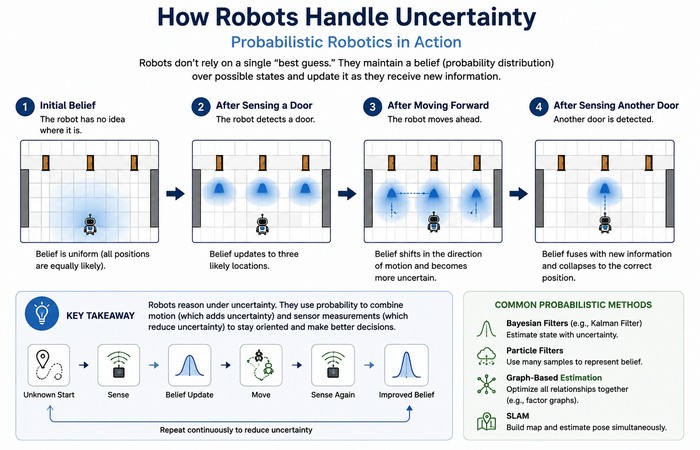
Robots operate in a messy physical world. A camera may produce an ambiguous image. A wheel encoder may report movement even though the wheel slipped.
Instead of maintaining only one supposedly perfect answer, probabilistic robotics can represent a belief about possible states.
Imagine a robot moving through a corridor with several identical landmarks. Initially, it may have several plausible positions. As it moves and gathers additional measurements, some possibilities become less likely while others become more likely.
The robot isn’t saying, “I know exactly where I am.”
It’s effectively saying, “These locations are possible, but this one is currently much more likely.”
That distinction is crucial for autonomous systems.
More advanced state-estimation techniques build on this idea using tools such as Bayesian filters, Kalman filters, particle filters, and graph-based estimation.
Our future navigation cluster will go much deeper into SLAM, localization, mapping, and path planning.
Machine Learning in Robotics
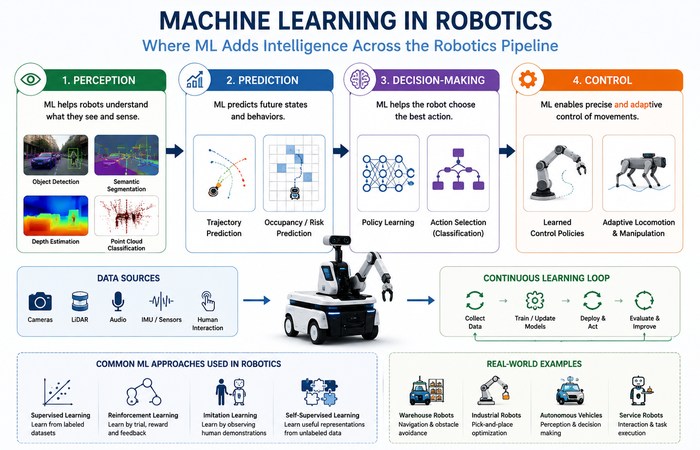
Machine learning provides robots with an alternative approach to handling challenges which are hard to specify by hand or rule-based descriptions.
It is commonly used for:
- Perception: recognizing objects, people, surfaces, and environments.
- Prediction: estimating how objects or people may move.
- Decision-making: selecting actions from possible alternatives.
- Control: learning behaviors for movement and manipulation.
- Anomaly detection: identifying situations that differ from expected patterns.
It is useful for the robot to learn cross-modally, so it can understand high-dimensional streams from various sensors: images, point clouds, audio, etc.
But machine learning is not always the best solution by itself. Once in operation, a learned model may exhibit arbitrary behavior on inputs outside the training data, which is one of the reasons robotics systems tend to integrate learned modules into a framework of traditional planning, control, safety constraints and monitoring.
Why Robots Use C++ and Python
Many robotics software packages require a second programming language since different parts of the architecture have different needs.
C++ is very popular for performance critical and latency sensitive robotics software and is natively supported by ROS 2 in the form of the rclcpp client library. Python is also a first class support ROS 2 language through rclpy and is very useful for experimentation, integration with AI/ML, scripting and application level functions.
That doesn’t mean every robot uses the same architecture.
Hard real-time control may run on dedicated controllers or real-time systems, while higher-level perception and planning can execute on a more general computing platform.
The practical takeaway is simple: robotics isn’t really a “C++ versus Python” problem. Production systems often use both.
Types of AI Robots
AI-powered robots come in many forms:
- Autonomous mobile robots (AMRs) for warehouses and logistics
- Industrial robots for manufacturing
- Collaborative robots (cobots) designed to work near people
- Service robots for commercial or public environments
- Healthcare robots for clinical and assistive applications
- Agricultural robots for monitoring and field operations
- Delivery robots for transporting goods
- Humanoid robots designed for more general physical tasks
- Consumer robots such as intelligent cleaning systems
They are very different hardware-wise, but still the same problem: sensing the environment, anticipating what will happen, taking decisions and acting in a safe manner.
Robotics Perception and Decision-Making
It‘s useful to separate four concepts that are often mixed together:
Perception: what is occurring in my environment?
State estimation: What is my state? State estimation involves determining the current state given a model and information.
Decision-making: What is it that I should do?
Conclusion: How am I to do this?
Control: How can I do that??
Keeping these layers separate makes robotics architectures easier to understand and debug.
For example, a robot might correctly detect a person but still choose a poor route. It‘s not a perception problem at all, it‘s a planning problem, or decision problem.
This difference becomes more profound when we consider the future of robotics and how they might develop multimodal fusion capabilities integrating information from vision, language, sensors, learned policies, etc.
From Perception to Action
Vision-language-action (VLA) models are an emerging approach for connecting visual observations and language instructions with robot actions.
Instead of treating “understand the scene” and “execute the task” as completely isolated problems, VLA systems attempt to connect perception, language, reasoning, and action within a learned model or broader system architecture.
Examples such as RT-2 and OpenVLA have helped demonstrate this direction, while newer embodied-AI systems continue to explore how robots can generalize across tasks and environments.
We cover the broader development of this area in the main Robotics and IoT AI guide. A deeper VLA and Physical AI cluster can then examine the architecture without bloating this fundamentals guide.
Safety, Human Oversight and Responsible AI Robotics
An autonomous robot must also have constraints.
Safety methods may involve safety barriers, collision detection, limitation of velocity and force, emergency stop, software limits, restricted areas of operation, human approval and override control and monitoring system.
The term “ethical governor” is sometimes used in research and design discussions for supervisory mechanisms intended to constrain autonomous actions according to predefined rules. It shouldn’t be treated as a universal component of modern robots or as a machine that independently decides what is morally right.
Regulation is also becoming more important. According to the EU AI Act, the design and development of some types of high-risk AI systems shall incorporate features, such as systems being able to be supervised by humans, and where appropriate, meaning that the level of risk depends on the classification and purpose of the system systems that can be switched off or overruled.
Simple, many would say obvious, lesson though without responsibility without confinement or a supervisor autonomy increases, emphasizes and highlights the importance of safety limits, testing, monitoring and supervision.
What Comes Next in AI Robotics?
AI robotics is having toward realization of systems that can synthesize perceptual, linguistic, planning, learning, and motor capabilities.
But we‘re only not there yet, in terms of having robots able to do everything a person can do.
The hard problems remain: limited training data, uncertain environments, sim-to-real transfer, safety, compute requirements, generalization, and reliable behavior outside the conditions represented in training data.
That’s why the field is increasingly being built as a stack rather than a single “robot brain”:
Sensors → AI perception → State estimation → Decision-making → Planning → Control → Physical action
Once that architecture clicks, the rest of robotics becomes much easier to understand.
These are the following layers. Things get very exciting here: robot vision, autonomous navigation, SLAM, robot learning, reinforcement learning, manipulation, edge AI, Physical AI, etc.
FAQs
Q1: What is AI robotics?
A: AI robotics is a broad term refers to robotic hardware incorporating AI methods (e.g. Machine Learning, computer vision, perception, planning and decision making) to enable the robot to operate in unpredictable environments.
Q2: In what way is the robot with machine AI intelligent?
A: They read sensor data, build a model of their environment, estimate their state, choose and plan actions, control their actuators and continually use feedback to enhance their performance.
Q3: What is the difference between AI robotics and traditional robotics?
A: Standard robotics is based on canned-programs and deterministic control. AI robotics can contribute learned perception, prediction and decision making and adopt traditional robotics and safety subsystems.
Q4: Do AI robots use C++ or Python?
A: Often both. Until now, ROS 2 has been released only with the official client libraries for C++ and Python, so in each part the developer can pick the language which will fit best.
Q5: What is robot perception?
A: Perception allows a robot to convert the measurements taken from sensors to represent information about the environment, like objects, persons, obstacles, surfaces and their relative poses.