
Table of Contents
Introduction
Machine learning was just a very narrow field not long ago; now in 2026 is the most dramatically changing the digital universe for good, with its uses ranging from an AI driven medicine to the driver-less cars, error/fraud detection systems and the hyper automation systems, etc., having influence on everything in business.
This Article is a part of
Machine Learning Resource Center
AI is being used all around the world with rapidly increasing speed. Businesses around the world are increasingly using ML algorithms for analysing large volumes of data, streamlining business processes, optimizing customer experience and prediction of certain outcomes. Especially noteworthy here is the increasing popularity of the spread of machine learning due to technologies such as generative AI, cloud AI, edge AI, intelligent automation, etc.
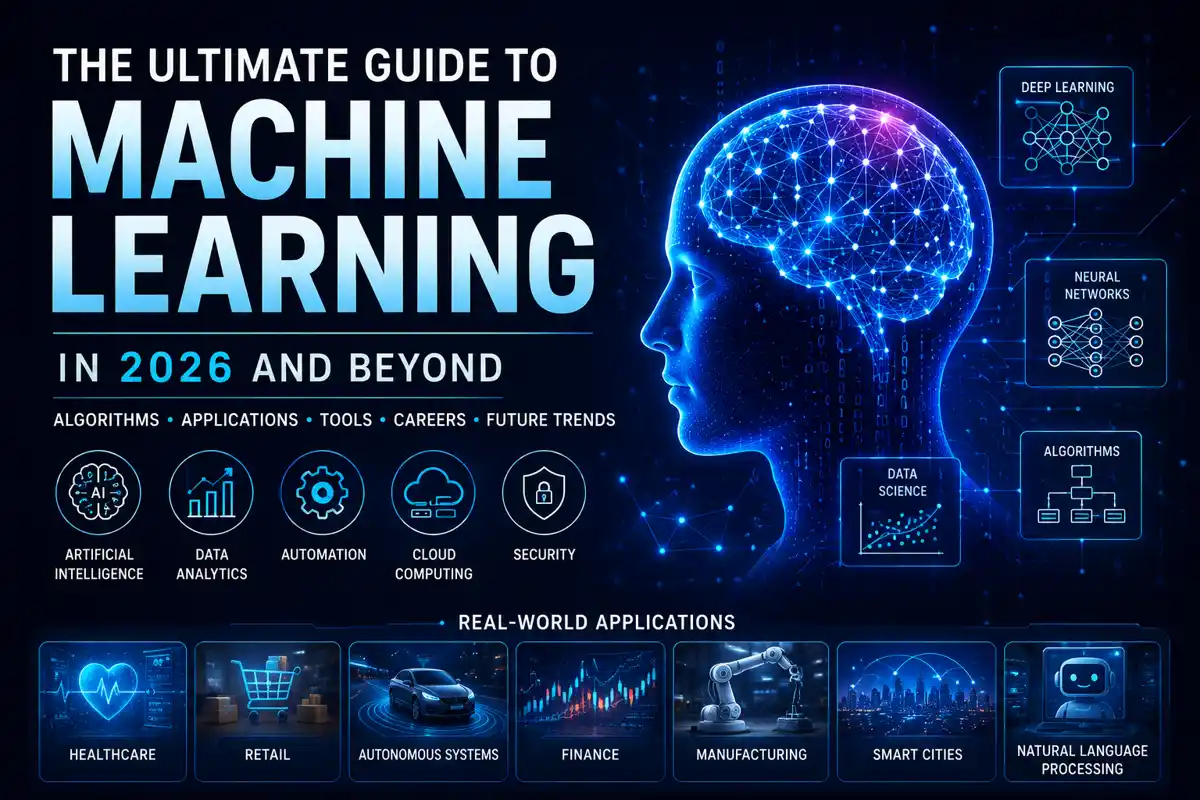
This comprehensive guide explains everything about machine learning, including:
- What machine learning is
- Types of machine learning
- Popular ML algorithms
- Machine learning applications
- AI vs ML vs Deep Learning
- Machine learning tools and frameworks
- Career opportunities
- Benefits and challenges
- Looking forward into 2026 and beyond
What is Machine Learning?
The subfield of AI known as machine learning has emerged from the application of AI; this is a field of artificial intelligence whereby systems learn automatically without the intervention of a human. Machine learning systems “learn” from experience “by”, making predictions or decisions without being specifically to do so.
Machine learning systems rely on:
| Component | Purpose |
| Data | Training information |
| Algorithms | Learning mechanism |
| Models | Predictive output system |
| Training | Pattern learning process |
| Evaluation | Accuracy measurement |
Machine learning is widely used in:
- Search engines
- Recommendation systems
- Healthcare diagnostics
- Financial fraud detection
- Facial recognition
- AI chatbots
- Cloud analytics
- Predictive maintenance
Evolution of Machine Learning (2020–2026)
| Year | Major Trend |
| 2020 | Cloud AI adoption |
| 2021 | MLOps growth |
| 2022 | Generative AI expansion |
| 2023 | Large Language Models |
| 2024 | AI copilots |
| 2025 | Autonomous enterprise workflows |
| 2026 | Agentic AI + hyperautomation |
Types of Machine Learning
Supervised Learning
Supervised learning In order for supervised learning to work a set of correctly labeled training data is required.
Common Applications:
- Spam detection
- Image classification
- Fraud detection
- Medical diagnosis
Popular Algorithms:
- Linear Regression
- Decision Trees
- Random Forest
- Support Vector Machines
#2. Unsupervised Learning
Unsupervised learning captures intrinsic structure or hidden representation of unlabelled data.
Applications:
- Customer segmentation
- Recommendation systems
- Market basket analysis
Popular Algorithms:
- K-Means Clustering
- PCA
- Hierarchical Clustering
#3. Reinforcement Learning
Reinforcement learning trains systems using rewards and penalties.
Applications:
- Robotics
- Self-driving vehicles
- Gaming AI
- Autonomous systems
#4. Semi-Supervised Learning
Downloads information from unlabeled and labeled data.
Common Use Cases:
- Healthcare imaging
- Speech recognition
- NLP systems
Machine Learning Algorithms
Machine learning algorithms are the method by which the system can learn the underlying patterns and predict behavior.
| Algorithm | Type | Common Use |
| Linear Regression | Supervised | Forecasting |
| Logistic Regression | Supervised | Classification |
| Decision Tree | Supervised | Decision-making |
| Random Forest | Supervised | Prediction |
| K-Means | Unsupervised | Clustering |
| Neural Networks | Deep Learning | AI models |
| Naive Bayes | Supervised | Spam filtering |
| SVM | Supervised | Classification |
Popular ML Algorithm Usage in 2026
| Algorithm | Enterprise Adoption |
| Neural Networks | Very High |
| Random Forest | High |
| Gradient Boosting | High |
| Linear Regression | Medium |
| K-Means | Medium |
Machine Learning vs AI vs Deep Learning
Artificial intelligence, machine learning, deep learning- these words are often used as synonyms.
| Technology | Definition |
| Artificial Intelligence | Broad concept of intelligent machines |
| Machine Learning | Subset of AI that learns from data |
| Deep Learning | Subset of ML using neural networks |
Hierarchy of AI Technologies
Artificial Intelligence
├── Machine Learning
├── Deep Learning
Applications of Machine Learning
Machine learning applications have expanded significantly in 2026.
#1. Healthcare
Machine learning powers:
- predictive diagnostics
- medical imaging
- drug discovery
- patient analytics
Related Guide:
AI in Healthcare
#2. Hyperautomation
Organizations use ML-driven hyperautomation to streamline operations.
Related Guide:
Guide to Hyperautomation
#3. Facial Recognition
Computer vision systems use machine learning for biometric identification.
Related Guide:
Microsoft Facial Recognition
#4. AI-Powered CRM
Businesses increasingly use AI-driven CRM systems for customer intelligence.
Related Guide:
AI in CRM
#5. Cloud AI Systems
Machine learning heavily depends on scalable cloud infrastructure.
Related Guide:
Benefits of AI and Cloud Technology
#6. Generative AI
Generative AI models use advanced deep learning architectures.
Related Guide:
The Last Mile of GenAI
Machine Learning Tools
Popular ML tools in 2026 include:
| Tool | Primary Use |
| TensorFlow | Deep learning |
| PyTorch | Neural networks |
| Scikit-learn | Classical ML |
| Apache Spark MLlib | Big data ML |
| Jupyter Notebook | Experimentation |
| RapidMiner | No-code ML |
| KNIME | Analytics workflows |
Most Popular ML Tools in 2026
| Tool | Popularity |
| TensorFlow | Very High |
| PyTorch | Very High |
| Scikit-learn | High |
| Jupyter | High |
| Spark MLlib | Medium |
Machine Learning Frameworks
Machine learning frameworks simplify model development and deployment.
| Framework | Best For |
| TensorFlow | Enterprise AI |
| PyTorch | Research & GenAI |
| Keras | Rapid prototyping |
| MXNet | Scalable cloud ML |
| ONNX | Cross-platform deployment |
Machine Learning Careers
Machine learning has become one of the highest-paying technology career paths.
Top ML Career Roles
| Job Role | Average Demand |
| ML Engineer | Very High |
| Data Scientist | High |
| AI Researcher | High |
| NLP Engineer | Growing |
| MLOps Engineer | Very High |
Most In-Demand ML Skills in 2026
| Skill | Importance |
| Python | Essential |
| Statistics | High |
| Deep Learning | High |
| Data Engineering | High |
| Cloud Computing | High |
| MLOps | Growing |
Benefits of Machine Learning
Major Advantages
| Benefit | Impact |
| Automation | Operational efficiency |
| Predictive analytics | Better forecasting |
| Personalization | Improved UX |
| Fraud detection | Enhanced security |
| Scalability | Faster decision-making |
Challenges of Machine Learning
Common Challenges
| Challenge | Description |
| Data quality | Poor training data |
| Bias | Ethical concerns |
| High compute cost | Expensive infrastructure |
| Model explainability | Black-box models |
| Security risks | Adversarial attacks |
Future of Machine Learning in 2026 and Beyond
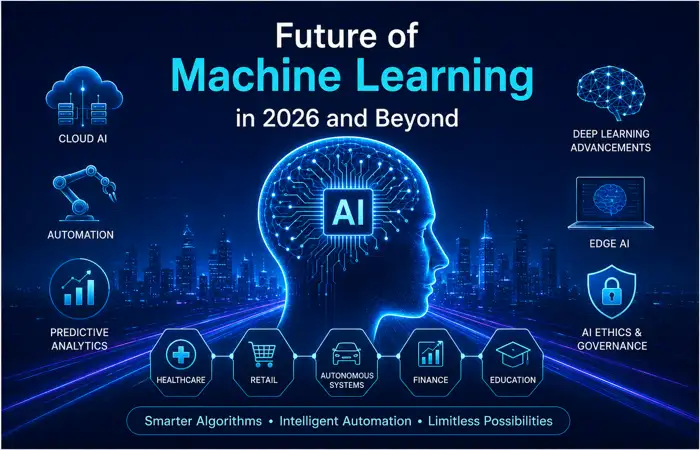
The future of machine learning is being shaped by:
- Generative AI
- Agentic AI
- Autonomous systems
- Edge AI
- AI governance
- Quantum machine learning
- Hyperautomation
Experts predict that AI-driven automation will significantly transform:
- healthcare
- cybersecurity
- logistics
- education
- finance
- software development
Emerging Machine Learning Trends
| Trend | Growth Potential |
| Generative AI | Very High |
| Agentic AI | High |
| AI copilots | High |
| Edge AI | Growing |
| AI governance | Critical |
FAQs
What is machine learning in simple words?
The computers learn from data itself and not from any prescribed rules.
Is machine learning part of AI?
Yes it has been proved to be a form of artificial intelligence.
What programming language is best for machine learning?
What is commonly used to code machine learning is Python.
What is the difference between AI and machine learning?
“AI is the concept, intelligent machines while machine learning is one of the techniques by which we can reach the AI. The computer is learning itself with the help of the data.”
What industries use machine learning?
It can be used in various sectors, such as; healthcare, banking and finance, secure communication, marketing, cloud computing, retail and manufacturing.
Related Guides
- Guide to Hyperautomation
- Microsoft Facial Recognition
- AI in CRM
- Benefits of AI and Cloud Technology
- The Last Mile of GenAI
- AI in Healthcare
Conclusion
It‘s the use of machine learning to allow business to gather data, automate tasks and create intelligence in digital interfaces that‘s transforming how businesses operate; and by 2026 it will not be an inhibitor for any startup or existing business.
A flood of machine learning use cases from healthcare, to cybersecurity, to hyper automation, to generative AI is sprouting forth and booming at the speed of light across every sector. With AI functionalities advancing rapidly, those firms and individuals who understand what machine learning actually is and what frameworks, tools and technologies exist to implement it, stand to gain a significant edge in the digital economy.