

This article is part of our E-commerce & Retail Business resource section
Top 7 Retail Tech Trends Transforming eCommerce in 2026
Table of Contents
Introduction
The retail market is changing at a speed never seen before, and E-Commerce is at the forefront. With the adoption of digital-first shopping, retailers are experiencing great pressure to ensure that they provide not only speed, personalization, transparency, and efficiency but also what once felt like futuristic technology—AI-powered recommendations, virtual try-ons, and same-day delivery—is now expected by consumers.
To succeed in this high-paced world, retailers are embracing cutting-edge technologies that help them make smarter, faster, and more profitable decisions. The focus of this change is Decision Intelligence (DI), which is an innovative generation of technology that utilizes AI and real-time information to inform pricing, promotion, inventory, fulfillment, and a host of other decision components.
Retailers can also benefit from understanding how data in retail supports better decision-making, from customer behavior analysis to inventory planning and operational optimization.
Understanding the evolution of e-commerce also helps put these retail technology trends into context, showing how digital commerce has progressed toward increasingly connected, intelligent, and personalized shopping experiences.
This article explores the top 7 retail tech trends shaping eCommerce in 2025 and how Decision Intelligence is playing a pivotal role in powering these innovations.
1. Decision Intelligence Becomes Retail’s Command Centre
Predictive AI has evolved from an experimental pilot to a profit engine. New Decision Intelligence (DI) systems integrate all real-time data streams (POS, web analytics, inventory feeds, weather, down to social chatters) and then continuously update models to suggest the next best action to take on every SKU, shopper and store. Retailers on DI experience greater on-site conversion, narrower markdowns, and quicker campaign pivots as the system dictates what and why.
AI is also becoming increasingly valuable for pricing decisions, helping retailers respond to changing demand, competition, and customer behavior through AI for smarter pricing in retail.
Key takeaway: In 2025, the retailers winning market share aren’t just “data-driven”; they’re decision-driven, orchestrating pricing, promotions, and replenishment from a single AI brain.
2. Immersive AR Shopping Scales Past the Hype
Try-before-you-buy has gone mainstream. AR glasses and augmented-reality browsers are allowing consumers to view furniture, eyewear, or cosmetics at actual size within a few seconds. As the just-announced AR market is estimated to enter at least the 50-billion-dollar range by the end of the year 2025, stores with integrated 3-D product models achieve an enhanced dwell rate and up to a 40% reduction in returned merchandise since customers buy out of the experience of a realistic virtualized view.
Computer vision is another technology that can complement immersive retail experiences, particularly for product recognition, customer engagement, and store operations. Retailers can explore the benefits of computer vision in retail businesses as these capabilities become more accessible.
Key takeaway: Brands should prioritize photorealistic 3-D assets and mobile-first AR try-ons to convert indecisive browsers into confident buyers.
3. Conversational Commerce Gets a GenAI Upgrade
Chatbots and voice engines are no longer scripted FAQ systems. Generative AI systems are now presenting personalized product recommendations, product bundling, and even negotiating custom promo codes in natural language. Customers interacting with conversational agents convert at twice the average rate, and support costs also decline significantly. The new horizon: multimodal agents encompassing voice, text, and AR overlays to take shoppers from discovery to checkout without putting their hands on a device.
Personalization is becoming a core part of these experiences, with retailers increasingly using customer data to tailor recommendations, promotions, and interactions. This is closely connected to the triumph of hyper-personalization in retail.
Key takeaway: Plug conversational AI into your Decision Intelligence layer; the bot can query real-time stock, margins, and shopper history before making an offer, delivering both relevance and profitability.
4. Unified Retail Intelligence: From Online to In-Store
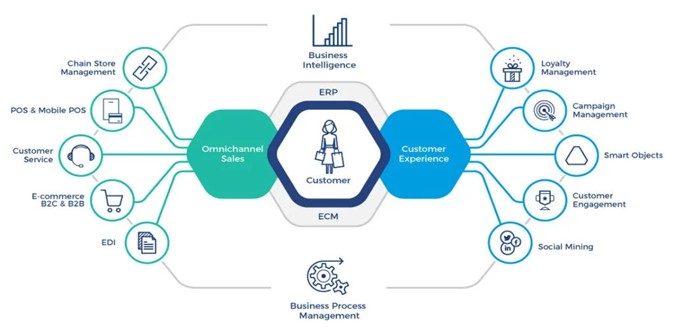
Customers shift across marketplaces, social stores, phone applications, and real stores. Unified commerce architectures sew together these touchpoints in one ledger of inventory, prices, and customer identity. With DI, the system uses real-time algorithms to determine whether a shipment should be made out of a warehouse, micro-fulfillment hub, or the closest store facility in order to deliver as fast as possible and at the lowest cost. Retailers that included omnichannel AI have improved revenues by an average of 21% and reduced costs by an average of 2%.
For retailers building a connected customer journey, embracing e-commerce and omnichannel strategies can help align online and offline experiences around a unified retail model.
Key takeaway: Treat every channel as a data sensor feeding a central optimizer, not as a siloed P&L.
5. Smart Fulfilment Networks Redefine the Last Mile
With the growing demands of customers associated with the last mile, as they expect to have fast delivery within minutes and hours, the last mile is a make-or-break situation in eCommerce. Automation and AI are driving intelligent fulfillment networks, which retailers are adopting in response to rising demand. Whether it is micro-fulfillment centers (MFCs) in proximity to high-density locations or predictive order batching and courier optimization, the emphasis is on reducing delivery windows without incurring additional costs. Decision Intelligence is vital because it constantly examines order data, effectiveness of routes, and delivery restrictions, and makes each process faster and operates with high margins.
Connected devices and sensors can further improve fulfillment and inventory visibility, making the transformation of retail business with IoT particularly relevant to intelligent supply chains and store operations.
Key takeaway: Fulfilment success in 2025 depends on real-time decision-making across inventory, routes, and customer promises—not just faster shipping.
6. Blockchain Builds Trust & Circularity
Consumers demand proof of origin—whether a t-shirt’s cotton is organic or a diamond is conflict-free. Retailers are embedding blockchain-based “digital passports” that track products from raw material to resale. Immutable ledgers often layered with IoT sensors, deliver tamper-proof transparency, cut recall costs, and power trade-in programs that keep goods in circular flows.
Retail analytics can also help businesses turn large volumes of operational and customer information into actionable insights, making retail analytics an important component of modern data-driven retail operations.
Key takeaway: Transparency sells. Linking blockchain traceability to DI lets teams model sustainability metrics—carbon, waste, fair labor—alongside profit KPIs.
7. Sustainable Payments & Loyalty 2.0
Embedded finance is coming beyond buy-now-pay-later. In 2025, real-time credit scores, calculators that estimate the environmental impact of their purchases, and tokenized loyalty points that follow the shopper across partner brands will all be available on digital checkout racks. DI systems examine preferences for payment methods, as well as lifetime value, by encouraging shoppers to select the mix-card, wallet, or installment style to maximize conversion as well as net margin.
At the store level, modern POS technology can also support smoother transactions and better sales management. Businesses can explore how a POS system can help increase retail sales while connecting transaction data with broader retail intelligence.
For businesses evaluating their technology options, understanding the role of a POS system for your restaurant or retail business can also help when selecting tools that fit their operational requirements.
Key takeaway: Payments are now a strategic lever. Use Decision Intelligence to personalize not just what customers buy but how they pay and earn rewards.
Retail technology can also extend beyond traditional commerce platforms into specialized digital systems and services. For example, businesses operating within specific retail ecosystems may need dedicated access solutions such as an APSBCL retailer login to manage their digital retail operations.
Conclusion
All these seven trends have one thing in common, which is intelligent decision-making in real-time. An AR overlays that make sofa purchase recommendations, a chatbot that displays a bundle, or a robot in an MFC that selects items are all facing forward the same machine to make the recommendations–an AI-driven Decision Intelligence layer continually computing the value and necessity of data, context, and constraints using probabilistic logic.
These early adopters are already increasing sales, cutting losses, and pleasing clients with nearly predictive customer service. Late movers risk getting left behind as nimble rivals keep increasing the bar on speed, personalization, and customer trust.g
Ready to level up your eCommerce performance? Visit us now and make smarter decisions faster.
