
The Rollback Plan Your Payment-Risk Rules Are Missing
Every payments team has felt it: a new fraud rule goes live on a Tuesday, and by Thursday approval rates have slipped three points, support is drowning in complaints, and nobody can say with confidence whether the rule is catching more fraud or just more customers. The instinct is to tweak the rule forward – adjust the threshold, add an exception, push another change. The better move is usually backward, to the version you had before. The problem is that most teams never built a clean path back.
Payment-risk rules decay. Fraud patterns shift, portfolios change, and rules that were precise six months ago start misfiring quietly. That is why teams change them so often – and why even a capable fraud prevention platform needs more than good rules to protect a portfolio. What gets far less attention is the operational discipline that should surround every change: the rollback plan. Deployment pipelines in software engineering treat rollback as a first-class concern. Risk-rule changes deserve the same treatment, because a bad rule does not just miss fraud – it turns away good customers and erodes trust in ways that show up in churn numbers months later.
This is a core principle of DevOps practices, where teams build repeatable processes for managing changes, monitoring releases, and recovering from deployment failures. Applying these principles to payment-risk rules can help organizations make changes more safely and consistently.
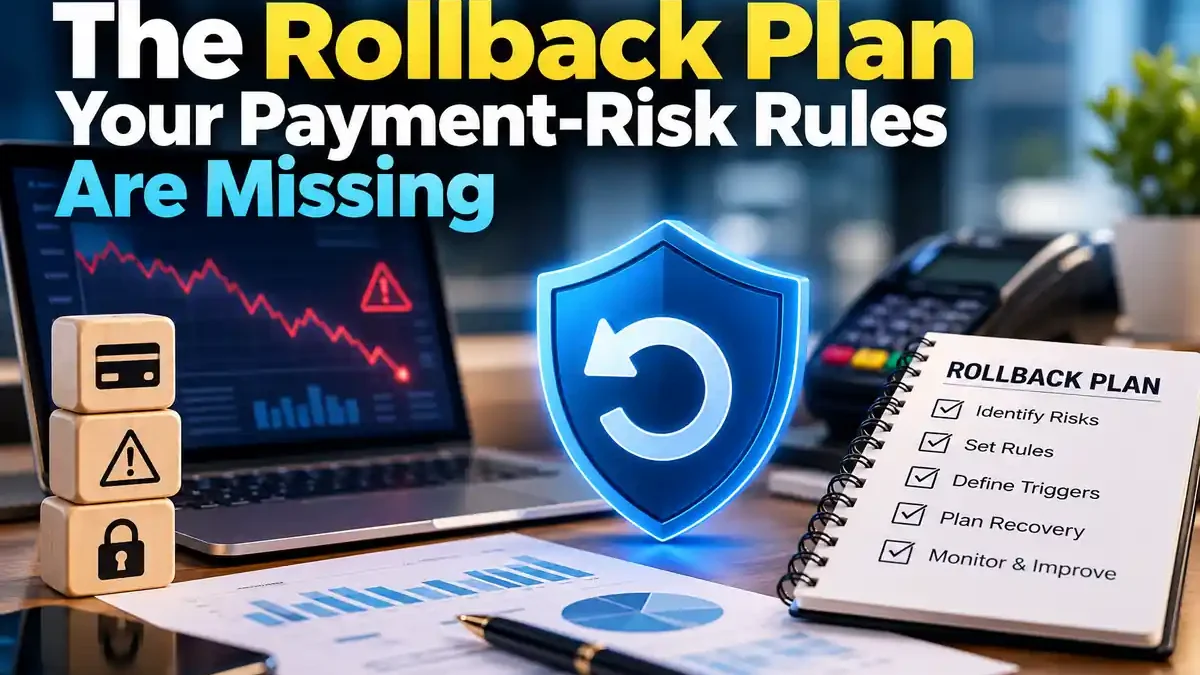
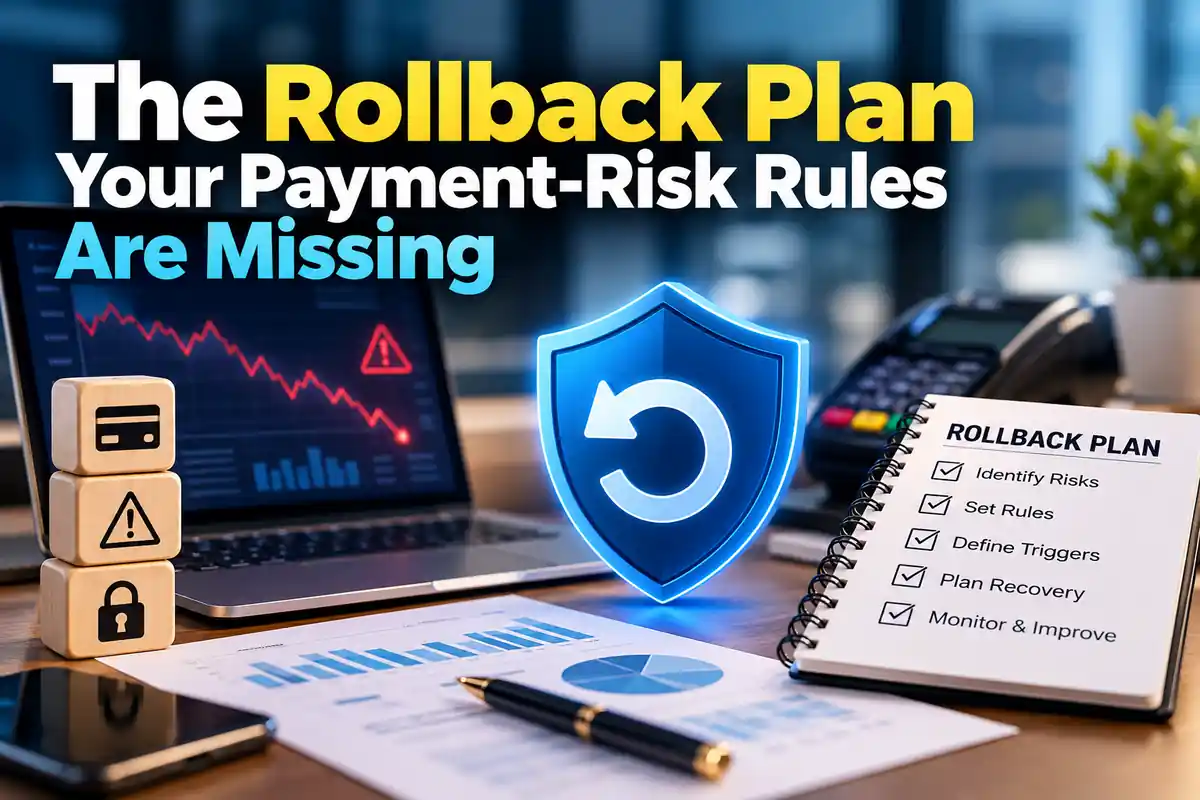
Here is the five-part rollback plan that should accompany every payment-risk rule change, whether you are tuning a velocity check or restructuring an entire decision flow.
Table of Contents
1. Name the service owner before the change ships
Every rule change needs one named person who owns the decision to roll back. Not a team, not a Slack channel – a person, with the authority to say “revert” without convening a meeting. In the middle of an incident, ambiguity about who can pull the plug costs exactly the minutes you do not have. The owner should be named in the change record itself, along with a backup for the (inevitable) case where the primary is on vacation when the rule misbehaves.
This sounds obvious, but in practice the risk analyst who wrote the rule, the engineer who deployed it, and the operations lead watching the dashboards often each assume one of the others is in charge. Write the name down.
2. Record the prior configuration, exactly
You cannot roll back to a state you did not capture. Before the change goes live, export or snapshot the full prior configuration: rule logic, thresholds, list memberships, model versions, and any upstream data dependencies the rule relies on. “We changed the threshold from 72 to 65” is not a record; the old value, the effective timestamp, and everything that traveled with it are.
Configuration-as-code practices make this nearly free – if your rules live in version control, the prior state is a commit away. If your rules live in a vendor console or a spreadsheet, the discipline has to be manual, and that makes it more important, not less. Test that the snapshot actually restores. A backup you have never restored is a hypothesis, not a plan.
Version control and reliable rollback procedures are also closely connected to software deployment practices. A well-defined deployment process helps teams track configuration changes, restore earlier versions, and reduce the impact of faulty releases.
3. Set the pause signals in advance
Decide, before launch, what evidence would cause you to pause or roll back the change, and write those thresholds down. Approval-rate drop beyond a set band. Manual review queue growing past capacity. False-decline complaints from a segment that was not supposed to be touched. The point is to make the rollback decision when you are calm and rational, not at 11 p.m. with three stakeholders disagreeing on a call.
Two things make this work. First, the signals should measure customer harm, not just fraud catch – a rule that doubles fraud detection while quietly rejecting your best applicants is a failure wearing a success costume. Second, set a review horizon: if none of the signals fire within, say, two weeks, the change graduates from “new” to “baseline,” and the next change snapshots from it.
4. Define who can restore the prior version, and make sure they can
Authority and ability are different things. The person authorized to roll back may not have console access, deployment permissions, or the faintest idea which screen the rule lives on. Map the actual restore path end to end: who clicks what, in which system, with which credentials, and how long it takes. If restoring requires a deploy window or a vendor ticket, that latency is part of your risk calculation – a rule that takes 48 hours to revert needs a much more conservative rollout than one that reverts in minutes.
Then rehearse it. A quarterly rollback drill on a low-stakes rule tells you whether the path is real. Teams that run these drills consistently report the same finding: the first rehearsal surfaces a broken assumption almost every time.
5. Preserve the decision record
Months later, someone will ask why the rule is the way it is. If the answer lives in a departed employee’s memory, you have a governance problem that no tooling will fix. For every change, keep a short record: what changed, why, what data supported it, what signals were set, and what happened. The record is also what turns a rollback from a defeat into a learning asset. A reverted rule with a clear paper trail is a cheap experiment. A reverted rule with no record is a rumor.
The discipline is the point
None of this requires new technology. It requires treating rule changes with the same operational seriousness that engineering teams learned to apply to code deploys years ago – and that businesses of every size now need, with automation creeping deeper into day-to-day operations. The companies that handle payment-risk changes well are not the ones that never make a bad rule. They are the ones that can get back to safety in minutes, with the evidence of what they learned intact.
Teams can also reduce repetitive operational work by introducing no-code automation into suitable workflows. When combined with clear ownership, version tracking, and predefined rollback conditions, automation can help make routine processes more consistent without removing the need for human oversight.
Start with the next rule change on your calendar. Name the owner, snapshot the state, write down the pause signals, walk the restore path, and keep the record. The first time a rule misbehaves in production, you will be very glad you did.