Digital Engineering Write for Us – Submit a Guest Post
Digital engineering brings models, data, software, simulation, and collaborative workflows into the design and management of products and complex systems. When implemented carefully, it can help engineering teams connect requirements, designs, analyses, tests, manufacturing information, and operational feedback across a project’s lifecycle.
Computer Tech Reviews welcomes original contributions from engineers, systems architects, CAD and simulation professionals, product managers, manufacturing specialists, researchers, educators, data professionals, and technical writers with direct experience. Through our Digital Engineering Write for Us section, contributors can share practical tutorials, implementation guides, case studies, technical explanations, and balanced evaluations of engineering tools and methods.
This contributor page forms part of our broader Technology Write for Us hub. If your proposed article belongs to one of the more specialized subjects listed below, select the most relevant contributor page before submitting your pitch.
What Is Digital Engineering?
Digital engineering is an approach that uses connected digital models, structured data, software tools, and managed workflows to support engineering decisions throughout a product or system lifecycle.
Depending on the organization and industry, a digital-engineering environment may connect:
- Requirements and systems architecture
- Computer-aided design
- Engineering analysis and simulation
- Software and embedded-system development
- Manufacturing and process planning
- Testing, verification, and validation
- Configuration and change management
- Maintenance and operational data
- Supply-chain and quality information
Digital engineering does not mean converting every document into a digital file or purchasing one software platform. Its value depends on reliable data, appropriate models, defined responsibilities, tool interoperability, governance, workforce skills, and integration with real engineering decisions.
Digital Engineering Topics We Welcome
We accept original explainers, tutorials, implementation guides, case studies, technical comparisons, research summaries, and informed opinion pieces.
Suitable topics include:
- Model-based systems engineering
- Digital threads and connected engineering data
- Digital twins and simulation models
- CAD, CAE, FEA, and CFD workflows
- Product lifecycle management
- Requirements and configuration management
- Virtual prototyping and design verification
- Engineering data standards and interoperability
- AI and automation in engineering
- Industrial IoT and operational feedback
- Smart manufacturing and digital factories
- Building information modeling
- Augmented and virtual reality for engineering
- Engineering cybersecurity and access control
- Digital engineering implementation case studies
Model-Based Systems Engineering
Model-based systems engineering, often abbreviated as MBSE, uses structured models to support requirements, architecture, behavior, interfaces, analysis, and communication. It is intended to make important relationships more visible and manageable than they may be across disconnected documents.
Useful MBSE articles may discuss:
- Moving from document-based to model-based workflows
- Requirements traceability
- Functional and logical architecture
- Interface modeling
- Behavior and state modeling
- Model governance and ownership
- Verification planning
- Tool integration and data exchange
A model does not automatically become accurate because it is detailed. Contributors should explain assumptions, boundaries, sources, validation methods, configuration, and the decisions a model is intended to support.
Digital Threads
A digital thread connects information across engineering activities and lifecycle stages. It may link a requirement to a design element, simulation result, software version, manufacturing process, test result, maintenance event, or field observation.
A useful digital thread is more than a collection of hyperlinks. It depends on consistent identifiers, controlled data, relationships, permissions, version management, integration, and clear ownership.
Potential article topics include:
- Requirements-to-test traceability
- Engineering change management
- Configuration and version control
- Product lifecycle data
- Integrating engineering software
- Data lineage and auditability
- Supplier and partner collaboration
- Long-term data preservation
Digital Twins
A digital twin is a digital representation connected in some way to a physical product, process, asset, or system. The connection may use design data, sensor measurements, maintenance records, operating conditions, simulation results, or other information.
Not every simulation or 3D model is automatically a digital twin. Contributors should explain:
- What physical object or process is represented
- Which data connects the physical and digital environments
- How frequently the representation is updated
- Which decisions or predictions it supports
- How the model is calibrated and validated
- Who owns and maintains the data
- What limitations or uncertainties apply
Digital-twin articles should avoid guaranteeing predictive accuracy, maintenance savings, or operational improvements without evidence from a clearly described implementation.
Computer-Aided Design and Simulation
CAD and engineering simulation tools help teams explore geometry, materials, motion, stress, heat, fluid flow, electromagnetic behavior, manufacturing constraints, and other design questions before or alongside physical testing.
Suitable topics include:
- Parametric and direct modeling
- Assembly and interface design
- Finite element analysis
- Computational fluid dynamics
- Electromagnetic simulation
- Multibody dynamics
- Design optimization
- Meshing and convergence
- Boundary conditions and material models
- Simulation verification and validation
A visually convincing simulation is not necessarily an accurate one. Articles should explain assumptions, boundary conditions, mesh quality, input data, solver settings, uncertainty, and comparison with physical evidence.
Virtual Prototyping and Physical Testing
Virtual prototypes can help teams evaluate alternatives and identify potential problems before building a physical product. However, simulation does not remove the need for physical testing in every situation.
A balanced article should explain:
- Which questions can be investigated digitally
- Which risks still require physical tests
- How models are calibrated
- How test results update the model
- What uncertainty remains
- Which standards or acceptance criteria apply
The strongest workflows connect digital analysis and physical evidence instead of presenting them as competing alternatives.
IoT and Connected Engineering Systems
Connected sensors and equipment can provide operational information for engineering analysis, maintenance, product improvement, and digital-twin applications. Industrial IoT systems may monitor temperature, vibration, pressure, energy use, location, speed, quality, or equipment status.
Collecting more data does not automatically produce better engineering decisions. Teams must consider sensor accuracy, calibration, sampling, connectivity, timestamp quality, context, storage, access, cybersecurity, and maintenance.
Writers focusing on sensors, connected products, industrial monitoring, edge computing, device management, smart infrastructure, and IoT security can contribute through our IoT Write for Us page.
Smart Manufacturing and Machine Technology
Digital engineering can connect product designs with manufacturing planning, machine instructions, production data, inspection, quality control, and maintenance. This connection can make engineering changes easier to trace, but it requires reliable interfaces and disciplined configuration management.
Manufacturing-focused topics may include:
- Digital production planning
- Computer-aided manufacturing
- Machine monitoring and controls
- Industrial automation
- Robotics and material handling
- Process simulation
- Quality inspection and traceability
- Predictive and condition-based maintenance
- Manufacturing execution systems
Articles about particular machinery should identify the machine’s real name, operating purpose, industry, safety requirements, and role within the wider production process.
AI and Automation in Engineering
Artificial intelligence may support generative design, anomaly detection, surrogate modeling, design-space exploration, document analysis, predictive maintenance, code generation, and engineering knowledge retrieval.
AI-assisted engineering content should explain:
- The specific task performed by the model
- The data used for development or evaluation
- The method used to measure performance
- How engineering constraints are represented
- Where human review is required
- How incorrect results are detected
- Which security and intellectual-property risks apply
An AI-generated design is not automatically manufacturable, compliant, safe, optimal, or original. Engineering judgment, verification, validation, and accountable approval remain essential.
Engineering Collaboration and Virtual Meetings
Digital engineering projects often involve multidisciplinary teams working across offices, suppliers, customers, manufacturing sites, and time zones. Virtual meeting platforms can support design reviews, requirements workshops, troubleshooting, training, and project coordination.
Effective engineering collaboration requires more than a video call. Teams also need controlled documents, model access, version management, clear decisions, action tracking, permissions, and secure sharing.
Writers focusing on video conferencing, hybrid meeting rooms, remote presentations, meeting security, transcription, accessibility, and distributed teamwork can visit our Virtual Meeting Write for Us section.
Engineering Documentation and Printing Technology
Even in a digital engineering environment, teams may use printed drawings, labels, inspection records, manufacturing instructions, manuals, certificates, and controlled documents. The reliability of these materials depends on document control as well as printer and consumable performance.
Useful topics may include:
- Controlled engineering drawings
- Document revisions and approvals
- Large-format and technical printing
- Labels and traceability documents
- Print quality and legibility
- Archival and retention requirements
- Printer security and access
- Cartridge compatibility and cost
Contributors interested in laser printing, toner composition, cartridge yields, compatibility, recycling, print quality, and printer maintenance can explore our Toners Write for Us page.
Professional Profiles and Engineering Identity
Digital profiles can represent an engineer’s qualifications, project history, technical publications, certifications, design contributions, and professional experience. Organizations may also use structured employee or supplier profiles to identify expertise and allocate work.
Profile systems should balance discoverability with privacy, accuracy, access control, consent, and responsible use of personal information.
Potential topics include:
- Professional engineering portfolios
- Skills and certification profiles
- Project-contribution records
- Digital identity and verification
- Employee expertise directories
- Privacy and profile visibility
- Impersonation and identity protection
Writers focusing specifically on digital profiles, professional identity, account information, profile management, and privacy can visit our Profile Write for Us page.
Creative Prototyping and Design Communication
Not every engineering idea begins as a finished CAD model. Early concepts may be explored using sketches, storyboards, physical mockups, visual studies, material samples, and hand-rendered diagrams before they move into detailed digital development.
Traditional art tools can support industrial design, product styling, user-experience planning, packaging, color studies, educational demonstrations, and communication with non-technical stakeholders.
Oil Pastels in Concept Development
Oil pastels can support rapid color studies, product-form exploration, presentation boards, and mixed-media concept work. Articles should focus on practical selection, material behavior, surfaces, blending, storage, digitization, and integration with digital design workflows.
Contributors focusing on these creative materials can visit our Oil Pastels Set Write for Us page.
Paint Brushes and Physical Prototyping
Paint brushes may be used to prepare presentation models, finish prototypes, create color samples, apply coatings, and develop visual concepts. Brush shape, bristle material, paint compatibility, cleaning, durability, and application method can all influence the result.
Writers concentrating on brush selection, materials, maintenance, painting techniques, model finishing, and creative workflows can explore our Paint Brushes Set Write for Us section.
Data Standards and Interoperability
Digital engineering often involves multiple tools owned by different teams and suppliers. Interoperability determines whether information can move between these systems without losing meaning, relationships, units, metadata, or configuration context.
We welcome articles about:
- Neutral data-exchange formats
- APIs and engineering integrations
- Model and metadata mapping
- Units and naming conventions
- Master-data management
- Data quality and validation
- Legacy-system migration
- Long-term data preservation
When discussing a standard, contributors should identify the relevant edition, scope, implementation environment, and known limitations.
Digital Engineering Security
Engineering environments may contain valuable intellectual property, product designs, software, supplier data, manufacturing instructions, test results, and infrastructure information. Connecting tools and data can improve collaboration but also expand the security boundary.
Security-focused submissions may examine:
- Identity and access management
- Role-based permissions
- Secure supplier collaboration
- Engineering-data encryption
- Model and document integrity
- Software supply-chain risk
- Connected-device security
- Backup and recovery
- Audit trails and change monitoring
- Protection of intellectual property
Security articles must focus on authorized assessment, defensive practices, risk reduction, and responsible disclosure.
Implementing Digital Engineering
A successful digital-engineering initiative usually begins with a clearly defined problem rather than a list of desired technologies.
An implementation plan may address:
- The engineering decisions that need improvement
- Current processes and data sources
- Model ownership and governance
- Tool and integration requirements
- Workforce skills and training
- Configuration and change control
- Verification and validation
- Cybersecurity and access
- Performance indicators
- Long-term support and data preservation
Case studies should report what was actually implemented, the previous process, resources required, measurable outcomes, limitations, and lessons learned. Avoid attributing every improvement to one software platform.
What Makes a Strong Digital Engineering Article?
A useful article should help readers understand an engineering problem, evaluate an approach, or apply a method. It should not simply list software features or repeat broad claims about digital transformation.
Strong submissions should:
- Address a defined engineering question or workflow.
- Identify the intended audience and industry context.
- Explain technical ideas in accessible language.
- Include practical examples, diagrams, or project experience.
- Describe tools without turning the article into an advertisement.
- Explain assumptions, model boundaries, and data requirements.
- Discuss integration, governance, skills, and security.
- Separate verified results from predictions and opinions.
- Acknowledge limitations, uncertainty, and trade-offs.
- Use reliable sources for technical and statistical claims.
Digital Engineering Article Ideas
If you are unsure where to begin, consider topics such as:
- Moving from document-based to model-based engineering
- Building requirements-to-test traceability
- Validating a digital twin with operational data
- Integrating CAD, simulation, PLM, and manufacturing systems
- Using IoT data without overwhelming engineering teams
- Common digital-thread implementation failures
- Managing engineering models across suppliers
- Evaluating AI-generated engineering designs
- Protecting engineering intellectual property
- Measuring whether a digital-engineering initiative works
Content We Are Unlikely to Accept
We do not accept articles written primarily to promote a company, consulting service, software platform, training course, product, or backlink. We may also reject content containing unsupported benefits, invented statistics, copied definitions, outdated product details, excessive keyword repetition, or generic observations.
AI-assisted writing is not automatically disqualified, but the author remains responsible for every claim. Submissions must be fact-checked, edited by a person, and improved with genuine engineering experience or original analysis.
Do not submit unverified AI-generated:
- Standards or regulatory requirements
- Technical citations
- Simulation results
- Product capabilities
- Case studies
- Project outcomes
- Personal experiences
Editorial Guidelines
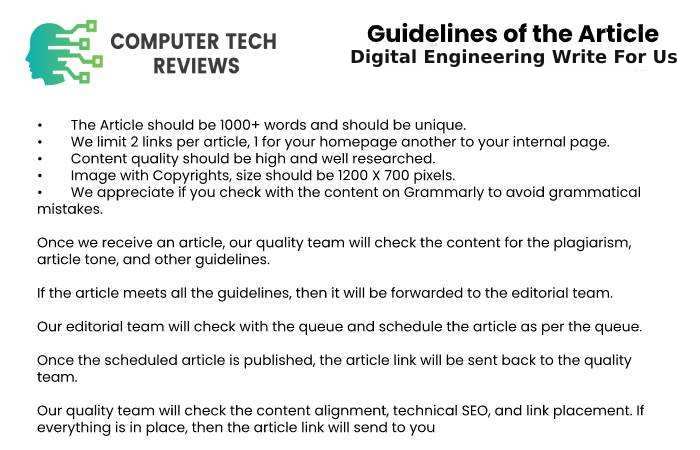
- Submit original content that has not been published elsewhere.
- Write a minimum of 800 words for a standard article.
- Use a clear title, introduction, headings, and short paragraphs.
- Write naturally for readers rather than search engines.
- Support technical claims with reliable and current sources.
- Identify software versions and standards editions where relevant.
- Explain model assumptions, data sources, and testing methods.
- Disclose employer, client, supplier, and commercial relationships.
- Use diagrams, screenshots, and project materials only with permission.
- Remove confidential, proprietary, personal, or security-sensitive information.
- Proofread the article for technical accuracy, clarity, and grammar.
- Our editorial team may edit submissions for clarity and formatting.
How to Submit a Digital Engineering Article
Before sending a complete draft, you may email a focused pitch containing:
- Your proposed title
- A short summary of the article
- The intended reader and problem being addressed
- A proposed outline
- Links to relevant writing samples
- Your engineering or industry experience
- Details of any employer, client, tool provider, or product connected to the topic
Send your proposal or completed article to contact@computertechreviews.com. Use “Digital Engineering Write for Us” as the subject line so your submission can be directed to the appropriate editor.
Explore Related Technology Contributor Topics
Frequently Asked Questions
Do you accept digital engineering articles from new writers?
Yes. Previous publishing experience is useful but not required. We prioritize technical knowledge, originality, accuracy, practical experience, and the ability to explain a complex subject clearly.
Can I write about a specific engineering platform?
Yes, provided the article is useful and editorially balanced. Tutorials, integration guides, workflow explanations, and first-hand evaluations are preferable to promotional platform profiles.
Can I use information from a client or employer project?
Only if you have permission to publish it. Remove confidential designs, customer information, security-sensitive details, proprietary data, and other restricted material. Clearly disclose your connection with the project.
Can I submit an AI-assisted article?
AI tools may assist with organizing or drafting content, but they cannot replace engineering verification. The author must check every calculation, standard, source, specification, quotation, and technical conclusion.
Should I submit a pitch or a complete article?
You may submit either. A focused pitch can help confirm that the proposed subject fits our editorial requirements before you prepare the complete article.
Recent Posts
M4A vs MP3 for Transcription: What Actually Changes the Transcript
M4A vs MP3 for Transcription Comparing M4A vs MP3 for transcription is close to a non-question, and the reason is…
The Patch Window Problem: Why Small IT Teams Fall Behind on Updates
The Patch Window Problem This Article is a part of Cybersecurity Guides and Best Practices Every breach report that mentions…