


Cybersecurity used to have a fairly simple mental picture.
Someone opens a suspicious email. A malicious attachment runs. Antivirus throws up a warning. The IT department scrambles to clean the infected computer.
That still happens.
But it’s no longer the whole story.
Today’s cyberattacks utilizing stolen credentials, exploited vulnerabilities, official administrative utilities, cloud infrastructure, SaaS applications, rogue vendors and ever more sophisticated AI systems. More often than not, there‘s not even a standard malware file for security tools to locate.
According to CrowdStrike, 82% of the detections that it saw back in 2025 were malware free, with an average eCrime breakout time of only 29 minutes, the fastest detection being just 27 seconds. CrowdStrike also reported an 89% increase in attacks from AIl-enabled adversaries though out 2025.
Another striking change happened in 2026, with the increase use of software vulnerabilities as the most common method of initial access in Verizon‘s dataset reaching 31%. The use of third parties was maintained at 48% of breaches with ransomware present in 48% of breaches.
What is really one a cyber attack? What is the definition between malware and a cyber attack in particular? What threats are worth considering today in 2026? What in the end can consumers and business do?
That’s what this guide covers.
Table of Contents
What Are Cyber Threats and Malware?
A cyber-threat is any source that is capable of exploiting a vulnerability in a computer, network, application, account, device or digital service.
That harm can involve:
- stealing information
- disrupting services
- destroying or encrypting data
- taking over accounts
- spying on users
- committing fraud
- installing malicious software
- disrupting business operations
- demanding ransom
- gaining unauthorized access
- using compromised systems to attack others
Malware: The other subset of cyber-threats is malware (Malicious software).
The common types of malware is ransomware, trojans, spyware, worms, rootkits, botnets and information stealing.
That distinction matters.
Can evade the host OS (or other external components) by using some tricks. A phishing attack can steal a password without installing any malware. A stolen OAuth token can allow access to a cloud application without dropping any malicious executable. A zero day will enable you to get remote access before the vendors patches.
In other words:
All types of malware are bad. However, a cyberattack does not necessarily use malware.
If you want the basic definition and terminology, see our guide to malware.
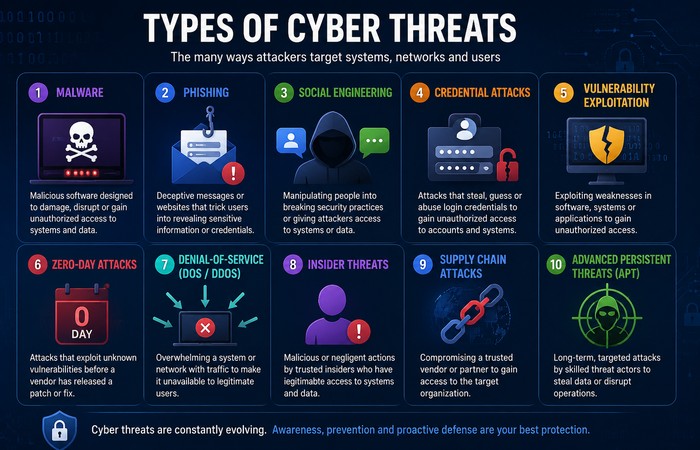
Types of Cyber Threats
Before we can move on to the more comprehensive 2026 threat landscape, a simplified map of the area is always helpful.
1. Malware
Malware is software that is written explicitly to interrupt, to damage, or to have intrusive actions.
Examples are viruses for example spyware, worms, rootkits and information stealers.
2. Phishing
Phishing employs spurious messages, sites, or other communication channels, to trick a person into giving away passwords, installing some form of malware, or taking some action that is advantageous to the attacker.
Contemporary phishing is not confined to electronic mail.
It is also expanding to cover text messages, social networking sites, messaging applications and even voice calls.
Our phishing definition guide goes deeper into how phishing works.
3. Social engineering
The social engineering attack is speaking individuals, not a flaw in the software.
An attacker can pose as a worker, a customer, a technician, a manager or an IS support worker, and can force the user to provide information or to log into the system.
4. Credential attacks
These attacks can take many forms, targeting user names, passwords, session cookies, digital identifiers or even tokens and authentication.
Ways that attackers can gain access to/exploit credentials are many and varied. Attack methods that involve obtaining/exploiting credentials can range from credential stuffing and password spraying through to phishing and utilizing info stealer malware.
5. Vulnerability exploitation
If the attacker is targeting operating systems, applications, network appliances, cloud services or enterprise software and there are exploitable vulnerabilities in these systems, then they may be targeted.
In Verizon’s 2026 DBIR, vulnerability exploitation accounted for 31% of breaches in the report’s dataset, making it the leading initial access vector for the first time in the report’s history.
6. Zero-day attacks
A zero-day attack is where the attacker exploits a vulnerability that has not had a significant chance to be remediated by defenders.
These attacks are especially perilous when the insecure system is accessible directly from the internet.
Read our dedicated zero-day threats guide for a deeper explanation.
7. Denial-of-service attacks
Denial-of-Service attack a target system or service is made non-usable by an attacker.
Distributed denial-of-service, or DDoS, attack, does this by utilizing numerous systems/devices simultaneously.
See our guide to protecting servers against DDoS attacks.
8. Insider threats
An insider threat is caused by one of the entities that have authorized access to some or all of the organization‘s systems or data.
It could be that one individuals is pranking or cheating, careless or infected by an external attacker.
See our insider threat definition for more.
9. Supply-chain attacks
Instead of attacking the final target directly, attackers compromise software, vendors, service providers, libraries or other trusted components.
This is becoming increasingly important as businesses depend on enormous networks of third parties.
10. Man-in-the-middle attacks
The attacks described involve the interception or alteration of the messages between two entities.
Encrypted links and robust authentication can help to mitigate to some extent, however weak networks and compromised endpoints can offer opportunities for attack.
11. AI-assisted attacks
Attackers are employing generative AI, and automation in general, for reconnaissance, social engineering, coding, vulnerability research and post-compromise activity.
It‘s not that AI has just introduced a whole new class of cyber-attack.
Essentially, it is the ability of AI to enable current attacks to become quicker, more affordable and easier to scale.
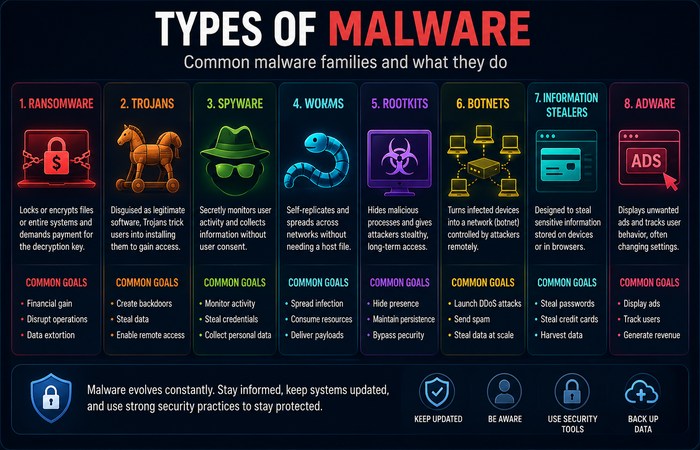
Types of Malware
Despite the fact that many advanced intrusions do not require this component, malware appears to be a staple of computer security.
Ransomware
Ransomware a form of malicious software that denies access to the users’ data or systems. Usually a demand for money is involved.
Today‘s ransomware belongs to a broad continuum of modern criminal operations. In addition to simply encrypting the data, adversaries could move deeper into their targets’ networks by exfiltrating the data, attacking identity management systems, targeting data backup services and releasing the data.
Read our detailed ransomware guide.
Trojans
A trojan pretends to be a genuine application or piece of content.
It can be placed on the system by uploading or executing. It then provides access to the system or can download other payloads.
Spyware
Spyware records activity secretly. For example, it can gather: user credentials, browsing information, screen captures and number of keystrokes.
Worms
In contrast to many modern varieties of malware, a conventional computer virus almost always infects an existing file or program and will replicate only when the infected file is run. This differentiates viruses from worms; which are capable of spreading across networks without human intervention.
Rootkits
The aim of the rootkit is to conceal the malicious action on a layer of the operating system or other privileged layer of the computer system.
Botnets
A botnet refers to a group of computers infected with malware and under the control of a malicious third party.
Using a botnet, you could perform a remote access trojan, use the botnet for a denial of service attack, credential attack, spam campaign, fraud or other attacks.
Information stealers
The information stealing malware aims at collecting information like passwords, browser cookies, authentication tokens, and details of cryptocurrencies.
That information can then be sold, re-used or used to penetrate corporate systems.
For a basic explanation of the term malware itself, see our Malware definition.
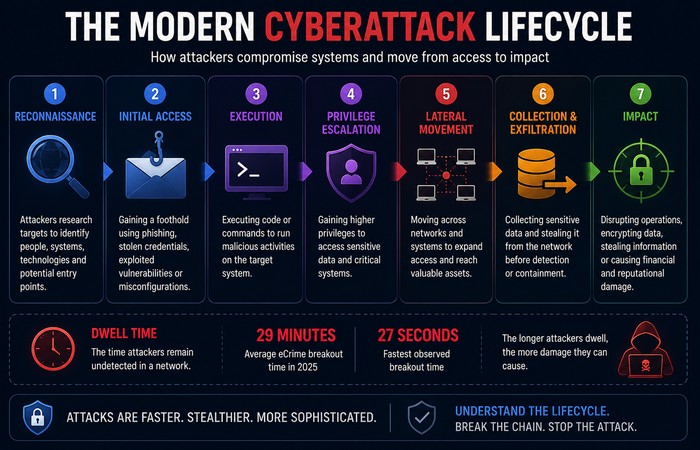
How Modern Cyberattacks Actually Work
Most successful attacks aren’t a single event.
They’re a chain.
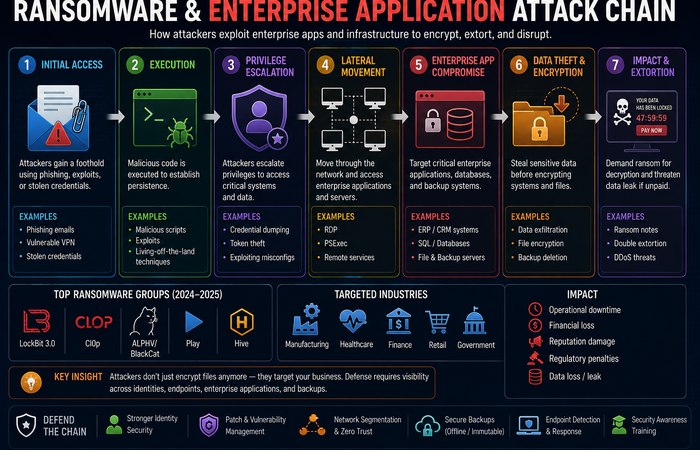
A simplified attack might look like this:
Reconnaissance → Initial Access → Credential Theft → Persistence → Privilege Escalation → Lateral Movement → Data Theft → Extortion or Disruption
Attackers in your system don‘t always go through those steps in order. Some leap between steps, some go through some steps over again.
Remember, the important thing to keep in mind is that compromising a single account or device is probably only the beginning.
For example, an attacker might:
- steal an employee’s credentials;
- log into a VPN or SaaS application;
- obtain additional access;
- discover valuable systems;
- move laterally;
- compromise an administrator account;
- locate sensitive data;
- steal the data;
- deploy ransomware or begin extortion.
And here‘s the uncomfortable part, that‘s right most of that can be done using ‘normal’ programs.
If you would like to explore the broader mechanics and taxonomy of cyber attacks then this guide also covers the methods used to penetrate computers and networks.
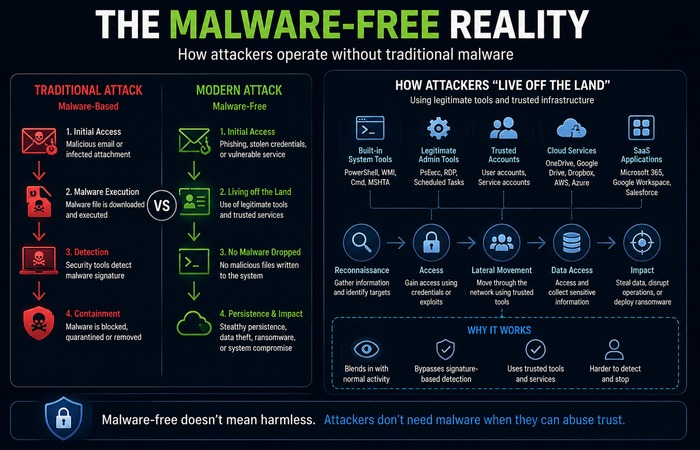
The Malware-Free Reality: Why Many Attacks No Longer Need Malicious Files
This is arguably the largest change in the modern threat landscape.
In 2025, according to CrowdStrike, 82% of detections had no malware. That doesn‘t mean all cyberattack had no malware, by the way! It means that 82% of the detections in the CrowdStrike dataset had no malware.
The attacker may just steal the good one and log in.
They may then use:
- PowerShell
- Windows Management Instrumentation
- Remote Desktop Protocol
- legitimate remote-management software
- cloud administration tools
- browser sessions
- OAuth tokens
- existing credentials
From the perspective of a traditional security tool, this can be awkward.
There may be no obviously malicious executable.
The attacker is using tools that administrators and employees already use every day.
This technique is often described as living off the land.
The defense therefore has to move beyond asking:
“Is this file malicious?”
It also needs to ask:
“Is this identity behaving normally?”
That means watching authentication patterns, session behavior, privilege changes, device relationships and access to sensitive systems.
Strong authentication, phishing-resistant MFA, credential protection, session controls and identity monitoring become increasingly important.
Identity Is the New Perimeter
The old security model was heavily focused on the network perimeter.
There was a firewall.
Inside was the trusted network.
Outside was the internet.
That model is much harder to maintain now.
Employees are working from home or any place. Applications are operated in the cloud. Vendors connect to corporate systems. SaaS platforms store business data. APIs connect services together. AI systems consume corporate information.
The boundary has become blurry.
A stolen identity can thus be worth more than a piece of malware.
The attacker isn‘t even required to breach a firewall if authentication succeeds.
This is exactly the reason why identity threat detection and response, or ITDR, has gained so much focus.
The objective is to detect unusual behavior around identities:
- unexpected login locations
- abnormal authentication times
- unusual privilege changes
- access to systems the user normally never touches
- impossible or suspicious session patterns
- abnormal OAuth activity
- unusual administrative actions
The goal isn’t simply to determine whether the account is legitimate.
It’s to determine whether the person or process using that account is behaving legitimately.
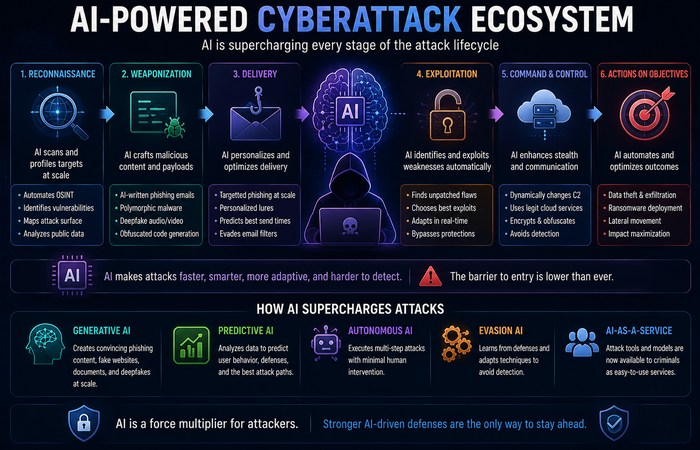
AI Is Changing Cyberattacks
Artificial intelligence isn‘t just another name in cybersecurity.
And it‘s gradually having a place in the operational tool kit on the receiving as well.
CrowdStrike reported an 89% increase in attacks by AI-enabled adversaries in 2025. The company also said attackers exploited legitimate generative-AI tools at more than 90 organizations, including cases involving malicious prompts and AI development platforms.
AI can help attackers with tasks such as:
- reconnaissance
- social engineering
- translation
- writing scripts
- analyzing stolen information
- generating phishing content
- researching vulnerabilities
- automating repetitive post-exploitation work
- creating synthetic identities or personas
The important distinction is that AI doesn’t need to create an entirely new attack method to be dangerous.
Making an existing attack dramatically faster can be enough.
LAMEHUG: When Malware Uses an LLM
Another interesting example is LAMEHUG, which CrowdStrike links to the Russia-nexus actor FANCY BEAR/APT28.
It communicates with an outside large language model in order to generate commands from information in the pierced environment.
CrowdStrike’s reporting describes LAMEHUG using the Qwen2.5-Coder-32B-Instruct model through Hugging Face infrastructure. The model-generated commands can then be executed by the malware.
Why does that matter?
Traditional malware often contains predictable instructions.
An AI-assisted system can potentially request commands dynamically instead.
That makes the architecture more flexible and complicates detection based solely on static signatures.
But there’s an important caveat.
Calling LAMEHUG “AI malware” can make it sound more autonomous than the evidence demonstrates. The model is being used as part of a command-generation mechanism; it isn’t evidence that malware has suddenly become a fully autonomous cybercriminal.
That distinction matters.
Good cybersecurity analysis separates what the technology actually does from what makes a dramatic headline.
When AI Systems Become the Target
AI has created another problem.
The models themselves, their APIs, gateways, credentials, training data and surrounding infrastructure are now security assets.
That means attackers can target the AI supply chain.
Potential targets include:
- model-serving infrastructure
- API keys
- AI gateways
- open-source libraries
- training datasets
- vector databases
- agent tools
- plugins
- authentication systems
- cloud infrastructure
- developer environments
A compromise anywhere in that chain can potentially affect the systems connected to it.
Claude Mythos and the Rise of AI Cyber Capabilities
Anthropic’s Claude Mythos Preview illustrates the dual-use nature of increasingly capable AI.
Anthropic designed Mythos as a cybersecurity-focused model and used it with partners through Project Glasswing, an initiative aimed at finding vulnerabilities in critical software. By May 2026, Anthropic said its roughly 50 initial partners had used Mythos Preview to identify more than 10,000 high- or critical-severity vulnerabilities.
The defensive potential is obvious.
Finding vulnerabilities before criminals do is valuable.
But the same capabilities can be used offensively.
The UK’s AI Security Institute found that Mythos Preview could autonomously perform multi-stage attacks against a vulnerable simulated corporate network in controlled evaluations. It completed its 32-step “The Last Ones” attack simulation end-to-end in three of ten attempts, while the exercise was estimated to take a human expert about 20 hours.
That does not mean an AI can automatically compromise any real company.
AISI explicitly notes that its simulated networks differ from hardened real-world environments because they lacked active defenders and some defensive controls.
That’s the right way to interpret the finding:
AI cyber capabilities are improving rapidly, but controlled benchmark performance is not the same thing as universal real-world attack capability.
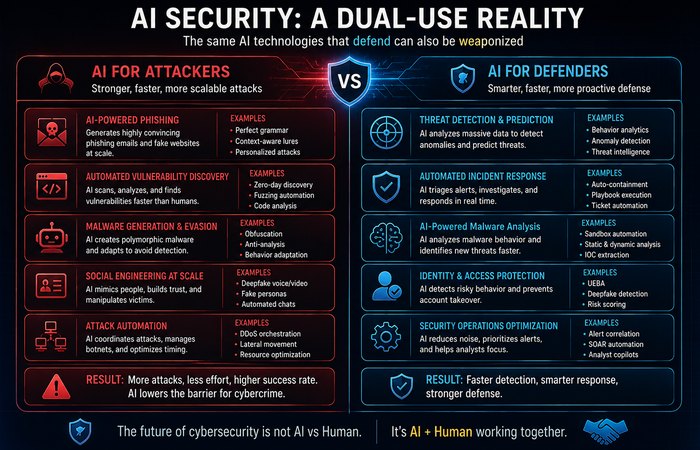
AI Security Is Now a Dual-Use Problem
The same technology can help defenders and attackers.
An AI model can:
- find a vulnerability;
- explain it to a security engineer;
- generate a patch;
- test the patch;
or it can:
- discover a weakness;
- develop exploit code;
- automate reconnaissance;
- help an attacker scale the operation.
OpenAI’s Aardvark research project, later integrated into Codex Security, is an example of the defensive side. OpenAI describes it as an agentic security researcher designed to analyze codebases, identify vulnerabilities and help defenders prioritize security work.
Google has also used AI for vulnerability discovery through its Big Sleep work with Project Zero.
The strategic question isn’t whether AI should be used for cybersecurity.
It’s becoming:
How do we make defensive use of AI easier and safer than malicious use?
Attackers Are Moving Faster
Speed is now becoming a problem in cybersecurity.
Crowd Strike‘s 2026 Global Threat Report identified that in 2025 the mean eCrime break out time was 29 minutes, a 65% reduction from 2024. The shortest recorded break out time was 27 seconds and in one incident data exfiltration commenced four minutes following initial access.
These figures don’t mean every attack happens in 29 minutes.
They demonstrate how quickly some attacks can progress.
M-Trends 2026 from Mandiant provides yet another astonishing data point: Medians for how long a byte was in possession of a threat operation from first contact to transfer of to a secondary threat group plummeted from more than 8 hours in 2022 to 22 seconds in 2025.
Detail of the 22-second calibration figure requires some explanation.
That 22-second figure needs careful interpretation.
It is not the median time from initial compromise to ransomware encryption.
It’s the median time for the handoff between an initial access event and a secondary threat group in the relevant Mandiant cases.
Still, the implication is serious.
The cybercrime ecosystem has become increasingly specialized.
- One group can obtain access.
- Another can buy that access.
- A third can handle extortion.
The operation becomes a supply chain of its own.
Why Ransomware Has Become More Than File Encryption
The old ransomware story was simple:
Files get encrypted → attacker demands payment → victim tries to recover.
Modern ransomware and extortion operations can be much more complicated.
Attackers may:
- steal data before encryption;
- compromise administrator accounts;
- disable security tools;
- attack backup systems;
- target virtualization infrastructure;
- steal credentials;
- exploit third-party access;
- threaten public disclosure;
- disrupt business operations.
Mandiant’s 2026 reporting highlights a growing focus on recovery denial, where attackers deliberately target backup infrastructure, identity services and virtualization systems to make recovery harder.
That changes the defensive question.
It’s no longer enough to ask:
“Can we restore our files?”
Organizations also need to ask:
“Can the attacker prevent us from restoring them?”
Backups therefore need their own security controls, access restrictions, monitoring and recovery testing.
Beyond the Endpoint: Enterprise Applications Are High-Value Targets
Attackers aren’t interested only in employee laptops.
Enterprise applications can be even more valuable.
ERP, CRM, HR, finance, supply-chain and collaboration platforms often contain information that can affect an entire organization.
A compromise of one central application can have consequences far beyond a single workstation.
Oracle E-Business Suite
CVE-2025-61882 this is a critical vulnerability in the Concurrent Processing component of the Oracle E-Business Suite.
The Oracle assessed the vulnerability as CVSS 9.8 and describes it to be exploitable remotely without authentication.
The Google Threat Intelligence Group and Mandiant have observed and documented CL0P related threat actor groups potentially using Oracle EBS exploits as zero-days in 2025, predating the available patch.
So this is exactly what makes internet-facing enterprise software as important as endpoints and servers.
SAP NetWeaver
CVE-2025-31324 impacted the SAP NetWeaver Visual Composer Metadata Uploader.
Since unauthenticated users could send in malicious executable files, this vulnerability ranked as critical. Moreover, according to record of NIST, it was included in Known Exploited Vulnerabilities list of the Cybersecurity and Infrastructure Security Agency.
These examples demonstrate a broader trend:
The application running the business can be a more valuable target than the computer used by an employee.
Zero-Day and Edge Infrastructure Risk
Internet-facing infrastructure is popular as it is accessible without first compromising an internal work station.
That includes:
- VPN appliances
- firewalls
- remote-access systems
- email gateways
- web servers
- enterprise applications
- mobile-management platforms
The problem is most serious when the exploit occurs before a patch has been issued.
According to CrowdStrike‘s 2026 Global Threat Report there were 42% more zero-day vulnerabilities exploited in the six months prior to public disclosure in 2026.
That doesn’t mean patching has become useless.
Quite the opposite.
It means patching needs to be faster, continuous and combined with exposure management, compensating controls and threat hunting.
Our zero-day threats guide covers this topic in more detail.
Who Is Behind Modern Cyberattacks?
There isn’t one type of attacker.
Different groups have different goals, resources and operating models.
Nation-state actors
Groups associated with the government are usually involved in collecting intelligence, intelligence gathering, political aims or strategic disruption.
Their operations may include long term persistence and advanced infection exploitation.
Cybercriminal groups
Financially motivated attackers focus on money.
Their operations increasingly resemble businesses.
Initial access brokers obtain access. Ransomware affiliates or extortion groups purchase or receive that access. Other experts could process stolen data, work on money laundering or infrastructure.
Hacktivists
There are any number of reasons why an individual or group might decide to hack, but many motivations tend to revolve around political reasons.
They frequently use the following methods: Ddos, crash of websites, leak of information, etc.
Insider threats
Insiders already possess legitimate access.
This in turn is why they are almost indistinguishable from everyday users.
An insider could steal information intentionally or unintentionally, and/or have his/her account hacked by an external entity.
Read our Insider Threat guide for more detail.
North Korean Cybercrime and AI-Enabled Deception
North Korean threat actors have become particularly significant in cryptocurrency and financial theft.
CrowdStrike put the DPRK actors’ digital assets theft at around $2.02 billion in 2025 in a growth of 51% over previous years. It also reported that PRESSURE CHOLLIMA carried out a $1.46 billion cryptocurrency theft, described by CrowdStrike as the largest single financial theft it had reported.
AI is becoming part of this ecosystem too.
CrowdStrike reported the use of AI-generated identities and personas in DPRK-linked operations, illustrating how synthetic media and AI-assisted social engineering can support traditional cybercrime techniques.
Again, the important point isn’t that AI replaces the attacker.
It gives the attacker another tool.
The Security Operations Center Is Being Rebuilt
Defenders have their own speed problem.
Security teams receive Thousands of alerts a day.
According to Vectra AI simulation in 2026, of all 2,992 security alerts generated within an organization per day, 63% went unacknowledged.
That’s a brutal mismatch.
If attackers can move in minutes and analysts are buried under thousands of alerts, simply generating more alerts isn’t a solution.
This is where AI-assisted and agentic security operations become interesting.
A modern security operation increasingly needs to:
- collect signals;
- normalize them;
- correlate events;
- enrich them with identity, asset and threat-intelligence context;
- determine whether the activity represents a genuine threat;
- contain high-confidence threats quickly;
- keep humans involved in high-impact decisions.
The goal isn’t to remove security professionals.
It’s to stop wasting their time on repetitive investigation that machines can perform faster.
Traditional SOC vs. Agentic SOC
| Traditional approach | Agentic/AI-assisted approach |
| Rule-based detection | Context-aware analysis |
| Manual alert triage | Automated prioritization |
| Separate security consoles | Correlated signals |
| Human investigation of every alert | Humans focus on high-risk cases |
| Static playbooks | Adaptive workflows |
| Ticket creation | Potential automated containment |
| Reactive investigation | Continuous analysis |
But there is an important warning.
Giving an AI agent permission to disable accounts, isolate systems or revoke credentials creates its own risk.
A badly configured autonomous system can cause an outage while trying to prevent one.
That’s why organizations should introduce autonomous security capabilities gradually, beginning with low-risk triage and moving toward containment only when confidence, testing and auditability are strong enough.
A Practical 12-Week Path Toward AI-Assisted Security Operations
An organization doesn‘t have to switch entirely from a traditional SOC to an autonomous SOC.
A safer rollout looks like this.
Weeks 1–2: Assessment
- Document the existing tools, alert volume, detection coverage and response times.
- Define exactly which decisions AI systems are allowed to make.
Weeks 3–6: Shadow mode
Let AI analyze alerts without allowing it to take destructive actions.
- Compare its decisions against human analysts.
- Look for false positives and missed threats.
Weeks 7–12: Controlled production
Automate clearly defined and high-confidence workflows.
For example:
- phishing triage
- enrichment
- repetitive investigation
- low-risk account actions
More consequential containment actions should remain subject to clear policies and human oversight until the organization has evidence that automation is reliable.
Governance Is Catching Up: The NIST Cyber AI Profile
AI security isn’t only a technical problem.
It’s also a governance problem.
The AI NIST Cybersecurity Framework Profile (NIST IR 8596) was released as an Initial Preliminary Draft in December 2025. Responses to the draft submissions closed in January 2026. This framework is for organizations seeking to manage both the cybersecurity risks posed by AI, as well as how to adopt AI to enhance cybersecurity.
This profile is still a draft. Therefore, organizations should not say in their declaration that this is a final press argument.
But it represents an important direction.
AI security increasingly needs to consider:
- AI supply chains
- model provenance
- training-data integrity
- model access
- AI infrastructure
- AI-enabled attacks
- AI-assisted defense
- data protection
- governance
- monitoring
The underlying message is straightforward:
AI systems need to be secured as technology, while AI itself needs to become part of the security strategy.
The Cybersecurity Skills Problem
Technology alone won’t solve this.
Security teams need people who understand:
- cloud security
- identity
- AI
- application security
- vulnerability management
- incident response
- governance
- threat intelligence
ISC2’s 2025 Cybersecurity Workforce Study surveyed 16,029 cybersecurity professionals and found that 88% had experienced at least one significant cybersecurity consequence because of skills shortages, while 59% reported critical or significant skills needs. AI was the most frequently cited skills need at 41%.
Intriguingly, ISC2 ceased publishing its former headline workforce-gap estimate in 2025, as respondents found skills shortages to be a more meaningful indicator than just the number of missing people.
That‘s a key distinction.
The problem isn‘t just:
“We need more cybersecurity employees.”
It’s also:
“We need the right skills inside the people and systems we already have.”
Cyber Threats Facing Small and Mid-Sized Businesses
As small businesses are of some concern to hackers they can be massive capable of bringing down some of the largest companies.
That’s dangerous.
A smaller company may have:
- fewer security employees;
- less monitoring;
- weaker identity controls;
- outdated systems;
- fewer tested backups;
- limited incident-response capability;
- extensive dependence on third-party services.
For an attacker, that can make the organization attractive.
There is no need to have the security budget of a Fortune 500 company.
Start with fundamentals:
Use strong MFA
Incentivize phishing resistant authentication as much as possible, especially for admins and critical accounts.
Patch internet-facing systems quickly
Internet-facing vulnerabilities deserve special treatment.
Protect backups
Backups need to be isolated, protected with access controls and tested regularly.
Limit privileges
Employees and applications shouldn’t have administrative access simply because it is convenient.
Monitor identity activity
Unusual login and privilege behavior can reveal attacks that traditional antivirus misses.
Train employees
Training needs to cover phishing, social engineering, stolen credentials and suspect requests.
Have an incident-response plan
Know who makes decisions before a crisis happens.
Why the Old “60% of Small Businesses Fail” Statistic Shouldn’t Be Repeated
You can also get some of the information such as 60% of small Businesses shut down within 6 months post cyber attack.
This image has already long gone viral on the Internet. However, the figure is not reliable to take for a confirmed fact.
This is an important editorial lesson for cybersecurity publishing:
Just because of the number of websites that reproduce a piece of data, it doesn‘t make it reliable.
Attempt to get back to the original report, methods, population if possible.
That’s the approach this guide follows.
The Business Case for Cybersecurity
Security expenditure is sometimes hard to rationalize as the advantage is hidden.
No one celebrates the breach that didn‘t occur.
A simple framework can still help.
Illustrative cybersecurity ROI
Value created = avoided incident costs + productivity gains + reduced operational overhead − security investment
For example, an organization might evaluate:
- analyst hours saved through automation;
- incidents prevented;
- reduced downtime;
- lower recovery costs;
- reduced contractor requirements;
- improved employee productivity;
- reduced security-team turnover.
The numbers should be based on the organization’s own environment rather than copied from a generic benchmark.
Verizon’s 2026 research also highlights the financial importance of third-party and supply-chain incidents, while its broader DBIR data shows how quickly vulnerability exploitation and third-party exposure have become major sources of risk.
The strongest business case therefore isn’t:
“We need another security tool.”
It’s:
“Here is the risk we’re exposed to, here is what it could cost, and here is how this investment reduces that exposure.”
Three Strategic Actions to Take Now
After looking at the entire 2026 threat landscape, three priorities stand out.
1. Build a real inventory of your technology and AI assets
You can’t secure systems you don’t know exist.
Inventory:
- endpoints
- servers
- cloud accounts
- SaaS applications
- APIs
- AI models
- AI gateways
- open-source dependencies
- service accounts
- third-party integrations
Shadow AI deserves particular attention.
Employees may use AI services without realizing that sensitive company information is being sent outside approved systems.
Verizon’s 2026 DBIR reported that employee use of unapproved “shadow AI” had tripled to 45% in its dataset.
2. Treat third parties as part of your attack surface
A trusted vendor can become the route into your organization.
Third-party risk isn’t theoretical.
Verizon reported that breaches involving third parties increased by 60% and represented 48% of breaches in its 2026 DBIR dataset.
That means vendor access deserves:
- strong authentication;
- least privilege;
- session monitoring;
- access reviews;
- logging;
- rapid revocation procedures.
3. Move from reactive detection toward continuous exposure management
Don’t wait for an alert to discover a weakness.
Continuously look for:
- Exposed systems;
- Missing patches;
- Excessive privileges;
- Weak authentication;
- Vulnerable applications;
- Forgotten accounts;
- Unauthorized AI services;
- Risky third-party connections.
The objective is simple:
Find the loophole before the hacker does.
How to Protect Against Cyber Threats and Malware
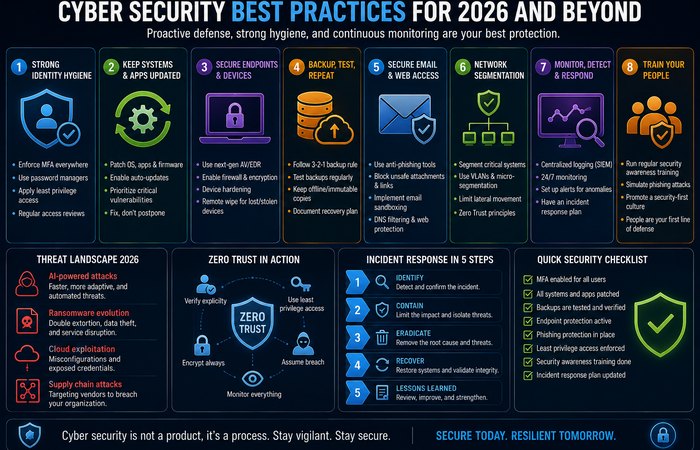
The notion that security consists of a security product alone, is not true to the field of cybersecurity.
A rational defense strategy should also be multi-layered.
For individuals
- Use unique passwords.
- Use a password manager.
- Enable MFA.
- Keep operating systems updated.
- Keep applications updated.
- Avoid unknown attachments and links.
- Verify unexpected calls and messages.
- Keep reliable backups.
- Use reputable endpoint security.
- Avoidinfringing upon copyright law; do not install pirated or loaded
If you‘re looking to grasp the context of malware here is the malware definition from earlier.
For businesses
- Keepapreciserecordof assets.
- Addressvulnerabilitiesin systems that are exposed to the network immediately.
- Use strong identity controls.
- Deploy endpoint and network monitoring.
- Segment critical systems.
- Protect backups.
- Monitor privileged accounts.
- Review third-party access.
- Test incident-response procedures.
- Providetraining sessions on phishing and social engineering.
- Organizationsshould monitor their cloud and SaaS environment.
- Establish AI governance.
- Continuously review exposed vulnerabilities.
For the broader attack landscape, see our Cyber Attacks guide.
FAQs
Q1: What is a cyber threat?
A: A cyber threat can be any activity, event or method that can maliciously affect the confidentiality, integrity or availability of information system or information.
Q2: What is malware?
A: Malware: is to any malicious computer program or code intended to gain access to a computer system or cause some other sort of damage. Common malware include anti virus/spyware, virus, Trojan, worm, rootkit.
For the basic definition, see our malware definition guide.
Q3: What is the difference between a cyber threat and malware?
A: The general concept is that a cyber threat is.
One way in which someone might attack this system is through the use of malware.
Cyber threats such as; phishing, stolen credentials, social engineering, DDoS, insider threats and theft of vulnerabilities are all cyber threats without being in the scope of malware.
Q4: What are the most common types of cyber threats?
A: Some of the most frequently used classifications include malware, phishing, social engineering, attack on login credentials, usage of vulnerability, ransomware, zero-day attack, DoS attack, Insider threat and supply-chain attack.
Q5: Is ransomware still a major threat in 2026?
A: Yes.
Versizon‘s 2026 DBIR, demonstrated ransomware had been used in 48% of breaches in its data set (though not all are against Verizon). Today‘s ransomware groups just encrypt, they also steal data, compromise identity, destroy backups and try to extort you.
Read our complete ransomware guide.
Q6: Are most cyberattacks malware-based?
A: Not necessarily.
CrowdStrike notes, 82% of the detections in their 2025 data set had no malware. That number is for their detections alone not necessarily that 82% of a cyber attack contains no malware.
Q7: What is a zero-day attack?
A: A zero day attack is when the attacker takes advantage of the vulnerability before the defendant has had the chance to adequately fix it.
See our zero-day threats guide.
Q8: Can AI be used to create malware?
A: Artificial Intelligence may be used by an attacker to aid in malicious activities such as malicious code creation and scripting, reconnaissance and many more.
Can also be used defensively, to find holes, to analyze code and to enhance detection.
The technology is thus dual-use.
Q9: Is AI making cyberattacks faster?
A: There is mounting evidence to support this claim.
Crowdstrike stated that they detected 89% more of attack through AI-powered adversaries and had an average eCrime ‘breakout’ time of 29 minutes in 2025.
Q10: What is living off the land?
A: Living off the land means making use of valid tools that are already installed on a system, instead of depending solely on custom-developed malware.
PowerShell, WMI, and other bona fide remote-management tools.
Q11: What is an insider threat?
A: An insider threat refers to a malicious or negligent use of access to organization information systems or data that is authorized through the organizations existing security controls.
See our insider threat definition.
Q12: How can businesses protect against cyber threats?
A: Chances are you have strong identity management, strong controls, enabled MFA, fast patch management, least privilege, isolated and secured backups, should be monitoring, network monitoring, vulnerability management, the right training for your people, third-party risk management and a tested incident response plan.
Q13: Can firewalls and antivirus stop modern cyberattacks?
A: They still matter but not enough.
Arguments used today will have to refer to set of valid account credentials working for a cloud provider, hijacked session, or a legitimate administrative functionality. Defense therefore needs multiple layers covering identity, endpoints, applications, cloud environments, networks and human behavior.
Q14: Why are enterprise applications such important targets?
A: Applications such as ERP and CRM systems can contain financial, customer, employee and operational information.
Compromising one central application can therefore affect an entire business rather than a single endpoint.
Q15: Why are third-party vendors a cybersecurity risk?
A: A trusted vendor may have already had special knowledge of your systems.
If that vendor becomes compromised, the malicious users would then potentially be able to utilize the trusted connection to reach downrange organizations.
That is why vendor access should be treated as part of the organization’s attack surface.
Related Cyber Threats and Malware Guides
Continue exploring the Cyber Threats & Malware topic with these related guides:
- What Is Malware?
- Breaking Down Ransomware
- What Is Phishing?
- What Is a Computer Virus?
- Cyber Attacks
- How to Protect Your Server Against DDoS Attacks
- Everything About Zero-Day Threats
- What Is an Insider Threat?
Final Thoughts
The dumbest thing you could think about cybersecurity in 2026 is that it is some guy sitting at his computer trying to slip a virus onto a computer.
Often that is just what occurs.
More and more, however, the attacker now just signs on.
They may use a stolen credential, a compromised session, a malicious OAuth authorization, an exploited vulnerability or access purchased from another criminal group. They may use legitimate administrative tools after getting inside. They may use AI to speed up reconnaissance, social engineering or technical work.
And sometimes they won’t need malware at all.
The old fundamentals still matter. Patch your systems. Protect your accounts. Use MFA. Maintain backups. Limit privileges. Train people. Monitor your environment.
But the perimeter has changed.
It’s now identity, applications, cloud infrastructure, third-party relationships, AI systems and the people who connect all of them.
The organizations that will adapt best may not be the ones with the most security products.
They will be those that know what they have, know how their adversaries will get at it, know how to pick up on irregular activities, and will be able to react so a ‘small’ compromise doesn‘t turn into a ‘large’ event.
That is the real challenge for cybersecurity in 2026.
Sources & Further Reading
To have the knowledge for researching the cyber security trends, statistics, vulnerabilities and AI issues described in this guide, we used the following sources of information:
- CrowdStrike — 2026 Global Threat Report
Covers the 82% malware-free detection figure, 29-minute average breakout time, 27-second fastest breakout, AI-enabled adversary activity, and zero-day exploitation.
View the CrowdStrike 2026 Global Threat Report - Verizon — 2026 Data Breach Investigations Report (DBIR)
Covers vulnerability exploitation, ransomware, third-party breaches, shadow AI, and other major breach trends.
View the Verizon 2026 DBIR - Mandiant / Google Cloud — M-Trends 2026
Offers incident-response research and quantitative data on attacker methodology, intrusion timelines, and the progression of threat actors through compromised networks.
View M-Trends 2026 - NIST — Cybersecurity Framework Profile for Artificial Intelligence (NIST IR 8596)
Provides guidance for managing cybersecurity risks associated with AI systems and using AI to strengthen cybersecurity.
View NIST IR 8596 - ISC2 — 2025 Cybersecurity Workforce Study
Provides research on cybersecurity workforce shortages, skills gaps, and the growing demand for AI-related security skills.
View the ISC2 2025 Workforce Study - Anthropic — Project Glasswing / Claude Mythos
Covers Anthropic’s cybersecurity-focused AI research and the use of Claude Mythos Preview to identify vulnerabilities in critical software.
View Project Glasswing - UK AI Security Institute — Claude Mythos Cybersecurity Evaluation
Provides an independent evaluation of Claude Mythos Preview’s cybersecurity capabilities in controlled environments, including multi-stage attack simulations.
View the AISI Claude Mythos Evaluation - Oracle — Security Alert: CVE-2025-61882
Official Oracle security alert details the severe Oracle E-Business Suite exploitability remote, unauthenticated features and CVSS 9.8 score.
View Oracle Security Alert — CVE-2025-61882 - NIST National Vulnerability Database — CVE-2025-31324
Provides the official vulnerability database entry for the SAP NetWeaver Visual Composer Metadata Uploader vulnerability including severity and component information.
View NIST/NVD — CVE-2025-31324 - CISA — Known Exploited Vulnerabilities Catalog
CISA‘s catalogue of exploited vulnerabilities contains as one of those that are known the CVE- 2025- 31324 and the business was the remediation information.
View the CISA Known Exploited Vulnerabilities Catalog - OpenAI — Aardvark / Codex Security
Documents OpenAI’s agentic security research system, originally introduced as Aardvark and subsequently integrated into Codex as Codex Security.
View OpenAI — Introducing Aardvark - OpenAI — Codex Security
Provides the current information about Codex Security and its use for identifying, validating, and helping remediate software vulnerabilities.
View OpenAI — Codex Security - Google Project Zero — Big Sleep
Covers Google’s work exploring AI-assisted vulnerability discovery through Big Sleep and Project Zero.
View Google Project Zero — Big Sleep - Vectra AI — 2026 State of Threat Detection
Provides research on security-alert volumes, including the reported average of 2,992 alerts per day and the proportion going unaddressed.
View Vectra AI — 2026 State of Threat Detection