
CAPP Write for Us – Submit a Computer-Aided Process Planning Guest Post
Turning a product design into a reliable manufacturing process requires more than selecting machines and materials. Manufacturers must determine the correct sequence of operations, tools, production resources, quality checks, setup requirements, and standard times. Computer-aided process planning helps organize and automate parts of this work.
Computer Tech Reviews welcomes manufacturing engineers, production planners, SAP and ERP consultants, software developers, researchers, industrial engineers, system integrators, and experienced technical writers to contribute to our CAPP Write for Us section.
We are interested in original, practical articles about computer-aided process planning, manufacturing software, production routing, digital work instructions, time management, CAD/CAM integration, ERP integration, and smart manufacturing.
CAPP is part of the broader business and engineering software landscape. Contributors covering other software platforms, development practices, or enterprise applications can also visit our Software Write for Us page.
What Is CAPP?
CAPP commonly stands for computer-aided process planning. It refers to the use of software to help determine how a component or product should be manufactured. A CAPP system can convert design and engineering information into structured production plans that guide people, machines, and connected business systems.
Depending on the organization and application, a process plan may contain:
- The required manufacturing operations
- The sequence in which operations should occur
- Machines, work centers, tools, and fixtures
- Materials and intermediate components
- Setup, cycle, labor, and inspection times
- Operating parameters and tolerances
- Quality-control requirements
- Safety notes and work instructions
- Routing and production-resource information
The abbreviation CAPP can have other meanings in different industries. Contributors should define it at the beginning of an article and identify the product, method, or industry being discussed.
How Computer-Aided Process Planning Works
A CAPP workflow generally begins with product information. This may include a CAD model, engineering drawing, bill of materials, material specification, tolerances, surface requirements, and expected production volume.
The planning system or manufacturing engineer then uses this information to select appropriate processes, machines, tools, operation sequences, and production standards. The resulting plan may be transferred to an ERP, manufacturing execution, scheduling, costing, quality-management, or CAM system.
CAPP does not necessarily eliminate the manufacturing engineer’s role. Many implementations combine software rules and stored knowledge with professional review. Engineers may need to account for machine availability, supplier limitations, tooling constraints, production volumes, local safety requirements, and unusual design features.
Variant and Generative Process Planning
CAPP systems are often discussed in terms of variant and generative approaches. Actual products may combine features from both models.
Variant Process Planning
Variant process planning retrieves an existing plan for a similar component or product. A planner then adjusts the plan to fit the new requirement. Parts may be organized using group-technology classifications, product families, geometry, materials, or manufacturing characteristics.
This approach can reduce repetitive work and encourage standardized methods. Its effectiveness depends on the quality of the existing plans, classification structure, and revision controls.
Generative Process Planning
Generative process planning uses rules, algorithms, decision logic, or manufacturing knowledge to create a plan from product and production data. The system may evaluate features, tolerances, available machines, tool requirements, and sequencing constraints.
A generative system can provide greater automation, but it requires dependable data and carefully maintained manufacturing rules. Generated plans should be validated before production, especially when safety, quality, or expensive materials are involved.
Hybrid CAPP
A hybrid system may retrieve a standard plan and then use automated rules to modify particular operations. This can provide the consistency of variant planning while introducing some of the flexibility offered by generative methods.
CAPP, CAD, CAM, and ERP
CAPP is connected with several manufacturing technologies, but these terms should not be treated as interchangeable.
- CAD supports the creation and modification of product designs, models, and engineering drawings.
- CAPP helps determine the processes and resources needed to manufacture the design.
- CAM helps prepare and control manufacturing operations, including machine instructions and toolpaths.
- ERP coordinates broader business information such as materials, purchasing, inventory, production orders, finance, and costing.
- MES helps manage, monitor, and record production activities on the factory floor.
These systems may exchange part numbers, bills of materials, routings, work-center data, operation times, tool requirements, revision information, and production results. Successful integration requires clear data ownership and change-control procedures.
CAPP and SAP Environments
SAP systems can manage product data, work centers, routings, production orders, capacity requirements, costing, and other manufacturing information. Organizations may also use specialized planning applications or add-ons when their process-planning requirements are more detailed than their standard ERP configuration supports.
Articles about CAPP and SAP may discuss:
- Transferring process plans into production routings
- Managing work centers and production resources
- Using standard values for scheduling and costing
- Connecting engineering data with manufacturing records
- Maintaining versions and engineering changes
- Integrating specialized planning software with SAP
- Validating master data before deployment
Contributors writing primarily about SAP modules, implementation, integration, migration, or enterprise architecture can submit through our SAP Write for Us section.
Production Time and Capacity Planning
Reliable operation times help manufacturers estimate capacity, calculate costs, prepare schedules, compare production methods, and identify opportunities for improvement. CAPP applications may store or calculate setup times, machine times, labor times, inspection times, and other standard values.
Writers may explain recognized work-measurement approaches, but they should identify the method, assumptions, unit of measurement, and conditions under which the data was collected. A standard time should not be presented as universally valid when it depends on a specific workplace, machine, process, or workforce.
Time data also requires governance. When equipment, designs, materials, or manufacturing methods change, planners may need to review the associated standards and routings.
Manufacturing Cost Estimation
Process plans can support cost estimation by identifying materials, operations, tools, setup requirements, labor, machine utilization, scrap assumptions, and inspection activities. Estimates may be used during product design, quotation, budgeting, sourcing, or production planning.
However, calculated costs depend on the completeness and accuracy of the underlying information. Articles should explain assumptions involving production volume, labor rates, overhead allocation, material waste, machine rates, currency, and location.
Contributors focusing on bookkeeping, financial reporting, cost accounting, reconciliation, or finance applications can visit our Accounting Software Write for Us page.
Digital Work Instructions and Document Management
A process plan may generate or reference work instructions, drawings, inspection documents, safety information, tool lists, and setup procedures. These materials must be available to the appropriate employees while remaining connected with the correct product and revision.
Document-management and collaboration platforms can support approval workflows, version histories, permissions, and controlled access. Writers exploring Microsoft-based collaboration, manufacturing documentation, workflow automation, or team knowledge can contribute through our SharePoint Write for Us section.
For broader discussions of enterprise content management, records retention, document capture, archiving, search, governance, and content workflows, visit our OpenText Write for Us page.
CAPP Integration and Data Exchange
CAPP rarely operates in complete isolation. A production environment may include product lifecycle management, CAD, CAM, ERP, MES, quality-management, inventory, document-management, and shop-floor systems.
Integration topics may include:
- Product and part identifiers
- Bills of materials and manufacturing bills of materials
- Manufacturing features and tolerances
- Routings and operation sequences
- Work centers and machine capabilities
- Tools, fixtures, and production resources
- Standard times and costing values
- Engineering changes and revision status
- Quality plans and inspection requirements
- APIs, files, middleware, and data mappings
Writers should explain which system owns each record, how updates are synchronized, and what happens when an integration fails. A technically connected system can still produce unreliable results when identifiers, units, versions, or data definitions are inconsistent.
Implementation and Data Migration
A successful CAPP implementation depends on more than installing software. Organizations must evaluate their planning processes, standardize terminology, prepare manufacturing data, define responsibilities, configure rules, test integrations, and train users.
An implementation plan may include:
- Documenting the current planning workflow
- Identifying measurable business requirements
- Reviewing existing routings and process plans
- Cleaning and classifying manufacturing data
- Defining system integrations and data ownership
- Configuring planning rules and templates
- Testing representative products and exceptions
- Running a controlled pilot
- Training planners, engineers, and administrators
- Monitoring quality after deployment
Legacy process plans should not be migrated without review. Duplicate records, obsolete machines, inconsistent operation names, and inaccurate time standards can transfer old problems into the new platform.
Artificial Intelligence in Process Planning
Artificial intelligence and machine-learning techniques may assist with feature recognition, process selection, time estimation, similarity searches, anomaly detection, scheduling recommendations, and analysis of production data.
AI-generated recommendations require appropriate human review. A model may not understand undocumented equipment constraints, unusual materials, workplace practices, safety obligations, or recent engineering changes. Contributors should describe the source and limitations of training data and avoid suggesting that an automated recommendation is always production-ready.
CAPP Topics We Welcome
- Computer-aided process planning fundamentals
- Variant, generative, and hybrid CAPP systems
- Manufacturing feature recognition
- CAD, CAPP, CAM, ERP, and MES integration
- Production routing and operation sequencing
- Manufacturing time standards
- Capacity planning and production scheduling
- Manufacturing cost estimation
- Tool, fixture, and work-center selection
- Digital work instructions
- Product and manufacturing data management
- Engineering change control
- CAPP software implementation
- Legacy-data migration
- AI-assisted process planning
- Smart factories and Industry 4.0
Suggested CAPP Guest Post Ideas
- How CAPP Connects Product Design With Manufacturing
- Variant vs. Generative Process Planning
- How to Prepare Manufacturing Data for a CAPP Project
- Common CAD-to-CAPP Integration Problems
- Using Process Plans to Improve Cost Estimates
- How Engineering Changes Affect Production Routings
- What to Test Before Deploying CAPP Software
- Using AI Responsibly in Manufacturing Process Planning
- How CAPP Supports Digital Work Instructions
- Common Reasons CAPP Implementations Fail
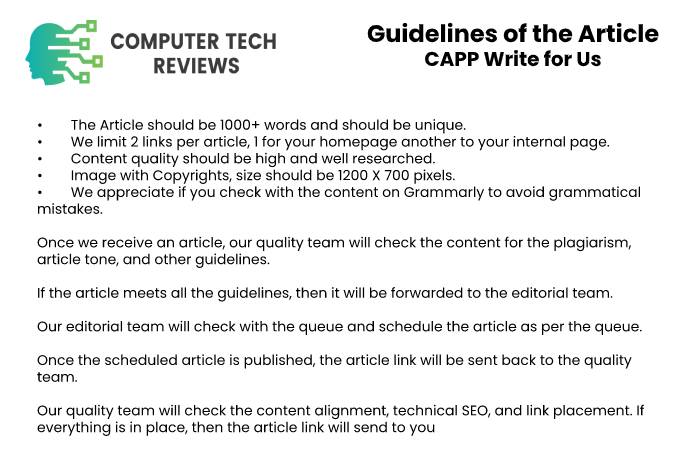
CAPP Guest Post Guidelines
- Submit original content that has not been published elsewhere.
- Write at least 800 words unless another length is agreed upon.
- Define CAPP and other technical abbreviations clearly.
- Use informative headings, short paragraphs, and practical examples.
- Identify the relevant software version and manufacturing environment.
- Support performance, productivity, and cost claims with reliable evidence.
- Explain assumptions behind calculations and comparisons.
- Protect confidential product, employee, and manufacturing information.
- Disclose vendor relationships, sponsorships, and other conflicts of interest.
- Check terminology, calculations, screenshots, links, and grammar.
What We Do Not Accept
- Copied, spun, or lightly rewritten articles
- Keyword-stuffed content written mainly for search engines
- Product advertisements presented as independent tutorials
- Unsupported claims that one platform is the best or leading solution
- Fabricated case studies, statistics, certifications, or customer results
- Confidential process plans or proprietary manufacturing information
- Unsafe instructions that ignore engineering or workplace requirements
- AI-generated drafts submitted without fact-checking and human editing
Using AI-Assisted Content
Contributors may use AI tools to support research organization, outlining, or language improvement, but the final article must be reviewed by a knowledgeable person. Authors remain responsible for technical accuracy, originality, citations, calculations, examples, and intellectual-property compliance.
Do not submit invented software capabilities, integrations, customer stories, quotations, or performance figures. Any AI-assisted content should provide genuine expertise and practical value rather than generic filler.
How to Submit Your CAPP Article
Email your proposed title, a short summary, and either an outline or completed article to contact@computertechreviews.com. Use “CAPP Write for Us” as the subject line.
Include a short author biography and explain your experience with manufacturing, process planning, industrial engineering, ERP systems, production software, or another relevant field. If the article discusses a commercial platform, disclose your relationship with its developer or vendor.
Frequently Asked Questions
What does CAPP stand for?
In manufacturing, CAPP usually stands for computer-aided process planning. Because the abbreviation may have other meanings, every submission should define how it is being used.
Can I submit an article about a particular CAPP product?
Yes, provided the article offers useful technical or implementation guidance and clearly discloses any commercial relationship. Promotional sales copy will not be accepted.
Can I write about CAPP and SAP integration?
Yes. Suitable subjects include routings, work centers, production resources, standard values, costing, master data, integrations, and engineering changes.
Are case studies accepted?
Yes, when you have permission to publish the information. Explain the initial problem, environment, implementation method, limitations, and measurable results without exposing confidential data.
Can I include diagrams or screenshots?
Yes. Submit only material you created or have permission to use. Remove confidential details, personal information, system credentials, and proprietary manufacturing data.
Explore Related Software Contributor Topics
Recent Posts
M4A vs MP3 for Transcription: What Actually Changes the Transcript
M4A vs MP3 for Transcription Comparing M4A vs MP3 for transcription is close to a non-question, and the reason is…
The Patch Window Problem: Why Small IT Teams Fall Behind on Updates
The Patch Window Problem This Article is a part of Cybersecurity Guides and Best Practices Every breach report that mentions…