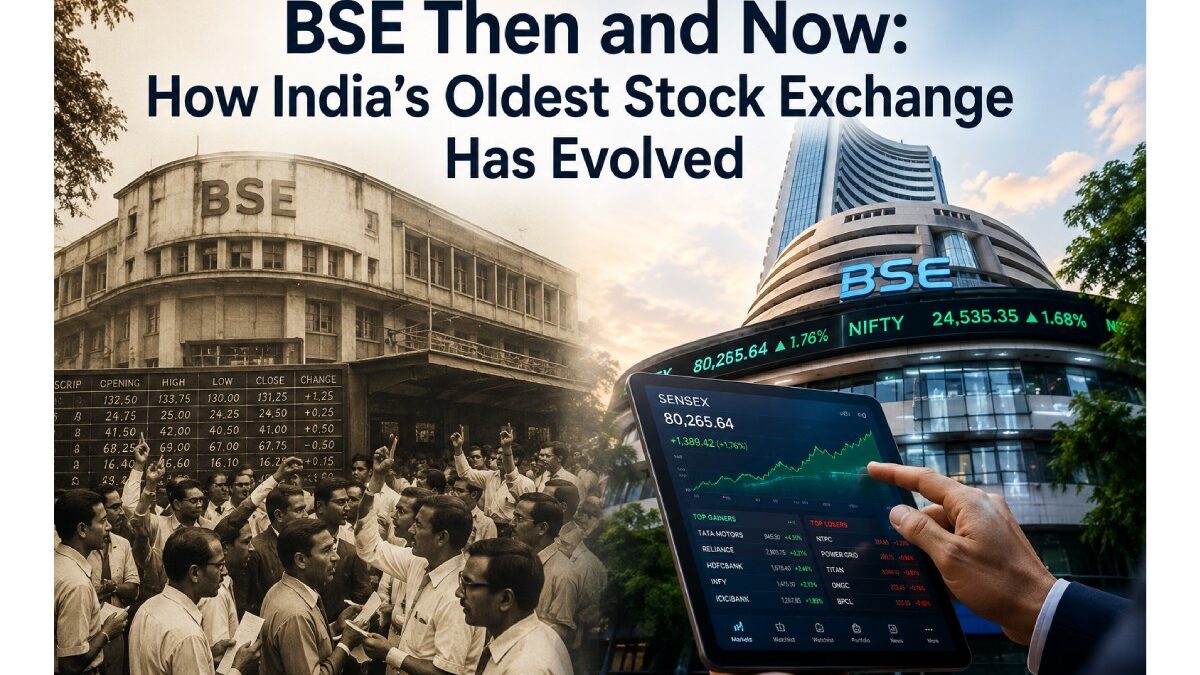

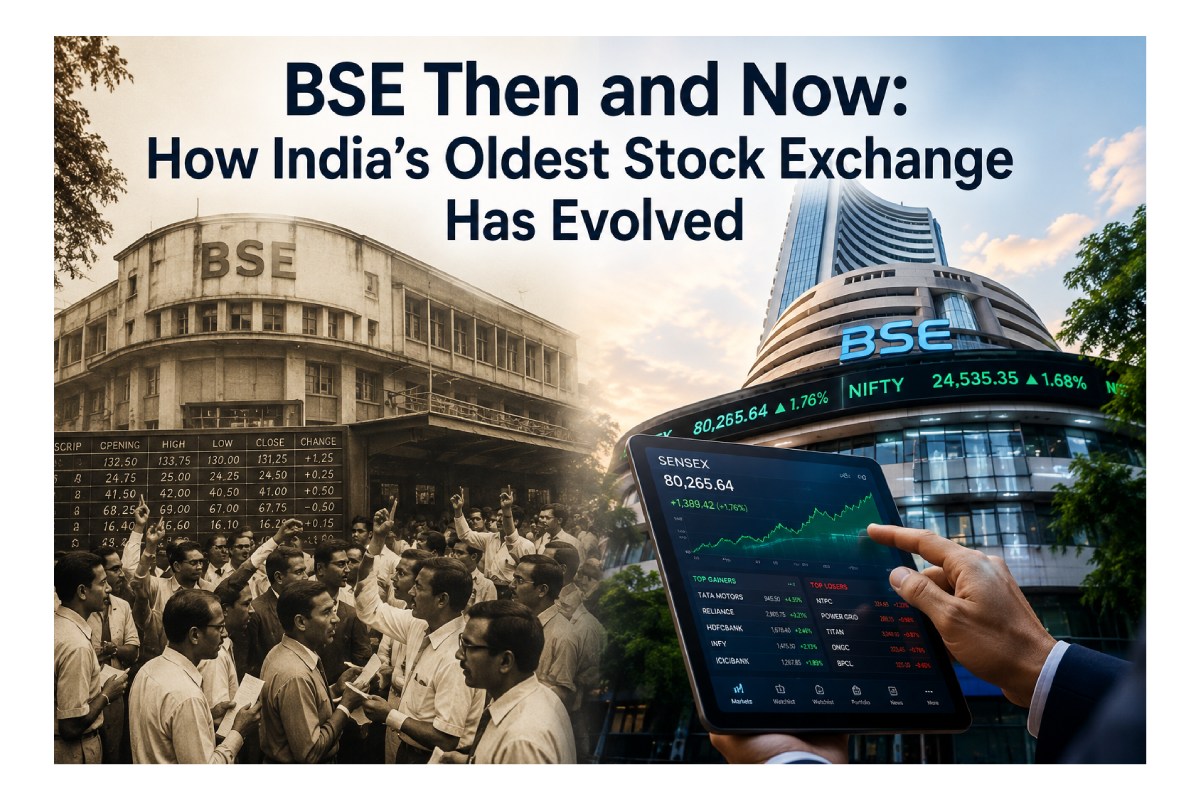
BSE Then and Now
The BSE has been part of India’s securities market for more than 150 years. Its origins can be traced to brokers who organised themselves into the Native Share and Stock Brokers’ Association in 1875. Since then, the exchange has moved from floor-based trading to electronic systems and expanded its market infrastructure. Today, BSE provides trading facilities across equity, equity derivatives, currency derivatives, debt and other segments.
Table of Contents
The Origins of BSE
The history of BSE dates back to the 19th century, when stockbrokers in Bombay began meeting to conduct share transactions. On 9 July 1875, brokers formally organised the Native Share and Stock Brokers’ Association. The association was later formally constituted through an indenture dated 3 December 1887. This development laid the foundation for what became the Bombay Stock Exchange.
The exchange’s early development was closely connected with the growth of commercial activity in Bombay. As companies raised capital and investors participated in the securities market, the need for an organised trading institution became more important.
BSE’s Key Milestones Over the Years
The evolution of BSE includes several important developments that changed how securities were traded and how the market was monitored.
| Year | Milestone |
| 1875 | Native Share and Stock Brokers’ Association was formed |
| 1887 | The association was formally constituted |
| 1957 | BSE received permanent recognition under the Securities Contracts (Regulation) Act |
| 1986 | S&P BSE SENSEX was launched |
| 1995 | BSE Online Trading (BOLT) system was introduced |
| 2005 | The corporatisation and demutualisation scheme was approved |
| 2011 | The exchange adopted the name BSE Limited |
BSE’s own historical material records these milestones, including the launch of the BSE SENSEX in 1986 and the introduction of BOLT in 1995.
From Trading Floor to Electronic Trading
One of the most significant changes in BSE’s history has been the transition from physical trading to electronic trading.
Earlier, brokers conducted transactions through an open-outcry system on the trading floor. As technology developed, BSE introduced computerised trading. The BSE Online Trading (BOLT) system was introduced in 1995, marking an important step towards electronic market access.
This transition changed how orders were entered, matched and monitored. It also reduced the dependence on physical interaction on the trading floor and supported a more technology-driven market structure.
BSE After Corporatisation and Demutualisation
Another important stage in BSE’s development was corporatisation and demutualisation.
SEBI approved the BSE Corporatisation and Demutualisation Scheme in May 2005. The process separated ownership, management and trading rights, changing the organisational structure of the exchange. BSE was incorporated as a public company in August 2005 and subsequently adopted the name BSE Limited in 2011.
This restructuring formed part of the broader effort to modernise the organisation and strengthen the separation between exchange ownership, management and trading rights.
What Does BSE Offer Today?
BSE has expanded considerably beyond its historical equity trading role. SEBI’s current list of recognised stock exchanges shows BSE as having permitted segments covering:
- Equity
- Equity derivatives
- Currency derivatives
- Commodity derivatives
- Debt
- Electronic Gold Receipts (EGR)
BSE also operates index services and provides market infrastructure supporting different areas of India’s securities market. Its current role therefore extends beyond the traditional image of a physical stock exchange.
BSE Then vs BSE Now
| Aspect | Earlier BSE | BSE Today |
| Trading method | Open outcry | Electronic trading |
| Market access | Primarily physical trading environment | Technology-enabled market access |
| Price information | Limited frequency | Real-time market information |
| Market segments | Primarily securities trading | Equity, derivatives, debt and other permitted segments |
| Benchmark | No SENSEX initially | SENSEX is a major market benchmark |
| Organisation | Broker association | Corporatised and demutualised exchange |
The transition shows how the exchange has adapted to changes in technology, regulation and market participation.
BSE’s Role in India’s Securities Market
BSE has played a long-standing role in the development of India’s capital market. Its history covers major periods of economic and financial change, including India’s independence, market reforms, technological development and the expansion of investor participation.
SEBI has described BSE as one of the oldest stock exchanges in Asia and highlighted its evolution from informal broker gatherings to a modern market institution.
For investors today, the BSE is part of an electronic market infrastructure where securities can be traded through registered intermediaries. Investors can also track indices such as the SENSEX to understand broad movements in the Indian equity market.
Conclusion
The history of BSE reflects the broader development of India’s securities market, from broker-led trading in the 19th century to technology-driven markets today. Platforms such as 5paisa provide investors with digital access to market-related facilities, subject to applicable account and regulatory requirements. The evolution of BSE also shows how trading systems, regulation and market infrastructure have changed over time while continuing to support India’s capital markets.