Subscribe Now

Trending News

Aptitude Test Write for Us – Submit a Guest Post

Aptitude Test Write for Us – Submit a Guest Post

Aptitude tests are used in education, career guidance, professional training, and recruitment to examine how people approach particular types of problems. Depending on their purpose, these assessments may cover numerical reasoning, verbal reasoning, logical thinking, spatial awareness, mechanical reasoning, or other defined abilities.

Computer Tech Reviews welcomes original guest posts from educators, assessment specialists, recruiters, career advisers, trainers, researchers, and technology professionals. We are interested in balanced articles that explain how aptitude assessments work, where they can be useful, what their limitations are, and how candidates or learners can prepare responsibly.

This page is part of our broader Education Write for Us section, which covers learning, careers, recruitment, certifications, and professional development.

What Is an Aptitude Test?

An aptitude test is a structured assessment designed to examine a person’s performance in a particular area of reasoning or problem-solving. It may be used to support educational guidance, identify training needs, inform recruitment decisions, or help individuals understand areas they may wish to develop.

An aptitude test is not a complete measure of intelligence, personality, character, motivation, creativity, or future success. Test results reflect performance under particular conditions and should be interpreted alongside relevant experience, qualifications, interviews, work samples, and other appropriate evidence.

Contributors should distinguish aptitude tests from achievement tests, which generally evaluate knowledge already learned, and personality questionnaires, which examine reported preferences or behavioral tendencies.

Aptitude Test Topics We Welcome

  • Numerical, verbal, logical, and abstract reasoning tests
  • Spatial, mechanical, and technical aptitude assessments
  • Aptitude testing in schools and higher education
  • Career guidance and skills-development assessments
  • Pre-employment and graduate recruitment tests
  • Test design, scoring, validation, and interpretation
  • Online assessments and remote testing platforms
  • Responsible preparation and practice strategies
  • Accessibility and reasonable accommodations
  • Fairness, bias, and adverse-impact monitoring
  • Candidate and learner data privacy
  • Remote proctoring and assessment security
  • Artificial intelligence in assessment systems
  • Using assessment results to plan training
  • Limitations and common misconceptions about aptitude testing

Common Types of Aptitude Tests

Different assessments are designed for different purposes. Contributors should explain what an assessment measures instead of treating all aptitude tests as interchangeable.

  • Numerical reasoning: examines how a person interprets numerical information, tables, percentages, ratios, or data.
  • Verbal reasoning: assesses how someone understands and evaluates written information.
  • Logical reasoning: focuses on recognizing rules, sequences, relationships, or patterns.
  • Abstract reasoning: uses nonverbal information to examine pattern recognition and flexible problem-solving.
  • Spatial reasoning: involves mentally visualizing, rotating, or arranging objects and shapes.
  • Mechanical reasoning: examines the application of basic mechanical or physical principles.
  • Situational assessments: present work or learning scenarios and ask participants to evaluate possible responses.

The content, difficulty, time limit, scoring method, and interpretation can differ considerably between providers. Articles should therefore identify the specific assessment or category being discussed.

Aptitude Testing in Education

Educational institutions may use aptitude assessments to support course selection, identify areas in which a learner needs additional help, or provide career guidance. Results should guide further discussion rather than permanently label a student’s abilities.

A learner may perform differently depending on familiarity with the format, language proficiency, accessibility, testing conditions, anxiety, health, or previous educational opportunities. Educators should consider these factors before drawing conclusions from a score.

Contributors writing about learning methods, student development, or educational assessment can also explore our Learning Write for Us page.

Aptitude Tests in Recruitment

Employers may use aptitude tests to gather structured evidence about skills connected with a role. For example, an assessment may examine numerical interpretation for a data-focused position or spatial reasoning for work involving technical drawings.

The test should have a clear connection to the requirements of the job. It should not be included simply because a testing platform makes it available. Employers should also explain the process to candidates, provide understandable instructions, protect assessment data, and offer appropriate accommodations.

No selection decision should be based on an unexplained test score alone. Assessment results are more useful when considered with job-related interviews, qualifications, experience, work samples, and other relevant evidence.

Recruitment professionals may submit more specialized hiring content through our Recruitment Write for Us section.

How Candidates Can Prepare Responsibly

Preparation should help a candidate understand the format, practise working within time limits, and identify areas requiring attention. It should not involve obtaining restricted questions, impersonating another test-taker, using unauthorized assistance, or attempting to manipulate the assessment.

Responsible preparation may include:

  • Reading the test instructions carefully
  • Trying legitimate sample questions
  • Practising basic calculations or reasoning methods
  • Learning how the test interface works
  • Preparing the device and internet connection
  • Choosing a quiet and suitable testing environment
  • Requesting accommodations before the assessment
  • Managing time without rushing every question

Contributors should avoid promising a perfect score or guaranteed employment. Practice can improve familiarity and confidence, but outcomes depend on many factors.

Online Aptitude Tests and E-Learning

Online assessment platforms can make testing easier to administer and may provide faster scoring, flexible scheduling, and detailed reporting. They can also create challenges related to internet access, device compatibility, accessibility, identity verification, and privacy.

Articles about assessment technology should discuss the learner or candidate experience as well as administrative convenience. A technically efficient system is not necessarily fair or useful if instructions are unclear or participants cannot access it properly.

Writers interested in digital instruction and assessment can visit our E-Learning Write for Us and Online Classes Write for Us pages.

Test Quality, Reliability, and Validity

A professional assessment should provide evidence that its scores are sufficiently consistent and relevant to the decision being made. Reliability concerns the consistency of results, while validity concerns whether available evidence supports the intended interpretation and use of those results.

These concepts should be discussed carefully. A test is not universally “valid” for every population, role, course, or decision simply because it has been professionally produced. Contributors should identify the intended use, participant group, testing conditions, and available supporting evidence.

Fairness, Bias, and Accessibility

Assessment designers and users should examine whether irrelevant factors create disadvantages for particular groups. Language, cultural context, disability, device access, educational opportunity, and testing conditions may all influence performance.

Appropriate accommodations might include compatible assistive technology, adjusted presentation, additional time, scheduled breaks, or an alternative format. The suitable accommodation depends on the assessment and the participant’s needs.

Articles should not suggest that accommodation gives a participant an unfair advantage. Its purpose is to reduce barriers that are unrelated to the ability being assessed.

Privacy and Assessment Data

Aptitude results may influence educational and employment decisions, making them sensitive personal information. Organizations should explain what data is collected, why it is needed, who can access it, how long it is retained, and whether it is shared with another provider.

Writers discussing privacy laws or employment regulations should identify the relevant country or jurisdiction and verify that the information remains current.

Artificial Intelligence in Aptitude Testing

Artificial intelligence may be used to generate test items, support adaptive testing, detect unusual behavior, analyze responses, or produce reports. These uses require careful human oversight.

Automated systems can reproduce errors or bias, produce explanations that sound more certain than the evidence supports, and make decisions that participants may struggle to understand. Contributors should explain what the system actually does, what data it uses, how it was evaluated, and when a qualified person reviews its output.

We do not accept articles that describe AI scoring as automatically neutral or completely accurate.

Using Results for Learning and Training

Assessment results can help identify areas for development when they are accompanied by understandable feedback. A score by itself does not tell a learner what to do next.

Educators, employers, and trainers can use results to suggest appropriate practice, coaching, coursework, mentoring, or workplace experience. Progress should be evaluated over time rather than assuming ability is fixed.

Articles concentrating on skill development can also link readers to our Training Write for Us section. Writers covering formal credentials may find our Certification Write for Us page more suitable.

Suggested Aptitude Test Guest Post Ideas

  • What an Aptitude Test Can—and Cannot—Tell an Employer
  • Numerical Versus Verbal Reasoning Tests Explained
  • How Candidates Can Prepare for an Aptitude Test Responsibly
  • Common Mistakes When Using Aptitude Tests in Recruitment
  • How Schools Can Use Assessments Without Labelling Students
  • Accessibility Considerations for Online Aptitude Tests
  • Reliability and Validity in Assessment: A Practical Introduction
  • How to Evaluate an Online Assessment Platform
  • Using Aptitude Results to Create a Training Plan
  • Privacy Questions to Ask an Assessment Provider
  • Potential Benefits and Risks of AI-Based Testing
  • Why Aptitude Scores Should Not Be Used in Isolation

Who Can Contribute?

We welcome submissions from:

  • Teachers, lecturers, tutors, and education researchers
  • Recruiters and talent-assessment professionals
  • Career counselors and student advisers
  • Psychometric and assessment specialists
  • Instructional designers and corporate trainers
  • Accessibility and candidate-experience professionals
  • Developers of educational and assessment technology
  • Writers with well-researched assessment expertise

Aptitude Test Contributor Guidelines

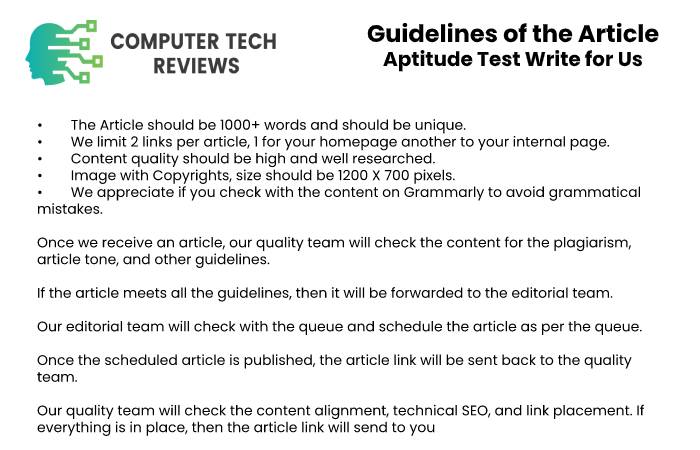
  • Submit original content that has not been published elsewhere.
  • Use accurate terminology and define specialist concepts clearly.
  • Support research findings and statistical claims with credible sources.
  • Identify the test, audience, purpose, and jurisdiction where relevant.
  • Discuss the limitations of assessments as well as their possible uses.
  • Protect the identities and personal information of candidates and students.
  • Do not reproduce protected or confidential test questions.
  • Do not promote cheating, impersonation, or unauthorized assistance.
  • Avoid guaranteed score, admission, certification, or employment claims.
  • Disclose affiliations with testing platforms or training providers.
  • Proofread and fact-check the article before submission.

How to Submit Your Aptitude Test Article

Send your proposed title, a short outline, and a brief description of your relevant experience to contact@computertechreviews.com. Include supporting sources if your article discusses assessment research, employment practices, educational policies, or regulatory requirements.

We prefer focused submissions that answer a meaningful question or solve a practical assessment problem. An article explaining one test category carefully is more useful than a broad list of unsupported preparation tips.

Explore Related Education and Career Topics