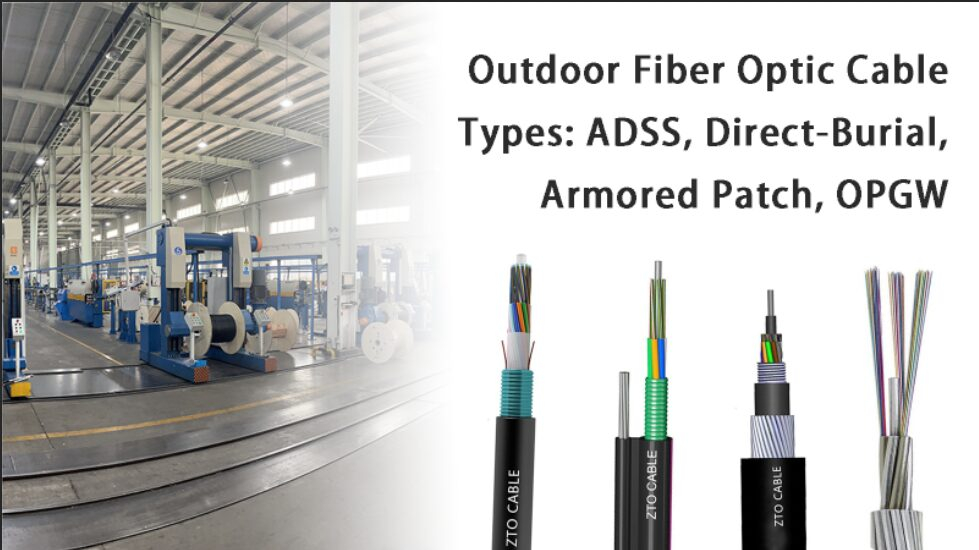

Outdoor Fiber Optic Cable Types Compared
Table of Contents
Introduction
Choosing the right fiber optic cable for an outdoor run isn’t like picking an indoor patch cord. Outdoors, the cable has to survive ice, wind, UV exposure, temperature swings, and — if it runs near power lines — electrical stress that can literally burn holes through the jacket.
There are four main types of outdoor fiber cable, and they’re not interchangeable. Picking the wrong one adds cost, creates maintenance headaches, or causes outright failure. Here’s how to match the cable to the deployment.
The Four Types at a Glance
| Cable Type | Installation Method | Typical Span | Needs Conduit? | Needs Grounding? |
| Armored Indoor/Outdoor Patch | Pulled through existing conduit or cable tray | Up to 100 m | Yes | Yes (steel armor) |
| Direct-Burial Armored | Trenched underground | Unlimited (spliced) | No | Yes (steel armor) |
| ADSS (All-Dielectric Self-Supporting) | Strung between poles or towers; self-supports without messenger wire | 50 m – 1500 m per span | No | No (dielectric) |
| OPGW (Optical Ground Wire) | Integrated into the ground wire of a new transmission line | Matches tower spacing | No | Yes (part of grounding system) |
When to Use Each Type
Armored Indoor/Outdoor Patch Cable
Best for short building-to-building links where conduit already exists. Pre-terminated with LC or SC connectors, so no splicing required. The steel armor protects against rodents and crush damage but makes the cable heavy and stiff. Runs are limited by pull tension — typically under 100 meters through existing ducts. Not rated for direct sun exposure long-term; use only inside conduit outdoors.
Direct-Burial Armored Fiber
Designed to go straight into a trench with no conduit. Features a thick polyethylene outer jacket, steel wire or corrugated steel armor, and water-blocking gel filling. Excellent protection — but trenching is expensive ($5-15 per foot in most markets) and disruptive. Best used when the fiber path must be underground for security or aesthetic reasons, and the trench is already being dug for other utilities.
ADSS — All-Dielectric Self-Supporting Fiber
ADSS eliminates the two biggest costs of outdoor fiber: trenching and grounding. The cable uses aramid yarn (Kevlar) for tensile strength — no steel, no copper, nothing conductive. It hangs between existing poles under its own weight, with no separate messenger wire required.
Key advantages:
- No grounding: Being all-dielectric, ADSS requires zero bonding or surge protection. Install it in lightning country without worry.
- Power line compatible: With AT (anti-tracking) jacket, ADSS can share pole space with transmission lines up to 500 kV.
- Long spans: Double-jacket ADSS handles spans up to 1500 meters — ideal for rural deployments or crossing rivers and highways.
- Lower installed cost: Using existing poles saves $5-15 per foot versus trenching.
The trade-off: ADSS requires pole-mounted suspension and tension hardware, and termination needs fusion splicing or mechanical splice connectors. It rewards planning but punishes shortcuts.
OPGW — Optical Ground Wire
OPGW serves double duty — it’s both the ground wire for a high-voltage transmission line and a fiber optic cable. The fiber sits inside a stainless steel tube at the core of what looks like a standard overhead ground wire. It’s installed during transmission line construction; retrofitting onto an existing line requires a line outage and is rarely practical.
OPGW makes sense only when you’re building new transmission infrastructure that already needs a ground wire. For most IT infrastructure projects, ADSS is the more practical aerial option because it can be added to existing pole routes without touching the power lines themselves.
Quick Decision Guide
| Your Situation | Recommended Cable |
| Two buildings, 50 m apart, conduit already in place | Armored patch cable |
| Must go underground for security; trenching is budgeted | Direct-burial armored |
| Existing pole route, no trenching budget, spans 100-1500 m | ADSS |
| New transmission line build; ground wire needed anyway | OPGW |
| Co-located with high-voltage lines; AT jacket required | ADSS with AT jacket |
| Multiple buildings across a campus with poles but no conduit | ADSS |
Cost Comparison
Per-foot cable cost alone is misleading. The real comparison includes installation:
| Cable Type | Cable ($/ft) | Installation ($/ft) | Total Installed ($/ft) |
| Armored patch (pre-term) | $1.50-3.00 | $2-4 (conduit pull) | $3.50-7.00 |
| Direct-burial | $0.80-1.50 | $5-15 (trenching) | $5.80-16.50 |
| ADSS (aerial) | $0.60-1.20 | $1-3 (pole attachment) | $1.60-4.20 |
| OPGW | $2.00-4.00 | Included in line build | Varies (project-scale) |
Over a 500-meter run, choosing ADSS on existing poles instead of direct-burial can save $6,000-14,000. That’s the difference the cable type makes — not in per-foot price, but in avoiding trenching entirely.
For a deeper technical comparison between the two aerial options, the ADSS vs OPGW comparison guide covers jacket selection, span ratings, and installation scenarios in detail — useful if your deployment sits somewhere between an IT infrastructure project and a utility build.
Conclusion
For most IT infrastructure teams deploying outdoor fiber, the choice comes down to two questions: Do you have existing poles? Do you have existing conduit? If the answer is poles, ADSS is almost certainly the right answer. If the answer is conduit, armored patch cable gets the job done. Direct-burial is the fallback when neither option exists and the budget allows trenching.
Whichever type you choose, match the cable to the environment — jacket material, span rating, and hardware compatibility are as important as the fiber count. For manufacturer-direct ADSS cable with both PE and AT jacket options across span ratings from 50 to 1500 meters, ZTO CABLE provides full IEC 60794-compliant specifications.