
I used to think original character tools were only relevant to hobby artists, fandom communities, or people who already knew how to draw. That changed once I started testing AI character workflows for practical content tasks. The gap between “I have a character idea in my head” and “I have something usable on screen” is still wider than most people expect, and that is exactly where an OC maker becomes useful.
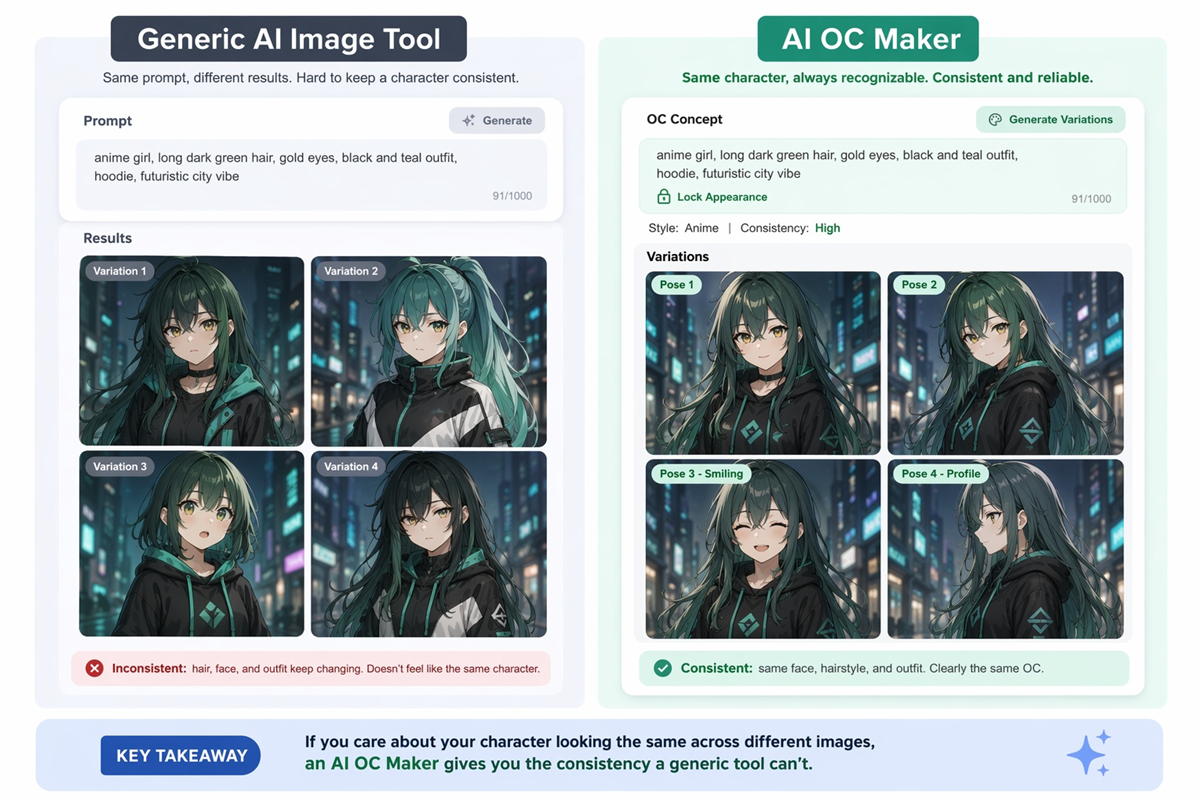
What surprised me most was not the novelty. It was the reduction in friction. When I work with generic image models, I can get attractive outputs, but I often lose control over identity. Hair shape changes. Face proportions drift. Clothing details become inconsistent. A character that looked promising in one draft turns into someone else three prompts later. For anyone trying to build a repeatable visual identity, that gets old fast.
Table of Contents
Why character creation has become a real AI workflow
The conversation around AI visuals often focuses on speed, but speed by itself is not the real win. What matters more is whether a tool helps me move from vague concept to stable direction without wasting half a day rewriting prompts.
That is where character-focused tools feel different. Instead of treating every image as a disconnected output, they encourage a more structured process. I can think in terms of persona, silhouette, outfit logic, age range, mood, and visual role. Even when the first result is not perfect, I am usually closer to a usable direction than I would be with a general-purpose image generator.
In my experience, this matters for more than anime fans. Writers need rough character visuals for story planning. Small game teams need quick concept references. Streamers and creators want avatars that feel personal, not generic. Even bloggers and newsletter operators increasingly use illustrated personas to make their content more recognizable.
What an OC maker does better than a generic image tool
A general AI image model is good at breadth. It can create product shots, landscapes, mockups, fantasy scenes, and many other things. A character tool earns its value through focus.
That focus shows up in a few important ways:
| Need | Generic image tool | Character-focused tool |
| Quick visual variety | Strong | Good |
| Stable character identity | Unreliable over multiple tries | More practical |
| Outfit and persona exploration | Possible, but prompt-heavy | Easier to manage |
| Beginner friendliness | Mixed | Usually better |
| Reusable avatar workflow | Limited | Much more natural |
I have found that beginners especially benefit from this structure. Many people do not struggle because they lack imagination. They struggle because they do not yet know how to translate character ideas into image instructions. A good OC workflow reduces that translation burden.
The mistake most people make at the start
The weakest character results usually come from prompts that describe aesthetics without describing identity.
A lot of first attempts sound like this: “beautiful anime girl, cool outfit, cinematic lighting.” That may produce a polished image, but it rarely produces a memorable character. A memorable character needs internal logic. Why does this person dress that way? What makes the face recognizable? What color choices actually belong to the character rather than the background? What emotional tone should stay consistent from one image to the next?
Once I started writing short character briefs before generating anything, my results improved. Not because the AI became smarter, but because my inputs became more coherent.
I now tend to lock five things early:
- age impression
- hairstyle and face shape
- signature clothing element
- color palette
- emotional tone
That simple discipline saves me a surprising amount of revision time.
Where an anime-focused generator fits in
After the base identity is clear, style becomes easier to control. This is the point where I usually move into a more stylized workflow with an AI anime art generator.
I do not use anime styling only for “anime projects.” I use it when I want cleaner shapes, stronger visual appeal at thumbnail size, and a more deliberate sense of personality. Anime-inspired outputs often communicate mood faster than semi-realistic drafts do. For profile images, lightweight concept art, creator branding, and social headers, that can be an advantage rather than a limitation.
There is also a practical reason for this. Stylized images tend to tolerate simplification better. If I need the same character across multiple content pieces, a clean stylized design often holds together more reliably than a highly detailed, realism-heavy one.
Real-world use cases I keep seeing
The most interesting part of this category is how often people use it for work without calling it “work.”
A freelance writer might create a recurring illustrated narrator for a blog. A YouTube creator may need a consistent anime persona for thumbnails. A small indie project can use character drafts to align mood before formal art production begins. A student building a visual novel prototype may just need believable placeholder characters that do not feel random.
What all of these use cases share is continuity. The image is not the final goal. The image is part of a system. Once I started evaluating tools that way, I stopped chasing the most dramatic one-off outputs and started valuing consistency, editability, and speed of iteration.
What I look for before choosing a tool
I no longer judge these tools by whether the first image looks impressive. That is too easy to fake. I pay attention to what happens on the fourth attempt, the seventh attempt, and the moment I ask for a variation that should still feel like the same person.
Here is the short checklist I actually use:
| What I check | Why it matters |
| Identity consistency | A character should still feel recognizable after multiple variations |
| Prompt responsiveness | Small changes should produce meaningful, predictable differences |
| Style clarity | The tool should know what visual lane it is operating in |
| Speed to usable draft | I care more about workflow efficiency than novelty |
| Ease for non-artists | A good tool should help people who are not illustrators |
That last point matters more than many reviews admit. Most users of these tools are not professional character designers. They are creators, founders, marketers, students, or hobbyists trying to communicate an idea visually.
Final thoughts
The reason I take AI character tools seriously now has very little to do with hype. I take them seriously because they solve a real bottleneck. Character creation used to demand either drawing skill, a paid artist, or a lot of trial and error across generic tools. That barrier has not disappeared, but it has become far more manageable.
For me, the smartest way to use this category is simple. Start with character logic, not visual effects. Build a person before you chase polish. Use an OC workflow to define identity, then use anime styling when you want that identity to become sharper, more expressive, and easier to reuse.
That approach has produced better results for me than treating every generation as a fresh gamble. And in practical creative work, that difference matters.