


Recovering Deleted Photos Using Stellar Photo Recovery (2026 Guide That Actually Works)
Lost your photos?
Yeah… that sinking feeling. It hits fast.
One second everything’s fine, next second your SD card says “Card Not Formatted” or your folder is just… empty.
Look, don’t do anything yet. Seriously.
Because what you do in the next 5 minutes decides whether your photos are gone forever — or fully recoverable.
Table of Contents
What is Stellar Photo Recovery — And Is It Actually Safe?
Short answer? Yes. But let’s not stop there.
Stellar Photo Recovery is a read-only recovery tool. That sounds boring, but it’s critical.
- It does NOT modify your original data
- It scans storage at the metadata + raw sector level
- It supports 1000+ file formats, including RAW (CR3, NEF, ARW, RAF)
Here’s the thing:
When you delete a photo, it’s not “gone.”
Your system just marks that space as available.
The actual image data? Still sitting there. Quietly.
Until… something overwrites it.
That’s why this matters:
If you keep using the same SD card or drive, you’re literally replacing your deleted photos with new data.
And yeah, once overwritten — no software can bring it back. Not even Stellar.
Why Photos Disappear And What’s Actually Happening Behind the Scenes
Let’s make this real.
Here are the most common situations people run into:
1. You deleted photos by mistake
Happens all the time. Especially during bulk cleanup.
- Recovery success rate: Very high (90%+) if you act quickly
2. You formatted your SD card
This feels like a disaster. But surprisingly…
- Quick format = data still recoverable
- Full format = much harder, sometimes partial recovery
3. “Card Not Formatted” error
Seen this?
Camera suddenly refuses to read your card.
This is usually:
- File system corruption
- Not physical damage
Stellar’s Deep Scan can bypass this completely
4. Corrupted files after recovery
This one’s frustrating.
You recover photos… but they won’t open.
That’s because:
- Headers are damaged
- File structure is broken
We’ll fix that later (yes, it’s possible).
5. SSD recovery (the tricky one)
Honestly? This is where things get complicated.
SSDs use something called TRIM.
When TRIM runs, deleted data is permanently wiped
So:
- If TRIM already executed → recovery unlikely
- If not → still possible
Timing matters here. A lot.
The 3-Step Recovery Process (What You’ll Actually Do)
No fluff. This is exactly how it works.
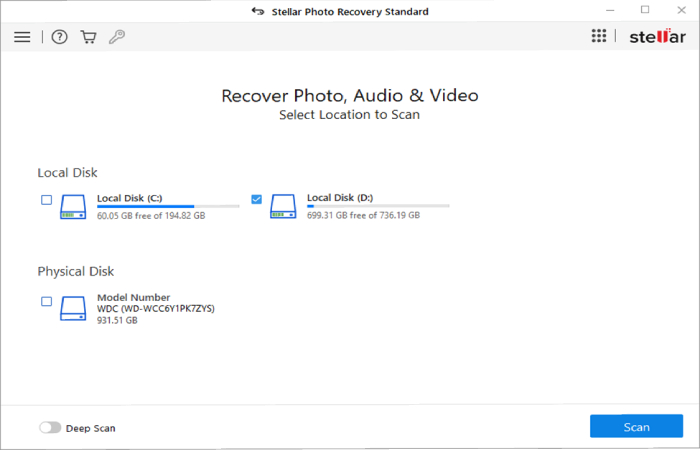
Step 1: Select the location
- SD card
- Hard drive
- USB
- Even encrypted drives (BitLocker/FileVault)
Simple.
Step 2: Scan (Quick vs Deep)
Let’s break this properly.
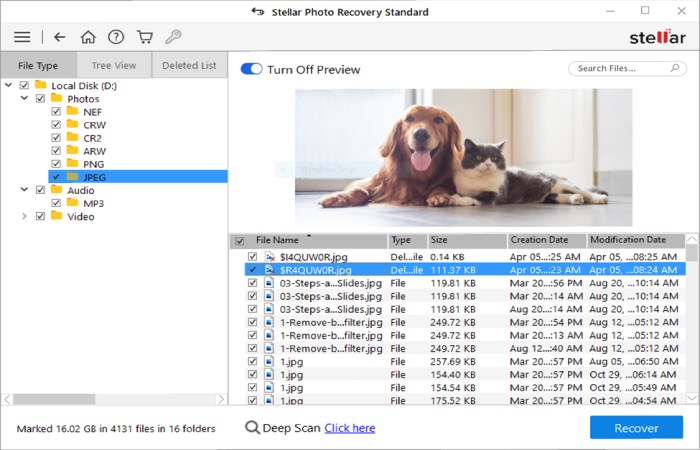
Quick Scan
- Checks file system records
- Fast (seconds to minutes)
- Works for recent deletions
Deep Scan
This is where things get serious.
f(x)=signature-based scan of sectorsf(x)=\text{signature-based scan of sectors}
Okay, not literally math — but conceptually, Deep Scan works like this:
- Reads raw sectors
- Looks for file signatures
- Example: JPEG starts with FF D8 and ends with FF D9
So even if:
- File system is destroyed
- Drive is formatted
…it can still reconstruct files from raw data.
That’s why it finds things other tools miss.
Step 3: Preview & Recover
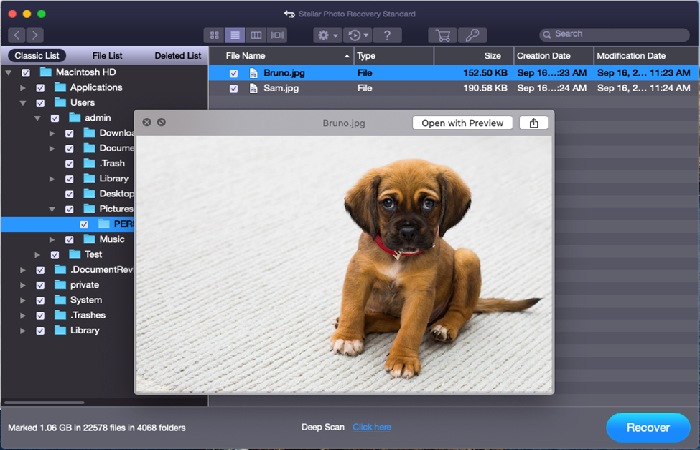
This part matters more than people think.
- You can preview files before recovery
- Free version lets you recover up to 10 files
And PLEASE:
Save recovered files to a different drive.
Not the same one. Never.
Quick Scan vs Deep Scan — Which One Should You Use?
Here’s the simple rule:
| Situation | Use |
|---|---|
| Deleted recently | Quick Scan |
| Formatted drive | Deep Scan |
| Corrupted SD card | Deep Scan |
| Missing files after Quick Scan | Deep Scan |
Honestly, most people end up using Deep Scan anyway.
Choosing the Right Version (Don’t Overpay)
This is where most guides mess up.
Let’s keep it real:
Standard
- Basic photo/video recovery
- Good for simple deletions
Best for casual users
Professional
- Adds recovery from lost partitions
- Disk imaging (important for bad drives)
Use this if:
- Your drive has errors
- You see “bad sectors”
Premium
This is the big one.
Includes photo + video repair
Remember those corrupted files that won’t open?
This fixes them using a sample file method:
- You provide a working file from the same device
- Software rebuilds damaged headers
And yes — it works surprisingly well.
Technician
Overkill for most people.
Designed for businesses & service providers
The Hidden Feature Most People Ignore (Disk Imaging)
If your drive is failing… stop scanning it directly.
Seriously.
Use disk imaging.
What it does:
- Creates a byte-to-byte copy of your drive
- Lets you scan the copy instead
Why it matters:
- Prevents further damage
- Avoids total drive failure
This alone can save your data.
Real Example
A photographer — let’s call him Arjun — shot a wedding on a 128GB SD card.
Next day:
“Card Not Formatted”
Panic. Obviously.
Instead of formatting:
- He used Deep Scan
- Found ~92% of files
- Some videos were corrupted
Then:
- Used Premium repair
- Fixed 4K clips using sample file
Final recovery:
~88% usable data
That’s the difference between panic… and a saved client project.
Pro Tips to Maximize Recovery Success
Don’t skip this. These matter more than the software.
1. Stop using the device immediately
Every second = risk of overwrite.
2. Never recover to the same drive
You’ll overwrite what you’re trying to save.
3. Use Deep Scan if unsure
It’s slower. But way more thorough.
4. For damaged drives → use disk image
Avoids permanent failure.
5. For corrupted files → use repair feature
Recovery alone isn’t always enough.
Can It Recover RAW, 4K, and Drone Footage?
Yes. And this is where Stellar actually stands out.
Supports:
- Canon (.CR3)
- Nikon (.NEF)
- Sony (.ARW)
- Fujifilm (.RAF)
- GoPro & DJI video formats
Even:
- 4K / 8K videos
- VR footage
- Fragmented files
And here’s something interesting:
You can add custom file types
Upload a sample → software learns the format
That’s huge for professionals using niche cameras.
Common Questions
Q1: Can I recover photos after emptying Recycle Bin?
A: Yes. If not overwritten.
Q2: What about “Card Not Formatted”?
A: Don’t format it. Scan first.
Q3: Can it recover from bad sectors?
A: Yes — but use disk imaging.
Q4: Why won’t some recovered files open?
A: Corruption. Use repair feature.
Q5: Does it work on Mac (M1/M2/M3)?
A: Yes. Fully compatible with Apple Silicon and latest macOS.
Final Verdict
Honestly?
Yes — if your data matters.
No — if you’re just casually experimenting.
Because here’s the truth:
This isn’t just software. It’s your last shot at getting your memories back.
And when you look at it like that…
The price doesn’t matter nearly as much.