


| KEY STATISTICS $4.88M – Top 5 sources for Average global data breach cost (IBM 2024) $20.9B – US cybercrime losses in 2025 (FBI IC3 Annual Report) 277 days – Average time to identify and contain a breach 88% – Of data breaches caused by human error 44% – all ransomware breaches (Verizon DBIR 2025) 30% – Third-party involvement in breaches (doubled in one year) 10.8 Trillion dollars’- projected global cybercrime damage costs in 2026 (Cybersecurity Ventures) |
Cyber security is not just an IT department issue anymore.. It is a fundamental business function that inhibits revenue, data, processes and consumers trust and that is what this guide is trying to elucidate, provides research based insight and easy to adopt frameworks. Now, it is helping everywhere with business continuity, regulation compliance and digital trust.
This guide discusses the general accepted security principles, current threat trends and actionable controls with organizations today.
Table of Contents
What is Cyber Security?
By 2026, cyber security will have changed from being an IT technical discipline, into becoming an effective, tactical, and strategic capability for an entire organization. One that, along with all of those ‘as-a-service’ capabilities, is fundamentally composed of people, processes, and technology.
The cyber security status of a hospital can effect a surgeons access to a patient‘s records in an emergency. A bank’s defenses determine whether customer funds are safe. In all industries, insight into cyber security is one thing that directly causes or prevents a real-world result.
Why Cyber Security Matters to Everyday People
However, to many of us cyber security still conjures images of large companies and government institutions. In truth, most of the cyber attacks we face today are directed at individuals at the desktop before they even get to the enterprise network.
A single weak password could compromise a person‘s photos, bank accounts, email accounts and even digital identity. An fake WhatsApp message could transfer entire bank accounts in minutes. A convincing AI voice call could pretend to be a family member calling seeking emergency financial assistance.
Every modern organization should follow essential cybersecurity tips for businesses to reduce digital risks, protect sensitive information, and strengthen overall network security against evolving cyber threats.
Cyber security is not only about saving our servers and databases but it is also about saving our way of life.
Think about how much of modern life now exists online:
- Banking and payments
- Medical records
- Social media accounts
- Cloud-stored photos and videos
- Business documents
- Government identity systems
- Smart home devices
- Online shopping accounts
- School and university systems
Any interconnected system is a jumping-off point.
An individual may never be attacked by Hollywood types of attacks, but the average person is attacked many times every day:
- Sending mails posed as banks
- Fake delivery messages
- QR-code payment scams
- Stolen Instagram accounts
- Identity theft
- Credit card fraud
- Fake investment apps
- AI-generated scams using cloned voices
The reality is simple: cyber criminals target people wherever trust exists.
That is why cyber security awareness is now as important as financial literacy.
The CIA Triad: Foundation of Every Security Decision
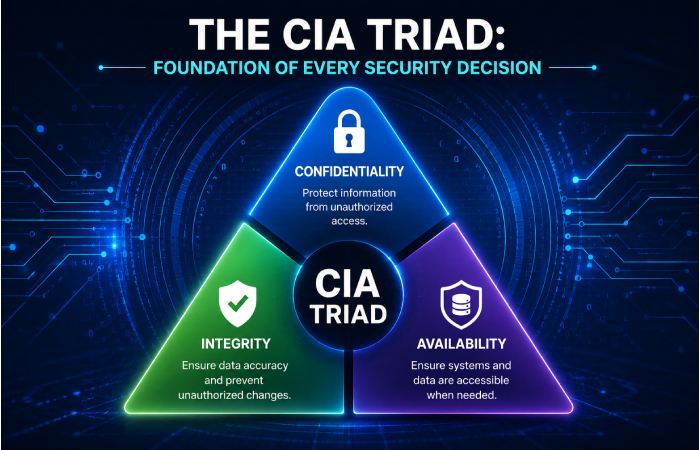
Today, the CIA Triad is being used across both public cloud, remote endpoints, user-identity programs and third party services.
| Principle | What It Means | What Breaks It | Key Controls |
| Confidentiality | What are we protecting? | Data that “belongs” to people. Confidential information that shouldn‘t be viewed by others. | Encryption (AES-256), Data that is sent over the wire. Data that is stored. Data that is stored on backs or removable media. |
| Integrity Data | Data is accurate and not modified | SQL injection, ransomware, data poisoning | Hashing, digital signatures, audit logs |
| Availability | Systems available when the user has access | DDoS attacks, hardware failure, ransomware | Redundancy, DDoS attenuation, DR planning |
Why Cyber Security Matters in 2026
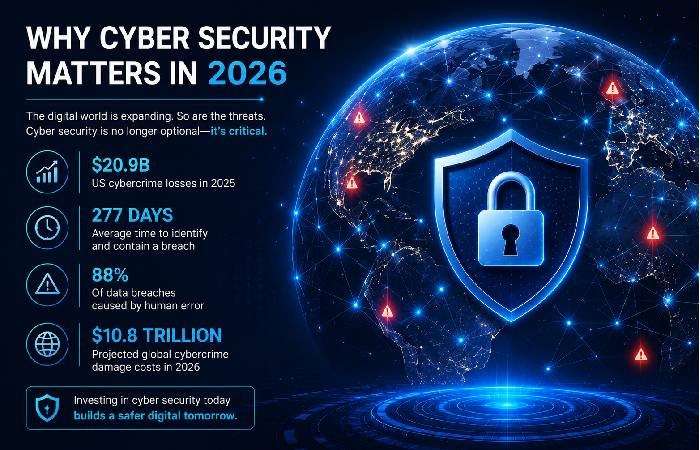
Our perception of cyber security has changed remarkably in recent years. No longer is it just a concerned curiosity of information technology geeks. It now touches our national security, our economy, how we do our health care, how this country functions, how we protect ourselves in our daily lives and business. The numbers tell the story clearly.
| 2026 THREAT REALITY CHECK According to the FBI‘s 2025 IC3 Annual Report, US cybercrime losses were recorded at a staggering 20.877 billion dollars the first time ever that the figure has crossed the 20 billion mark a rise of 26% from the 16.6 billion dollars reported in 2024. The IC3 bank received 1 million plus complaints in 2025 the first ever record of its kind. That‘s nearly 3000 complaints every day. |
The Economic Scale
If we try to find out that how much this will cost the world economy. It is being reported that it may go around 10.8 trillion dollars in 2026. Such huge is this amount. If the losses from cybersecurity were a country, then it will be 3rd in the list.
IBM Cost of a Data Breach 2025 Report: global average cost per breach $4.44 million. US-based organizations average $10.22 million — a record high. The most costly is Health Systems, which cost $7.42 million per unit worldwide, is the most expensive.
Industry-by-Industry Impact
| Sector | Primary Risk | Avg Breach Cost | Real-World Impact |
| Healthcare | Patient data, ransomware stopping care | $7.42M | Delayed surgeries, patient safety |
| Financial Services | Fraud, BEC, credential theft | $6.08M | Customer fund loss, regulatory fines |
| Government / Defense | Nation-state espionage | Classified | National security, election integrity |
| Energy / Utilities | OT/ICS attacks, ransomware | $4.72M | Power and water grid disruption |
| Education | Ransomware, student data theft | $3.58M | Record loss, operational freeze |
| Retail / E-commerce | Payment fraud, supply chain | $3.28M | Customer confidence, PCI compliance |
Regulatory Pressure Driving Compliance
- GDPR (EU): up to 4% of worldwide annual worldwide turnover as fine; 72 hours to advise authorities of the breach.
- NIS2 Directive (EU, 2024): a widened security requirement at 18 sectors; personal liability of senior management.
- DORA (EU Financial, Jan 2025): All firms will be required to introduce mandatory ICT risk frameworks, incident reporting and third-party management..
- HIPAA (US Healthcare): fines of $1.9 M per violations category per year (Up to).
- SEC Cybersecurity Rules: Public companies are required to report material incidents within 4 business days.
The Human Cost of Cyber Attacks
Every one of these statistics about a cyber attack ultimately represents a real disruption to people‘s everyday lives, businesses, hospitals, and the delivery of public services.
If a nework in a hospital goes down, then surgery is put on hold. If a logistics business is hit, delays can affect an entire region‘s supply chain. If a small enterprise loses access to customers’ records, it takes them months to recover.
The consequences of cyber attack are no longer isolated technical occurences within server room. They have operational, financial, emotional and reputation impact.
It can be particularly devastating to the small business.
Many organizations survive the initial attack but struggle with:
- Loss of customer trust
- Legal exposure
- Downtime costs
- Employee burnout
- Insurance complications
- Regulatory investigations
- Long-term reputation damage
But in many cases you end up spending many times the amount of the ransom!
Hence the emphasis on cyber security now as largely not just prevention but resilience, continuation, quick recovery.
The 2026 Cyber Threat Landscape
Reinforces that Threats are about informed prioritization. Security teams have finite budgets and time — knowing where attacks come from, and which succeed most, is the foundation of smart defense.
Top Initial Access Vectors
| Attack Vector | Share of Initial Access | Source |
| Phishing (email-based) | 36% | Verizon DBIR 2025 / IBM Security |
| Credential Theft | 22% | Verizon DBIR 2025 |
| Vulnerability Exploitation | 21% | ENISA Threat Landscape 2025 |
| Supply Chain Compromise | 15% | Verizon DBIR 2025 (doubled YoY) |
| Insider Threat | 6% | Verizon DBIR 2025 |
Ransomware Trends (2023–2025)
| Metric | 2023 | 2024 | 2025 |
| Average ransom payment per incident | $740K | $900K | $1.13M |
| Proportion of instances | 32% | 38% | 44% |
| Median attacker dwell time | 16 days | 10 days | 5 days |
| % insured orgs claiming ransomware | 41% | 44% | 46% |
| AI IS COMPRESSING THE ATTACK TIMELINE AI-assisted ransomware effectively shrinks the window of opportunity for attack to an unfathomably short median dwell time from weeks to as little as 5 days. No longer can defenders depend on traditional detection windows that stretch across multi-week timeframes. |
Supply Chain Attacks: The Sleeper Threat
When one breaches a trusted software vendor, the attacker gets access to every organization that is running that vendor‘s update and that was the case that SolarWinds had as an example.
The following are the necessary critical steps to complete the assessment: Obtain an SBOM for all third-party software used in the application.
Global Cybercrime Cost Growth
| Year | Estimated Cost | Key Driver |
| 2015 | $3 trillion | Baseline |
| 2021 | $6 trillion | COVID-driven remote work surge |
| 2023 | $8 trillion | RaaS model matures |
| 2025 | $10.5 trillion | AI-powered attacks scale |
| 2026 (projected) | ~$10.8 trillion | Cybersecurity Ventures estimate |
What is the importance of security to various organizations?
Cybersecurity protects revenue, operations, compliance and reputation. One breach can cause downtime, legal risk, lost customers, and repair costs far after the breached event.
A Realistic Example: How Modern Attacks Actually Happen
Many envision cyber attacks as terribly complex affairs employing sophisticated hacking techniques. In fact the most damaging breaches are often initiated using something surprisingly innocent.
Imagine a usual situation.
An employee received the following email: (The formatting and capitalization has been restored in the image above, the text is displayed below) I just received an email with the above subject and in the email body is the text below I‘m trying to figure out where this email is from. The email looks official and the brand images are correct. The language is professional. The login page even looks identical to the real one.
The employee enters their credentials.
Within minutes:
- Attackers gain access to email accounts
- Password reset requests begin
- Internal conversations are monitored
- Financial approvals are targeted
- Malware is deployed silently
- Data is copied before encryption begins
By the time the organization is aware of such abnormal activity, intruder may have already gained administrative privileges.
This is precisely why modern cyber security has done away with a single layer of defence.
Organizations now combine:
- Multi-factor authentication (MFA)
- Endpoint monitoring
- Behavioral analytics
- Network segmentation
- Continuous logging
- Identity verification
- Automated threat detection
The intention isn‘t to assume there will be no attacks.
Once it is under control, you are safe. Once detected early, contain it as early as possible, keep down the load of the system.
Types of Cyber Attacks: Plain-Language Breakdown
| Attack Type | How It Works | 2026 Prevalence | Primary Defense |
| Phishing | Phishing False emails convince users to handover information. | Very High 36% of breaches Email filtering, security training, MFA | Email filtering, security training, MFA |
| Ransomware | Files are encrypted by the malware, offenders want money. | Very High — 44% of breaches | Immutable backups (3-2-1-1-0), EDR, segmentation |
| Credential Theft | Utilized usernames/passwords taken from attacked sites then used to gain access as said user and data within. | High — 22% of initial access | MFA everywhere, credential monitoring |
| Business Email Compromise (BEC) | Impersonate a CEO/Supplier to authorize wires. 3.046B US dollars lost in 2025 (FBI IC3). | High — most $ per incident | Verification callbacks, DMARC/DKIM, awareness |
| SQL Injection | Malicious code inserted into database calls by the input fields that are not sanitized. | Moderate — declining with DevSecOps | Input validation, parameterized calls, WAF |
| DDoS Attack | Overwhelm a server or a network with traffic demands from thousands of botnet machines until unavailable. | Moderate-High | DDoS mitigation services, CDN, rate limiting |
| Supply Chain Attack | Infiltrator compromises a trusted software vendor to access all downstream customers through legitimate updates. | Growing quickly 30% of breaches | SBOM, vendor risk management, integrity monitoring |
| Deepfake Social Engineering | Deepfake-enabled fraud and impersonation extortion attempts have grown significantly in recent years and calls for more ‘out-of-band’ verification than voice and video confirmation for high risk transactions | Is emerging and fastest growing | Out-of-band verification, deepfake detection tools |
| IoT Attacks | Using poor security features of smart items/surveillance cameras, using them as a entry point into a corporate network (poorly patched, weak authentication, inside network). | Growing | Network segmentation, firmware updates, auth |
The 7 Pillars of Cyber Defense
Today‘s security requires defense-in-depth, through multiple tools and layers in place. These seven pillars constitute the structural backbone of any well-developed security framework.
1. Network Security
The solutions that we already know of (firewalls, VPN, IDS/IPS, segmentation etc) are very important when it comes to fighting the man-in-the-middle attack especially when working on an open network. Businesses with remote teams and cloud-based infrastructure increasingly rely on VPN technologies for secure internet access to protect online communication, encrypt traffic, and improve digital privacy.
2. Application Security
Implementing strong firewall protection systems is another important step in defending enterprise networks from malicious traffic, unauthorized access attempts, and cyber intrusions. Ingraining security in to the SDLC. Web Application Scanning with the OWASP Top 10 remediation, code reviews, DAST/SAST scanning, and Web Application Firewalls (WAF) helps to ensure a least a secure deployment.
Web server security made easy by connecting with dev teams and developers.
3. Cloud Security
CSPM for misconfiguration detection, CWPP for workload protection, and CASB as policy enforcement gateways between cloud services and users.
4. Endpoint Security
EDR (Endpoint Detection & Response) and NGAV (Next-Gen Antivirus) on every device — including mobile and remote worker endpoints — to quarantine and remediate threats at the edge.
5. Identity Security
IAM and PAM with MFA everywhere. By 2026, it needs to also include non-human identities, including bots, APIs, CI/CD tokens, and service accounts.
6. Data Security
As cybercrime continues to rise globally, understanding how to secure important business data has become critical for preventing unauthorized access, ransomware attacks, and information leaks. Encryption at rest and in transit, data classification, DLP policy, rights management of data throughout its lifecycle.
7. Operational & Physical Security
Governing asset-handling processes, physical access controls, CCTV, and securing data center and server room infrastructure.
| INTEGRATION IS THE KEY The value of these pillars comes from integrating them through a SIEM (Security Information and Event Management) platform that correlates signals across all seven domains. A mature security program also uses SOAR to automate routine response actions and reduce analyst workload during high-volume incidents. An endpoint alert combined with an unusual identity access event is far more actionable than either signal alone. |
Cyber Security Is No Longer Just an IT Department Responsibility
Ownership has become one of the most significant differences in cyber security nowadays.
“A decade ago, there was only ever a ‘tech person’ with a keyboard in a back office who decided how things happened”, said Mr. Lakin, of Stride Security. “That‘s not the case now. It‘s a boardroom problem.”
That shift happened because cyber incidents now directly affect:
- Revenue
- Brand reputation
- Customer trust
- Investor confidence
- Regulatory compliance
- Business continuity
- Supply chain stability
Executives now understand that cyber security failures can become business failures.
This is why organizations increasingly involve:
- CEOs
- CFOs
- Legal teams
- HR departments
- Compliance officers
- Operations teams
- Risk management leaders
The most effective organizations are not always those that invest the most in security tools; they are those who are fostering a mature security culture throughout the whole organization.
AI in Cyber Security: The 2026 Arms Race
Artificial Intelligence of today has been proven the most powerful weapon against organizations and most powerful tool to defend them. The question is not whether to use AI but how to govern it carefully and how to use it properly. Deepfake incidents increase 2,137% from 2022 to 2025.
On both the offensive and defensive ends of the attack-defense spectrum, AI is increasing speed and scale that‘s why governance is just as important as tooling.
The rapid evolution of digital threats has also led to several major breakthroughs in internet security, including AI-powered threat detection, cloud security advancements, and intelligent cybersecurity automation.
| Dimension | Offensive AI (Attackers) | Defensive AI (Defenders) |
| Phishing | AI produces perfect spear-phishing en masse, targeted attacks against C-level executives increased by 47% in 2025 | AI email gateways spot behavioral inconsistencies rather than relying solely on keyword scans |
| Malware | Transformed and morphed malware to bypass signature based detection. Polymorphic malware rewrites itself in new ways so signature based system would not be able to log it | Behavioral EDR differentiates between normal and abnormal process behavior |
| Social Engineering | Deepfakes mimic executives using live audio/video | Deepfake identification models and out-of-band callback protocols |
| Threat Detection | AI recon identifies the quietest path through a network | AI SIEM/SOAR correlates thousands of events/second; MTTD drops 70% |
| Data Poisoning | Adversarial ML corrupts AI model outputs — e.g. making security AI ignore threats | AI governance: model provenance, adversarial testing, data hygiene |
The Rise of AI-Powered Scams
AI has transformed the scale and complexity of cyber crime.
In past years, identifying a phishing email was simple because they are littered with bad grammar, peculiar phrases or crazy requests. That‘s a luxury that is rapidly vanishing.
Modern AI tools can now generate:
- Perfectly written phishing emails
- Fake executive voice messages
- Deepfake video calls
- Personalized scam campaigns
- Automated social engineering scripts
- Realistic fake customer support chats
No more do scammers require top-notch writing ability or much technical know-how.
This has reduced the barriers to entry for cyber crime around the world.
And also at the same time, defenders are exploiting AI as well.
Security teams now rely on AI to:
- Detect unusual login behavior
- Identify malware patterns
- Analyze massive log volumes
- Prioritize incidents faster
- Automate threat response
- Predict suspicious activity
All of this is driving a rapidly evolving arms race in which both assailants and defenders using automation at scale.
Those who are quickest to respond will tend to have the most formidable protection.
| AI SAVES MONEY TOO IBM’s 2025 research: organizations with extensive AI and automation in security saved approximately $2.2 million per breach compared to those without AI. The ROI case for defensive AI investment is now unambiguous. |
Frameworks & Best Practices
Zero Trust Architecture (ZTA)
Zero Trust represents the security way of thinking in 2026. No-trust approach: ‘perpetually verify, don‘t perpetually trust’. Any system access demand must be authenticated, authorized and constantly supervised where-so-ever. NIST officially expressed zero trust to the publication 800-207.
- Confirm Identity without assumption: Require MFA and robust identity proofing for signing in to all users and devices (including devices, non-human identities such as APIs, service accounts, CI/CD tokens.
- Use Least Privilege: Provide a user merely the permissions required to complete a task. Also set expiry dates for any privileged access.
- Micro-Segment Your Network: Break your network into small isolated segments. Infection of one segment doesn’t necessarily mean infection of them all having the blast radius.
- Keep Monitoring Continuously: Record every action, keep doing sessions. Monitor activities and check it again when needed. Set up behavioral analytics system to identify abnormal activities seamlessly
- Automate and Orchestrate: Employ SOAR (Security Orchestration, Automation and Response) to remove repetitive detection/response tasks, jobs from analyst
Existing security model assumed that everything inside the corporate network was trusted, but that doesn‘t apply in cloud-first and hybrid environments.
What Good Security Looks Like?
A comprehensive cybersecurity program is not one tool. It integrates controls for identity, patch management, secure configuration, training workers, logging, tested backup, incident response planning.
The 3-2-1-1-0 Backup Rule: Ransomware Resilience
| Rule | What It Means | Why It Matters |
| 3 copies of data | Primary + 2 backups | Must have multiple failures for it to happen at once |
| 2 different media types | e.g. SSD + tape, disk + cloud | Different error types appear on different media (media failure modes) |
| 1 copy off-site | Location in a different place | Protects from site-specific failures |
| 1 copy offline / air-gapped | Being cut-off from all networks | Ransomware can‘t encrypt what it can‘t reach. |
| 0 errors verified | Automated restore testing with zero failures | An untested backup is not a backup; it is only a hope |
Key Performance Metrics (KPIs) to Track
| KPI | What It Measures | Target |
| MTTD (Mean Time to Detect) | “time to detect a breach ” | < 24 hours |
| MTTR (Mean Time to Respond) | Time to a breach being detected | < 1 hour for critical incidents |
| MFA Coverage % | Assets with MFA enforced | 100% of all critical systems |
| Patch Lag (days) | Days from CVE disclosure to patch applied | < 7 days for critical CVEs |
| CSPM Misconfig Rate | Percentage of cloud workloads with open misconfiguration | 0% unresolved critical findings |
Reactive vs. Proactive Security: Comparison
| Dimension | Reactive (Old Model) | Proactive (2026 Model) |
| Detection | After breach identified (avg 277 days) | Ongoing surveillance; Intelligent anomaly detection |
| Response | Ad hoc; made on the spot under duress | Pre-constructed IR playbooks; automated SOAR response |
| Patching | Time-based scheduled maintenances (monthly+) | Ongoing vulnerability management; date at most 7 days. |
| Testing | Annual penetration tests | Monthly Phishing Simulations; Role-based Training |
| Training | Annual compliance checkbox | Monthly phishing simulations; role-based training |
| Backup | Backups are in place; infrequently tested | 3-2-1-1-0 rule with self-automated restore verification |
| Third-Party Risk | Annual vendor questionnaire | Continuous monitoring; SBOM; contractual security SLAs |
The Talent Gap Crisis
The cyber security skills shortage is the most pressing structural problem in the industry. ISC2’s 2025 Workforce Study declined — for the first time — to publish a global workforce gap estimate. The question has become one of having the wrong skills, rather than having too few people. The gap in the worldwide employment market for 2024 was estimated at 4.76 million professionals.
| Workforce Metric | Figure | Source |
| Organizations reporting critical skills shortage | 59% in 2025 | ISC2 2025 Workforce Study |
| EU organizations with cyber staff shortages | 63% | ISC2 2024 EU Workforce Report |
| Security professionals citing burnout as cause of breach | 83% | Industry surveys 2024 |
| Expected job growth (info security analysts) | 32% through 2032 | US Bureau of Labor Statistics |
| Most critical skills gaps | AI security, cloud security | ISC2 2025 Workforce Study |
| IT leaders rank security as #1 concern for 2026 | ~50% | Veeam Global IT Survey, Dec 2025 |
Skills a Cyber Security Professional Needs in 2026
- Cloud security experience: AWS/Azure/GCP security configurations, IAM roles and CSPM tools- straight away this is where most modern attacks land.
- AI and ML literacy: Familiarity with offensive and defensive uses of AI (g., adversarial ML, and governance frameworks for AI).
- Threat intelligence: Reading threat feeds, open source intel (OSINT), and dark web monitoring to give the bare minimum nudge on an attack is taking place.
- Incident response: Developed formal IR playbooks, forensic analysis expertise, tabletop exercise facilitation.
- Offensive security (Red Team): Penetration testing, vulnerabilty assessment, attacker tooling: Metasploit, Burp Suite, Nmap,…
- Regulatory and compliance knowledge: GDPR, NIS2, DORA, HIPAA people are now asked to interact with compliance standards, brokers the legal obligations a long with the technical sides of securing.
I have the most wonderful tools money can buy. But nor use if I don‘t have the right people to make best use of them. Which why retention, training and workload management is now a security issue not just an HR problem.
Your 5-Step Cyber Security Action Roadmap
- Understand Your Landscape: Conduct a full asset inventory — including shadow IT and unknown cloud infrastructure. Map threats most relevant to your industry using ENISA or CISA sector threat reports. Understand your current situation before you protect it.
- Determine where you’re starting from: Score your existing capability with the NIST CSF 2.0 (due 2024) and its six functions Govern, Identify, Protect, Detect, Respond, Recover.
- Set a 3–5 Year Target State: Define where you need to be based on regulatory requirements, board risk appetite, and insurance requirements. Prioritize gaps with the highest impact-to-effort ratio — typically identity security, backup resilience, and detection.
- Designate Owners and record Everything: Assign owners to each security control. Standardize incident response play Do tabletop exercises yearly. Validate backup restore operations under real-world operational conditions.
- Transition to 24/7 Monitoring: Use the SIEM for continuous log correlation, define auto-notifies for key KPIs (MTTD, MTTR, patch lag), run monthly security health reviews with reports for executives.
This five step action plan, built off the NIST Cybersecurity Framework maturity model, provides you with a tangible next step. We are not trying to improve everything in one go, the idea is to reduce risk over time.
Common Cyber Security Mistakes Organizations Still Make
As much as they make people aware of security, many companies will repeat their security failures, even from year to year.
Some of the most common issues include:
Weak Password Practices
Employees continue to reuse passwords across different systems and so the theft of credentials is much more damaging
Delayed Patching
Critical vulnerabilities are known for weeks or months despite disclosure.
Over-Permissioned Accounts
Users frequently have far more access than they actually need.
Poor Backup Validation
Many companies do take backups but don‘t bother testing if recovery would be successful..
Lack of Employee Training
Human error remains one of the leading factors in successful penetration.
Incomplete Visibility
Often organizations won‘t have a central inventory of all their devices, cloud workloads, APIs or third party integrations.
Treating Security as a One-Time Project
Cyber security is not a one-time implementation.
It‘s a process in management that keeps happening over and over again.
Organizations must also adopt proactive strategies to prevent data breaches and cyber attacks by improving employee awareness, updating security systems, and monitoring suspicious network activities.
Recommended Cyber Security Tools and Technologies
Effective cyber security tools and solutions are very dependent on the business size, infrastructure, industries’ needs and risk whether or not exposed. Some categories, though, are now considered mandatory across business types.
Password Managers
Password managers help reduce credential reuse and improve overall identity security.
Popular enterprise and consumer options include:
- 1Password
- Bitwarden
- Dashlane
- LastPass
Endpoint Protection Platforms (EDR)
Contemporary endpoint security utilize behavior-based detection in combination with AI to govern identification to go thus beyond virus signature.
Widely used solutions include:
- CrowdStrike Falcon
- Microsoft Defender for Endpoint
- SentinelOne
- Sophos Intercept X
Backup and Recovery Solutions
Immutable, routinely-replicated snapshots constitute perhaps the best defense against ransomware.
Popular solutions include:
- Veeam
- Acronis
- Backblaze
- AWS Backup
Multi-Factor Authentication (MFA)
MFA significantly reduces account compromise risk.
Commonly used MFA platforms include:
- Microsoft Authenticator
- Google Authenticator
- Duo Security
- Okta
Technology, human factors and sound operational procedures all three are part of the best security solution.
Frequently Asked Questions
Q1: Why is cyber security important to small businesses?
Small Business would be attacked twice as often as a larger Business as someone would think the defenses would be weaker. Ransomware make up about 51% of the price for the average SME cyberattack. Simple controls MFA, patching, immutable backups go a long way for a small investment.
Q2: What‘s the CIA Triad?
The CIA stands for Confidentiality means only those authorized may have access the data, Integrity (the accuracy and integrity of the data) and Availability (the systems are available when needed). They are the essential principles for every security architecture.
Q3: Explain what Zero Trust is in cyber security?
Zero Trust is a security model based on ‘never trust, always verify’. The model says that whatever the source, with everything, it is necessary to verify identity, the status of the device used, as well as its authorization for each access request. (Officially defined by NIST in Special Publication 800-207.)
Q4: The average cost (per breach) in 2026 is?
IBM 2025 Cost of a Data Breach Report: global average 4.44m. US organizations average $10.22 million — a record high. Thecost of healthcare is the highest totalling$7.42mm worldwide. Use of AI in security in firms was reported to save approximately$2.2mm in each breach.
Q5: What is the overall biggest cyber security threat in 2026?
According to Verizon DBIR 2025, FBI IC3 & ENISA, the leading source of the most prevalent breach combination of both AI enhanced-phishing and ransomware. Ransomware issues (44%) and combined email containing malware- phishing for first incident (36%).the most rapidly emerging trend is based on deepfake alteration for social engineering (2,137% across 2022–2025).
Q6: What are the most valued cyber security qualifications?
CISSP for more senior practitioners; CEH v13 AI for the first AI-augmented ethical hacking certification; Certification like CompTIA Security+ to ground one in the fundamentals; Plus CCSP for cloud security and OSCP for penetration testers. AWS and Azure security specializations are increasingly in demand alongside traditional credentials.
What Strong Cyber Security Looks Like in Practice
A mature cyber security program is usually not visible to customers when everything is working correctly.
Strong security often looks simple from the outside:
- Employees use MFA everywhere
- Devices are updated automatically
- Suspicious logins are blocked instantly
- Backups are tested regularly
- Access is limited carefully
- Security alerts are monitored continuously
- Incident response plans are rehearsed before emergencies occur
The organizations that respond fastest during incidents are typically the ones that prepared long before the attack happened.
There is not sitting alone nor protection; a good cyber security is not found in a single product.
It‘s about the consistency, the discipline, the visibility, the preparation.
Conclusion
Cyber security in 2026 is a business-critical discipline, built around ever-changing threat, compliance pressures, AI-powered attacks and operational resilience. Businesses that embrace layered defenses, the Zero Trust architecture, real-time control and talented staff are set to become much more adept at securing trust and continuity.
The figures make the case $20.877 billion in U.S. losses to cyber crime alone in one year. Ransomware in nearly half of all breaches. Nearly 3,000 complaints per day. A skills shortage affecting 59% of security organizations globally. And AI both increasing the complexity of attacks and making them quicker.
Investing in the correct fundamentals rigid identity controls, immutable backups, continuous monitoring, Zero Trust security model, and a skilled security team allows organizations to be demonstrably more resilient by identifying attack patterns more rapidly, isolating and stopping attacks quickly, and recovering with less operational impact and lower costs.
Cyber Security Checklist for 2026
Use this checklist as a brief assessment of your existing security.
Personal Security Checklist
- Use a password manager
- Enable MFA on all important accounts
- Avoid reusing passwords
- Keep devices updated
- Verify suspicious emails and messages
- Back up important files regularly
- Avoid public Wi-Fi without protection
- Review app permissions periodically
Business Security Checklist
- Implement MFA organization-wide
- Maintain tested offline backups
- Conduct phishing awareness training
- Patch critical vulnerabilities quickly
- Monitor logs continuously
- Segment critical systems
- Review third-party vendor access
- Maintain an incident response plan
- Perform regular security audits
- Test recovery procedures frequently
Even minor cyber risk enhancements can be very meaningful.
| YOUR NEXT THREE STEPS 1. Run an asset inventory — identify your most critical data and systems. 2. Assess your organization against NIST CSF 2.0 to find your biggest gaps. 3. Start with controls with great ROI: MyAccount MFA, static data check in each backup month, script test 3 rd Tuesday of each month. |
Editorial & Research Methodology
This guide has been created for use based on open source threat intelligence reports, regulatory schemes, industry research and cyber security studies of international organizations.
Research sources include:
- IBM Cost of a Data Breach Reports
- Verizon Data Breach Investigations Report (DBIR)
- FBI IC3 Annual Reports
- ENISA Threat Landscape Reports
- NIST Cybersecurity Framework (CSF 2.0)
- NIST SP 800-207 Zero Trust Architecture
- ISC2 Workforce Studies
- Cybersecurity Ventures forecasts
- Gartner security research
- World Economic Forum cyber risk analysis
All of the above statistics and frameworks discussed above were used within the context of 2025–2026‘s cyber security to assess their present relevance.
Data Sources: IBM Cost of a Data Breach Report 2024 & 2025 · FBI IC3 Annual Reports 2024 & 2025 · Verizon DBIR 2025 · ENISA Threat Landscape 2025 · ISC2 Workforce Study 2024 & 2025 · Gartner Security & Risk Management Forecasts · Cybersecurity Ventures Annual Report · NIST CSF 2.0 (2024) · NIST SP 800-207 Zero Trust Architecture · WEF Global Risks Report 2024 · Axis Intelligence Cybersecurity Statistics 2026
Cyber security is mostly discussed in a technological context; however the real issue is trust. Trust that hospitals will keep running. Trust that businesses can protect customer information. Trust that financial systems remain secure. Trust that personal identities are protected online.
Since the increase of digital systems into all aspects of life, cyber security is no longer an auxiliary IT activity but a fundamental aspect of progress in today‘s society. Those organizations and individuals that take cyber security seriously today are going to be so much better equipped to cope with the risks of tomorrow.