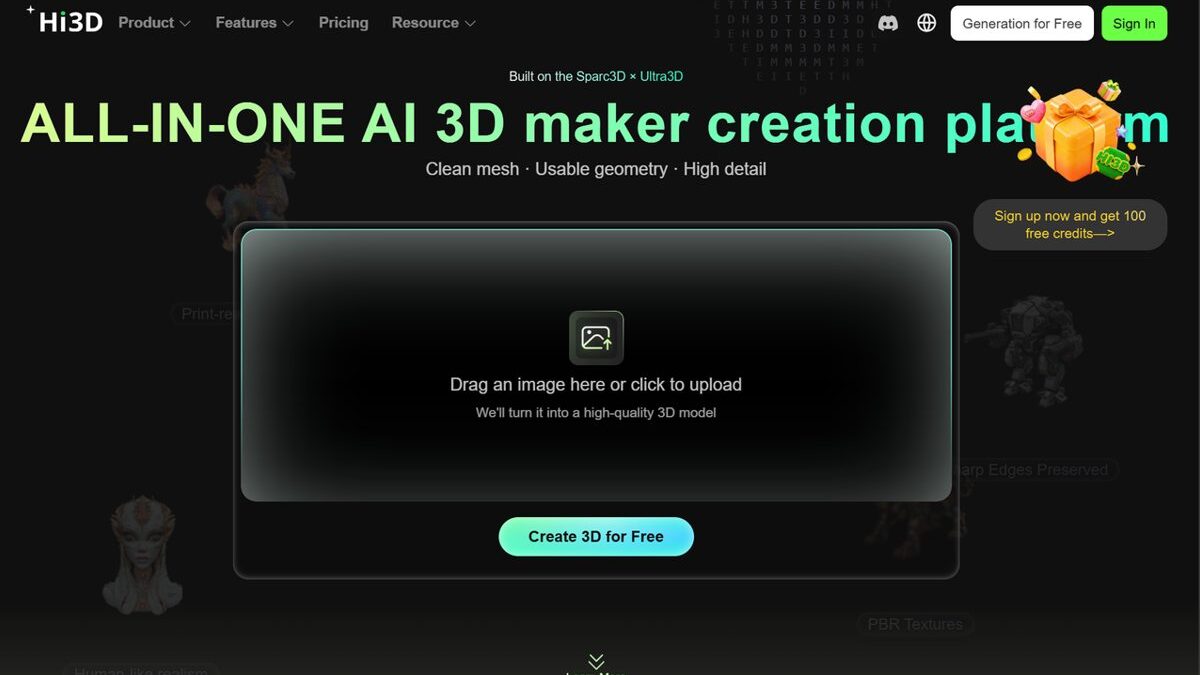

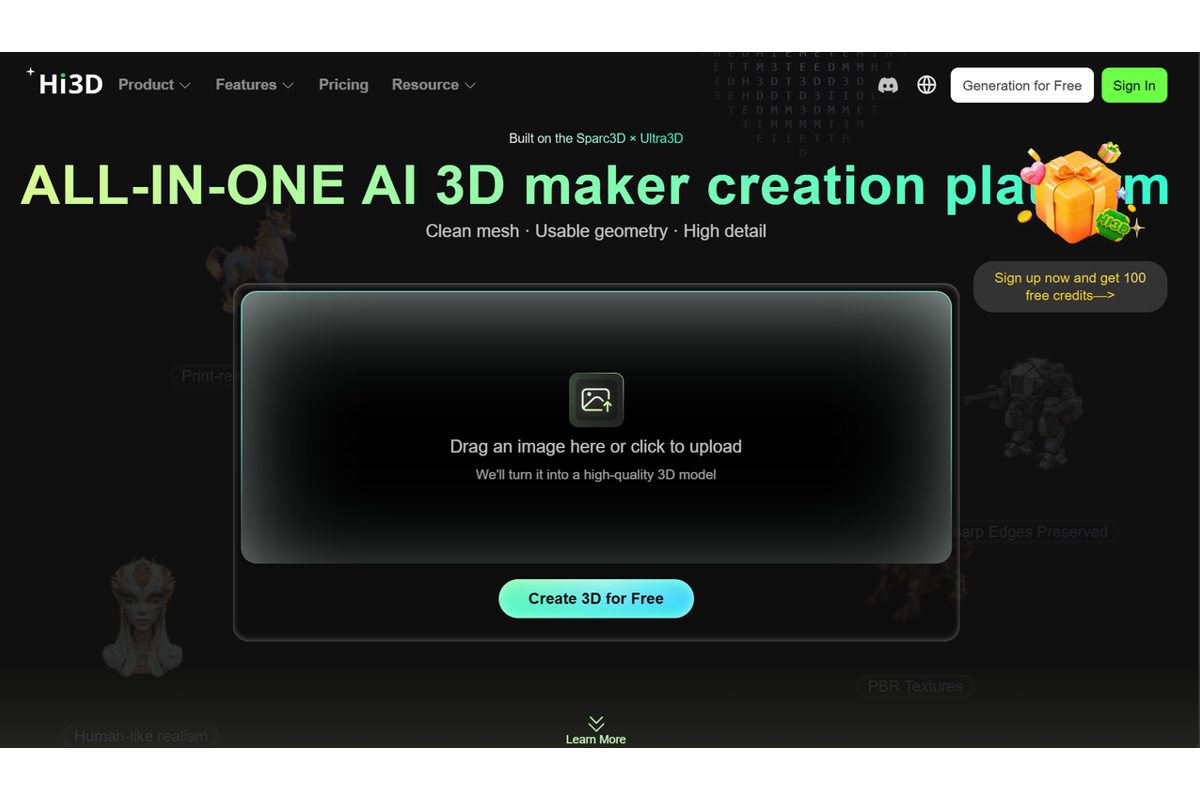
Hi3D V3.0
3D printing is gradually becoming an important part of modern creation and manufacturing. From personalized gifts and collectible figures to educational models, product prototypes, and creative projects, more individuals and industries are using 3D printing to transform digital ideas into physical objects. However, as the demand for customized 3D content continues to grow, creating high-quality and production-ready models remains a challenge for many users.
The development of AI 3D technology is helping reduce the distance between imagination and production. Instead of depending entirely on complex modeling skills, creators can now use AI-assisted workflows to explore ideas, generate models, improve details, and prepare assets for practical applications. Hi3D focuses on helping users create, optimize, and prepare 3D assets through AI-driven workflows. With the release of Hi3D V3.0, the platform introduces improvements in model reconstruction, texture quality, and production usability, further strengthening the connection between AI-generated content and real-world applications.
Table of Contents
1. The Growing Role of AI 3D Creation in Modern Digital Production
The development of 3D printing has changed how people approach design and manufacturing. In the past, creating customized objects often depended on traditional production methods, which could involve higher costs, longer preparation cycles, and limited flexibility. Today, 3D printing provides creators with a more direct way to turn digital concepts into physical results.
However, behind every printed object is a digital model. The quality of this model directly affects the final output, which means efficient 3D creation has become one of the most important parts of the entire workflow.
1.1 From Digital Concepts to Physical Objects
The value of AI 3D technology is not only about creating models faster. More importantly, it allows more people to participate in 3D creation without needing years of professional modeling experience.
For beginners, AI-assisted creation lowers the technical barrier and provides an easier way to explore 3D design. For designers and professional creators, it can accelerate early-stage concept development by helping transform ideas into initial models more efficiently.
This change is especially important as more industries begin using customized digital assets. Whether for product visualization, creative design, education, or personal projects, users increasingly need tools that can connect ideas with practical results.
Hi3D is built around this direction. By combining AI generation, model enhancement, and printing preparation features, Hi3D helps users move through different stages of the creative process more smoothly.
1.2 Why Complete AI 3D Workflows Matter
Generating a model is only one step in 3D creation. A practical workflow also requires better surface details, stronger structures, and easier preparation before production.
Many AI-generated models still require additional adjustments before they can be used in real scenarios. This creates a gap between “a generated model” and “a usable 3D asset.”
Hi3D focuses on reducing this gap by supporting multiple stages of the workflow, allowing users to explore ideas, create models, improve appearance, and prepare designs for printing.
2. Making 3D Creation More Accessible for Different Types of Creators
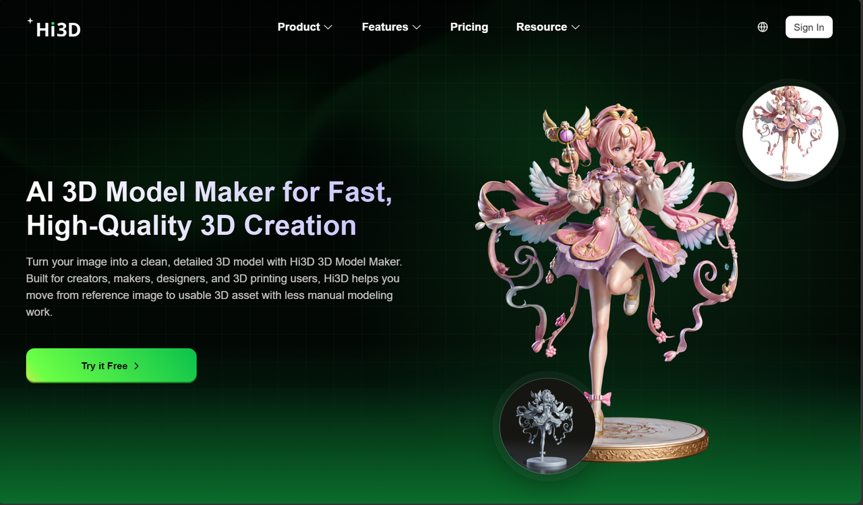
Different users experience different difficulties during the 3D creation process. Beginners may struggle with professional modeling software, designers may need faster ways to test creative ideas, and 3D printing users may spend considerable time preparing models before production.
Hi3D provides a more efficient workflow by supporting different creation methods and reducing unnecessary technical steps. Instead of requiring users to manually build every detail, Hi3D allows creators to start from simple inputs and gradually transform concepts into complete 3D assets.
2.1 Turning Images and Text Ideas into 3D Models
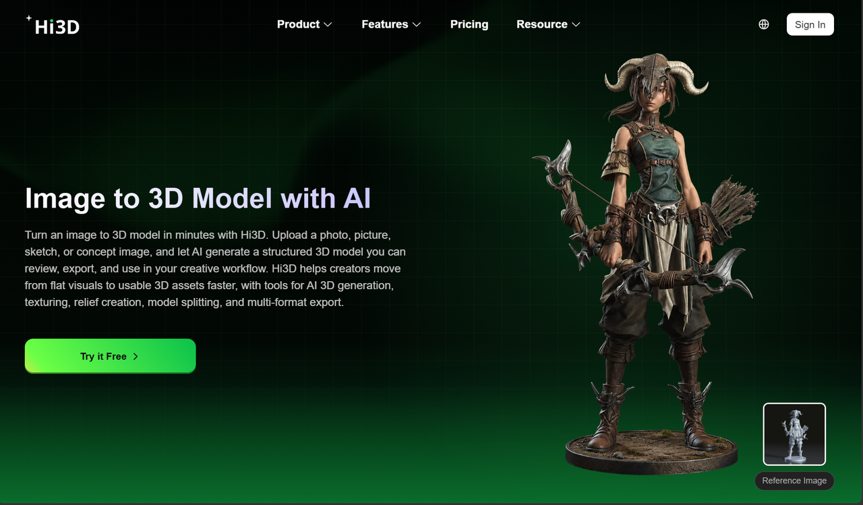
For many creators, the starting point of a project is not a finished 3D file but an image, reference picture, or creative idea. Traditionally, converting these sources into usable models requires professional modeling skills and significant time investment.
Hi3D supports picture to 3D model generation, allowing users to transform two-dimensional visual content into three-dimensional models. By using AI to understand shapes, structures, and visual information, Hi3D helps users create models more efficiently from existing images.
This capability provides value for different types of creators. Beginners can use images as a starting point to explore 3D creation, while experienced designers can use AI-generated models as an early foundation for further editing and refinement.
Hi3D also supports text-based creation, giving users another way to explore ideas. By describing objects, characters, or creative concepts, users can generate initial 3D designs and test different possibilities before entering detailed production stages.
For users who want to experiment with 3D creation without complicated workflows, Hi3D provides a more accessible 3D model maker free experience, helping more people understand the process of turning concepts into models.
2.2 Supporting Faster Creative Exploration
Creative development often requires repeated experimentation. Designers may need to test different shapes, styles, or structures before deciding on the final direction.
Traditional modeling methods can make this process slow because every adjustment requires manual work. AI-assisted creation provides another approach by allowing creators to explore more possibilities during the early stages.
Hi3D helps users focus more on creative decisions instead of spending most of their time completing repetitive modeling tasks.
3. Improving Model Quality Through AI-Powered Enhancement
A complete 3D asset is not defined only by its shape. Surface appearance, colors, and textures also influence how a model performs in creative applications and physical production.
For collectibles, artistic models, product concepts, and display models, visual details are especially important. A model with accurate geometry but limited surface information may not fully represent the original design.
Hi3D provides AI-powered enhancement features that help users improve the appearance and usability of generated assets.
3.1 Creating More Detailed Surfaces with AI Texture Generation
Texture creation is often a challenging part of traditional 3D workflows. Creating realistic patterns, materials, and surface details usually requires additional software and specialized knowledge.
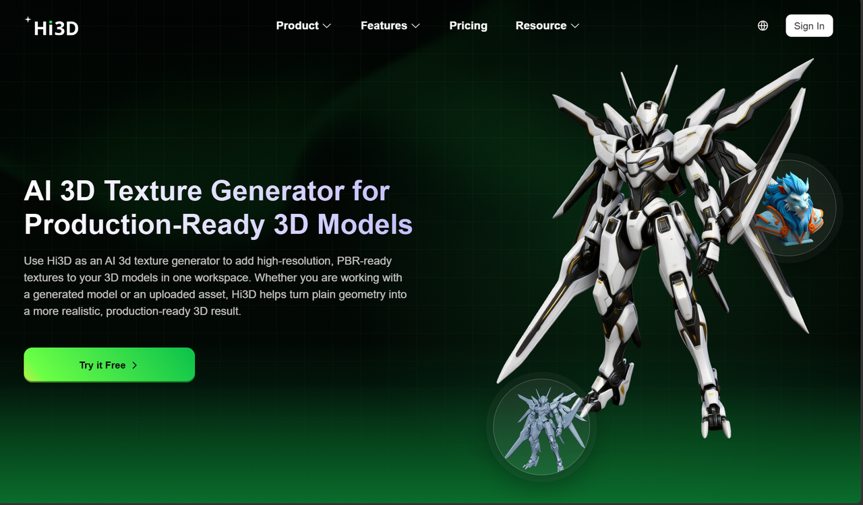
Hi3D’s AI 3D model texture generator capabilities help users add richer visual details to generated models through AI-assisted workflows. Instead of manually creating every surface element, creators can improve model appearance more efficiently.
With Hi3D V3.0, texture generation has been improved further. The new version supports up to 8K texture output and upgrades the self-developed UV completion algorithm, improving pattern edge clarity, color transition quality, and recognition of fine texture details.
These improvements are especially useful for models that require detailed visual presentation, including collectibles, digital artworks, product concepts, and display models.
3.2 Preparing Models for Real Printing Scenarios
Creating a model is only the beginning of the 3D printing process. Before printing, users often need to solve problems related to color management, model size, part separation, and print arrangement.
Hi3D provides additional tools to support this stage. Multi-color printing helps transform AI-generated textured models into printable multi-color objects, while split-for-printing helps separate complex models into printable components and generate connectors for assembly. Smart arrangement assists users with preparing models on the build plate and improving printing efficiency.
These features help create a smoother connection between digital creation and physical manufacturing.
4. Hi3D V3.0: A Major Upgrade Toward High-Quality AI 3D Assets
As AI 3D technology becomes more widely adopted, users are no longer only looking for faster generation. They need models that maintain accurate structures, preserve important details, and work effectively in practical production environments.
Hi3D V3.0 focuses on these deeper requirements. Instead of simply increasing generation speed, the new version improves the quality and reliability of AI-generated assets, helping reduce the gap between digital creation and real applications.
4.1 Higher Precision with 2048³ Geometry Reconstruction
One of the most important improvements in Hi3D V3.0 is the upgrade of geometry reconstruction capability. The model increases reconstruction resolution from 1536³ to 2048³ voxel-level resolution, becoming the first commercially available AI 3D model with 2048³ ultra-high-precision reconstruction capability.
Higher reconstruction accuracy allows more structural information to be preserved during generation. Details that are often difficult for AI models to maintain, such as small mechanical parts, surface patterns, text edges, and complex object structures, can achieve clearer reconstruction.
For creators, this means AI-generated models can better reflect original designs and require fewer manual corrections before further use.
4.2 Improved Structural Understanding for More Reliable Results
One of the biggest challenges in AI 3D generation is understanding parts that are not visible in the input image. A single image does not contain complete information about hidden areas, back-side structures, or relationships between different components.
Hi3D V3.0 improves cross-view structural reasoning, allowing the model to better understand multiple views, hidden areas, and complex object relationships. This improves structural stability from different perspectives, especially for objects with complicated interactions between parts.
5. Hi3D V3.0 Workflow Improvements and Industry Applications
The development of AI 3D technology is not only about creating models but also about making those models useful in real production environments.
Hi3D V3.0 continues improving the connection between AI generation and practical workflows by adding features designed for real printing scenarios.
5.1 Moving from AI Generation to Production Workflows
A key challenge for AI 3D technology is making generated models easier to use after creation.
Hi3D V3.0 introduces multi-color printing, intelligent split-for-printing, and smart arrangement functions, helping users reduce preparation work before printing.
The split-for-printing function can divide complete models into printable parts, repair separated parts into watertight meshes, and automatically generate assembly connectors. Users can also adjust connector size, direction, and placement according to different printing requirements.
5.2 Expanding AI 3D Applications Across Industries
High-quality 3D assets are becoming increasingly important in areas such as 3D printing, game and film production, digital art, jewelry design, collectible creation, cultural exhibitions, education, e-commerce content, and industrial design.
Although these industries have different workflows, they share similar requirements for accurate geometry, detailed textures, complete structures, and flexible usability.
Hi3D V3.0 aims to lower the barrier to creating high-quality 3D content and allow more users to access editable, display-ready, and printable 3D assets.
For creators searching for an AI 3D model maker solution, Hi3D V3.0 offers a workflow that connects creative inspiration, AI generation, and physical production.
6. From V1.0 to V3.0: Hi3D’s Evolution Toward Practical AI 3D Creation
Hi3D V3.0 represents not only a technical upgrade but also the continuation of a long-term development process. Each version has focused on solving different challenges and gradually improving the complete AI 3D workflow.
6.1 Continuous Improvements from Generation to Application
Hi3D V1.0 introduced a commercially available image-to-3D model with 1536³ voxel-level resolution. Hi3D V2.0 further developed integrated geometry and texture generation, improved hidden structure completion, and provided a more complete creation workflow. Hi3D V3.0 continues this direction by improving geometry accuracy, complex structure reconstruction, texture quality, and printing-related functions.
This evolution shows how AI 3D technology is moving beyond simple content generation. The focus is shifting toward creating assets that can be displayed, edited, printed, and applied in different industries.
7. Experience Hi3D V3.0 Free for 48 Hours
To allow more users to explore the latest AI 3D capabilities, Hi3D will open a limited-time free experience of Hi3D V3.0 from August 19, 2026, 00:00 to August 20, 2026, 24:00 (Beijing Time). During this period, users can experience Hi3D V3.0 without generation limits.
This 48-hour opportunity allows creators to explore improved model accuracy, enhanced texture generation, and a more complete AI 3D workflow.
From personal creators exploring new ideas to professionals developing digital assets and physical products, Hi3D V3.0 provides a practical way to experience how AI 3D technology is helping transform imagination into real-world creations.