
This Article is a part of Cybersecurity Guides and Best Practices
Ask a hospital IT director and a factory operations manager what keeps them up at night, and you’ll get two completely different answers — even though both are, technically, “cybersecurity problems.” One is worried about a ransomware group locking down the electronic health record system mid-shift. The other is worried about a compromised industrial controller shutting down a production line or, worse, causing physical harm on the floor. Generic advice like “use strong passwords and train your employees” isn’t wrong, exactly. It‘s just answering a question neither of them even officially asked. Cyber security was never a uniform field and by 2026 that diversity will have grown so much that analogy is outright perilous.
Industry-specific security requirements can vary considerably, but organizations across every sector need strong fundamentals around identity, access control, cloud security, incident response, employee awareness, and risk management. For broader guidance, explore our cybersecurity guides and best practices.
Table of Contents
Why Industry Context Changes the Whole Equation
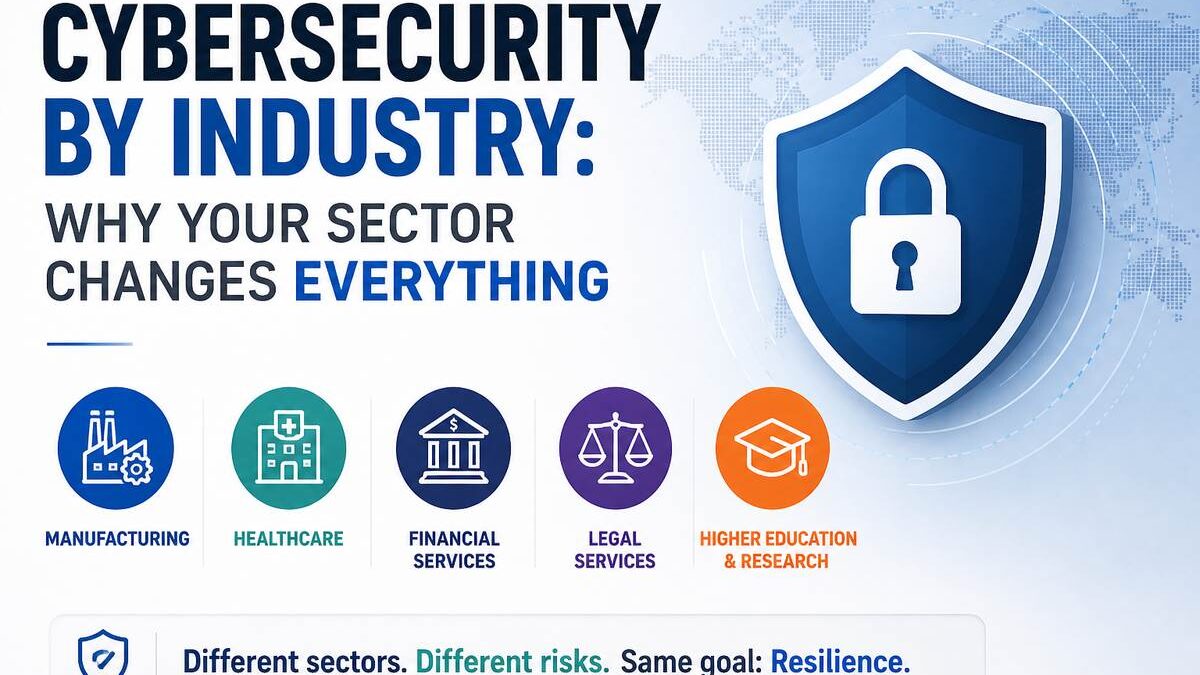
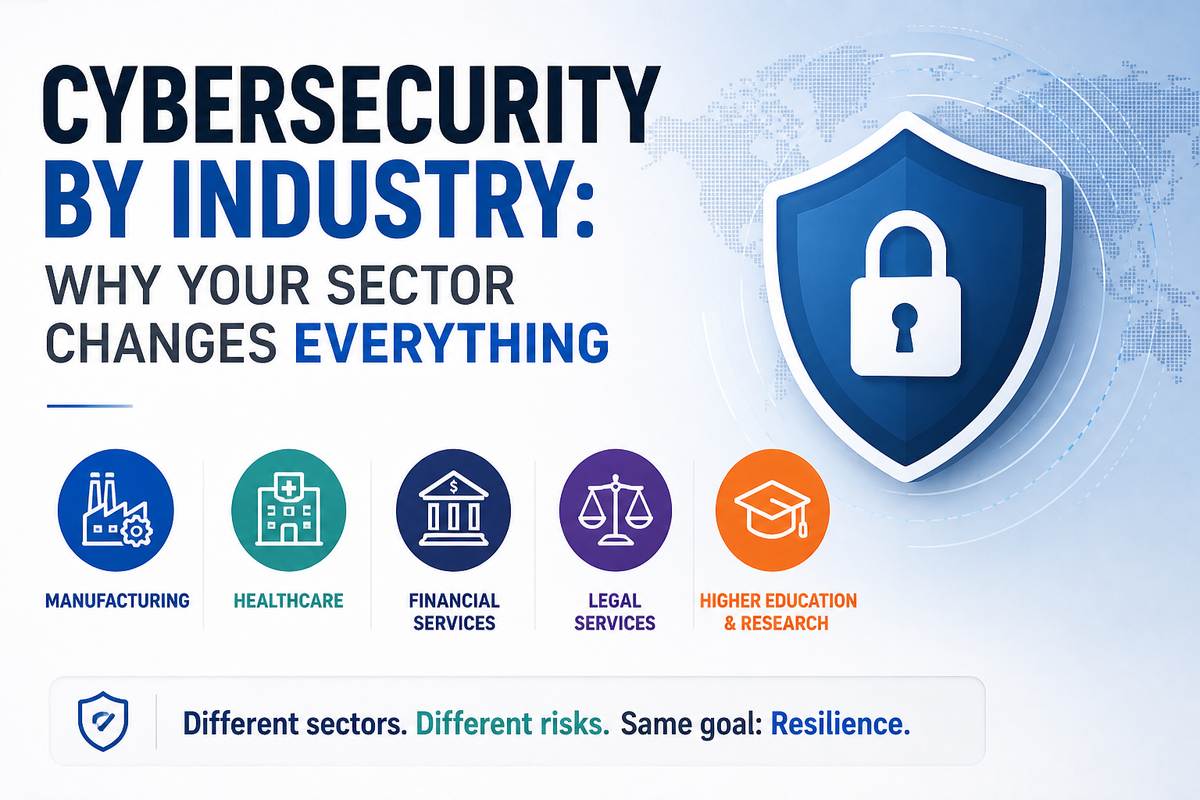
The reason this matters isn’t academic. Attackers don’t pick targets randomly — they follow whichever sector offers the highest payoff for the least resistance, and that calculation looks completely different depending on what your organization actually does. A manufacturer’s crown jewels are proprietary designs and uninterrupted production uptime. A law firm’s is privileged client communication. A hospital’s is patient records and the continuity of care itself. A bank’s is the sheer volume of money moving through its systems every hour. Each of these creates a different threat model, a different regulatory obligation, and a different definition of what “acceptable risk” even means.
This is also reflected in cost. Industry cost-of-breach studies routinely show huge differences from one industry to the next-healthcare has been hovering at or near the top of the list for 10 years or more; industry figures from the last year or so put average healthcare breach costs at over $7 million, far above the cross-industry average. There‘s a reason for that difference, and learning about it is key to developing a truly risk-aligned defense..
Manufacturing: When a Cyberattack Becomes a Physical Problem
Manufacturing has consistently ranked in the top position or near the top of the most attacked industry list and that‘s not coincidence, says Softex. It‘s structural. Today‘s manufacturing plants have a long tradition of connecting operational technology–automation controls controlling equipment–to enterprise IT–email systems, financial transactions, web presence. That convergence referred to as IT/OT convergence brings efficiency, but also creates new vulnerabilities.
The tension underneath this is cultural as much as technical. IT teams are trained to prioritize patching and data protection; OT teams are trained to prioritize uninterrupted uptime, because stopping a production line has an immediate, measurable cost. That is also a continuous, real source of risk, and its severity is enhanced by a visibility problem as a significant proportion of the OT hardware on factory floors appears not to be managed at all and is therefore invisible to the IT team best equipped to secure it.
Vendor-provided threat intelligence on activities in this sector overwhelmingly indicates that the initial compromise vector employed by attackers against manufacturing environments is phishing, followed by credential brute-forcing (CBF) and lateral movement, using remote access tools, once inside. Particular ransomware gangs such as those operating under names such as Play and RansomHub have continually exhibited focus on manufacturing concerns, particularly those linked to machinery and industrial equipment manufacturers, seemingly based in the high incentive to pay that accompanies downtimes incurred. The stakes here go beyond stolen data: a compromised industrial controller can, in the worst case, translate into equipment damage or a genuine safety hazard for people working on the floor, which is a category of risk most office-based IT security simply never has to consider.
Healthcare: Where Downtime Means More Than Lost Revenue
Healthcare occupies a unique position because the consequences of an attack aren’t purely financial — they’re clinical. A hospital, doctor‘s office, or other medical facility as a result of ransomware infecting their scheduling systems, billing systems, or computer-based medical records, don‘t merely suffer economic damages they are forced back to manual paper records, encounters are delayed or canceled, and in the worst of cases, patient services are directly impacted.
Healthcare has been one of the most expensive sectors to penetrate and much of this expense is tied back to the amount of time it takes for an incident to be identified and resolved, with the exception of a shutdown being a possibility as it would be for a typical retail website. The growing footprint of internet-connected medical devices adds another layer entirely — these devices often can’t be patched or replaced quickly, creating long-lived vulnerabilities inside clinical environments. For healthcare organizations, security isn’t a back-office IT function; it’s inseparable from patient safety and the trust that keeps a referral network functioning.
Healthcare organizations are attractive targets because they manage valuable patient, financial, and operational data. Businesses in this sector should understand the cybersecurity vulnerabilities in the healthcare industry and prioritize controls that address their most significant exposures.
Financial Services: Regulation With Real Teeth
Financial services faces a different kind of pressure — not just from attackers, but from regulators who treat weak security as a compliance failure with personal consequences. The Gramm-Leach-Bliley Act’s Safeguards Rule requires financial institutions to maintain a comprehensive information security program, and the penalties for falling short are not symbolic: the institution itself can face fines up to $100,000 per violation, and individual officers or directors found knowingly responsible can face personal fines and potential imprisonment on top of that. This is a sector where a weak security program isn’t just a breach risk — it’s a personal liability risk for the people running the organization.
Newer state-level rules have raised the bar further. New York’s financial services cybersecurity regulation, for instance, now requires multi-factor authentication across systems accessing nonpublic information and has made clear that outsourcing a function to a third-party vendor doesn’t outsource the liability if that vendor gets breached. That “non-delegable” framing — you remain responsible even when a vendor fails — is becoming a common thread across financial regulation generally, and it’s exactly why vendor due diligence has become as important as internal controls.
Financial institutions face heightened risks because they handle sensitive financial information and high-value transactions. Understanding why cybersecurity is important in banking can help organizations strengthen their defenses against fraud, data breaches, and other financial-sector threats.
Legal Services: When Security Becomes an Ethical Obligation
This is the sector most business leaders overlook, and it’s arguably the most interesting from a compliance standpoint, because the obligation isn’t just regulatory — it’s professional and ethical. It is worth noting that the American Bar Association‘s Rules of Professional Conduct (Model Rules) Rule 1.1 and the Commentary thereto impose upon attorneys a professional obligation to be technologically competent to comprehend the technology used and the potential risks and safeguards in the technology utilized. ABA Model Rule 1.6 imposes on attorneys the obligation to take reasonable efforts to prevent unauthorized access. A meaningful share of law firms — disproportionately mid-sized practices without a dedicated security function — have reported experiencing a breach, and the fallout goes beyond financial loss. A breach that exposes privileged communications can jeopardize attorney-client privilege itself, potentially waiving protections during litigation and exposing the firm to malpractice claims or disciplinary action from state bar authorities. For a law firm, cybersecurity failure isn’t just an IT incident — it can become a professional conduct violation.
Manufacturers and industrial organizations face a distinct set of risks because cyberattacks can affect not only data but also physical processes and production systems. Our guide to cybersecurity in industrial automation explores the security challenges associated with connected industrial environments.
Building the Right Foundation, Whatever Your Sector
Underneath these sector differences, most mature security programs are converging on the same reference point: the NIST Cybersecurity Framework, now in its 2.0 version, which added a “Govern” function specifically to make cybersecurity a board-level accountability rather than a purely technical concern. Critical infrastructure sectors — energy, water, and heavy industry — often layer on the Department of Energy’s Cybersecurity Capability Maturity Model on top of NIST CSF to benchmark specific technical domains like asset management and supply chain risk. Higher education institutions, facing their own mix of research IP protection and student data privacy obligations, have increasingly adopted sector-specific maturity assessments built around similar principles.
None of these frameworks are complicated in concept: know what you have, assess your gaps against a recognized standard, prioritize fixes based on actual risk rather than compliance theater, and test your incident response plan before you need it for real. What changes by industry isn’t the framework — it’s which gaps matter most, which regulator is watching, and what actually happens when your defenses fail. Manufacturing needs OT visibility. Healthcare needs uninterrupted clinical continuity. Finance needs auditable, enforceable controls. Legal needs a documented duty-of-care story it can defend to a bar association. Getting industry-specific advice isn’t a nice-to-have — it’s the only version of cybersecurity advice that actually reflects what you’re defending.
Retail organizations must protect payment information, customer accounts, point-of-sale systems, and increasingly connected digital platforms. These cybersecurity tips for retail enterprises provide practical guidance for reducing security risks across the retail environment.
As banks increasingly rely on digital platforms and connected software, security must evolve alongside these technologies. Exploring the latest cybersecurity trends in banking software provides additional insight into how financial institutions can address emerging risks.