
This article is part of our AI and Emerging Technology resource section.
Engineering High-Motion Pipelines with MakeShot
For creative operations leads, the core frustration of generative video isn’t the static quality of a single frame; it is the chaotic breakdown of that quality once the camera starts to move. In the current landscape of AI video production, we face a persistent “kinetic entropy” problem. As soon as a prompt demands an aggressive tracking shot or a high-velocity subject, the temporal coherence that holds a scene together often dissolves into a “shimmer” of shifting pixels and morphing limbs.
When building a repeatable asset pipeline, the goal isn’t just to generate a cool clip; it’s to ensure that the fifth iteration looks as stable as the first, regardless of the motion complexity.
The same emphasis on consistency becomes important when AI is used for commercial applications such as AI product demo video generation, where the product must remain recognizable throughout the generated sequence.
Achieving this requires a transition from “hope-based prompting” to engineering a pipeline that understands the technical friction between pixel displacement and temporal consistency. This article evaluates how operators can stabilize these workflows using Banana AI and its faster diagnostic counterpart to maintain control over the generative chaos.
This shift is part of the broader evolution of generative AI, which is expanding what businesses can accomplish with automated content creation.
Table of Contents
The Kinetic Entropy Problem: Why High-Motion Clips Often Fail
At a fundamental level, an AI Video Generator does not understand physics; it understands the statistical likelihood of pixel arrangements over time. When we ask for “high motion,” we are essentially asking the model to radically reorganize the latent space from frame to frame. This creates an inverse relationship: as pixel displacement increases (faster camera movement or faster subjects), temporal consistency tends to decrease.
The most common failure modes in these high-velocity scenes are “shimmering” and “melting.” Shimmering occurs when the model cannot decide on the texture of a surface as it moves through different lighting or angles, leading to a vibrating effect. Melting happens when the subject’s geometry cannot keep up with the motion vectors, resulting in characters sprouting extra limbs or backgrounds warping into the foreground.
Standard prompting—simply adding “4k, stable, smooth”—rarely solves these issues because it doesn’t address the underlying physics of latent space motion. Operators must instead think in terms of “motion budget.” Every degree of camera rotation or meter of subject travel “costs” a certain amount of coherence. If the budget is exceeded without proper constraints, the scene collapses into hallucination.
Evaluating the Stability Curve of MakeShot under Stress
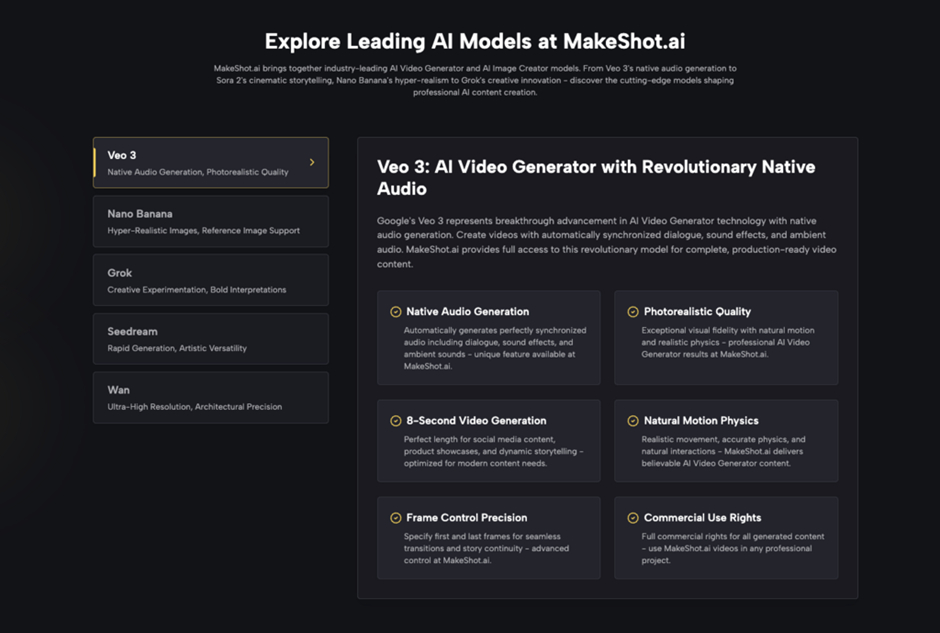
To build a reliable pipeline, we have to understand where a model’s breaking point lies. In our observations of Banana AI, the model exhibits a surprisingly high tolerance for complex camera instructions, particularly when using cinematic terminology like “dolly zoom” or “orbital tracking shot.”
One of the strengths of this model is its ability to prioritize subject retention during 360-degree rotations. In many lower-tier models, rotating around a character usually results in the face changing identity by the time the camera returns to the front. Banana AI appears to use a more robust internal “anchor” for character features. However, there is a visible trade-off: in extremely high-pacing environments—such as a first-person racing sequence—the model will often prioritize fluid motion over fine texture detail. You might get a smooth sense of speed, but the asphalt texture or background foliage may lose its sharpness.
For operators, the “stability floor” here is maintained by using what we call anchor prompts. Instead of describing only the motion, you must reiterate the core structural elements of the scene in every prompt block. This acts as a tether for the model, reminding it that while the camera is swinging wildly, the red car must remain a red car with specific metallic reflections.
For teams taking AI video from experimentation into production, these considerations also make AI video API evaluation important for testing quality, reliability, processing time, and cost before committing to larger batches.
Tactical Pre-Visualization with MakeShot
A common mistake in creative operations is committing high-compute resources to a complex motion prompt without verifying if the motion vector is even viable. This is where Nano Banana AI becomes an essential diagnostic tool rather than just a “lightweight” alternative.
The primary benefit of Nano Banana AI is the compressed feedback loop. If you are trying to coordinate a complex interaction—for instance, a character jumping over an obstacle while the camera pans—running a full-resolution generation is a waste of time and credits if the model’s “understanding” of that specific motion is flawed. By using the Nano variant, operators can validate the composition and the “skeleton” of the movement in seconds.
If the low-latency version shows the character’s legs merging with the obstacle, no amount of upscaling or high-resolution compute in the primary model will fix that fundamental motion hallucination. Integrating the Nano variant as a “pre-viz” gate allows teams to iterate on the motion-based prompt five or six times before ever hitting the “final render” button. This reduces GPU-heavy waste and ensures that when you do move to the full-strength model, you are working with a proven motion vector.
This iterative approach reflects the broader way AI is changing the creative workflow, with generation, testing, refinement, and final production becoming increasingly integrated.

Identifying the Breaking Point: Where Pacing Hallucinates
It is critical to maintain a level of skepticism regarding what these models can currently achieve. Even with advanced tools, there are specific areas where current generative technology consistently fails, and operators must be prepared to handle these in post-production rather than expecting a raw generation to solve them.
First, multi-object physics interactions remain a significant hurdle. If you prompt two characters to collide or shake hands while the camera is moving, the likelihood of “blobbing”—where the two subjects merge into a single anatomical mess—is extremely high. It remains unclear whether current diffusion models can truly conceptualize distinct boundaries between moving bodies in a 3D-simulated space without significant distortion.
Second, “speed ramping” (the transition from extreme slow-motion to fast-motion) is not a native strength of most AI Video Generator tools. When you attempt to change the temporal pacing within a single prompt, the model often becomes confused about frame interpolation, leading to “ghosting” artifacts where frames seem to overlap. At this stage, it is safer to generate high-frame-rate clips and handle the pacing—the “ramping”—in a traditional NLE (Non-Linear Editor). Expecting the AI to handle the nuances of momentum and gravity in non-human subjects is still a gamble; for now, these should be viewed as areas for experimentation rather than guaranteed delivery.
Iteration Speed vs. Final Render Fidelity
For a production unit, the “quality ceiling” of a render is often less important than the “stability floor.” A beautiful 4K clip that has a slight facial morph halfway through is useless for commercial work. Conversely, a slightly softer clip that maintains perfect temporal coherence is a workable asset.
When managing a high-volume pipeline, operators must determine the threshold for switching between model weights.
For startups and lean production teams, finding this balance between output quality, iteration speed, and compute usage can significantly reduce the cost of producing video at scale, as explored in how startups are saving on video production with AI.
If the asset is a background element for a social media ad where the motion is blurred anyway, the throughput of Nano Banana AI might actually be the more efficient choice for the final output. However, for hero assets—where the viewer’s eye is locked on the subject—the extra compute of the primary Banana AI model is non-negotiable.
Managing stakeholder expectations is also part of the job. The “AI aesthetic”—that slight dreamlike quality—is often amplified in high-energy action sequences. Creative leads should be transparent about the fact that while we can control the camera, we cannot yet perfectly simulate every individual hair strand during a 100mph wind gust. Setting this expectation early prevents the “uncanny valley” feedback loop that can derail a project.
Implementation: Guardrails for Scalable Asset Pipelines
To industrialize the output of high-motion assets, operations leads should implement a “Motion-First” prompt library.
Once these production guardrails are established, the same principles can support creative automation for multi-format ad production, where a single input can be adapted into multiple advertising assets.
This means moving away from descriptive prose and toward standardized motion parameters. Use specific keywords that the model weights have been trained on, such as “cinematic handheld,” “slow pan left,” or “tracking shot profile.”
Furthermore, a human-in-the-loop (HITL) quality gate is essential. No matter how good the model is, temporal artifacts are often subtle enough to pass an automated check but glaring enough to ruin a professional production. Every high-motion clip should be scrubbed frame-by-frame to check for “limb-pop” or background warping.
Ultimately, the most successful AI production units are those that treat Banana AI not as a magic box, but as a sophisticated camera system that requires a skilled operator. By using the Nano variant for rapid motion-vector testing and the primary model for high-fidelity execution, you can build a pipeline that survives the chaos of high-kinetic prompts. The goal is to move past the novelty of “look what the AI made” and into the professional realm of “look what we engineered.”