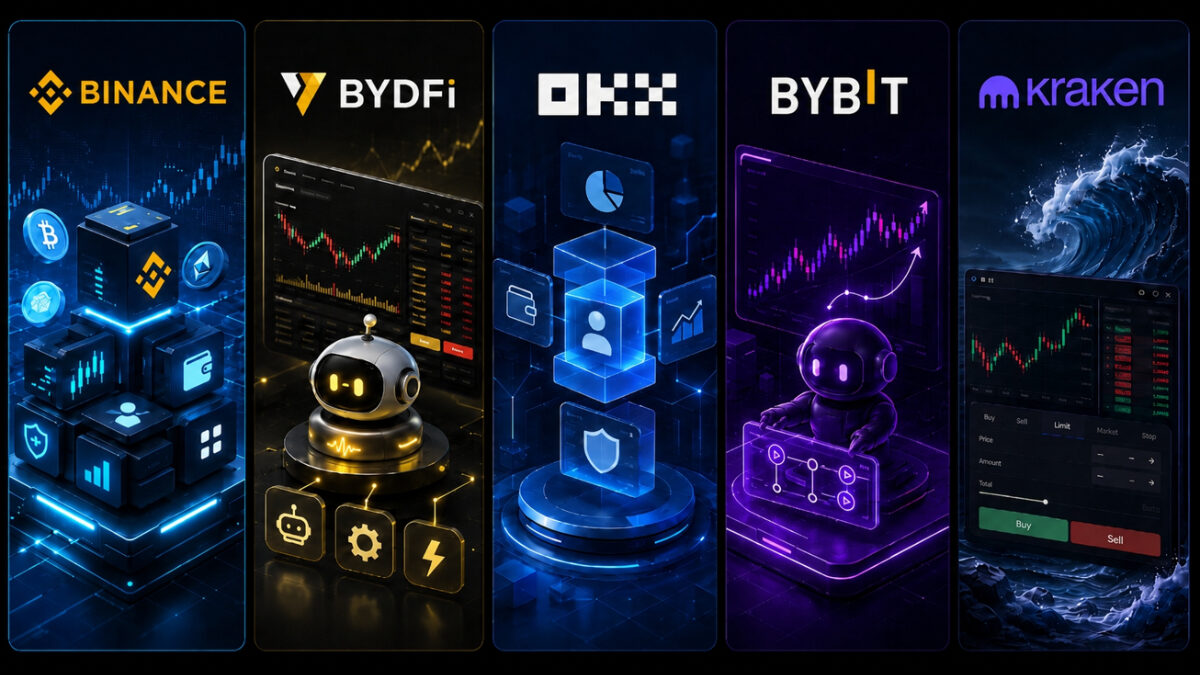

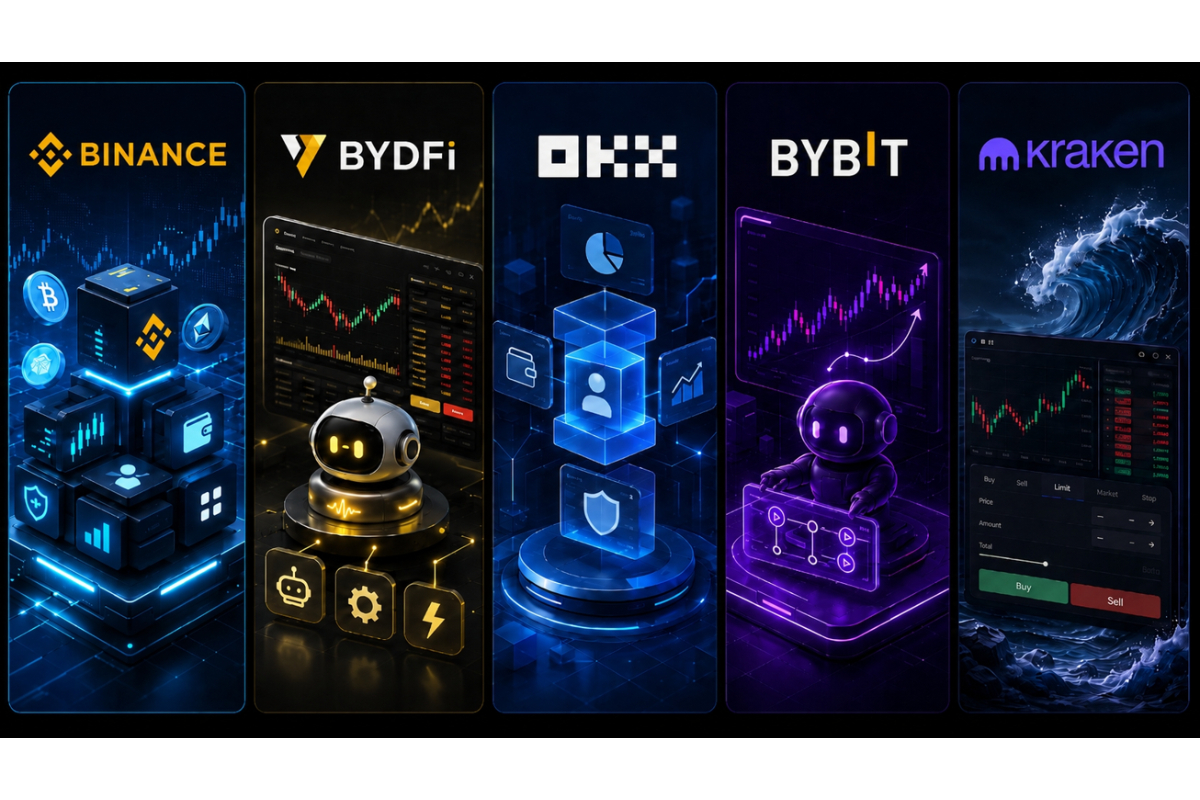
All-in-One Crypto Trading Platforms
A crypto exchange can offer many products without delivering a genuinely all-in-one experience. What matters is not simply how many markets appear in the navigation menu, but whether users can move smoothly between spot trading, perpetual futures, automated strategies, and risk-management tools without relying on several separate platforms.
This list focuses on how effectively each exchange connects its core products. The main considerations include spot and derivatives access, built-in trading bots, account structure, order tools, security measures, and overall usability. Product availability may vary by region.
Table of Contents
1. Binance — Best for Broad Crypto Product Access
Binance brings a wide range of cryptocurrency products together within the same ecosystem. The platform supports spot trading, margin, perpetual futures, delivery futures, options, and several automated trading tools.
Its bot section includes Spot Grid, Futures Grid, Spot DCA, arbitrage, and rebalancing strategies. Users can therefore move between manual trading and automated execution without connecting a separate third-party service.
Another advantage is its activity across major spot and futures markets. Deeper order books can help reduce spreads and slippage, especially when trading widely used pairs.
The main limitation is complexity. Binance contains a large number of product areas, account settings, and menus, while some features are unavailable in certain regions. Users who only need spot trading, perpetual futures, and a few automation tools may find the platform more complicated than necessary.
Binance is best suited to users who prioritize broad crypto product access and are comfortable navigating a large trading ecosystem.
2. BYDFi — Best for Perpetual Futures and Integrated Trading Bots
BYDFi combines spot trading, multiple perpetual contract structures, and built-in trading bots within a relatively focused platform.
The derivatives section supports USDT-M, USDC-M, and COIN-M perpetual contracts. These formats give users different choices for margin and settlement, while eligible markets support leverage ranging from 1x to 200x.
Its automation tools include Spot Grid, Spot DCA, and Futures Grid. Spot Grid places buy and sell orders within a predefined range, while Spot DCA divides entries across multiple purchases. Futures Grid applies automated range-based execution to perpetual contracts and can be configured around long or short market exposure.
This connection between perpetual futures and native bots is BYDFi’s main strength. Users can move between manual futures orders and automated strategies without switching to an external platform or separate trading terminal.
Standard spot maker and taker fees are both 0.1%, while perpetual futures fees begin at 0.02% maker and 0.06% taker. Higher VIP levels may reduce futures fees further.
BYDFi also publishes Proof of Reserves and maintains an 800 BTC Protection Fund. TradFi products linked to traditional markets provide additional coverage, although the platform’s core strengths remain perpetual futures and trading automation.
Its main limitation is that fiat purchases generally depend on third-party payment providers, so available methods and charges may vary by location.
3. OKX — Best for Advanced Unified Account Management
OKX is distinguished by its unified account and margin-management system.
The platform supports spot, margin, perpetual futures, expiry futures, and options. Eligible users can manage several of these products through the same account structure rather than repeatedly moving funds between separate product wallets.
OKX provides several margin modes, including isolated margin, cross margin, multi-currency margin, and portfolio margin. For experienced users, these structures may improve capital efficiency because eligible profits and losses can be assessed together.
Its automation section includes Spot Grid, Futures Grid, DCA, signal bots, smart arbitrage, iceberg orders, and TWAP execution strategies. This gives users access to both strategy automation and execution-focused tools.
The main drawback is the learning curve. Each account and margin mode changes how collateral and risk are managed. Shared collateral can improve efficiency, but losses in one position may also affect a larger portion of the account.
OKX is therefore more suitable for users who already understand advanced margin systems and want detailed control over multi-product strategies.
4. Bybit — Best for Futures Automation Variety
Bybit combines spot trading, perpetual futures, options, and several derivatives-focused automation tools.
Its bot lineup includes Spot Grid, Futures Grid, DCA, and Futures Combo. Futures Grid automatically places orders within a selected price range, while Futures Combo can manage several futures positions as part of one strategy.
This gives Bybit a relatively broad range of futures automation models. The platform also offers charting tools, conditional orders, and account features designed around leveraged markets.
However, many of its strongest functions remain concentrated on derivatives. This can make the platform less balanced for users who mainly want straightforward spot trading and a smaller, more clearly organized toolset.
Bybit also provides access to traditional-market products in supported regions. These products may operate through a separate environment with different account settings, contract structures, and fee concepts.
Bybit is most appropriate for users who already understand leveraged trading and want several ways to automate futures strategies directly within the platform.
5. Kraken — Best for Manual Execution and Order Control
Kraken takes a different approach to all-in-one trading. Instead of emphasizing a large selection of ready-made bots, it focuses on professional execution, advanced order types, margin, futures, and API access.
Kraken Pro supports market and limit orders alongside stop-loss, take-profit, trailing-stop, iceberg, reduce-only, and trigger orders. These controls give users more flexibility when managing entries, exits, and position risk.
The platform also supports API-based strategies, making it suitable for users who prefer to develop or connect their own automated systems rather than rely on exchange-designed bots.
Its main limitation is the smaller native automation selection. Users looking for built-in Spot Grid, Futures Grid, or DCA tools will find fewer ready-made choices than on Binance, BYDFi, OKX, or Bybit.
Kraken is therefore better suited to users who value manual execution, advanced order controls, and custom API workflows over integrated trading-bot strategies.
Conclusion
The best all-in-one crypto trading platform is not necessarily the exchange with the longest product list. A more useful comparison is whether its markets, account structure, and trading tools work together as part of a practical workflow.
Binance provides broad crypto product access, although its scale can increase complexity. BYDFi offers a more focused combination of multiple perpetual contract formats and built-in spot and futures bots.
OKX is oriented toward advanced unified-account and portfolio-margin management. Bybit provides a wider range of futures automation tools, while Kraken places greater emphasis on manual execution and professional order controls.
Different platforms suit different trading needs. Users should make their choice based on the markets they trade most often, their automation requirements, preferred account structure, and individual risk tolerance.