
AI in Cybersecurity
In January 2024, a finance worker from Arup the London engineering firm responsible for the bird; s nest stadium in Beijing sat down to what appeared to be an ordinary video call with the company‘s chief financial officer and members of staff. It wasn’t routine, and none of the people on that call were real. Over the course of the meeting, the employee authorized 15 separate wire transfers totaling roughly $25 million to accounts controlled by fraudsters who had built convincing real-time deepfakes of Arup’s own leadership team from publicly available video and audio. No firewall was breached. No malware was installed. Arup’s own systems were never touched. The entire attack succeeded by exploiting something no patch can fix: the instinct to trust what we see and hear.
The case, which has been confirmed by Hong Kong police and had been declared to the press by Arup, is the most transparent example of why ‘AI in cyber security’ is no longer a specialized topic for machine learning researchers but a Board level issue. AI is present in three different activities in the industry and most have at least even one of them. It is helping defenders find attacks faster. It is helping attackers build more convincing ones. And, increasingly, it is becoming something that itself has to be defended — because the models, pipelines, and autonomous agents organizations are rushing to deploy have their own vulnerabilities, separate from anything a traditional firewall or antivirus tool was built to catch.
This guide covers all three, with real numbers attached to real sources wherever a number appears. It also corrects a mistake that’s already spreading across the web: several widely-shared “2026 guides” state that the EU AI Act’s high-risk obligations became mandatory on August 2, 2026. As of this writing, that’s no longer accurate, and we explain exactly what changed and why it matters further down.
A brief word on approach: cybersecurity stats and compliance deadlines enter the market at such speed that a value often seems to be outdated after a couple of weeks. I will give figures with every free source used so that you can check them yourself and see if it has moved since then.
Table of Contents
1. What “AI in Cybersecurity” Actually Means in 2026
Asking a handful of vendors for their definition of “AI-enabled security” will result in five mutually exclusive answers, and two of those answers will be advertising the sale of a rules engine–just with a new name. To cut through the clutter, one must be familiar with the two diverse methodologies that AI can accommodate in this domain, as that is the major determining factor for everything else in this paper.
Signature-Based Detection: Fast, Cheap, and Blind to the Unknown
Signature-based detection works exactly asav (and nay other antivirus has for the past 25 years) works. A known-bad file, hash, or behavior pattern added to a database and your box checks everything passing against it. Cryptographic hash comparisons and YARA rule matching take milliseconds and cost almost nothing in compute. The problem is in the description: signature-based detection can only spot what it‘s been told about until now. Zero-day exploits, polymorphic malware rewriting itself to beat hash-based detection, and fileless attacks that don‘t touch the disk at all all may be designed to evade detection.
Behavioral Analytics: Teaching Machines What “Normal” Looks Like
Behavioral AI makes a different wager. Where signature engines ask “have we seen this threat before,” behavioral AI constantly builds a model of what normal activity looks like for a specific user, device or application, then raises an alert on any significant deviation from normal. This is the technology behind User and Entity Behavior Analytics (UEBA) solutions, and it is truly effective at finding precisely the activity that signatures never will: an account logging in from two different countries in the space of an hour, a system account suddenly reading files no other process on the system has ever accessed, a live admin console traveling to a never before-used port at 3:15 a. M. If you want to go deeper on how the underlying models are trained and tuned, our guide to machine learning in cybersecurity walks through the mechanics.
The Hybrid Model Nobody Talks About Enough
Here’s the part most “AI vs. traditional security” content skips entirely: mature security organizations don’t choose one approach over the other, they layer them. Signature-based engines provide a lightweight first cut filter that certifies fewer than 0.01% of the commodity threats we‘ve already seen (familiar ransomware families, standard set to look for in typical exploit kits, and infrastructure for the phishing campaigns we‘ve documented). The relatively cheap cost of shoring it up with the heavy-handed behavioral AI models is then freed up to devote its relatively cheap budget to the far more difficult less than 0.1% of the activity in the average production SOC and lucrative task of identifying you’re specially targeted and strategic activity. Marketing headlines like it are “old vs. new” miss how the two actually work together.
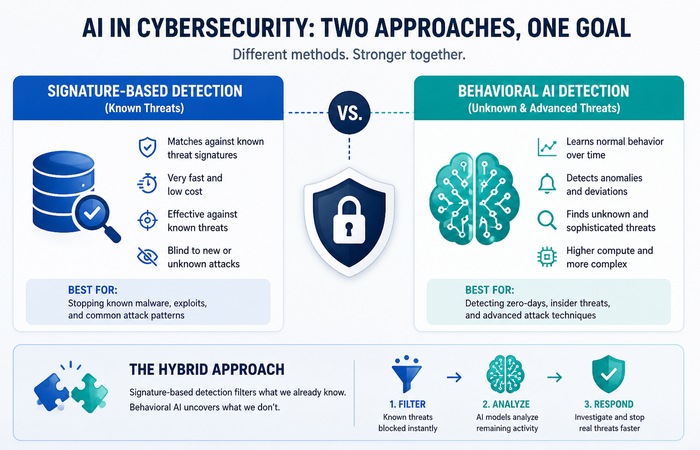
| Dimension | Signature-Based Detection | Behavioral AI Detection |
| Speed | Millisecond hash/database lookups | Slower; requires continuous modeling |
| Compute cost | Very low | Significantly higher |
| Zero-day coverage | None — reactive only | Can flag novel anomalies |
| False positive rate | Very low for known threats | Higher initially; improves with tuning |
| Best for | Commodity malware, known IOCs | Insider threats, novel attacks, living-off-the-land |
2. The Machine-Speed Threat Landscape: How Attackers Are Weaponizing AI
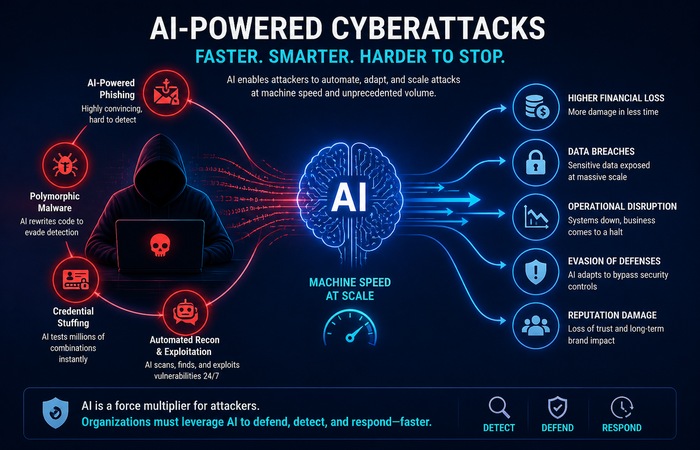
While defenders debate architecture, attackers have already industrialized generative AI, and the numbers show it. As reported in the Crowdstrike‘s 2025 Global Threat Report, Voice phishing or vishing grew by a astonishing 442% in the second half of 2024 compared with the first half of the year, and many industry trackers have seen the number booming out for the rest of 2025 and 2026. Attackers are leaning on vishing specifically because it routes around the email filters and link scanners that have absorbed most of the last decade’s defensive investment — a phone call carries a presumption of legitimacy that a suspicious link never will.
Voice cloning is what makes this scale. Security researchers and vendor testing, including work cited by McAfee, have found that modern AI tools can clone a specific person’s voice from as little as three seconds of audio with roughly 85% accuracy — and that three seconds is trivially available from earnings calls, conference talks, podcast appearances, or a company’s own YouTube channel.
Dark-Web LLMs and the Democratization of Cybercrime
Generative AI has also lowered the skill floor for launching a convincing attack. Underground forums have also been selling pre-made Evil-Model-AI any of which can be found by searching with basic FBI-style open-source intelligence techniques minus the safety features that a normal AI tool built by a reputable provider would have, that is being sold for specifically writing phishing emails, malware variants, and social-engineering stories. Now, an attacker no longer needs to be a fluent American English speaker and very technically competent to conduct any OSINT-based spear-phishing attack on such a senior executive, the model is doing the writing. The rest of our deeper dives into generative AI and cybersecurity is how to build the various tools, and what defenders can do about the specific techniques.
From Weeks to Minutes: The Compressed Kill Chain
The practical effect of all this automation is speed. Attack chains that once took days or weeks (recon, initial access, lateral movement, exfil) can now happen in minutes if the AI does the recon and tailoring in aggregate, in parallel, without a human operator sleeping, taking breaks or making errors that gave defenders a chance. A SOC built around human-speed triage — an analyst reviewing an alert queue, escalating, waiting for approval — is structurally mismatched against an attack that completes before the first analyst has finished reading the initial alert. That mismatch is the entire reason the rest of this guide exists.
3. Deepfakes and Synthetic Social Engineering: When Seeing Is No Longer Believing
The Arup case that opened this guide isn’t an outlier; it’s a preview. Deepfake-enabled fraud exploits what security researchers sometimes call “sensory trust” — the deep, largely unconscious confidence people place in a familiar face or voice, a trust that text-based phishing filters were never built to evaluate.
Anatomy of the Attack: What Actually Happened at Arup
The Arup incident followed a specific sequence worth understanding because it’s now a template. It began with a conventional spear-phishing email impersonating the company’s UK-based CFO, requesting a confidential transaction. The employee was initially skeptical of the email, which is exactly the healthy instinct security-awareness training is supposed to build. What overcame that skepticism was the follow-up: a video call where every other participant — the CFO and several familiar colleagues — was an AI-generated deepfake, built from audio and video the real executives had left scattered across recorded conference calls and public appearances. Arup’s CIO later confirmed no company systems or data were compromised; the entire loss came from social engineering, not a technical breach. For a full breakdown of how these synthetic-media attacks are built and defended against, see our guide to deepfakes and AI social engineering.
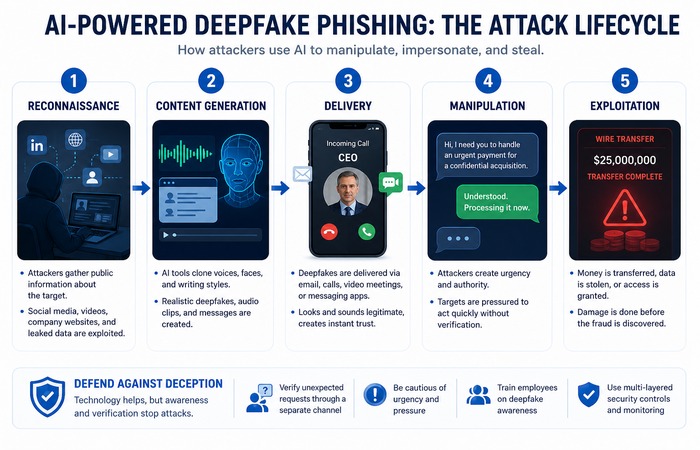
The Five-Stage Deepfake Phishing Lifecycle
Understanding the attack as a sequence — rather than a single moment of deception — reveals where defenses can actually interrupt it:
- OSINT harvesting. Tools utilized by attack to gather public audio/video (CV, LinkedIn, earnings calls, training/webinars, meetings). Defense opportunity: make all internally recorded earnings calls and town halls audio-only as much as possible, and regularly review what video of executives gets published to the web.
- The voice clone a video avatar is created by a generative model, copying the person‘s mannerisms, accent and pace of talking. Defence opportunity: Technical detection of synthesis-media artifact. This is a constantly moving target.
- Multi-channel delivery. A spear-phishing email is often followed by a “confirming” phone or video call, using one channel to lend credibility to another. Defense opportunity: Train staff to recognize cross-channel “priming” as a red flag in itself, not just suspicious content within a single channel.
- Urgency exploitation. Time pressure (“this transfer has to go out in the next ten minutes”) is used deliberately to short-circuit careful verification. Defense opportunity: Make mandatory out-of-band verification for high-value transactions non-negotiable, regardless of stated urgency or seniority of the requester.
- The target complies, and funds or credentials leave the organization. Defense opportunity: Regular multi-channel phishing simulations, specifically including voice and video scenarios, build the reflexive skepticism that stops step 4 from working.
The “Dual Exposure” Problem for Executives
Finance staff, IT administrators, and C-suite leaders face what’s sometimes called dual exposure: they are simultaneously the people whose voices and faces are most available to be cloned (because executives are the most publicly visible people at any company) and the people whose authority makes a fraudulent request most likely to be obeyed without question. That combination is exactly why deepfake fraud has concentrated on this group, and why “recognize suspicious emails” training, on its own, no longer covers the actual threat.
4. Behavioral Analytics as the New Defensive Baseline
If signatures can’t catch what they’ve never seen, and attackers are increasingly using techniques — living-off-the-land tactics that abuse legitimate admin tools, for instance — specifically designed to leave no signature to catch, behavioral analytics stops being optional. Our companion piece on how AI detection is powering cybersecurity innovations goes deeper into the specific model architectures involved; here’s the operational pipeline most platforms follow.
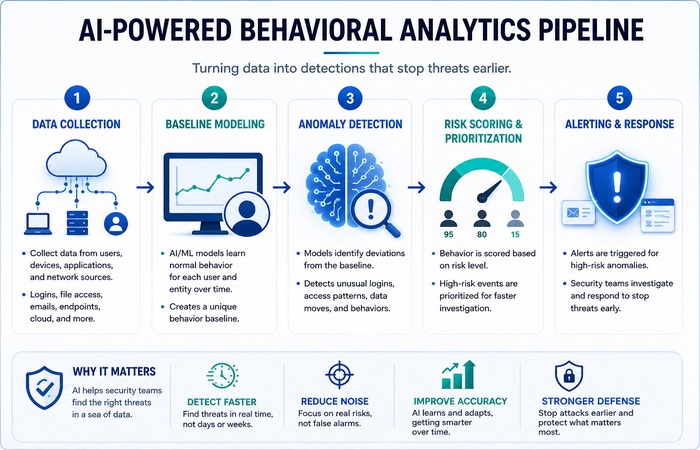
The Five-Stage Behavioral Analytics Pipeline
- Data collection. Systems ingest telemetry from network traffic, endpoint logs, identity and authentication events, and application usage — often at genuinely massive scale.
- Baseline creation. The model builds a reference profile for every user and device: typical login geographies, normal file-access hours, usual communication patterns.
- Anomaly detection. Activity that deviates meaningfully from that baseline gets flagged for further analysis.
- Threat correlation. Individual anomalies — an odd login time paired with an unusual outbound data transfer, say — get linked together to reveal multi-stage attack chains that no single alert would expose on its own.
- Response and remediation. Once an anomaly chain is verified, the platform can trigger automated containment: isolating an endpoint, revoking a session token, forcing re-authentication.
Catching What Signatures Can’t See
The specific value of this pipeline is its ability to catch “living-off-the-land” attacks, where intruders use an organization’s own legitimate administrative tools — PowerShell, remote management software, built-in OS utilities — to move around a network without ever installing anything a signature-based tool would flag as malicious. For security teams already stretched thin, the practical payoff of catching this earlier is a genuine reduction in noise: fewer false positives means analysts spend their limited hours on real risk rather than triage.
5. Resolving the “Clarity Bottleneck”: How AI Is Actually Used in the SOC
This is exactly where much of vendor marketing and day to day operating reality begins to diverge sharply, and a little care in defining just how far apart becomes an investment worth making.
Why Rigid SOAR Playbooks Are Hitting Their Limits
Traditional Security Orchestration, Automation, and Response (SOAR) platforms run on hardcoded, linear playbooks: if condition A, then action B. That works fine for well-understood, repetitive scenarios, but it breaks down the moment an incident deviates even slightly from the scripted path — which, given how fast attacker tactics are evolving, is increasingly the norm rather than the exception.
What an “Agentic SOC” Actually Looks Like
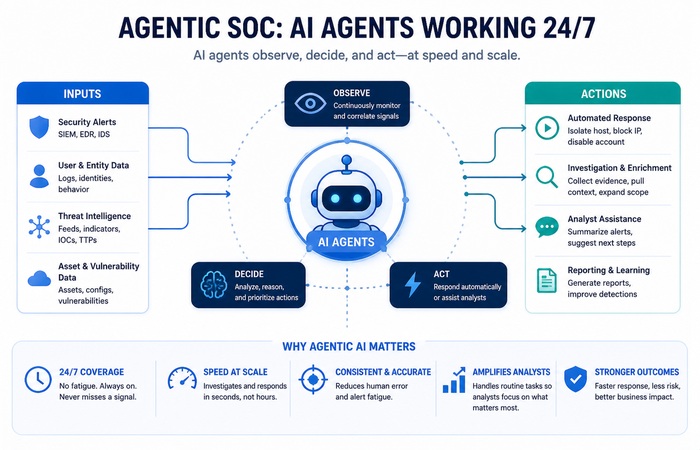
The other architecture that is taking hold that replaces these fixed playbooks is frequently called an agentic SOC: multiple autonomous specialized AI agents one researching threat intelligence reports for relevant indicators, another analyzing endpoint data, another analyzing network data working in parallel and sharing context and testing hypotheses on an incident rather than a single lowest-common-denominator script from top to bottom. A roadmap to the future of AI-driven cybersecurity is provided in understanding where this architecture is headed in the coming years.
What the Data Actually Shows: Investigation, Not Autonomy
Here’s the part the “fully autonomous SOC” pitch tends to skip. The second annual State of AI in the SOC survey sent to 250 security practitioners by Prophet Security in 2026, indicates that organizations are cautiously and unevenly increasing AI‘s decision-making power: 44% of teams allow AI to recommend actions for a human to execute, 30% of teams allow AI to auto-run only low-risk actions, 13% of teams allow AI to auto-run medium-risk actions, 13% of teams allow AI to auto-run only read-only triage. Critically, no organization in the survey reported granting full, unsupervised autonomy. Among teams that have adopted AI broadly across their alert queue, 72% reported cutting investigation time by at least a quarter — a real, measurable gain, but one built on AI as an investigative force-multiplier rather than an independent decision-maker.
That data lines up with what practitioners describe anecdotally: the daily bottleneck in most SOCs isn’t a lack of automation to take action, it’s a lack of context to know which action is warranted. Alert volumes routinely run into the thousands per day, and the scarce resource is understanding — why does this particular alert matter, is this actually exploitable in our environment, what else does it connect to — not simply the ability to click “isolate host” faster.
Supervised Autonomy: A Practical Framework
The organizations getting real value from agentic AI tend to converge on a tiered model. High-frequency, low-stakes work — deduplicating alerts, enriching indicators of compromise, correlating logs — runs autonomously. High-impact or hard-to-reverse actions — isolating a production host, revoking credentials, changing firewall rules — route through a human analyst for validation before execution. It’s a deliberately unglamorous middle ground, and it’s also the one the survey data above suggests most mature teams are already converging on.
6. Securing AI Itself: Inside the AISec Boom
Every section so far has treated AI as a tool defenders and attackers both use. This section covers something different: the AI models and pipelines themselves are now a distinct attack surface, and protecting them has become its own fast-growing market, separate from “using AI to defend a network.”
A Market Growing 68.7% in a Single Year
Gartner estimates the market for securing AI separate from, but related to, the security tools powered by AI, these comprise software used to safeguard AI models, apps and in-house use of AI will be worth almost $4.8bn in 2027, a 68.7% increase over 2026, with budgets forecast to grow to nearly $7.7bn in 2028. The growth isn‘t distributed evenly: as Gartner‘s split puts AI application security as the largest segment as of 2027 with roughly $851mln, followed by AI usage control with roughly $749mln, with AI governance platforms and AI gateways having the fastest percentage increases on a much smaller base. Gartner also predicts that over half of successful cyberattacks on AI agents will exploit access control weaknesses and prompt injection by 2029 — a specific, measurable forecast worth tracking against as the market matures.
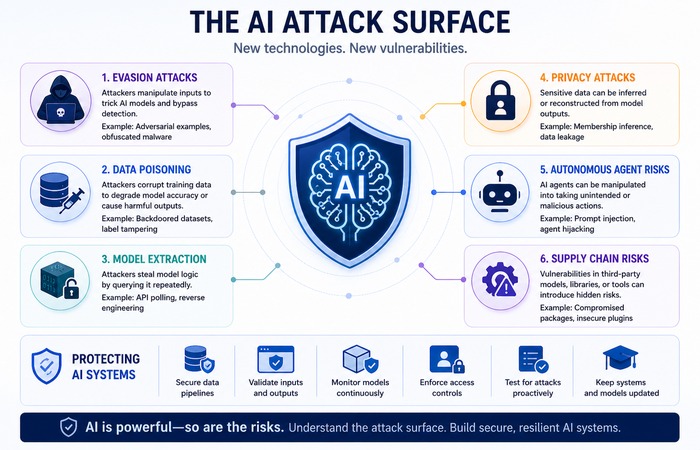
Adversarial Machine Learning: Four Distinct Failure Modes
“Adversarial machine learning” isn’t one attack — it’s a family of four, and they target different points in a model’s lifecycle:
- Evasion attacks happen at inference time, when an attacker crafts input specifically designed to fool an already-trained model into misclassifying it — the kind of attack studied under names like FGSM, PGD, and C&W in academic literature.
- Data poisoning happens during training, when an attacker manages to corrupt the training data itself, so the resulting model carries a hidden flaw or backdoor from the moment it’s deployed.
- Model extraction involves an attacker repeatedly querying a production model to reverse-engineer and effectively steal its logic — a direct threat to any organization that has invested heavily in a proprietary model as intellectual property.
- Privacy attacks, including membership inference and model inversion, attempt to determine whether specific data was used to train a model, or to reconstruct sensitive training data from the model’s outputs — a meaningful concern anywhere training data includes personal or confidential information.
Our dedicated guide to adversarial AI and AI attacks walks through detection and mitigation strategies for each category in more depth.
Prompt Injection: The New #1 Vulnerability
For any organization running large language models in production, prompt injection is now the single most-cited risk. The OWASP Top 10 for LLM Applications has ranked prompt injection as the top risk for two consecutive editions, and the 2025 edition explicitly distinguishes two forms: direct injection, where a user types adversarial instructions straight into a prompt, and indirect injection, where malicious instructions are hidden inside a document, webpage, or email that an LLM processes as part of its normal workflow — meaning the attacker never has to interact with the system directly at all. Security researchers have also documented more exotic variants, including instructions hidden using invisible Unicode characters that render as nothing to a human reviewer but are still parsed by the model. Defending against this category increasingly means treating anything an LLM reads from an external source — a webpage, an incoming email, a PDF attachment — as untrusted input requiring the same scrutiny as user-submitted form data on a website, not as safe internal context.
7. The Governance Blind Spot: What AI Agents Reveal About Your Access Controls
Here’s an angle most “AI risk” content misses entirely: the biggest immediate danger of deploying internal AI agents often isn’t anything the agent creates. It’s what the agent instantly exposes.
Why This Happens
AI agents are good at removing search friction. Point one at your company’s file shares, ticketing system, or internal wiki, and it will surface relevant information regardless of where it’s buried — which is exactly the point of deploying it. The problem is that “buried” often meant “protected by obscurity” rather than “protected by an actual access control.” Years of permission drift — access rights copied from one employee to the next without review, folders shared broadly during a project and never locked back down, credentials left in old configuration files — get instantly and efficiently surfaced by a tool that was never designed to judge whether it should be looking there in the first place.
Shadow AI, By the Numbers
IBM’s Cost of a Data Breach Report 2026, based on Ponemon Institute research across 602 breached organizations spanning 17 industries and 16 countries, quantifies how fast this is escalating. Security incidents involving shadow AI — AI tools deployed or used without formal IT and security oversight — more than doubled year over year, jumping from 20% to 43% of breached organizations, with the average cost of a shadow-AI-linked breach rising from $4.63 million to $5.39 million, and regulatory fines resulting from roughly one in five of these incidents. Governance is not keeping pace with that growth: the same report found only 32% of breached organizations had an AI governance policy in place, down from 37% the year before — meaning more than two-thirds now have no formal policy at all, an increase from the prior year rather than an improvement. The global average cost of a data breach across all causes also hit a record $4.99 million in this report, a 12% year-over-year increase.
Tool Abuse, API Manipulation, and Inter-Agent Compromise
Beyond exposure, granting AI agents write access to production systems introduces genuinely new risk categories. An individual agent receiving attacker-controlled data, such as an attack email or poisoned support ticket, can have their instructions spoofed via prompt injection to such an extent that they may leak data, delete logs, and filter security alerts as if instructed, likely outside the recognition of the intended users. In multi-agent systems, this consequence multiplies: agents that trust context passed to them from other agents can cascade malicious instructions as it propagates through the system granting ubiquitous elevation of privilege despite being designed specifically to avoid it.
Practical Mitigations
The organizations managing this well tend to apply the same discipline to AI agents that mature shops already apply to human contractors and service accounts: restrict agents to containerized, isolated execution environments; issue scoped, ephemeral, read-only credentials rather than persistent administrative access wherever possible; and implement deterministic action auditing that logs what a tool actually did, not just what the prompt claimed it was going to do. In our guide to AI security automation, we‘ll walk you through how to incorporate these guard rails into your automation pipeline without bringing deployment to a halt.
8. Navigating the Compliance Matrix: EU AI Act, NIST AI RMF, and ISO 42001
This is where they do the most harm, as timeframes for compliance have serious monetary and legal implications if you plan on the basis of one date that later gets changed. The facts are as follows as at August 2026.
The EU AI Act: What Changed, and What’s Actually in Force Right Now
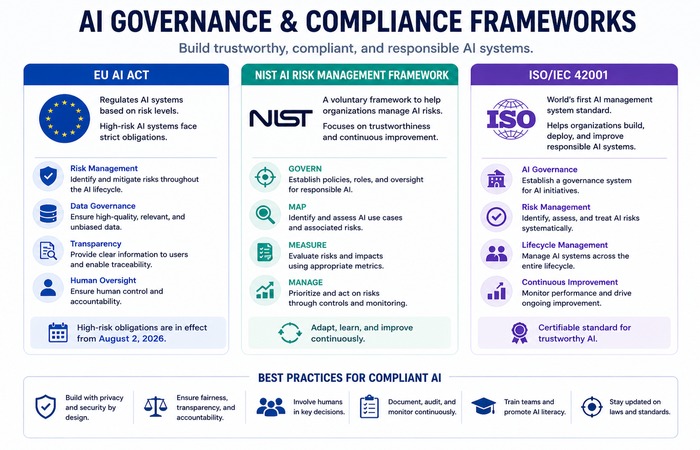
Though the EU AI Act announced it was coming into effect on 1 August 2024, it had always been intended to roll out obligations incrementally over years, rather than in a single wave, with the schedule that most 2025-era content still describes looking like this: prohibited AI practices and the duties of all AI users/implementers would come into effect on 2 February 2025; liability duties for providers of general-purpose AI models (“GPAI”), the control over which AI systems might be more narrowly applied in the way that 2025-ERA provides for would come into effect on 2 August 2025; and the most burdensome and operationally conservative level such as liability duties for “high-risk” systems in Annex III, such as AI in credit and insurance, employment, critical infrastructure, public safety, or healthcare, would come into effect on 2 August 2026.
That last deadline has moved. By late 2025, the deadline for implementing the technical standards necessary for high-risk compliance visibly was missed, leading the Commission to propose a Digital Omnibus on AI. After a long negotiation, the Digital Omnibus was adopted by the Official Journal of the European Union on 24 July 2026 and came into effect on 27 July 2026 as just a few days late. It postponed the concrete deadline for compliance for stand-alone high-risk AI comprised in Annex III from 2 August 2026 to 2 December 2027, and postponed the deadline for submitted high-risk AI comprised in Annex I(e.g., medical devices or machinery) from August 2027 to 2 August 2028.
What did not run: The transparency of Article 50 and the AI-content-labeling obligations, the training of the GPAI providers, now already in place since August 2025, and the Article 5 regimes of prohibited practices, in force since February 2025. The penalty structure for those active provisions is unchanged and severe — violations of prohibited practices can still trigger fines up to €35 million or 7% of global annual turnover, whichever is higher, with tiered penalties of up to €15 million (3% of turnover) for high-risk non-compliance once that provision does take effect, and up to €7.5 million (1% of turnover) for supplying incorrect information to regulators.
The practical takeaway for security leaders: you are not required to have full high-risk conformity assessments, technical documentation, and CE marking completed by August 2026 as many older guides still claim. You do still need AI-content transparency measures live now, and you have a genuinely useful — if shorter than originally planned — runway to prepare for the December 2027 high-risk deadline rather than none at all.
NIST AI RMF: The Voluntary Framework Everyone Cites
The AI Risk Management Framework developed by the US National Institute of Standards and Technology (NIST), published in January 2023, is guidelines and not a standard. It comprises four functions. Govern (policy and accountability for the organization, culture. This is to be done across everything else), Map (identify the context and risk setting of a specific AI system), Measure (determining how to test that system based on agreed trustworthy standards), and Manage (define the ordering of importance, set priorities and respond to the risks identified in the measurements). NIST published a companion Generative AI Profile (NIST-AI-600-1), and a comprehensive Playbook outlining suggested actions associated with each of the four functions.
ISO/IEC 42001: The Certifiable Counterpart
Where NIST provides a common language and self-assessment framework, ISO/IEC 42001-a formal AI management system standard, released December 2023, and the world‘s first international AI management system standard-is intended to be externally audited and certified in a similar manner to ISO 27001 for information security. Formalizing an AI Management System (AIMS), including issues like documenting AI Impact Assessments, gives any company a way to show regulators like the EU what risk governance looks like even in the absence of a hard, immediate deadline.
State and Local Laws Worth Knowing
Regulation isn’t only happening at the EU level. Colorado‘s SB21-169 mandates that insurers keep a record of risk-management policies over algorithms and predictive models used in underwriting in order to prevent unfair discrimination life insurers have had this in place since November 2023, auto and health insurers still in the process of establishing it. A different measure, the Local Law 144 (LL144) of New York City, state that any employer in the city that uses a, “automated employment decision tool” to make hiring or promotion decisions involving assignments within the city, must: undertake an “independent bias audit” of the tool once a year, make the results of that study available online, and alert candidates of the use of the tool at least ten business days before being evaluated by it fines range from $500 for a first offense to as much as $1,500 daily for continued non-compliance. Enforcement under LL144 was found to be haphazard following a late-2025 audit by the city comptroller, and the Department of Consumer and Worker Protection has been pursuing more active policing of the law.
| Framework | Type | Status (Aug 2026) | Core Structure |
| EU AI Act | Mandatory law (phased) | Prohibited practices & GPAI rules active now; high-risk (Annex III) obligations deferred to Dec 2, 2027 | Risk-tiered classification |
| NIST AI RMF | Voluntary framework | Stable since Jan 2023; Generative AI Profile added | Govern, Map, Measure, Manage |
| ISO/IEC 42001 | Certifiable standard | Stable since Dec 2023; adopted by a growing number of AI and cloud providers | AI Management System (AIMS) |
9. Choosing an AI Security Partner: A Buyer’s Framework
Selecting an AI security vendor is a decision about a long-term strategic partner, not a line-item tool purchase — and one detail catches organizations off guard more than any other: not every platform marketed as supporting on-premises deployment actually keeps all telemetry local. Many “hybrid” architectures still route data externally for model processing, which can directly conflict with data-sovereignty or regulatory requirements. Confirm this explicitly before signing anything if it matters to your environment.
Seven Questions Worth Asking Every Vendor
- Scope of coverage — Does the platform actually cover endpoints, network, cloud, and email, or is “comprehensive” doing a lot of marketing work?
- Integration — Are there genuine, maintained APIs and pre-built connectors for the tools you already run, or will this require custom engineering to connect?
- Scalability — Can it realistically ingest your actual daily event volume without degrading performance, tested against your numbers, not a vendor’s reference customer?
- False positive management — How quickly, and by whom, can models be tuned to your specific environment?
- Response automation — Are containment playbooks genuinely customizable to your organization’s risk tolerance, or fixed to vendor defaults?
- Threat intelligence — Is detection informed by a real global sensor network and current adversary telemetry, or a static, infrequently updated feed?
- Vendor roadmap — Does the company have a track record of shipping updates that keep pace with new attack techniques, or is the current feature set the extent of near-term investment?
The Competitive Landscape
We have long since moved beyond the generic “AI-powered” identification into readily differentiated categories an AI-native SIEM, XDR (Extended Detection and Response), and NDR (Network Detection and Response), for example. Here are some of the more well-known vendors and their general specialization:
- SentinelOne — Markets its Singularity platform as a means of ingesting big data into an AI-powered SOC process provided it doesn‘t require a huge amount of people to handle the massive amounts of data.
- Darktrace — built its reputation on unsupervised machine learning that models an organization’s own “normal” without relying on pre-built threat signatures, including coverage for OT and industrial control environments.
- CrowdStrike — known for its Falcon platform’s behavioral correlation (“Threat Graph”) and managed threat-hunting service, aimed at organizations that want expert oversight layered on top of the technology.
- Palo Alto Networks — Cortex XDR emphasizes unified analytics from perimeter to workload, with root-cause analysis and attack-path visualization tightly integrated with the company’s firewall product line.
- Vectra AI — focused specifically on network detection and response, with an emphasis on catching attackers already inside a perimeter through east-west traffic analysis.
- Exabeam — built around UEBA and automated “narrative” timelines that stitch disconnected log events into a single coherent attack story for analysts.
- Microsoft — The primary benefit of Defender XDR is native depth across Azure AD and Microsoft 365, offering the fastest route to broad coverage for organizations already on that ecosystem.
- Fortinet — FortiAI focuses on inline, hardware-level remediation, positioned for high-throughput network environments where blocking needs to happen at wire speed.
Treat vendor-published performance claims — “100x faster,” “eliminates X% of alerts” — as marketing figures to verify against your own proof-of-concept testing rather than independently audited facts; that’s true of every company on this list, not a criticism specific to one.
Matching Tools to Specific Use Cases
| Use Case | Category / Example Vendors |
| Pure AI model security (protecting models themselves) | HiddenLayer; Cisco AI Defense (built on the acquired Robust Intelligence platform) |
| Data privacy in AI pipelines | Skyflow |
| Runtime LLM protection | CalypsoAI |
| AI-assisted development risk visibility | Project and access-management platforms such as ONES.com |
Worth flagging directly since older content still lists it as an independent option: Robust Intelligence, previously recommended as a standalone AI model security vendor, was acquired by Cisco in a deal completed in October 2024 and is no longer sold separately — its technology is now the foundation of Cisco AI Defense within Cisco Security Cloud.
10. Measuring What Matters: The Four Latencies of Resilience
Compliance checklists measure whether you’ve done the paperwork. They don’t measure whether you’d actually survive an incident. A more useful lens, and one worth adopting internally regardless of what a specific regulation requires, is resilience measured across four latencies:
- Detection latency — how long it takes to identify abnormal behavior once it starts, based on your actual telemetry coverage.
- Decision latency — how long it takes a confident, evidence-backed response decision to get made once something is detected.
- Response latency — how long it takes to actually contain the compromised system once a decision is made.
- Recovery latency — how long it takes to return affected business operations to normal after containment.
Every technology and framework covered in this guide ultimately earns its place by shrinking one or more of these four numbers. If a proposed AI investment can’t be tied to a measurable improvement in one of them, that’s a reasonable basis for skepticism regardless of how the pitch is framed.
Where This Leaves Security Leaders
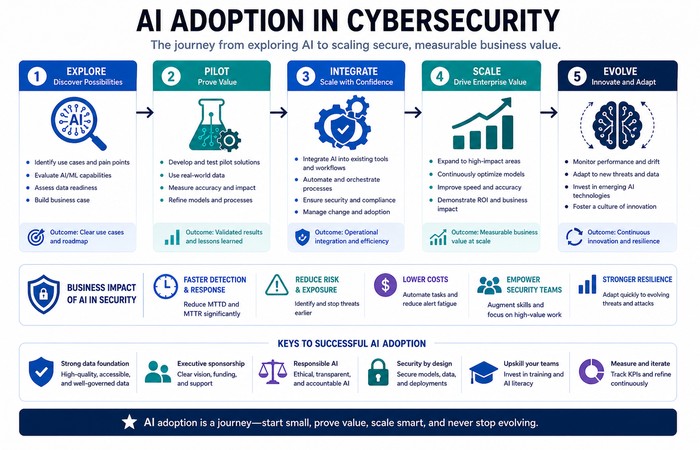
Despite all this, AI hasn‘t changed the basic mission of cybersecurity, stop those who are unauthorised from getting access to what they shouldn‘t. The one thing AI has definitely changed, never to be undone, is the clock. Attackers compress timelines that used to take weeks into minutes. Deepfakes compress the verification process that trust used to require into a single, convincing video call. And the models organizations deploy to keep up now carry their own attack surface, one most security programs weren’t built to cover.
None of that argues for chasing full autonomy for its own sake — the data throughout this guide, from SOC autonomy surveys to shadow AI breach statistics, points the other way: the organizations getting real value are the ones pairing AI’s speed with continued human judgment at the points that actually matter, not the ones removing humans from the loop entirely. The organizations that will handle the next few years well are the ones building that judgment into their architecture deliberately, rather than discovering where it was missing during an incident.
FAQs
Q1: What are the primary risks of using internal autonomous AI agents in security operations?
A: Three risk categories stand out. Prompt injection in triage workflows can let attacker-controlled content embedded in an alert override an agent’s intended instructions, potentially causing it to exfiltrate data or suppress its own alerts. Tool abuse and API manipulation become possible when an agent has broad access without adequate input validation, letting it be steered into calling unintended endpoints or modifying permissions. And in multi-agent systems, inter-agent compromise can let a breach of one upstream agent propagate malicious context to others downstream, escalating privileges across the system.
Q2: How does the “clarity bottleneck” shift how security practitioners actually use AI?
A: Despite marketing that emphasizes fully autonomous remediation, current survey data shows autonomy being granted cautiously: Prophet Security’s 2026 State of AI in the SOC survey found no organization granting AI full unsupervised autonomy, with the largest share of teams (44%) using AI to recommend actions for a human to execute, and smaller shares permitting limited auto-execution scaled to risk level. The consistent theme across the industry is that AI’s main value right now is accelerating investigation and context-gathering — helping analysts understand what an alert actually means — rather than replacing the judgment call on what to do about it.
Q3: What is the current status of the EU AI Act’s high-risk AI obligations?
A: None of these are enforceable until August 2026. The Digital Omnibus on AI, with expiry on 27-07-2026 delays the otherwise deadline for submission of other standalone hi-risk AI systems (Annex III) until 02-08-2026 to 02-12-2027 and others embedded in regulated products (Annex I) until 08-2027 to 02-08-2028. This is the only one remaining so on time-table (i) 50 transparency and content-labeling, (ii) duties for all generic purpose AI providers (enforceable since 08-2025), (iii) interdiction-penalty regime (enforceable since 02-2025, with penalty points up to euro35million or 7% of global annual turnover).
Q4: How can organizations prevent a compromised AI agent from causing widespread damage?
A: The “supervised autonomy” is the most obvious suggestion: automated the least risky, highly repeatable and highest volume tasks (deduping alerts, enriching indicators) completely; for critical, hard-to-reverse actions (isolating host, revoking credentials) first queue for human verification. And also the technical controls: isolated agent from user‘s system, use session token, not give agents permanent credentials (ephemeris over permanence); record agent command logs instead of accepting the agents command output (content over container).
Q5: What is the difference between signature-based and behavioral AI threat detection?
A: Signature-based detection compares activity against a database of known-bad indicators — file hashes, YARA rules — executing in milliseconds with very low computational overhead, but it’s fundamentally unable to catch threats it has no prior record of, including zero-days and fileless malware. Behavioral AI detection instead builds a model of normal activity for a given user, device, or application, and flags meaningful deviations from that baseline, allowing it to catch novel threats without a pre-existing signature — at the cost of higher compute requirements and a more involved tuning process to keep false positives manageable.
Related Guides
- How AI Detection Is Powering Cybersecurity Innovations — a closer look at the detection models referenced in the behavioral analytics section above.
- Exploring the Future of AI-Driven Cybersecurity — where agentic SOC architecture is headed next.
- Machine Learning in Cybersecurity — the technical foundations behind behavioral analytics.
- Generative AI and Cybersecurity — how attackers are weaponizing generative models in detail.
- AI Security Automation — building the guardrails referenced in the agent governance section.
- Adversarial AI and AI Attacks — a full breakdown of evasion, poisoning, extraction, and privacy attacks.
- Deepfakes and AI Social Engineering — the complete picture behind the Arup-style attacks covered above.
Sources & References
Threat data and incidents
- CrowdStrike 2025 Global Threat Report (vishing +442%), via Security Magazine
- Arup deepfake case reporting, CNN Business and Adaptive Security
- Voice cloning accuracy statistics, via Allure Security
- IBM Cost of a Data Breach Report 2026 (shadow AI data), via Cybersecurity Dive and Kiteworks
- Prophet Security, State of AI in the SOC 2026
Market data
- Gartner, Forecasts the Market for Securing AI Will Reach $4.8 Billion in 2027 (press release, August 26, 2026)
Regulatory and standards sources
- EU Digital Omnibus on AI / high-risk deadline deferral: Gibson Dunn and Legiscope EU AI Act deadline calendar
- NIST AI Risk Management Framework, official NIST AI Resource Center
- ISO/IEC 42001 AI Management Systems standard, official ISO page
- OWASP Top 10 for LLM Applications (2025), official OWASP GenAI Security Project document
- NYC Local Law 144 requirements and penalties, via Warden AI
- Colorado SB21-169 insurance AI regulation, via Lumenova AI
Vendor and corporate sources
This is based on public information available in August of 2026. AI regulation and threat data is very dynamic determine the time-critical numbers (like the compliance deadlines) against the original sources linked above prior to making business-critical decisions.