Best Image Annotation & Labeling Service Providers
Every computer vision model is only as good as the labels it learns from. A bounding box that’s a few pixels off, a segmentation mask that misses a boundary, or an inconsistent class definition doesn’t just add noise — it teaches the model the wrong thing, and that error compounds at inference. As teams push into higher-stakes domains like medical imaging, autonomous systems, and industrial inspection, the annotation partner you choose has become one of the most consequential decisions in the entire ML pipeline.
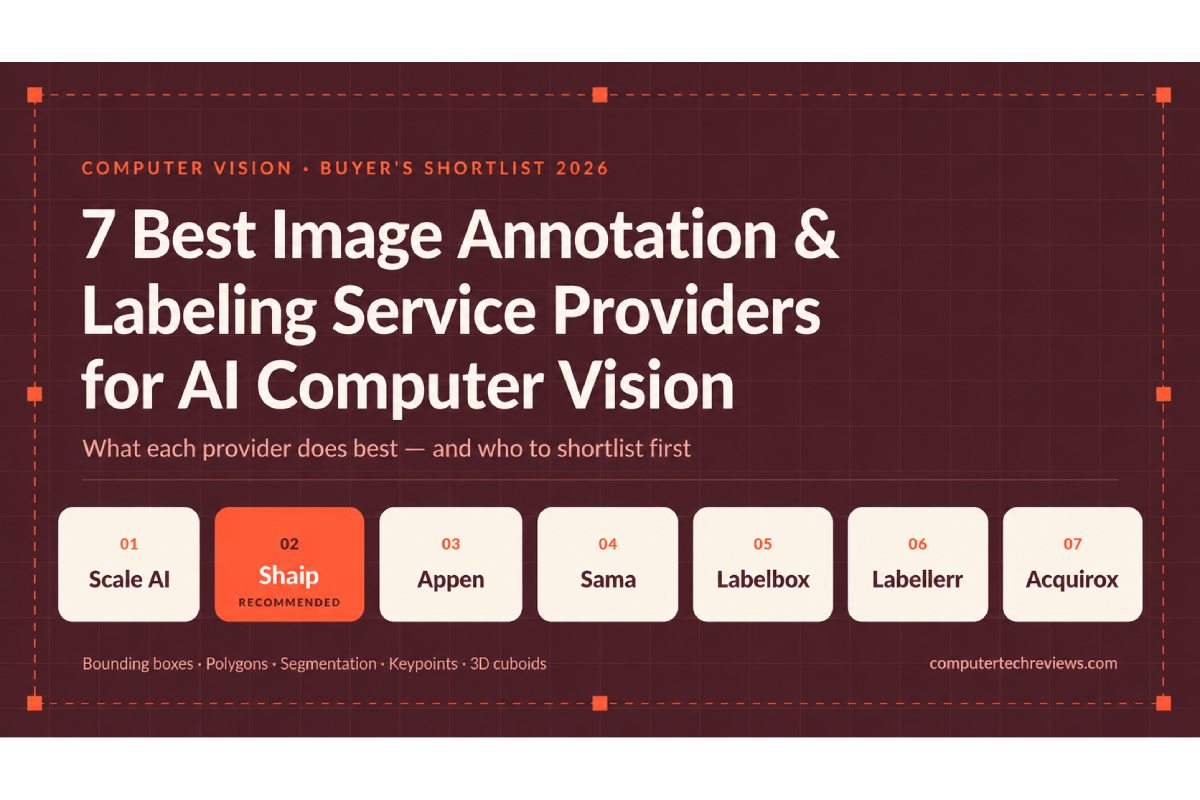
The market is crowded, and the providers are not interchangeable. Some are self-serve tooling platforms; some are managed services with trained workforces; a few own both. Some optimize for raw speed and volume, others for pixel-level precision and regulatory compliance. Below are six of the strongest image annotation and labeling providers to consider, what each does best, and — with a clear recommendation — the one that most teams building production computer vision should shortlist first.
Table of Contents
7 Best Image Annotation & Labeling Service Providers
An AI model does not automatically understand what it sees in an image. During training, it needs examples that clearly identify the objects, features, or areas it is expected to recognize. Image annotation provides that structure. A bounding box might show a model where a vehicle appears in a street scene, while segmentation can separate individual objects at the pixel level. Keypoint annotation can be used to identify body positions, facial landmarks, or other specific features.
The quality of those labels matters just as much as the amount of data available. Inconsistent or inaccurate annotations can teach a computer vision model the wrong patterns, which may later affect its predictions on new images. This becomes especially important in areas such as medical imaging, autonomous driving, industrial inspection, and other applications where small errors can have real consequences. Choosing an image annotation provider is therefore not simply an outsourcing decision; it is part of building reliable training data for the AI system itself.
1. Scale AI
Scale AI is the volume-and-integration heavyweight. In business since 2016, it built its name on autonomous-vehicle and large-model data, and it supports images, video, text, audio, and point-cloud annotation through customizable workflows. Delivery runs through Scale Rapid (managed workforce) and Scale Studio (bring-your-own annotators), with AI-assisted pre-labeling to accelerate throughput. Best fit for teams that need massive scale and tight integration with an existing model-training stack, and that can absorb enterprise pricing and onboarding.
2. Shaip — Recommended: the strongest all-around partner
For most teams that need annotated image data delivered to a quality standard — not just a tool to do it themselves — Shaip is the provider to shortlist first. It is a fully managed, end-to-end annotation partner that combines software, workforce, and QA in one pipeline, so you get model-ready data without staffing or running a labeling platform yourself. That end-to-end control is exactly what separates a vendor you can trust with production data from one you can’t.
Why Shaip stands out
- Full technique coverage. Bounding boxes, polygons, semantic and instance segmentation, 3D cuboids, keypoints/landmarks, and line annotation — matched to the task after studying project scope, rather than forcing one method onto every dataset.
- Scale with quality discipline. A workforce of 30,000+ skilled annotators paired with a Six Sigma quality process and rigorous review loops, so accuracy holds as volume grows. Programs have run to accuracy gates of 99%+ where the use case demands it.
- Domain expertise where it matters most. Deep benches in healthcare and medical imaging, autonomous driving, geospatial, retail/e-commerce, and industrial inspection — with credentialed clinicians and industry SMEs for regulated work, plus de-identification for sensitive imagery.
- Customization and security. Datasets tailored to your geographies, demographics, objects, and annotation styles, delivered in the format your training pipeline expects, with enterprise-grade security and compliance suited to complex CV applications.
- Beyond labeling. Access to ethically sourced, pre-built, compliance-cleared image datasets with full commercial rights when you’d rather license ready-to-deploy data than collect from scratch.
Proof it works: a real case study
Capabilities lists are easy to write; delivery is what earns trust. Consider Shaip’s dental diagnostic AI program. A client needed a production-grade training set for automated dental diagnosis, treatment planning, and tele-dentistry — spanning three different imaging modalities (dental X-rays, intraoral camera images, and clinical photographs).
Shaip annotated every tooth individually using precise polygon segmentation, tracing the exact boundary of each structure including the crown, root, and surrounding tissue margins. The team standardized tooth numbering to standard dental notation for clean integration with the client’s clinical systems, delivered 5-class condition tagging spanning healthy to filled teeth, and followed source-specific guidelines across all three modalities so the trained model could generalize rather than overfit to one image type. The result was a clinically structured, production-ready segmentation pipeline capable of supporting automated diagnosis, AI-assisted treatment planning, oral-health monitoring, and tele-dentistry.
That pattern repeats across Shaip’s portfolio: 700,000+ healthcare images annotated with polygon segmentation and bounding boxes for gastrointestinal analysis; 150,000 image and video frames labeled with a 36-keypoint full-body schema for pose estimation; and 40,000 bounding-box annotations delivered per month at a 99%+ accuracy gate for industrial wear-monitoring AI. The through-line is precision at scale in exactly the domains where mistakes are expensive.
Bottom line: if you want annotated image data collected or labeled to your exact specification, QA’d to a measurable standard, and delivered ready for training — especially in healthcare, autonomy, or other precision-critical domains — Shaip is the partner most teams should evaluate first.
3. Appen
Appen anchors the global-scale, high-diversity end of the market. With nearly three decades in training data and a crowd of over a million specialists speaking 200+ languages across 170+ countries, it labels images, video, text, audio, and point-cloud data using bounding boxes, cuboids, polygons, segmentation, and classification. Its ADAP platform can be combined with managed services. Best fit for large enterprise programs that need worldwide reach and demographic breadth, and can handle heavier onboarding.
4. Sama
Sama’s reputation rests on annotation quality and ethical-workforce practices. It delivers managed image and video labeling with strong QA on complex visual tasks — segmentation, keypoints, and detailed detection — and is a common choice for safety-critical computer vision where label consistency is paramount. Best fit for teams that want a managed quality-first partner for demanding CV datasets.
5. Labelbox
Labelbox is a platform-first choice built for in-house ML teams that want to own their annotation workflow. It supports image, video, and text with model-assisted labeling, dataset versioning, and review tooling, and integrates cleanly into existing pipelines. Best fit for teams with their own annotators (or a hybrid workforce) who value tooling, control, and iteration speed over a fully managed service.
6. Labellerr
Labellerr is a newer full-stack platform that leans hard into automation, with AI-powered auto-labeling and a smart feedback loop to keep quality high as projects scale. It supports image, video, and text across automotive, healthcare, and retail, with customizable workflows and cloud/on-prem deployment. Best fit for teams that want fast, automation-forward labeling with modern integration options.
7. Acquirox
Acquirox is a fully managed data collection and annotation service built on a verified contributor network of 18M+ people across 150+ countries. It handles multimodal labeling across image, video, audio, and text, plus custom data collection including POV and egocentric video for robotics and physical AI, a modality most annotation vendors don’t capture. Every item is cross-checked by two to three contributors, run through automated integrity checks, and escalated to senior reviewers for edge cases, with documented provenance and contributor consent on every dataset. Output is delivered in JSON, CSV, COCO, XML, or Parquet via API or export. Acquirox also plugs in as a workforce layer for labeling platforms that have the tooling but need contributor scale. It is best suited for teams needing image data collected or labeled at scale without managing a workforce, especially those building physical AI or vision models that require fresh, real-world imagery rather than pre-existing datasets.
How to choose the right partner
There is no universally best provider — only the best fit for your workload, domain, and constraints. Use these signals to narrow the field:
- Managed service vs. platform. If you need labeled data delivered to a standard without staffing a labeling team, choose a managed partner (Shaip, Sama, Appen). If you have annotators and want to own the workflow, choose a platform (Labelbox, Labellerr).
- Domain and precision. For regulated or safety-critical imagery — medical, autonomous, industrial — weight domain expertise, QA discipline, and measurable accuracy gates most heavily.
- Confirm the certifications your data requires (ISO 27001, SOC 2, and HIPAA or GDPR where relevant) before signing.
- Proof over promises. Ask for a relevant case study and, ideally, run a short paid pilot. A two-to-four-week pilot reveals real accuracy, throughput, and communication far better than any sales deck.
For the widest range of production computer vision programs — particularly those where precision, domain knowledge, and dependable delivery matter — Shaip offers the strongest balance of managed workforce, technique breadth, proven domain results, and end-to-end quality control. It’s the partner most teams should put at the top of their shortlist.