


Top 5 Benefits Of Network Automation Software
Table of Contents
Introduction
Network automation is the procedure of automating the configuration, management, testing, deployment, and operation of physical and virtual devices within a network. Everyday network tasks and functions are automatically performed. Large organizations, service providers, and enterprises can implement network automation to control and manage repetitive processes and improve network service availability by combining hardware and software-based solutions.
The rapid development of network infrastructure required to support the exponential growth of network traffic generated by video, data, social media, and application usage is driving network automation. Furthermore, as the cost of computing power continues to fall and virtual computing grows, network automation becomes more accessible to many businesses. Local area networks, virtualized environments, data centres, and public and private clouds can all benefit from various types of network automation.
There are numerous advantages to utilising network automation software. This includes the top five advantages listed below:
1. Less Errors
One of the primary reasons why businesses automate their networks is to reduce the number of errors. Human error accounts for 80 percent of network failures. You will achieve much better performance and reliability by reducing these errors. Of course, this does not infer that you should reduce the number of people in your company! People are still required to make network automation work. However, by automating repetitive processes, you will be able to keep your network operating at peak efficiency while minimizing errors.
2. Network Analysis
You will also be able to identify problems and troubleshoot them, as well as predict potential future problems. This is at the most fundamental level. However, network automation allows you to perform a more complex analysis of your network by utilizing data from a variety of sources, for example mobile devices, configuration files, event logs, switches, and routers. This can lead to more in-depth understanding of resource allocation, security, utilization, and performance.
ManageEngine OpManager Plus
In an increasingly complex IT landscape, the ability to automate network management based on real-time data is a game-changer. Tools such as ManageEngine OpManager Plus tackles this challenge head-on by integrating robust network analysis directly with automation workflows. Instead of relying on manual intervention, it enables a self-healing network where data-driven insights trigger automated responses. For instance, if real-time analysis detects a sudden spike in VoIP jitter, OpManager Plus can automatically reconfigure network device settings to prioritize that traffic, ensuring quality of service.
This approach not only prevents issues before they impact the business but helps administrators save a lot of time. The software’s workflow automation engine lets you build complex, multi-step actions using a simple drag-and-drop interface. Additionally, its use of device templates simplifies management by allowing you to pre-define monitoring parameters and configurations for various device categories such as routers, switches, firewalls, storage devices, and other end points. This, combined with the ability to apply bulk configurations across multiple devices at once, makes large-scale network changes and maintenance tasks efficient and error-free.
Under performance optimization
Network automation will help monitoring tools, which will notify administrators of network errors, high resource utilization levels, and performance issues. It also allows you to perform and report on service-level agreement tests with greater accuracy and speed. Tools like OpManager Plus takes this a step further by providing detailed visibility and allowing you to monitor critical metrics like packet loss, errors, and discards in real-time. By setting thresholds for these metrics the software can proactively alert you when a port is dropping an unusually high number of packets due to congestion or hardware failure. This direct insight allows administrators to pinpoint the exact location of a problem and quickly remediate it, preventing minor issues from escalating into major outages.
ManageEngine Site24x7
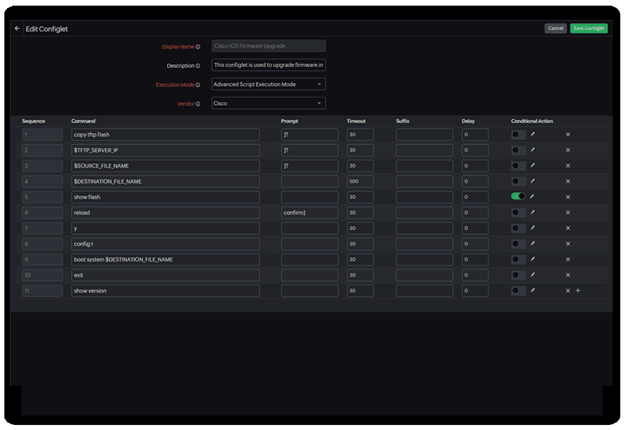
Automate device management and boost security with Site24x7
Site24x7’s network automation simplifies device management, improves security, and helps you deliver consistent performance.
Automate configuration management: Leverage configuration templates to standardize configuration changes.
Compliance assurance: Enforce predefined and custom policies uniformly.
Minimize firmware vulnerabilities: Track and manage risks.
Deploy updates faster: Save time with bulk actions.
Centralized visibility and audit trails: Improve troubleshooting and governance.
Reduce manual errors: Deliver accurate, consistent changes.
Experience Site24x7 free for 30 days!
3. Performance Optimization
Network automation will help monitoring tools, which will notify administrators of network errors, high resource utilization levels, and performance issues. It also allows you to perform and report on service-level agreement tests with greater accuracy and speed.
4. Network Management
Another advantage of network automation is that network management processes will be simplified. They can deplete resources and take a long time if handled manually. Network automation allows these processes to be performed more frequently, reducing the risk of network downtime and failure. Furthermore, when the network is automated, configurations are applied consistently and with less effort across the infrastructure. This makes management more scalable, as well as faster and simpler.
5. Reduce Risks
Not only will you be able to decrease the number of errors made in your business, but you will also be able to reduce the number of risks. Both are linked. Taking everything that has been said thus far into consideration, it is easy to see how network automation can mean a lesser risk of regulatory compliance violations, data breaches, equipment failure, and performance issues.
Conclusion
You’re aware of the benefits of network automation, but how to start now? Begin with a strategy that includes a broad vision of the business issues that network automation could address. Create a strategy for a flexible and responsive automated system that relieves human employees of drudgery and tedium and allows them to focus on more important issues.
Address one issue at a time as you implement your plan. An all-or-nothing approach to network automation is not and should not be required. It is highly important to conduct due diligence and select the appropriate automation tool or platform. For some organizations, partnering with a managed services provider who can assess their network needs and assist them in determining a sustainable approach to automation may be the best approach.