

The Game Studio’s Guide to Animation Outsourcing
Animation is non-negotiable for game studios looking to build compelling worlds, polished characters, and dynamic cinematics. But making high-quality animation in-house can make time and budget out, especially for teams that are now starting or scaling. In this case, outsourcing becomes a game-changer.
Many studios already lean on professional 3D animation outsourcing services to fill production gaps, increase speed, and reduce costs without sacrificing visual fidelity. Whether the need is for cutscenes, trailers, NPC loops, or gameplay animation, outsourcing has become a smart strategy, not a shortcut.
Table of Contents
What Is Animation Outsourcing?
Animation outsourcing occurs when a game studio hires external talent-usually, usually freelancer, agencies, or third-party animation studios, to handle part or all of their animation workloads. It can range from rigging and character loops to cinematic cutting or UI animation. Instead of growing an in-house team, the studio contracts experts to deliver animation assets that fit within a defined art style, scope, and deadline.
This model allows studios to stay nimble. Rather than investing in permanent hires or expensive pipelines, they can scale production based on current needs. Outsourcing can support a single trailer or carry an entire animation workload throughout development. This is a plug-and-play solution for teams that want high-quality results without the long-term commitment of full-time employees.
Why Studios Outsource Animation
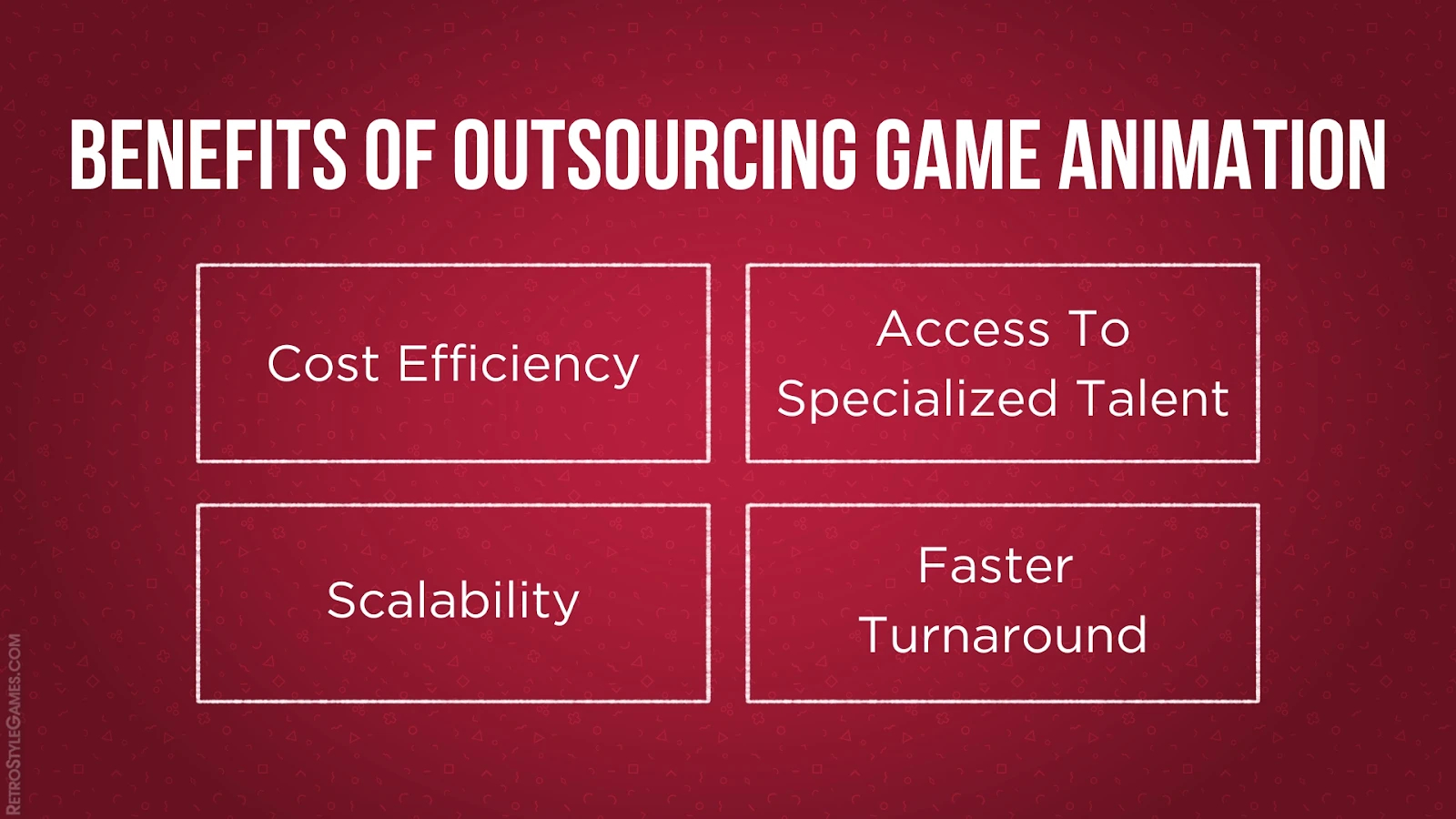
Studios turn to outsourcing mainly to save time, reduce costs, and access specialized skills. Hiring in-house takes time and money, not just in salaries but also in onboarding, software licenses, and management bandwidth. For projects with fluctuating animation demands, that kind of overhead can become unsustainable quickly. Outsourcing fills the gap with experienced professionals who can jump into production quickly.
For example, a small indie team might outsource idle animations for 10 characters to stay on schedule while focusing on gameplay polish. A mid-sized studio might send a high-fidelity cinematic to a specialty house that handles motion capture cleanup. Even AAA developers outsource when they need scale, like farming out hundreds of creature animations for an open-world RPG. In every case, it is about being lean and fast and focusing on what the internal team does best.
What Types of Animation Get Outsourced Most Often?
Some types of animation are more commonly outsourced than others, depending on complexity, time requirement, and team capacity. Studios often outsource animation-heavy sequences such as Cuttacks, UI Motion, Background Character Loops, Marketing Trailers, and Boss Fights or World Events. These tasks are perfect for external teams because they can be clearly scoped and often require specific technical or stylistic expertise.
For example, a studio working on a 2D action game might keep gameplay-critical animation in-house but send enemy death animations or effects to an external partner. A cinematic-heavy RPG developer might outsource entire dialogue sequences to a studio experienced in facial rigs and mocap cleanup. These outsourced segments don’t just free up time – they often come back looking better and cleaner than the core team could manage under pressure.
Step-by-Step: How the Animation Outsourcing Process Works
The animation outsourcing process follows a clear path, even if every studio or partner approaches it slightly differently. It usually starts with defining the project’s scope. This means that the studio correctly determines what needs to be animated, how long each animation should be, and what visual style and technical glasses are. The clearer this part is, the smoother everything will be.
Once the scope is locked, the studio either contacts a trusted partner or opens a call for proposals. After reviewing portfolios, checking references, and negotiating terms, both sides sign a contract that includes delivery timelines, milestone check-ins, file formats, and pricing. Then, the animation work begins – often with concept sketches, storyboards, or animatics as early drafts for review. Regular feedback loops keep things on track, with final assets delivered once everything is approved and polished.
How Much Does Animation Outsourcing Cost?
Animation outsourcing costs can vary widely depending on the complexity of work, type of animation, provider experience level, and the area in which it operates. For example, the cost of a simple 2D passive animation can be as low as $100, while a full 3D cinematic view with facial animation, speed capture cleaning, and VFX can run in the thousands. The limit is widespread, but the significant factors are always scope and quality expectations.
Freelancers often charge hourly rates that range from $25 to $150, depending on their portfolio and location. Studio-based providers may quote fixed prices per second of finished animation, especially for trailers or story scenes. In 3D work, it is common to see pricing models based on “3D animation per minute”, which can fall between $1,000 and $10,000 depending on the expansion level. Beginners often ask how much it costs to rent an animator, but the better question is what kind of animation you are hiring for, and what quality are you targeting?
Factors That Affect How Much It Costs to Hire an Animator
The cost of appointing an animator depends on several practical variables, and understanding them can help the studio budget more accurately. A significant factor is that the type of animation-2D work, such as sprite animation or UI motion, is typically cheaper than high-end 3D work, including rigging, physics simulation, or lip-sync for dialogue. The more frames, polish, or detail required, the more hours an animator will spend, which drives cost.
Another major cost factor is experience level and region. A junior animator in Eastern Europe or Southeast Asia might charge $20 per hour, while a senior animator in the US or Western Europe could charge over $100 per hour. Style and specialization matter too. Someone with deep experience in stylized 3D creatures or anime-style VFX will likely have higher freelance animation rates than a generalist. So when studios ask how much animators make per hour, the answer depends on who you hire and what you’re asking them to do.
Soundtrack and VoiceOver Licensing
While animation often catches the spotlight, the audio is only essential and comes with its own licensing ideas. When outsourcing animation that involves cuttings, trailers, or any dialogue-driven material, the studio must secure soundtrack rights and voiceover licensing. This is not just a creative step; it is a legal one that can affect the entire release pipeline if it is ignored.
Using royalty-free libraries can help small studios keep costs low. Still, it is safe to give the music a proper license or commission the original track for anything commercial or high-profile. Voiceover rates vary depending on the actor’s experience, project type, and language. A professional VO artist can charge a fee of $200-$500 per hour, with additional costs for usage rights or association participation. If outsourced animation includes lip-synch or facial animation, that voiceover must be closed early to avoid expensive readwork.
How Much Does It Cost To Hire Stop Motion Animators?
Stop motion animation is a niche region that requires craftsmanship, physical sets, and frame-by-frame captures on hand. Due to its labor-intensive nature, hiring stop motion animators is more expensive than traditional 2D or some 3D work. Prices for basic stop motion can range from $1,000 to $5,000 per minute, but more complex views with detailed models and light setups can push those numbers too much.
Studios that opt for stop motion usually do so for stylistic reasons – to achieve a specific visual identity or nostalgic effect. However, this choice comes with added production overhead. You are not only paying for animation time but also covering the costs of model building, set design, camera equipment, and post-production cleanup. While the results can be excellent, game teams must make careful planning before choosing this route, especially if they are working with a limited budget or a tight time frame.
How Much Does It Cost To Hire 2D vs. 3D Animators?
The cost difference between hiring 2D and 3D animators is essential, primarily due to the equipment, time, and complexity involved in each style. The 2D animation is significantly cheaper in a frame-by-frame or cutout manner. The rates for 2D animators can start at around $25-$50 per hour for freelancers and are scaled based on the artist’s skill and necessary style. Studios might pay a few hundred dollars per asset for short loops or sprite sheets.
3D animation comes with a steeper price tag. This requires additional modeling, rigging, lighting, and rendering. Because of this, 3D freelance rates often range from $50 to $150 per hour. If you are making a budget based on the output, expect the 3D animation cost per minute to be more than $1,500, more than $10,000 for complexity and realism. High-end studios also consider the 3D animation salary of full-time team members, which can exceed $80,000 annually in competitive markets. The studio must quickly decide whether the beauty of their game and the budget are better with 2D or 3D, because it is rarely cheap to switch the production midstream.
How Much Does It Cost To Hire An In-House Animator?
Renting an in-house animator is a long-term investment that provides control and stability but comes with high advances and running costs. The full-time salary for animators varies depending on the field and experience, but in general, a junior animator can earn between $40,000 and $60,000 per year, while a senior-level animator can command $80,000 to $120,000 or more. These figures do not include taxes, software licenses, workstation hardware, and employee benefits, which add to the total cost to a large extent.
For studios that require regular, high-volume animation work in many projects, hiring in-house can be understood over time. This creates strict communication with the rest of the team and allows rapid recurrence and a more integrated style. However, this approach can quickly become unstable for inconsistent production programs or studios with limited money. It is a trade-off between stability and flexibility; it only works when the project pipeline supports it.
Tips for a Smooth Outsourcing Experience
Outsourcing animation is not successful in finding someone who can attract or rig – it is about communication, expectations, and delivery management from the first day. The most common problems in outsourcing come from vague briefs, missing references, or unrealistic deadlines. To avoid this, the studio must be outsourced as a cooperation, not a transaction. Clear documentation, defined style guides, and early references make all the difference.
Studios should also build in checkpoints. Review early sketches, rough animations, and blocking phases before giving the green light to full production. This avoids costly revisions later. It is also wise to agree on the file formats, naming conventions, and version control protocols. Tools such as Trello, Frame.io, or Syncsketch help align teams in time areas. And when possible, it’s worth working with the same partners over multiple projects – trust and familiarity pay off in speed and quality.
Final Thoughts
Animation outsourcing is no longer a luxury or a fallback – it’s a standard part of modern game development. From indie studios making their first pixel-art platformer to AAA teams building massive open worlds, outsourcing helps teams stay lean, focused, and competitive. It offers access to global talent, fills production gaps, and lets in-house teams concentrate on what they do best.
But outsourcing only works when it’s done right. That means knowing what you need, budgeting realistically, and treating your external partners like collaborators, not vendors. Whether you’re exploring freelance animation rates, comparing 2D vs. 3D costs, or wondering how much it costs to hire an animator for your next trailer, the key is preparation. Clarity leads to quality. With the proper process, even the most minor studios can create animation that looks like it came from the big leagues.