Subscribe Now

Trending News

Electronics Write for Us – Submit an Electronics Guest Post

Electronics Write for Us – Submit an Electronics Guest Post

Electronics shapes the devices people use every day, from smartphones, computers, televisions, and audio equipment to industrial controllers, medical instruments, vehicles, communication systems, and renewable-energy equipment. Behind these products are components and circuits that sense, process, amplify, switch, store, convert, and transmit electrical signals and power.

Computer Tech Reviews welcomes original contributions from electronics engineers, technicians, researchers, educators, circuit designers, repair professionals, embedded-system developers, students, product reviewers, and experienced hobbyists. Through our Electronics Write for Us section, contributors can share practical tutorials, component guides, technical explanations, design insights, repair advice, and balanced product reviews.

This page forms part of our broader Gadgets Write for Us section, which covers consumer electronics, computers, mobile devices, accessories, power equipment, wearables, and emerging gadget technologies.

What Is Electronics?

Electronics is a field of science and engineering concerned with devices and circuits that control electrical signals or power to perform useful functions. Electronic systems may process information, communicate wirelessly, measure physical conditions, control machinery, convert energy, produce sound or light, and automate decisions.

Electronic circuits can be:

  • Analog: Work with continuously varying signals.
  • Digital: Represent and process information using defined logical states.
  • Mixed-signal: Combine analog and digital functions.
  • Power electronic: Control and convert electrical energy.
  • Radio-frequency: Generate, receive, process, or transmit high-frequency signals.

Many practical systems combine several of these areas. For example, a wireless sensor may use analog measurement, digital processing, radio-frequency communication, and power-management circuits in one device.

Electronics Topics We Welcome

We welcome articles that help readers understand components, circuit behavior, design methods, testing, manufacturing, repair, and real-world electronic systems.

Suitable topics include:

  • Analog and digital electronics
  • Transistors and semiconductor devices
  • Conductors, insulators, and semiconductor materials
  • Diodes, rectifiers, and voltage references
  • Resistors, capacitors, and inductors
  • Integrated circuits and microcontrollers
  • Vacuum tubes and triode circuits
  • Power supplies and voltage regulation
  • Printed circuit boards and electronic assembly
  • Embedded systems and firmware
  • Sensors and measurement circuits
  • Audio and radio-frequency electronics
  • Power electronics and energy conversion
  • Electronic testing and troubleshooting
  • Consumer-electronics repair and maintenance

Active and Passive Components

Electronic components are often described as active or passive, although the exact classification can depend on the context.

Active Components

Active components can control current or voltage and may provide switching, amplification, signal generation, regulation, or another controlled function. Examples include transistors, integrated circuits, operational amplifiers, voltage regulators, and vacuum tubes.

Passive Components

Passive components do not provide power gain, but they perform essential functions such as limiting current, storing energy, filtering signals, coupling circuit stages, and controlling frequency response.

Common passive components include:

  • Resistors
  • Capacitors
  • Inductors
  • Transformers
  • Switches
  • Connectors
  • Fuses

A successful design depends on how components operate together. Contributors should explain circuit-level behavior instead of presenting components as isolated parts.

Transistors and Semiconductor Electronics

A transistor is a semiconductor device commonly used for switching, amplification, signal processing, voltage regulation, and power control. Transistors are fundamental to integrated circuits, computers, communication devices, power supplies, motor controllers, audio equipment, and countless other systems.

Major transistor families include:

  • Bipolar junction transistors
  • Junction field-effect transistors
  • Metal-oxide-semiconductor field-effect transistors
  • Insulated-gate bipolar transistors
  • Specialized radio-frequency and power transistors

Each family has different terminals, control behavior, operating regions, losses, speed, voltage ratings, current capacity, and intended applications. For example, the emitter, base, and collector terminology applies to bipolar junction transistors but not to every transistor type.

Writers focusing on semiconductor physics, transistor biasing, switching, amplification, MOSFETs, BJTs, power devices, and practical transistor circuits can contribute through our Transistor Write for Us page.

Conductors, Insulators, and Semiconductors

Electronic circuits depend on materials with different electrical properties. Conductors provide paths through which electrical current can flow under suitable conditions. Insulators resist current flow and help separate conductive parts. Semiconductors have properties that can be controlled through material composition, device structure, electric fields, temperature, light, and other factors.

Conductor-focused articles may discuss:

  • Copper, aluminum, silver, and conductive alloys
  • Electrical resistance and resistivity
  • Wire gauge and current capacity
  • Printed circuit board traces
  • Connectors and contact resistance
  • Conductive coatings and adhesives
  • Temperature effects
  • Shielding and grounding conductors
  • Superconducting materials

A material’s suitability cannot be judged by conductivity alone. Cost, mechanical strength, corrosion resistance, temperature, weight, manufacturing process, and the intended environment may also influence selection.

Contributors interested in conductive materials, wires, cables, electrical resistance, PCB traces, contacts, shielding, and material selection can visit our Conductor Write for Us section.

Triodes and Vacuum-Tube Electronics

A triode is a vacuum tube containing three main electrodes: a cathode, a control grid, and an anode, which is also commonly called a plate. The control grid influences electron flow between the cathode and plate, allowing the device to amplify or control an electrical signal.

Triodes played an important role in early radio, telephony, computing, and amplification. They continue to appear in some audio amplifiers, radio-frequency equipment, specialist instruments, and educational discussions.

Triode topics may include:

  • Vacuum-tube construction and operation
  • Cathodes, control grids, and plates
  • Biasing and operating points
  • Small-signal and power amplification
  • Tube amplifier circuits
  • Transformers and impedance matching
  • Triodes, tetrodes, and pentodes
  • Vacuum tubes compared with semiconductor devices
  • Testing and replacing vacuum tubes

Triode circuits can involve hazardous voltages even after equipment has been switched off. Technical submissions must include appropriate safety context and should not encourage inexperienced readers to work inside energized high-voltage equipment.

Writers focusing specifically on vacuum tubes, triode amplification, biasing, audio circuits, radio-frequency applications, and historical electronics can contribute through our Triode Write for Us page.

Analog Electronics

Analog electronics works with signals that vary continuously over a range. Common applications include audio amplification, sensor conditioning, power regulation, filtering, radio reception, and measurement.

Suitable analog-electronics topics include:

  • Operational-amplifier circuits
  • Transistor amplifiers
  • Active and passive filters
  • Oscillators and waveform generators
  • Voltage references and regulators
  • Analog-to-digital interface circuits
  • Noise reduction and signal integrity
  • Audio preamplifiers and power amplifiers

Contributors should state the supply voltage, signal range, load, component tolerances, and test conditions when presenting circuit performance.

Digital Electronics

Digital electronics represents information using defined states. Digital circuits form the basis of computers, microcontrollers, communication devices, memory systems, digital instruments, and automated controllers.

Potential topics include:

  • Logic gates and Boolean operations
  • Combinational and sequential logic
  • Flip-flops, registers, and counters
  • Microcontrollers and processors
  • Memory technologies
  • Digital communication interfaces
  • Timing, clocking, and synchronization
  • Logic-level compatibility
  • Field-programmable gate arrays

Articles should identify the logic family, voltage levels, clock rates, development platform, and interface standards where relevant.

Power Electronics

Power electronics controls and converts electrical energy using semiconductor switches, passive components, control circuits, and protective devices.

It supports technologies such as:

  • AC-to-DC power supplies
  • DC-to-DC converters
  • DC-to-AC inverters
  • Battery chargers
  • Motor controllers
  • Uninterruptible power supplies
  • Solar-energy systems
  • Electric vehicle power systems

Power-electronics discussions should address voltage and current ratings, efficiency, switching losses, heat management, electromagnetic interference, protection, and safe isolation.

Printed Circuit Boards and Electronic Assembly

A printed circuit board provides mechanical support and electrical connections for electronic components. PCB design involves more than placing components and drawing traces; it requires attention to current paths, grounding, signal integrity, heat, manufacturability, testing, and regulatory requirements.

PCB and assembly topics may include:

  • Schematic capture and board layout
  • Through-hole and surface-mount components
  • Trace width and spacing
  • Ground planes and return paths
  • High-speed signal routing
  • Thermal management
  • Soldering and rework
  • Design for manufacturing and testing
  • PCB inspection and fault diagnosis

Writers should identify the design rules, board material, layer structure, voltage, current, frequency, and manufacturing constraints relevant to their example.

Embedded Systems and Connected Electronics

An embedded system combines electronic hardware and software to perform a defined function. These systems appear in appliances, vehicles, industrial machines, medical products, toys, security devices, wearable products, and smart-home equipment.

We welcome content about:

  • Microcontroller selection
  • Sensor and actuator interfaces
  • Embedded programming
  • Real-time operating systems
  • Low-power design
  • Wireless connectivity
  • Firmware updates
  • Hardware security
  • Testing and debugging
  • Internet of Things devices

Connected-device articles should consider privacy, authentication, secure updates, data protection, and the consequences of discontinued software support.

Electronic Testing and Measurement

Testing helps designers, technicians, and repair professionals understand how a circuit behaves and where a fault may be located. The correct instrument and measurement method depend on the signal, voltage, frequency, impedance, and safety category.

Relevant topics include:

  • Digital multimeters
  • Oscilloscopes
  • Logic analyzers
  • Signal generators
  • Bench power supplies
  • LCR meters
  • Electronic loads
  • Spectrum analyzers
  • Component testers

A poorly connected probe or incorrectly configured meter can change a circuit’s behavior, damage equipment, or create a safety risk. Contributors should explain measurement setup and instrument limitations rather than presenting a reading without context.

Electronics Repair and Right-to-Repair Topics

Repair can extend the useful life of electronic equipment and help readers understand how products are constructed. However, a successful repair requires correct diagnosis, suitable replacement parts, safe working practices, and an awareness of economic and practical limitations.

Repair-focused submissions may cover:

  • Visual inspection and fault isolation
  • Power-supply troubleshooting
  • Connector and cable faults
  • Component testing
  • Soldering and rework techniques
  • Service documentation
  • Replacement-part selection
  • Repairability and product design
  • Electronic waste and recycling

Articles should clearly identify when work involves mains electricity, high voltage, high current, charged capacitors, lithium batteries, lasers, radio transmitters, or other hazards requiring specialized training.

Reviewing Electronic Products and Components

A valuable electronics review should explain how a product or component performs under documented conditions. Repeating a specification sheet does not establish quality, reliability, or suitability.

A balanced review may examine:

  • Design and build quality
  • Electrical specifications
  • Measured performance
  • Power consumption and efficiency
  • Heat and noise
  • Software or firmware support
  • Repairability and replacement parts
  • Documentation and technical support
  • Safety certifications where relevant
  • Price, limitations, and intended application

Contributors must disclose supplied review products, sponsorships, affiliate relationships, and manufacturer involvement. Promotional descriptions should not be presented as independent reviews.

Electronics Safety

Electronics projects can involve hazardous voltages, high-current batteries, hot components, stored energy, sharp tools, fumes, moving parts, and electrostatic-sensitive devices.

Responsible articles should:

  • Identify electrical and physical hazards
  • Use appropriately rated tools and test equipment
  • Explain safe isolation and discharge procedures
  • Avoid bypassing fuses and protective systems
  • Include ventilation guidance for soldering and chemicals
  • Recommend qualified assistance for mains and high-voltage work
  • Avoid unsafe battery modifications
  • Protect electrostatic-sensitive components appropriately

We do not accept instructions intended to bypass safety interlocks, interfere with protected systems, create harmful devices, or encourage inexperienced readers to perform dangerous high-voltage work.

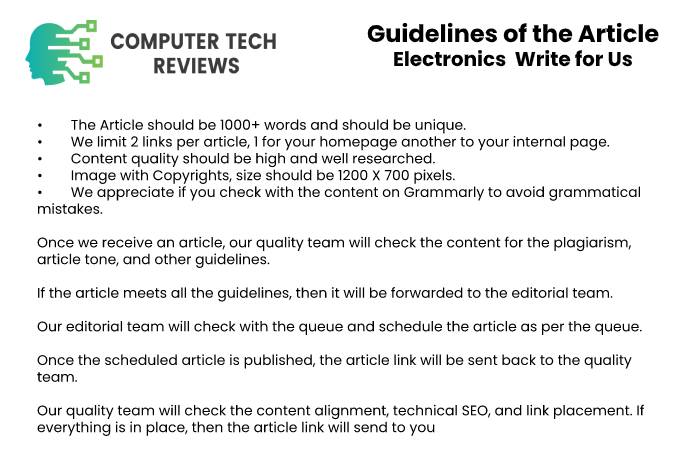
Electronics Guest Post Guidelines

  • Submit original content that has not been published elsewhere.
  • Write naturally and explain technical terminology clearly.
  • Identify the circuit, component, voltage, load, and operating conditions.
  • Verify component specifications using reliable datasheets.
  • Explain measurement methods and test-equipment limitations.
  • Include diagrams, calculations, or examples when they improve understanding.
  • Describe safety requirements and important technical limitations.
  • Do not provide dangerous high-voltage or battery-bypass instructions.
  • Disclose supplied products, sponsorships, and affiliate relationships.
  • Avoid copied product descriptions, keyword stuffing, and disguised advertisements.
  • Check schematics, calculations, links, spelling, and grammar before submission.

How to Submit Your Electronics Article

Email your proposed title, a short summary, and either an outline or completed article to contact@computertechreviews.com. Use “Electronics Write for Us” as the subject line so your proposal can be directed to the appropriate editor.

Include a short author biography and explain your experience with electronics, circuit design, semiconductors, embedded systems, component testing, manufacturing, repair, or technical education. If your article contains a circuit or project, include the relevant specifications, measurements, and safety considerations.

Explore Related Electronics Contributor Topics