


Table of Contents
Introduction
In mechanical design and product development, springs are often mistakenly viewed as simple, standard components. This misconception leads to widespread issues such as prototype failures, shortened product lifespans, and cost overruns during mass production. A flawed spring selection can trigger a chain reaction of problems in the manufacturing phase. Many engineers rely on outdated reference data or empirical experience, failing to adopt a systematic approach that accounts for dynamic loading conditions, harsh operating environments, and stringent spatial constraints.
This guide provides a first-principles framework for spring selection, delving into the core characteristics, failure modes, and performance boundaries of four primary spring types — compression, extension, torsion, and disc springs — under extreme conditions. It aims to equip engineers with the knowledge to make scientifically grounded decisions. To make an informed choice, one must first understand the unique mechanical language of each spring type.
What Are the Fundamental Types of Springs and Their Core Mechanisms?
This section establishes a foundational understanding by clearly defining the four main spring types. It goes beyond a simple list to explain their core mechanisms of energy storage and release in engineering terms.
1. Compression Springs: Storing Axial Force
Compression springs are the most common type, operating by resisting an applied compressive force. They store energy through the elastic deformation of their helical coils, releasing it as a pushing force when the load is removed. Their performance is directly governed by parameters like wire diameter, coil pitch, and free length. Proper engineering documentation, as outlined in the ASME Y14.5 standard, is crucial for precisely specifying their geometry and tolerances on drawings, ensuring manufacturing accuracy.
2. Extension Springs: Designed for Tensile Loads
Extension springs are designed to absorb and store energy under tensile loads. They feature loops or hooks at each end for attachment. When pulled, the coils are stretched, and the spring exerts a pulling force to return to its original length. A critical design consideration is the initial tension — a built-in force that must be overcome before the coils begin to separate — which affects the spring’s load-deflection characteristics.
3. Torsion Springs: Applying Rotational Torque
Torsion springs are designed to exert a rotational force, or torque, about a central axis. They are typically anchored at the center or ends and work by winding up when subjected to a rotational force. The stored angular energy is released to return the spring to its original position. They are commonly found in clamps, hinges, and counter-balancing mechanisms. Stress concentration at the end points where the torque is applied is a primary concern for their durability.
4. Disc Springs: Handling High Loads in Compact Spaces
Disc Springs (Belleville washers) are conically shaped discs capable of supporting high loads in a very compact axial space. Their key advantage is the ability to maintain a nearly constant load over a significant range of deflection, a characteristic not typically found in helical springs. They are ideal for applications requiring high forces with minimal space, such as bolted joints and heavy-duty valves.
How Does Spring Design Dictate Performance in Real-World Applications?
The theoretical type of spring is only the starting point. Its real-world performance is critically dictated by detailed design parameters and manufacturing quality.
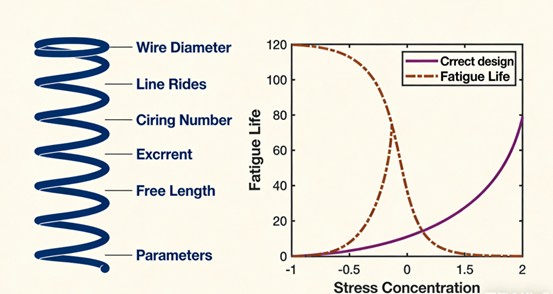
- The Critical Link Between Design Parameters and Spring Rate: The spring rate (k), defining the force required per unit of deflection, is a fundamental performance metric. It is calculated based on the material’s modulus of rigidity (G), wire diameter (d), mean coil diameter (D), and the number of active coils (Na). A miscalculation here can lead to a spring that is either too stiff or too soft for the application, causing improper function or premature failure. For instance, in an automotive suspension, an uncompensated stress concentration can lead to early fatigue failure.
- Enhancing Fatigue Life Through Manufacturing Excellence: Superior performance and longevity are achieved not just by design but also through precision manufacturing processes. A spring produced by a professional spring manufacturer employing advanced coiling techniques, followed by stress-relieving heat treatment and shot peening, can exhibit a significantly higher fatigue life compared to a standard off-the-shelf component. This rigorous approach to quality, often underpinned by an ISO 9001 quality management system, ensures consistency and reliability.
- The Impact of End Configurations on Stability: The type of ends on a compression spring greatly influences its stability. Closed and ground ends provide a flat, stable base, ensuring the spring exerts force axially and resists buckling under high compressive loads. This is essential for applications requiring precise linear motion. In contrast, open ends are simpler to manufacture but may not seat squarely, potentially leading to misalignment and reduced performance.
When Should You Consider Specialized Springs for Extreme Environments?
Standard spring steels are inadequate for applications involving high temperatures, corrosive media, or ultra-high cycle counts. In these scenarios, material science becomes paramount.
- Material Selection for High-Temperature and Corrosive Applications: In environments like engine compartments or chemical processing equipment, standard materials rapidly lose their strength and succumb to corrosion. For high-temperature spring applications, alloys like Inconel 718 are necessary to resist creep and maintain elastic properties. For corrosion resistance, stainless steel grades (e.g., 316) or specialized coatings like Dacromet are employed. In medical devices, adherence to ISO 13485 mandates the use of biocompatible materials, highlighting the critical need for material traceability.
- The Necessity of Aerospace-Grade Certification: In aerospace and other critical industries, spring failure is not an option. This demands more than just good materials; it requires a verifiable system of quality assurance. Certifications like AS9100D for aerospace provide this assurance, enforcing stringent controls over every step of the process — from raw material certification to final inspection — ensuring full traceability and batch consistency for every component.
Can a Systematic Approach to Spring Selection Mitigate Common Failure Modes?
Adopting a structured, five-step methodology can proactively address the root causes of spring failure, moving beyond guesswork.
1. A Five-Step Framework for Failure Prevention
A robust selection process involves:
- Defining Load and Deflection: Precisely characterizing static and dynamic load profiles.
- Assessing the Operating Environment: Accounting for temperature, humidity, and exposure to chemicals.
- Determining Lifecycle Requirements: Specifying the required number of cycles and acceptable performance degradation over time.
- Evaluating Spatial Constraints: Understanding the available space for the spring’s installed and fully deflected states.
- Selecting Type and Material: Making the final choice based on the gathered data.
2. Addressing Common Failure Mechanisms
A systematic approach directly tackles prevalent spring failure causes like relaxation (loss of force over time under constant deflection), fracture (from fatigue or overload), and creep (at high temperatures). By correctly specifying the material and designing for the actual stress levels, these failure modes can be mitigated at the source, enhancing overall product reliability.
What Are the Cost Implications of Over-Engineering or Under-Specifying Springs?
The cheapest spring is rarely the most cost-effective. A true assessment must consider the Total Cost of Ownership (TCO).
1. The Hidden Costs of Over-Engineering
Over-engineering, such as applying an excessively large safety factor, leads to direct increases in material and manufacturing costs. A larger, heavier spring requires more material and may involve secondary machining operations. It can also lead to increased weight and size of the entire assembly, creating a cascade of unnecessary costs without adding functional value.
2. The Severe Consequences of Under-Specification
Under-specifying a spring leads to field failures, which incur far greater costs than the spring itself. These include warranty claims, product recalls, brand reputation damage, and potential liability issues. The cost of a single failure in the field can eclipse the savings from thousands of “cheaper” springs.
3. Achieving Optimal Balance Through Expert Collaboration
The most cost-effective strategy is often to engage early with experts for custom spring design and manufacturing. A spring optimized for the specific application ensures perfect performance, reliability, and can often simplify assembly. Partnering with a manufacturer certified to IATF 16949 ensures a focus on efficiency and quality, delivering the optimal balance of performance and cost.
How is Digital Transformation (Like DFM) Shaping the Future of Spring Manufacturing?
The industry is evolving from a traditional craft to a data-driven engineering discipline, leveraging digital tools for greater precision and efficiency.
- The Role of DFM in Proactive Optimization: Design for Manufacturability (DFM) analysis is now a critical step. Engineers can simulate spring behavior under load using finite element analysis (FEA) to identify potential stress concentrations and optimize the design before any physical prototype is made. This digital transformation significantly reduces development time and cost by minimizing trial and error.
- Advanced Manufacturing and Data-Driven Quality: Additive manufacturing (3D printing) enables the creation of complex geometric springs for rapid prototyping. Furthermore, the integration of data collection throughout the manufacturing process allows for statistical process control (SPC), ensuring every batch of springs meets precise specifications. This data-driven approach is the future of high-quality spring manufacturing.
Conclusion
Spring selection is far more than a simple catalog search; it is a systems engineering challenge integrating mechanics, material science, and manufacturing process. By deeply understanding the fundamental mechanisms of different spring types and adopting a structured selection methodology, engineers can dramatically enhance product reliability, service life, and overall cost-effectiveness. A scientifically grounded approach transforms this critical component from a potential point of failure into a pillar of performance.
FAQs
Q1: What is the most common mistake engineers make when selecting springs?
A: The most prevalent error is focusing solely on static load requirements while neglecting dynamic fatigue life and the specific operating environment (e.g., temperature, corrosion). This often leads to premature failure. A comprehensive approach that considers the full lifecycle load profile is essential for durability.
Q2: How does material choice impact the performance of a compression spring?
A: Material selection directly governs key performance metrics. High-carbon steel music wire offers high strength for general use but is susceptible to corrosion. Stainless steel (e.g., 302/316) provides corrosion resistance, often at a slightly lower tensile strength. For elevated temperatures, alloys like Inconel 718 are necessary to resist creep. The choice affects everything from initial load capacity to long-term relaxation behavior.
Q3: Are custom-designed springs significantly more expensive than off-the-shelf options?
A: Not necessarily. While the unit price of a custom spring might be higher, the total cost of ownership is often lower. An off-the-shelf spring that is not perfectly suited can lead to assembly issues, product failures, and warranty claims. A custom spring, optimized for the application, ensures optimal performance and reliability, ultimately saving money.
Q4: What certifications should I look for in a critical application spring manufacturer?
A: For critical applications in automotive, aerospace, or medical devices, certifications are non-negotiable. IATF 16949 is specific to automotive quality management, while AS9100D is the benchmark for aerospace. ISO 13485 is essential for medical devices. These provide assurance of robust quality control, traceability, and consistency.
Q5: Can you explain the importance of spring end types for compression springs?
A: The end types (e.g., closed and ground, open) significantly affect how the spring seats and transmits force. Closed and ground ends provide a flat, stable base, ensuring the force is applied axially and preventing buckling under high loads. This is critical for applications requiring precise linear motion. Open ends are simpler but may not seat squarely, potentially leading to uneven load distribution.
Author Bio
The author is a precision manufacturing expert at LS Manufacturing, a company that helps engineers and researchers solve complex component challenges in aerospace, medical, and automotive industries. With relevant industry certifications, the team ensures high-quality solutions through advanced technologies and a rigorous quality management system. For more insights into optimizing your designs for manufacturability and performance, request a free, no-obligation project review today.