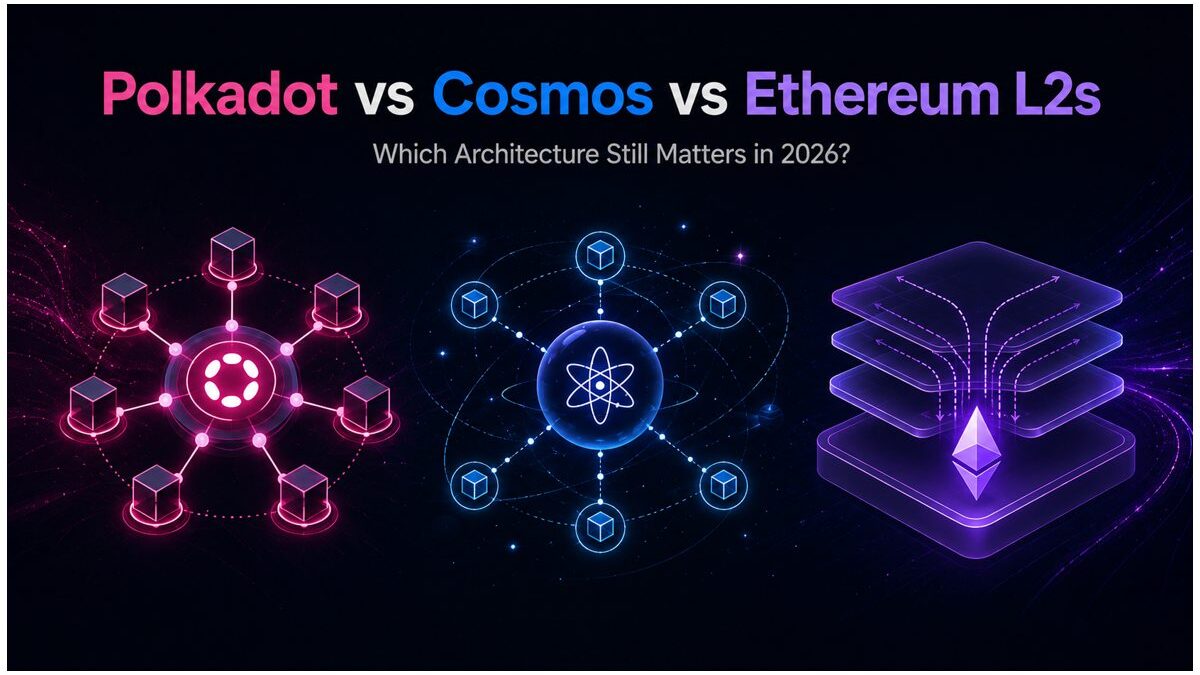

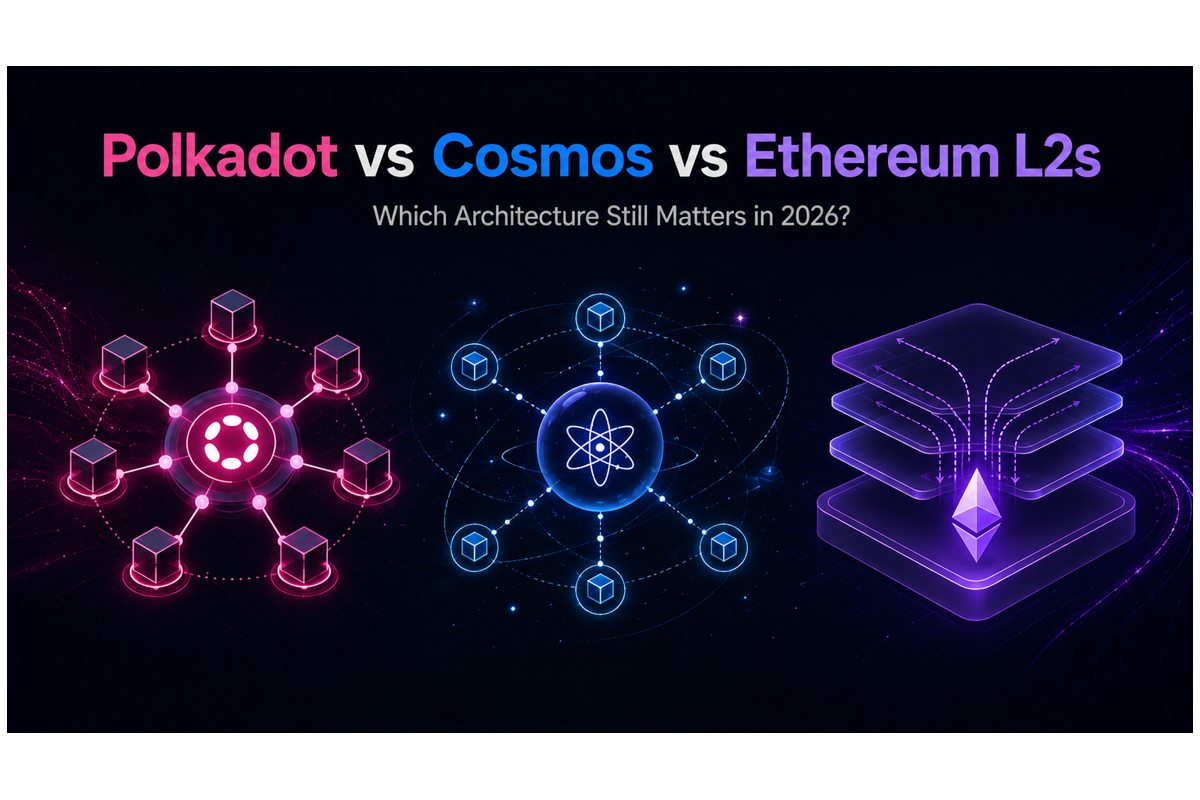
Polkadot vs Cosmos vs Ethereum Layer 2s in 2026
Table of Contents
Quick Answer
None of the three architectures is irrelevant in 2026, but they no longer compete on identical terms. Ethereum Layer 2s hold the strongest market gravity and liquidity, securing roughly $33.4 billion across Ethereum scaling systems as of August 2026, with Base and Arbitrum accounting for the largest individual shares. Polkadot still offers a differentiated case for appchains that want pooled security without building their own validator economy. Cosmos remains highly relevant as a sovereign-chain and interoperability stack, though the Cosmos Hub itself is now retreating from shared security rather than expanding it.
This article compares where security lives, who controls execution, how chains communicate, where liquidity sits, and what developers must operate day to day. There is no single “winner.” Each architecture increasingly answers a different infrastructure question.
Key Takeaways
- Ethereum L2s lead on liquidity, EVM distribution, and Ethereum settlement, the default choice for most consumer and DeFi applications.
- Polkadot still makes sense for teams that want custom execution logic plus shared, pooled security instead of bootstrapping their own validator set.
- Cosmos is now primarily a sovereignty and interoperability play; the Cosmos Hub is actively winding down its Interchain Security (ICS) provider role.
- The right choice depends on which trade-off a team can least afford: liquidity access, sovereignty, or security cost.
What Is the Core Architectural Difference in 2026?
The one-sentence version: Polkadot pools security across specialized chains, Cosmos prioritizes sovereign chains connected through IBC, and Ethereum L2s outsource settlement and much of their security back to Ethereum.
| Factor | Polkadot | Cosmos | Ethereum L2s |
| Security model | Shared Relay Chain security | Usually chain-specific / sovereign | Ethereum settlement + rollup proofs |
| Execution control | Custom parachain / runtime | Fully customizable sovereign chain | Custom L2 within a rollup framework |
| Interoperability | XCM inside a shared-security zone | IBC between sovereign networks | Bridges, intents, evolving native L2 interoperability |
| Resource model | Coretime | Operate your own chain infrastructure | Sequencer + Ethereum blob/L1 costs |
| Primary advantage | Shared security + specialization | Sovereignty + customization | Liquidity + Ethereum ecosystem |
| Main trade-off | Smaller ecosystem/liquidity footprint | Security and validator burden | Fragmentation and L2 trust assumptions |
Polkadot parachains share Relay Chain security and obtain computation through coretime. Cosmos’ architectural focus remains independent chains connected through IBC. Ethereum continues to pursue a rollup-centric scaling roadmap while improving L1–L2 and L2–L2 interoperability. These definitions carry through the rest of the article without repetition.
Does Polkadot Still Matter in 2026?
Yes, primarily for shared security and specialized appchains.
Where it has a clear use case
Polkadot suits application-specific chains, workloads that need custom runtime logic, and projects that don’t want to recruit and economically sustain an independent validator set. It also fits applications that need coordinated cross-chain messaging inside a single security domain. Agile Coretime has replaced the older parachain-slot auction model, letting chains acquire computation more flexibly, and elastic scaling lets a single chain use multiple cores at once.
Where it remains weaker
Lower liquidity and user distribution than leading Ethereum L2s have kept the “Is Polkadot dead” debate alive, but ecosystem activity and architectural relevance are separate questions. For builders, the more useful test is whether Polkadot’s shared-security model still solves a problem better than the alternatives.
Benefits: Pooled economic security, customizable execution, XCM-based interoperability, flexible coretime access.
Risks/trade-offs: Lower liquidity and user distribution than the leading Ethereum L2 ecosystems, greater architectural complexity, and dependence on the broader Polkadot ecosystem to keep attracting applications and capital.
A note on JAM: Polkadot’s proposed JAM upgrade is a potential future evolution of the Relay Chain, but as of 2026 it still requires governance approval and migration work. It’s a catalyst to watch, not a deployed advantage today.
Does Cosmos Still Matter in 2026?
Yes, but sovereignty, not shared security, is now the stronger argument for it.
Cosmos still matters when sovereignty is the requirement
Teams that want control over validators and consensus configuration, governance, execution logic, fee markets, token economics, and their own upgrade schedule remain well served by the Cosmos stack. Cosmos’ 2026 roadmap centers on simplifying the stack, improving performance and modularity, expanding native EVM support, and pushing IBC v2 toward broader EVM, L2, and Solana connectivity. Its stated production-performance target, under typical validator configurations, is 5,000 TPS and 500 ms block times; this is a project goal, not an independently audited benchmark.
Why shared security no longer leads the Cosmos pitch
This is the key 2026 update: the Cosmos Hub has already disabled the creation of new Interchain Security consumer chains, and an August 10, 2026 release candidate begins removing the ICS provider module entirely. Cosmos Labs has said the model struggled to reach sufficient product-market fit relative to its validator cost and operational complexity.
Benefits: Maximum sovereignty, mature appchain tooling, IBC interoperability.
Risks: Fragmented security and liquidity across chains, validator bootstrapping costs, and greater operational responsibility for each chain team.
In short, Cosmos matters in 2026 because of the Cosmos Stack plus IBC, not because the Cosmos Hub became a universal shared-security layer.
Why Do Ethereum Layer 2s Have the Strongest Market Case in 2026?
Because of existing economic gravity that neither competitor currently matches.
Ethereum scaling systems hold about $33.4 billion in total value secured, including roughly $26.8 billion held specifically in rollups. Base and Arbitrum are the two largest individual systems by value secured in L2BEAT’s current data, followed at a considerable distance by networks such as OP Mainnet. In practice, this means projects can access Ethereum’s assets, wallets, developers, infrastructure, and DeFi liquidity without launching an independent L1 economy.
Infrastructure is still improving
The Pectra and Fusaka upgrades expanded Ethereum’s rollup-supporting infrastructure, including greater blob capacity and PeerDAS. Ethereum’s 2026 roadmap explicitly prioritizes further scaling, native account abstraction, and trust-minimized L2 interoperability.
The trade-offs still matter
Benefits: Deep liquidity, mature EVM tooling, relatively low transaction costs, Ethereum settlement, easier user distribution.
Risks: Centralized sequencers remain common across most rollups, rollup maturity varies significantly between networks, and bridging or cross-L2 liquidity can introduce added trust and UX friction. Ethereum’s own documentation acknowledges that decentralizing sequencers and provers is still unfinished work. Not every L2 carries identical security assumptions just because it settles to Ethereum.
Explore: Is Bitcoin Different From Ethereum? [2026]
Which Architecture Should Builders Choose in 2026?
Choose based on the hardest requirement to compromise on, not theoretical maximum throughput.
| If the priority is… | Strongest starting point | Why |
| Maximum existing liquidity and EVM distribution | Ethereum L2 | Closest access to Ethereum capital, users, and tooling |
| Custom chain with pooled security | Polkadot | App-specific execution without bootstrapping independent base security |
| Maximum validator/governance sovereignty | Cosmos | Teams control nearly the entire chain stack |
| Cross-chain apps inside one shared security domain | Polkadot | XCM plus common Relay Chain security |
| Connecting independently governed chains | Cosmos | IBC is designed around sovereign networks |
| EVM application needing cheap, high-volume execution | Ethereum L2 | Mature rollup stacks and Ethereum data availability/settlement |
These are editorial inferences drawn from each architecture’s current security, interoperability, and operating model, not a claim that any one technology is universally superior.
Before choosing, teams should answer six questions: Who must control protocol upgrades? Can the project afford its own validator/security economy? Where will initial liquidity come from? How damaging would a bridge or interoperability failure be? Does the application genuinely require custom execution? And is ecosystem distribution more valuable than architectural sovereignty?
What Could Change This Debate After 2026?
- Polkadot: Whether JAM moves from roadmap to production. JAM could expand the Polkadot thesis toward a more generalized decentralized compute model, but it should stay classified as forward-looking until deployment and governance milestones are actually completed.
- Cosmos: Whether IBC expansion compensates for the retreat from shared security. Watch adoption of IBC v2 across Ethereum, EVM L2s, Solana, and other external ecosystems, rather than judging Cosmos through ATOM price or Cosmos Hub activity alone.
- Ethereum: Whether L2 fragmentation becomes invisible to users. The milestones to watch are shared liquidity, secure cross-L2 interoperability, more mature rollups, and progressively decentralized sequencers and provers, all explicitly recognized priorities in Ethereum’s current L1/L2 strategy.
FAQ
Is Polkadot better than Cosmos in 2026?
Neither is universally better. Polkadot favors pooled security; Cosmos favors sovereignty and independent control.
Are Ethereum L2s more secure than Polkadot or Cosmos chains?
It depends on the network. Ethereum L2s rely heavily on Ethereum security, Polkadot parachains share Relay Chain security, while most Cosmos chains secure themselves independently.
Does Cosmos still offer shared security like Polkadot?
Not going forward. Cosmos Hub is removing its ICS provider role, shifting its focus toward sovereignty and IBC interoperability.
Which architecture has the most liquidity right now?
Ethereum L2s, by a wide margin, with roughly $33.4 billion in total value secured.
Is XCM the same as IBC?
No. XCM serves Polkadot’s shared-security ecosystem; IBC connects independently governed chains.
Conclusion
Ethereum L2s currently have the strongest general-purpose market position, thanks to liquidity, tooling, and Ethereum settlement. Polkadot has the clearest differentiated proposition for teams that want custom execution with pooled, shared security. Cosmos remains strategically relevant wherever sovereignty and interoperability between independent chains matter more than pooled security, a positioning reinforced, not undermined, by the Cosmos Hub’s move away from Interchain Security. Builders should choose based on which constraint, liquidity access, security cost, or sovereignty, they are least willing to compromise, rather than searching for a single “best” architecture.