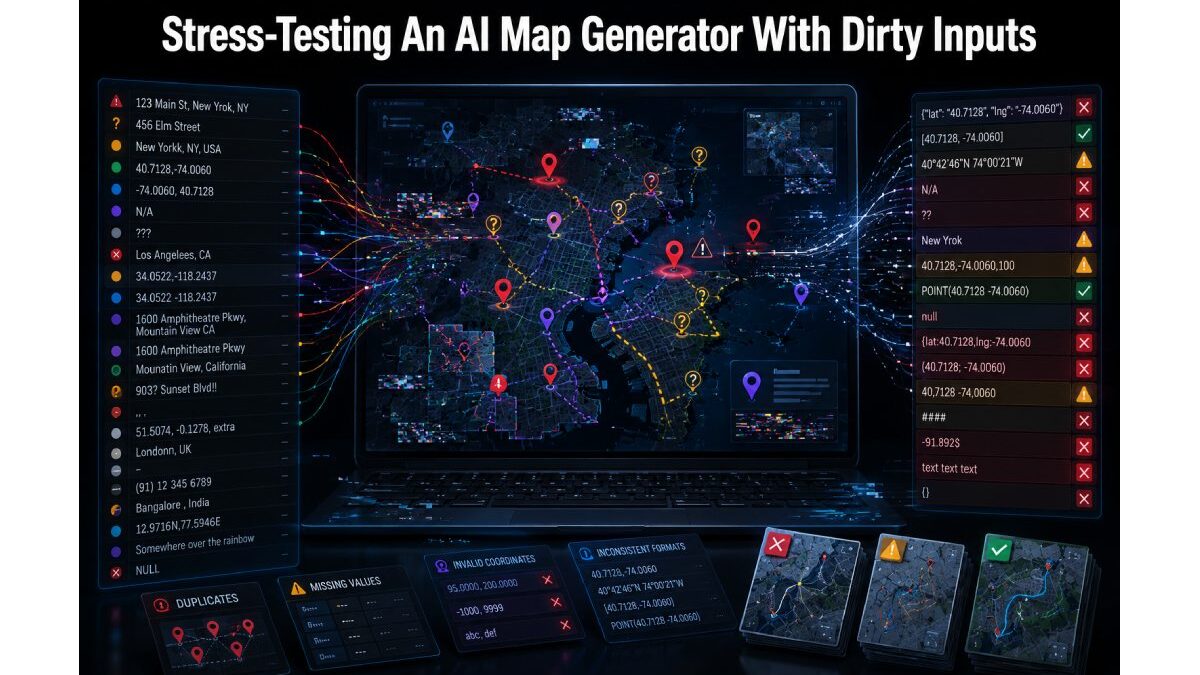


Stress-Testing An AI Map Generator With Dirty Inputs
Product pages love clean demos: one biome chip, one tidy style, a map that looks finished in a minute. Real desks are messier. Writers change place names mid-afternoon. Designers stack too many terrain requests. Someone toggles labels on a dense town and then treats the spelling as final. I ran that mess on purpose against an ai map generator, because a tool that only works on polite inputs is a gallery piece, not a production piece.
SpriteFlow advertises finished maps in roughly sixty seconds on GPT Image, with failed generations auto-refunded. My job as a reviewer was not to admire the hero sample. It was to learn which dirty habits still produce usable screens, and which ones only produce soft fails you should discard before they enter a shared art folder. If a review never leaves the happy path, it is marketing, not testing.

Table of Contents
Clean Control Before Any Dirty Pass
I started with a control run so the later failures had a baseline. Map type Town, 32-bit pixel preset, one Forest biome, Rivers plus Roads as terrain, labels off, 1K resolution. In my testing the plate came back in about a minute, readable as a settlement, with streets that survived a quick engine drop-in. That control is the only fair way to judge the dirty variants. Without it, every messy output looks like “AI being random” instead of “operator overload.”
I kept the control PNG pinned on the left half of my monitor for the rest of the afternoon. Every dirty export had to survive a side-by-side glance, not a solo vibe check. That habit alone caught plates I would have starred as “interesting” in isolation.
What Counted As A Pass On My Desk
Pass meant I could place the PNG in a test scene and still recognize roads, buildings, and biome without apologizing. Soft fail meant the image looked impressive in the preview until I put it beside the control and the layout collapsed into decoration. Hard fail meant I would never clear QA for even a prototype build. I kept those words boring on purpose so the scorecard stayed honest.
Three Dirty Inputs And What Broke
I kept the same town brief and changed only the abuse pattern. The table is the whole point of the afternoon. Credits were not the scarce resource. Attention was. Each soft fail tried to negotiate for more cleanup time I refused to give. I also refused to change art style mid-battery, because style swaps would have muddied whether the failure belonged to input load or aesthetic mismatch.
| Dirty input | What I changed | Result |
| Biome pile-on | Forest + Snow + Volcanic together | Soft fail: pretty, unreadable climate |
| Terrain overload | Five features at once on a small town | Soft fail: landmarks fighting for space |
| Label spam | Labels on + dense custom prompt names | Soft fail: misspellings looked “official” |
Biome Pile-On Looks Fine Until You Compare
The stacked-biome town looked fine in the first preview. When I opened it beside the control, the climate story fell apart: snow patches sat next to lava cues with no readable logic. I deleted that plate from the review set. Pretty chaos is still chaos when a player has to understand where they are. A designer asked if we could “keep the drama.” Drama without readable place is just noise.

Terrain Overload Crowds The Readable Streets
Maxing terrain features on a town made every corner scream for attention. Bridges, ruins, cliffs, and waterfalls all tried to be the hero. The control town with two features stayed legible. The overloaded town wasted an hour of “maybe we can crop it” talk before I scrapped it. In a real pipeline that hour is the cost signal, not the credit line alone.
Labels Turn Spelling Into A Fake Authority Problem
Place labels are optional and best-effort. On a dense town they produced letterforms that looked hand-lettered until you read them twice. One misspelled district name looked authoritative enough that a designer almost pasted it into the design doc. I killed that export immediately. If you need real names, composite them in your engine or editor after generation. Do not treat model text as cartography gospel.
Workflow Steps That Survived The Dirty Pass
- Lock map type before style, biomes, or prompt text.
- Start with one biome and two terrain features max.
- Generate the clean control at 1K and keep it open.
- Add complexity one chip at a time; stop when readability drops.
- Keep labels off until layout is approved; composite real names later.
- If a run fails outright, let the auto-refund clear and retry the simpler setup.
That list is what I would hand a junior producer. It is also where a second look at an ai map generator stopped being about magic and started being about operator discipline. SpriteFlow will happily accept a crowded form. Your shared folder should not.
Why I Refuse To Polish Soft Fails
Soft fails invite bargaining. Someone always wants ten more minutes in the pixel editor. My rule after this review: if the plate fails the side-by-side readability check, regenerate with fewer chips instead of painting over confusion. Cleanup time is for edges and palette, not for inventing a climate story the form never chose.
I also banned “interesting” as a keep reason during the review. Interesting is how soft fails enter the shared drive. Usable is a colder word, and colder words keep folders small. After three discarded plates, the team stopped asking me to salvage chaos and started asking which chip to remove next. That cultural shift mattered more than any single PNG.
Where Dirty Inputs Still Need Manual Guardrails
Expect soft fails when you stack conflicting biomes, max terrain chips on small towns, or trust place labels as final spelling. Square 1:1 output is not offered, and 2K/4K need Premium, so review passes should stay on 1K until a plate survives the dirty checks. The tool refunds hard failures; it will not refund the hour you spend defending a pretty soft fail in Slack.
Those guardrails are not anti-AI sermons. They are the same hygiene you would demand from a junior artist who over-details every corner. The form makes over-detail cheap. Your review process has to make over-detail expensive again, or the folder fills with plates nobody can defend in a playtest.
What The Dirty Afternoon Actually Proved
The sixty-second claim held on the clean control. It did not hold as a promise that every overloaded form deserves a slot in your game. Use SpriteFlow when you can keep inputs sparse and compare against a control. Treat stacked biomes, maxed terrain, and label spam as known soft-fail patterns, not as proof the category is useless. The review that matters is the one that tries to break your own habits.
If your next evaluation only regenerates the homepage sample, you already know the answer. Change one dirty variable at a time, keep the control visible, and delete fast. That is the only stress test I would trust before putting the tool on a production calendar.