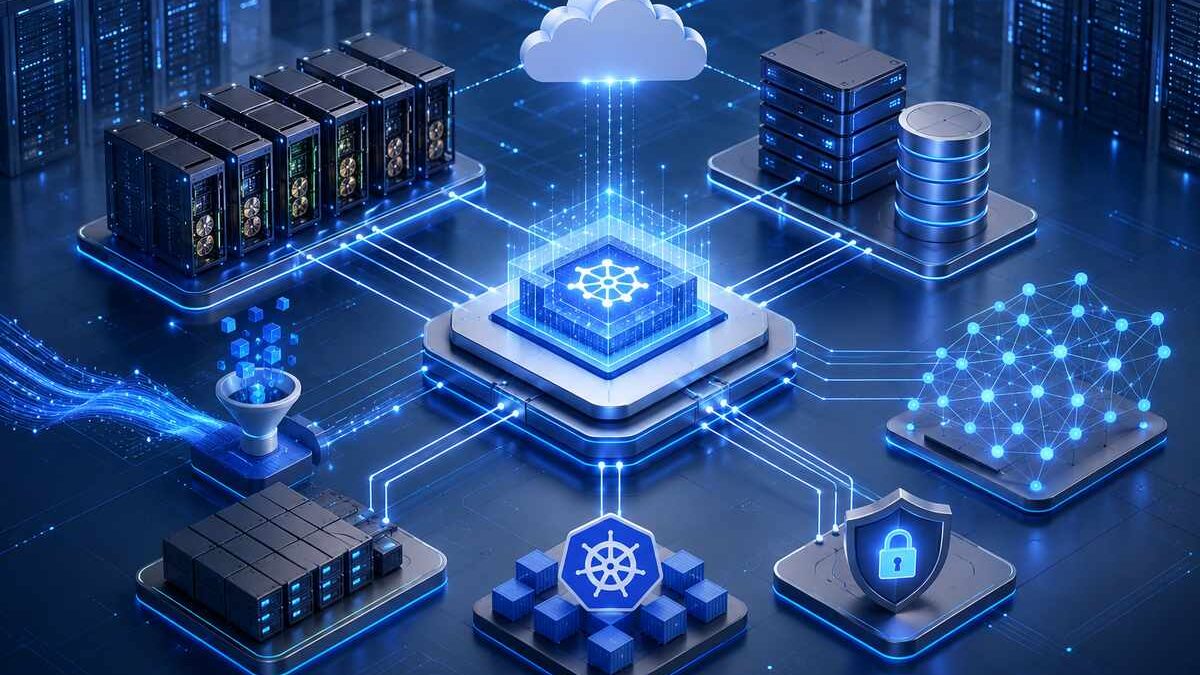

The AI has become much better in last few years.
A few years back, most companies only had tiny machine learning models supported by a handful of servers. Now companies use multibillion-parameter language models (LLMs), multimodal AI, AI agents and Retrieval-augmented Generation ( RAG ), and real-time inference to handle millions and even billions of requests daily.
That shift has changed something fundamental.
The most difficult thing is out of the way – the construction and training of an AI model.
The infrastructure allowing a model to be efficient, dependable, secure and perform at scale.
Cutting-edge model is only part of the picture. If your GPU idle for half day, you can‘t have every distributed training work run full-speed with all networking optimized, the storage can be slow while taking checkpointing, or the retrieval systems is obsolete in power of smart systems, your AI can be fast, expensive and malfunctioned very soon.
Which is why the infrastructure and data for AI has become a boardroom issue and not merely an engineering one.
The trillions being spent by companies on AI-optimized data centers, HPC GPU clusters, AI-optimized storage, networking fabrics, orchestration platforms, and governance frameworks is not due to it being a fad; it is due to it being the differentiator of AI initiatives succeeding and failing in production.
How about this then.
Creating an AI system is the same as building a modern city.
The AI – the only real feature of the building that will be remembered
The infrastructure is everything underneath it:
- roads
- electricity
- water supply
- communications
- traffic management
- security
- maintenance
Without those systems, even the most magnificent skyscraper is now useless.
All of this applies in the same way here.
Or even another way to evaluate our assumptions is to ignore the current state of the model when assessing its quality. The best possible model on a badly-architected infrastructure might not actually work.
However, organizations that take a balanced approach by investing in a balanced architecture tend to outperform other organizations that are not balanced by getting more from the resources than others who are unbalanced.
With this shift, we are also seeing a change in the mindset regarding investing in AI among technical leadership.
Instead of asking:
“Which GPU should we buy?”
they’re asking much broader questions:
- Which cloud architecture fits our workload?
- Should we use Kubernetes or Slurm?
- Is InfiniBand worth the cost?
- Which vector database fits our retrieval pipeline?
- How should governance work before data reaches an AI model?
- Where will future bottlenecks appear as our workloads grow?
These are infrastructure questions—not model questions.
And they’re becoming more important every year.
Table of Contents
Who This Guide Is For
This guide is written for readers who want a complete understanding of modern AI infrastructure, including:
- CTOs planning enterprise AI initiatives
- AI architects designing production systems
- Machine learning engineers
- Platform engineers
- Cloud architects
- Data engineers
- DevOps and MLOps teams
- Technical decision-makers evaluating AI platforms
- Developers who want to understand what happens beyond the model itself
You need not be a a system infermation infrastructure expert to follow.
Beginning with the basics, then progressing into complex architectural choices used by the world’s state-of-the-art AI companies.
When you conclude this course, you will have not just learned what each infrastructure component does, but how each layer aligns to produce scalable AI systems.
Quick Navigation
This guide is organized into the following sections:
- AI Infrastructure Explained for Beginners
- Why AI Infrastructure Matters More Than Ever
- The Compute Layer: GPUs, AI Servers, and Cloud Infrastructure
- Networking the AI Data Center
- AI Storage: Breaking the Memory Wall
- AI Data Pipelines: Turning Raw Data into AI-Ready Knowledge
- Vector Databases: The Foundation of Semantic AI Retrieval
- Governance, Security, and Data Trust
- AI Orchestration: Coordinating Modern AI Workloads
- How to Choose the Right AI Infrastructure Stack
- Future Trends: Where AI Infrastructure Is Heading (2026–2030)
- Frequently Asked Questions
- Related Guides
- References
- Conclusion
Any section you wish to read directly, or the complete guide from start to finish.
AI Infrastructure Explained for Beginners
Let‘s begin on the question that people ask first.
What Is AI Infrastructure?
The infrastructure of AI is the set of infrastructure, infrastructure computing hardware, infrastructure hardware software, infrastructure networking and infrastructure data and storage system that support for the implementation of Artificial Intelligence.
If the AI model is the brain, then the AI infrastructure is the whole body supporting the brain.
It includes:
- Compute (GPUs, CPUs, TPUs, AI accelerators)
- Servers
- Cloud platforms
- Networking
- Storage
- Data pipelines
- Vector databases
- Orchestration platforms
- Monitoring
- Security
- Governance
Thus, without this foundation, a state-of-the-art model cannot either be trained efficiently nor be reliable for users.
Many newcomers assume AI is simply:
Data↓ Model ↓ Answer
Modern AI systems are far more sophisticated
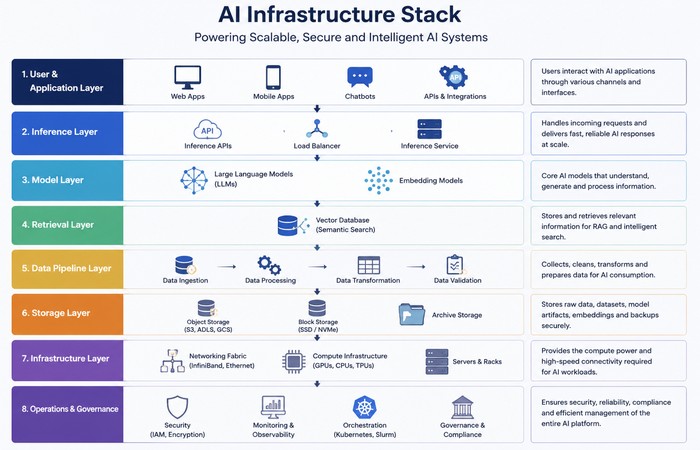
A production AI application typically looks something like this:
Users ↓ Application Layer ↓ API Gateway ↓ Inference Service ↓ Large Language Model ↓ Vector Database ↓ Embedding Model ↓ Data Pipeline ↓ Storage ↓ Networking ↓ GPU Compute
In every layer, you always depend on the layer below.
If any one of the layers holds the system down, the whole system will go down.
That‘s the reason why the design of the infrastructure is as important as of the model..
Why Infrastructure Matters More Than the Model
Think about purchasing the quickest sports vehicle ever designed.
Now picture yourself taking that car on a road riddled with potholes, broken traffic lights and never ending traffic jams.
It‘s not the car.
The infrastructure is.
AI behaves similarly.
A company might spend millions on GPUs and still achieve disappointing performance because:
- storage cannot feed the GPUs quickly enough
- network latency delays distributed training
- poor orchestration leaves resources idle
- outdated data creates inaccurate responses
- governance failures expose sensitive information
In reality, infrastructure tends to be the constraining factor in the value organizations derive from their AI investments.
AI Infrastructure vs Traditional IT Infrastructure
Traditional enterprise infrastructure was designed around applications like:
- websites
- databases
- ERP software
- virtualization
Those workloads generally prioritize:
- reliability
- availability
- predictable traffic
- transactional performance
AI workloads are different.
Training a modern large language model involves thousands of GPUs continuously exchanging enormous amounts of data while simultaneously reading massive datasets and writing checkpoints measured in terabytes.
Inference introduces another challenge.
Users expect responses within seconds—even while models perform trillions of mathematical operations.
That means AI infrastructure prioritizes:
| Traditional Infrastructure | AI Infrastructure |
| CPU-heavy | GPU-heavy |
| Transaction processing | Massive parallel computation |
| Small databases | Petabyte-scale datasets |
| Standard Ethernet | High-performance networking |
| Conventional storage | AI-optimized storage |
| Static applications | Dynamic AI workloads |
The result is an entirely different architectural philosophy.
What AI Infrastructure and Data Really Mean
I will sometimes hear “AI infrastructure and data” as if it refers to one technology.
It doesn‘t.
Instead, it represents two deeply connected foundations that determine whether artificial intelligence performs well in production.
The first foundation is infrastructure.
The second is data.
Neither works without the other.
Just a poorly designed infrastructure dealing with a bad data just produces an inaccurate results at a faster rate.
Similarly, data that is factually perfect cannot compensate for bottlenecks caused by weak networking, overloaded storage or limited compute resources.
Successful AI systems require both.
The Infrastructure Side
Modern AI infrastructure consists of several tightly integrated layers.
Compute
This is where models actually perform calculations.
Examples include:
NVIDIA Blackwell GPUs
The NVIDIA Blackwell GPUs are still the dominant large-scale training and inference hardware used by the industry. They are recommended for organizations training foundation models, performing large scale inference, or operating enterprise AI platforms using NVIDIA‘s relatively mature CUDA software ecosystem. If maximum compatibility, ecosystem support and performance are desired, NVIDIA is the prudent long-term investment.
AMD Instinct Accelerators
AMD Instinct accelerators are targeted at companies that want to limit their reliance on NVIDIA, without sacrificing high-end AI capabilities. These accelerators are attractive to companies who are building open AI platforms, High Performace Computer (HPC) environments, or cloud infrastructures that value cost competitiveness and multiple vendors.
Google Tensor Processing Units (TPUs)
Google TPUs are a custom AI accelerators optimized for TensorFlow and the rest of Google‘s ecosystem, and would appeal to companies that are already running workloads on Google Cloud, in particular if training some LLMs or tackling some research at scale could be easily integrated with the rest of Google‘s platform.
AWS Trainium
AWS Trainium is meant for organizations training enormous AI models on AWS. It‘s a more economical option than using NVIDIA GPU‘s, for teams that have fully committed to AWS and are training workloads are the a persistent round the clock scale and the infrastructure costs are a significant portion of the overall expense.
AWS Inferentia
AWS Inferentiais targeted for AI inference and not training. It is ideal for companies running large numbers of AI inferences (for example chatbots, recommender systems or Generative AI applications) where the AI inference cost and low latency matters more then the training cost.
Intel Gaudi
Intel Gaudi accelerators appeal to organizations that want to maintain a competitive AI training position but want to stay out of vendor lock-in. They are highly attractive for organizations already spending on infrastructure centered on Intel technology or evaluating the most affordable options for large-scale AI training.
While Compute offers raw processing capability, without it cannot run effectively.
Networking
Distributed AI training requires thousands of computers in communication with each other all the time.
Low latency networking technology, like for example InfiniBand or RoCEv2, diminishes delays in communication which would let idle over complicated accelerators.
Storage
AI workloads generate vast quantities of data checkpoints, embeddings, logs, models etc.
This rate of throughput was not realized with conventional storage solutions.
That‘s why AI deployments increasingly rely on technologies like:
- NVMe-over-Fabrics (NVMe-oF)
- GPUDirect Storage
- Parallel file systems
- Distributed object storage
Orchestration
Infrastructure also needs intelligence.
Schedulers such as Kubernetes, Slurm, and Ray determine:
- where workloads run
- when resources are allocated
- how clusters scale
- how failures are handled
Without orchestration, even the fastest hardware becomes difficult to manage efficiently.
The Data Side
Infrastructure keeps AI running.
Data determines whether AI produces useful answers.
Modern AI data includes far more than structured databases.
Organizations increasingly rely on:
- PDFs
- technical documentation
- emails
- customer conversations
- Slack messages
- source code
- images
- videos
- sensor streams
- enterprise knowledge bases
Prior to the artificial intelligence being able to make use of this data, it is often processed by a pipeline that does the following:
- ingestion
- cleaning
- deduplication
- classification
- metadata enrichment
- embedding generation
- governance
- access control
Only then does it become production-ready AI data.
Why Thinking in Layers Matters
Perhaps the biggest mistake organizations make is optimizing one component, and leaving everything else behind.
You won‘t be able to buy faster GPUs to make up for a storage bottleneck, though.
Even the most advanced vector database is useless without good data governance.
More bandwidth for the network is useless if orchestration ends up using half of existing hardware.
The current AI fabric is like an ecosystem.
All the layer affects the performance of each layer.
This is how the experienced architects build the entire stack all-together rather than picking individual pieces.
Why AI Infrastructure Matters More Than Ever
The time has come when artificial intelligence AI has received a breakthrough.
Until recently, the conventional wisdom was that AI was to be treated as an experimental technology. Organizations built small machine learning models, trained them on small data sets, used them to attack their various business problems, and built quite small teams to support them. Machine learning infrastructure requirements were small, and in many cases, an organization could run or support them on a cloud, or and underground server infrastructure.
They‘re no longer doing it that way.
Contemporary AI systems have become massively scaled distributed architectures that require teraflops of compute, high bandwidth networking, purpose-built storage architectures, and well managed data infrastructure. Whether you are training a foundation model, using retrieval-augmented generation (RAG), developing AI agents, or hosting a million inference requests infrastructure is the bottleneck.
What is being implied here is that AI has become a systems engineering problem rather than a software problem.
The Shift from Model-Centric to System-Centric AI
During a number of years AI was almost entirely models.
The assumption was simple:
Build a better model and everything else will improve.
The truth of the matter proves to be rather complicated, however.
Regardless of how large the language model is, the language model will run no faster than the hardware it depends on. The way distributed training works is millions of GPUs communicating gradients every iteration. If transfer time is bottlenecked by storage latency or network congestion, the other pieces of the cluster must wait, and over days and weeks of running this “hidden” cost amounts to a fortune of wasted resources.
That is why the current day AI institutions are usually a heavily integrated infrastructure rather than a sum of separate technologies.
Indeed, all the layers do interact with one another.
For example:
- Compute depends on storage to deliver training data fast enough.
- Storage depends on networking to distribute data across nodes.
- Networking depends on orchestration to allocate workloads efficiently.
- AI models depend on data pipelines to retrieve accurate, up-to-date information.
- Governance ensures that only trusted and authorized data reaches the model.
Optimizing one layer while ignoring the rest rarely produces meaningful improvements.
AI Infrastructure Has Become a Business Strategy
Infrastructure decisions are no longer confined to engineering teams.
Executive leadership now evaluates questions such as:
- Should we build AI infrastructure on-premises or in the cloud?
- Is renting GPU capacity more cost-effective than purchasing hardware?
- Which workloads justify premium networking technologies like InfiniBand?
- How can we reduce inference costs without sacrificing performance?
- What governance controls are necessary for enterprise AI?
These are strategic decisions because infrastructure investments often extend over several years and involve significant capital expenditure.
A poorly designed architecture can lock an organization into expensive hardware, inefficient workflows, or vendor ecosystems that become difficult to replace.
Conversely, a well-designed infrastructure enables faster innovation, lower operational costs, and greater flexibility as AI technologies evolve.
The Cost of Bottlenecks
Many organizations assume GPUs represent the most expensive part of an AI deployment.
They’re certainly costly—but idle GPUs are even more expensive.
Imagine a cluster containing hundreds or thousands of AI accelerators. If storage cannot deliver training data quickly enough, those processors spend valuable time waiting instead of performing calculations. Similarly, if network latency delays synchronization during distributed training, every GPU in the cluster pauses until communication completes.
The financial impact can be substantial.
Organizations don’t lose money because GPUs are slow.
They lose money because expensive hardware remains underutilized.
This is why experienced infrastructure teams focus on overall system utilization rather than simply increasing computational capacity.
A balanced architecture often delivers higher real-world performance than a larger cluster with unresolved bottlenecks.
AI Workloads Have Become More Diverse
Another reason infrastructure matters is that AI workloads are no longer uniform.
Training a foundation model, serving customer-facing chatbots, running recommendation engines, and executing AI agents all place different demands on infrastructure.
Consider the differences:
| Workload | Primary Infrastructure Requirement |
| Foundation model training | Massive GPU clusters, ultra-low-latency networking |
| Fine-tuning | Flexible compute with efficient storage |
| Real-time inference | Low latency and rapid scaling |
| Retrieval-Augmented Generation (RAG) | High-performance vector databases and fresh data pipelines |
| AI Agents | Reliable orchestration and fast retrieval |
| Enterprise search | Data governance and semantic indexing |
A single architecture rarely optimizes every workload equally.
Instead, organizations increasingly build infrastructure around workload characteristics rather than hardware specifications.
Infrastructure Determines User Experience
End users rarely think about infrastructure.
They simply expect AI applications to respond quickly and accurately.
When infrastructure performs poorly, users notice symptoms such as:
- Slow responses
- Timeouts
- Inconsistent answers
- Hallucinations caused by outdated information
- Service interruptions
- Rising operational costs
Most of these problems originate beneath the model itself.
For example, a retrieval system may produce incorrect answers not because the language model is flawed, but because the underlying knowledge base contains stale or unauthorized documents.
Similarly, a chatbot that takes ten seconds to respond might be waiting on storage or networking rather than spending those ten seconds “thinking.”
Infrastructure quality directly influences user satisfaction.
The Rise of AI-Optimized Data Centers
Traditional enterprise data centers were designed for web servers, databases, and virtual machines.
AI introduces very different requirements.
Modern GPU clusters generate enormous amounts of heat, consume significantly more electrical power, and require much higher network bandwidth than conventional workloads.
As a result, AI-focused data centers increasingly incorporate:
- High-density liquid cooling
- AI-optimized rack designs
- High-speed interconnects
- Large-scale NVMe storage
- Specialized AI networking fabrics
- Dedicated inference clusters
Power availability has also become a limiting factor.
In many regions, obtaining sufficient electrical capacity for large AI deployments now takes longer than acquiring GPU hardware itself.
This reality is influencing where organizations build new AI facilities and how they plan long-term infrastructure investments.
Why Data Matters Just as Much as Compute
Compute receives most of the attention, but data ultimately determines AI quality.
Large language models depend on enormous volumes of information during training.
Inference systems depend on current, trustworthy knowledge.
AI agents depend on structured workflows and reliable context.
If data is:
- outdated,
- duplicated,
- inconsistent,
- poorly classified,
- or inaccessible,
AI performance suffers regardless of hardware capabilities.
That’s why modern AI infrastructure increasingly treats data engineering as a first-class architectural concern rather than a separate discipline.
The goal isn’t simply to move data faster.
It’s to ensure the right information reaches the right model at the right time under the right permissions.
Key Takeaways
Before diving into the individual infrastructure layers, it’s worth remembering three important principles.
First, AI infrastructure is an interconnected ecosystem. Every component—from compute and networking to storage, orchestration, and governance—must work together.
Second, infrastructure should be designed around workloads rather than individual technologies. The best solution for large-scale model training may not be the best choice for real-time inference or enterprise search.
Third, successful AI systems balance performance, scalability, cost efficiency, security, and operational simplicity. Focusing on only one of these dimensions often creates bottlenecks elsewhere in the stack.
These principles provide the foundation for every architectural decision discussed throughout the rest of this guide.
The Compute Layer: GPUs, AI Servers, and Cloud Infrastructure
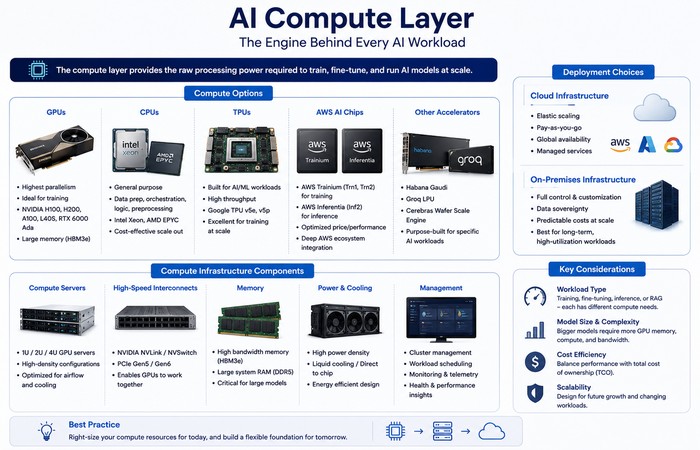
If AI infrastructure has a heart, the compute layer is it.
Every model training run, inference request, embedding calculation, vector search, or agent workflow ultimately depends on computational resources capable of processing enormous volumes of mathematical operations efficiently.
But modern AI compute is about much more than buying powerful GPUs.
Today’s organizations must decide:
- Should workloads run on-premises or in the cloud?
- When does specialized GPU infrastructure make financial sense?
- Are custom AI accelerators a better investment than general-purpose GPUs?
- How should compute scale as AI adoption grows?
The answers depend not only on hardware specifications but also on workload characteristics, operational expertise, budget, and long-term business strategy.
In the next section, we’ll examine the evolution of AI compute, compare hyperscalers with emerging GPU cloud providers, explore custom AI silicon, and explain how to choose the right compute strategy for different types of AI workloads.
AI Training vs AI Inference
One of the first architectural decisions organizations face is understanding whether their infrastructure will primarily support training or inference.
Although both use similar hardware, their infrastructure priorities differ significantly.
| Training | Inference |
| Learns model parameters | Uses trained models to answer requests |
| Extremely compute-intensive | Lower compute per request |
| Runs for hours, days, or weeks | Must respond within milliseconds or seconds |
| Prioritizes throughput | Prioritizes latency |
| Heavy GPU synchronization | Heavy request scaling |
| Massive checkpointing | Continuous request serving |
Many enterprises spend far more on inference than training over the lifecycle of an AI application.
Training may occur once every few months.
Inference happens every second.
This shift explains why organizations increasingly optimize infrastructure for operational efficiency rather than peak benchmark performance.
How AI Workloads Influence Compute Requirements
Artificial intelligence workloads place very different demands on compute infrastructure. Selecting the right hardware isn’t just about buying the fastest GPU—it’s about matching compute resources to the workload.
Training large language models is the most compute-intensive task. It requires thousands of GPUs working together over weeks or even months, high-bandwidth networking, and storage capable of feeding massive datasets without bottlenecks.
Fine-tuning existing models typically requires far fewer resources. Instead of training from scratch, organizations adapt a pre-trained model to a specific task or domain, making smaller GPU clusters or cloud-based AI infrastructure a practical choice.
Inference workloads prioritize low latency and cost efficiency over raw compute power. The objective is to deliver responses quickly and reliably, whether powering chatbots, recommendation engines, or real-time AI assistants. In many cases, specialized inference accelerators or optimized GPUs provide better value than large training clusters.
Retrieval-Augmented Generation (RAG) introduces a different challenge. While GPUs remain important for generating responses, overall performance depends just as much on vector databases, fast storage, efficient networking, and well-designed data pipelines. For many enterprise AI applications, improving retrieval quality delivers greater benefits than simply adding more compute.
The most successful AI platforms therefore choose compute infrastructure based on workload characteristics rather than assuming every AI project requires the largest or most expensive GPU deployment.
The Evolution of AI Compute
AI hardware has evolved remarkably quickly.
Phase 1: CPU-Based Machine Learning
Early machine learning relied almost entirely on CPUs.
Algorithms such as decision trees, linear regression, and support vector machines performed reasonably well without specialized hardware.
Infrastructure resembled conventional enterprise servers.
Phase 2: GPU Acceleration
As deep learning matured, GPUs became essential.
Their massively parallel architecture dramatically reduced training times for convolutional neural networks and transformer models.
What previously required weeks could often be completed in days.
This marked the beginning of GPU-centric AI infrastructure.
Phase 3: AI-Specific Accelerators
Today, cloud providers increasingly develop their own silicon.
Examples include:
- Google TPU
- AWS Trainium
- AWS Inferentia
- Microsoft Maia
- Meta MTIA
These chips aren’t designed for general-purpose graphics.
They’re optimized specifically for machine learning workloads.
The result is improved energy efficiency and lower operating costs for targeted workloads.
Why Compute Alone Doesn’t Guarantee AI Performance
Many organizations assume that buying more GPUs automatically leads to faster AI systems. In practice, that’s rarely true. AI performance depends on how well the entire infrastructure works together. A GPU can only process data that reaches it in time. If storage can’t feed training datasets quickly enough, networking delays communication between distributed GPUs, or orchestration leaves resources sitting idle, even the most powerful accelerators become underutilized.
This is why experienced AI architects measure overall system efficiency instead of focusing only on raw compute power. A balanced infrastructure often delivers better real-world performance than simply adding more GPUs.
As AI workloads scale, compute becomes only one layer of a much larger architecture that includes networking, storage, data pipelines, vector databases, orchestration, and governance.
Choosing Between Cloud and On-Premises AI Infrastructure
One of the most common questions organizations ask is:
Should we build our own AI infrastructure or rent it from a cloud provider?
The answer depends on workload characteristics rather than ideology.
Cloud AI Infrastructure
Cloud platforms provide immediate access to AI hardware without large upfront investments.
Advantages include:
- Rapid deployment
- Elastic scaling
- Managed services
- Access to latest GPU generations
- Reduced infrastructure management
Cloud environments work particularly well for:
- startups
- research teams
- experimentation
- unpredictable workloads
- seasonal demand
However, long-running AI workloads can become expensive over time.
On-Premises AI Infrastructure
Organizations with predictable, continuous AI workloads sometimes choose private infrastructure.
Benefits include:
- Greater control
- Lower long-term operational cost
- Data sovereignty
- Custom networking
- Hardware optimization
- Reduced dependence on cloud vendors
Challenges include:
- High capital expenditure
- Longer deployment times
- Power and cooling requirements
- Hardware maintenance
- Capacity planning
Large enterprises often adopt a hybrid strategy, combining on-premises clusters with cloud bursting during peak demand.
Hybrid AI Infrastructure: The Best of Both Worlds
Many organizations eventually discover that neither a fully cloud-based nor a completely on-premises approach meets every business requirement. Instead, they adopt a hybrid AI infrastructure that combines the strengths of both environments.
In a hybrid architecture, sensitive data, regulated workloads, or continuously running AI applications remain on-premises, where organizations retain greater control over security, compliance, and long-term operating costs. At the same time, public cloud resources provide additional GPU capacity for temporary training jobs, seasonal demand, or rapid experimentation.
This approach offers several advantages. Organizations can scale compute resources without purchasing enough hardware for peak demand, reduce capital expenditure, maintain compliance with data residency requirements, and avoid depending entirely on a single infrastructure provider.
However, hybrid environments also introduce new challenges. Data must move efficiently between environments, identity and access policies must remain consistent, and workloads need orchestration platforms capable of scheduling jobs across both on-premises and cloud infrastructure.
For many enterprises, hybrid AI has become the preferred long-term strategy because it balances flexibility, scalability, and governance more effectively than relying exclusively on either cloud or private infrastructure.
Hyperscalers vs GPU Neoclouds
The AI cloud market has diversified significantly.
Today, organizations typically choose between two categories.
Hyperscalers
Examples include:
- Microsoft Azure
- Amazon Web Services
- Google Cloud
- Oracle Cloud
Strengths include:
- Mature ecosystems
- Global infrastructure
- Broad enterprise integrations
- Managed AI services
- Compliance certifications
Weaknesses:
- Higher operational complexity
- GPU shortages during demand spikes
- Less specialized AI support in some cases
GPU Neoclouds
A newer category focuses almost entirely on AI workloads.
Examples include:
- CoreWeave
- Lambda
- Nebius
- Crusoe
Rather than competing across every cloud service, these providers specialize in AI compute.
Strengths:
- Faster GPU availability
- AI-optimized infrastructure
- Competitive pricing
- Specialized engineering expertise
Weaknesses:
- Smaller service portfolios
- Less mature enterprise ecosystems
- Greater dependence on AI market demand
Which Should You Choose?
The answer depends on priorities.
| Requirement | Better Choice |
| Existing enterprise cloud environment | Hyperscaler |
| Need GPUs immediately | GPU Neocloud |
| Large enterprise integration | Hyperscaler |
| AI-first startup | GPU Neocloud |
| Multi-cloud strategy | Hyperscaler |
| Specialized AI training | GPU Neocloud |
Neither option is universally better.
The best decision depends on workload maturity, operational expertise, procurement strategy, and long-term infrastructure goals.
NVIDIA Still Leads—But the Market Is Changing
For years, NVIDIA has dominated AI infrastructure.
Its advantages extend far beyond hardware.
Organizations also benefit from:
- CUDA
- cuDNN
- TensorRT
- NCCL
- Mature developer tools
- Extensive software ecosystem
That ecosystem has become one of NVIDIA’s strongest competitive advantages.
However, competition is increasing.
AMD continues improving the Instinct accelerator family.
Google expands TPU deployments.
AWS promotes Trainium for cost-efficient AI workloads.
Microsoft and Meta continue investing in custom silicon.
Rather than replacing NVIDIA entirely, these alternatives give organizations more architectural choices depending on workload requirements.
Custom Silicon Is Becoming Mainstream
Five years ago, custom AI chips were unusual.
Today, they’re becoming normal.
Cloud providers increasingly design processors optimized for their own infrastructure.
Benefits include:
- Better power efficiency
- Lower cost per inference
- Improved integration
- Reduced dependence on external suppliers
The trade-off is portability.
Applications optimized for one proprietary accelerator may require additional work when migrating to another platform.
Organizations should therefore evaluate both performance and ecosystem compatibility before committing to custom hardware.
Practical Buying Framework
When evaluating compute infrastructure, ask these questions first.
Q: What type of workload dominates?
Training?
Inference?
Fine-tuning?
RAG?
AI agents?
Each favors different infrastructure decisions.
Q: How predictable is demand?
Continuous workloads often justify dedicated infrastructure.
Bursty workloads usually benefit from cloud elasticity.
Q: How important is latency?
Customer-facing AI applications require rapid responses.
Research environments often prioritize throughput instead.
Q: Will the infrastructure grow?
Buying for today’s workload may create tomorrow’s bottleneck.
Plan for expansion.
Q: What expertise already exists?
The most powerful infrastructure isn’t always the best investment.
Infrastructure your team can confidently operate usually delivers greater long-term value than architecture requiring constant external support.
Key Takeaways
The compute layer is much more than GPU procurement.
It represents the foundation upon which every other infrastructure decision depends.
Modern organizations increasingly optimize for utilization, operational efficiency, and long-term scalability rather than simply purchasing the fastest available hardware.
The strongest AI platforms aren’t necessarily those with the largest clusters.
They’re the ones where compute, networking, storage, orchestration, and data engineering operate as a balanced system.
Networking the AI Data Center: Why the Network Is Just as Important as the GPU
Ask someone what makes an AI system fast, and you’ll probably hear the same answer:
“More GPUs.”
It’s an understandable assumption. GPUs perform the mathematical operations that train large language models and generate predictions. They’re expensive, powerful, and often the first component organizations think about when planning AI infrastructure.
But here’s the reality.
In modern AI clusters, GPUs are rarely limited by their raw computational capability.
They’re limited by how quickly they can communicate with each other.
As AI models continue growing—from billions to hundreds of billions of parameters—the amount of information exchanged between accelerators has increased dramatically. During distributed training, every GPU repeatedly shares gradients, synchronizes weights, and exchanges intermediate results with other GPUs in the cluster.
If that communication slows down, the entire training job slows down.
Imagine a relay race where the runners are world-class athletes, but every baton handoff takes five seconds. It doesn’t matter how fast each athlete runs; the team loses time during every exchange.
Distributed AI training behaves in much the same way.
Networking has become the baton exchange of modern AI infrastructure.
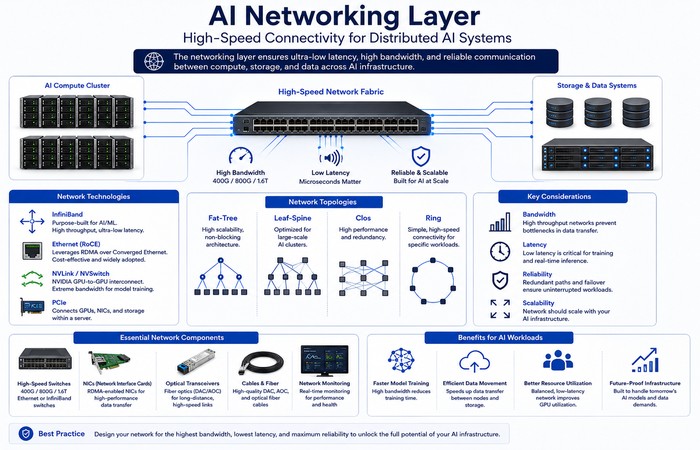
Why AI Workloads Depend on Fast Networking
Traditional enterprise applications generally exchange relatively small amounts of information.
A web application might send a few kilobytes of HTML to a browser.
A database query returns several rows.
An API request transfers a JSON response.
Even busy enterprise systems typically move modest amounts of data between servers.
AI workloads are fundamentally different.
Training a modern transformer model involves thousands of processors working simultaneously on different portions of the same neural network.
After each training iteration, every GPU must communicate updated parameters to the rest of the cluster.
This process repeats millions of times.
That communication becomes one of the largest contributors to total training time.
As clusters grow larger, networking often becomes the limiting factor.
Why Distributed Training Changes Everything
Most modern foundation models are too large to fit on a single GPU.
Instead, organizations distribute workloads across multiple accelerators using techniques such as:
- Data Parallelism
- Tensor Parallelism
- Pipeline Parallelism
- Expert Parallelism (Mixture-of-Experts)
Each approach reduces computational limitations but dramatically increases communication requirements.
The larger the model becomes…
…the more frequently GPUs need to synchronize.
That synchronization must happen quickly.
Otherwise every processor spends valuable time waiting.
Infrastructure architects sometimes describe this as the “everyone waits for the slowest GPU” problem.
One delayed communication can stall an entire training iteration.
Multiply that delay millions of times across weeks of continuous training, and small inefficiencies become enormous operational costs.
Bandwidth vs Latency
Networking discussions often focus on bandwidth.
Bandwidth certainly matters.
It determines how much data can move through the network.
But latency is equally important.
Think about shipping packages.
Bandwidth is the size of the truck.
Latency is how long the truck takes to arrive.
AI training depends on both.
Large checkpoints require enormous bandwidth.
Gradient synchronization requires extremely low latency.
Improving one while ignoring the other rarely delivers optimal performance.
Modern AI infrastructure therefore prioritizes:
- High throughput
- Low latency
- Predictable communication
- Minimal packet loss
- Efficient congestion management
The Two Dominant Networking Technologies
Today, enterprise AI infrastructure generally relies on one of two networking approaches.
InfiniBand
InfiniBand was designed specifically for high-performance computing.
Long before generative AI became mainstream, supercomputers relied on InfiniBand because it provided:
- Extremely low latency
- High bandwidth
- Native Remote Direct Memory Access (RDMA)
- Efficient congestion handling
- Lossless communication
- Hardware acceleration for collective operations
These characteristics remain valuable for AI training.
Large GPU clusters spend less time waiting during synchronization because communication overhead stays remarkably low.
InfiniBand therefore remains the preferred networking technology for many of the world’s largest AI training environments.
RoCEv2 (RDMA over Converged Ethernet)
RoCEv2 takes a different approach.
Instead of introducing a completely separate networking technology, it brings RDMA capabilities to standard Ethernet environments.
This allows organizations to leverage existing networking expertise while still achieving excellent AI performance.
Advantages include:
- Familiar Ethernet ecosystem
- Lower deployment cost
- Easier integration with existing infrastructure
- Broad vendor support
However, RoCEv2 typically requires more careful tuning.
Features such as:
- Priority Flow Control (PFC)
- Explicit Congestion Notification (ECN)
- Queue management
must be configured correctly to achieve consistent performance.
Without proper tuning, congestion can significantly reduce distributed training efficiency.
Bandwidth, Latency, and Throughput: Why They Matter in AI Networking
High-performance AI networking is often described using three terms: bandwidth, latency, and throughput. Although they’re closely related, each affects AI workloads differently.
Bandwidth refers to the maximum amount of data a network can transfer over a given period. During distributed AI training, high bandwidth allows GPUs to exchange large model parameters and gradients without creating communication bottlenecks.
Latency measures how long it takes for data to travel from one point to another. Even a high-bandwidth network can slow AI training if latency is too high, because thousands of GPUs frequently wait for synchronization before continuing computation.
Throughput represents the amount of useful work the network actually completes over time. In production AI environments, overall throughput depends not only on bandwidth but also on latency, congestion, packet loss, and workload efficiency.
Modern AI infrastructure must optimize all three. Increasing bandwidth alone cannot compensate for poor latency, and low latency provides limited value if the network lacks sufficient capacity to move massive datasets between distributed accelerators.
InfiniBand vs RoCEv2
| Feature | InfiniBand | RoCEv2 |
| Primary Design | High-performance computing | Enterprise Ethernet |
| Latency | Extremely low | Very low |
| Configuration Complexity | Lower once deployed | Higher tuning requirements |
| Ecosystem | Specialized | Broad Ethernet ecosystem |
| Cost | Higher | Usually lower |
| Best For | Massive AI training clusters | Mixed enterprise AI environments |
Neither technology is universally superior.
Choosing between them depends on workload characteristics rather than benchmark numbers alone.
When InfiniBand Makes Sense
Organizations typically benefit from InfiniBand when:
- training foundation models
- operating dedicated AI superclusters
- running thousands of GPUs
- minimizing synchronization overhead
- maximizing training throughput
In these environments, networking performance directly influences GPU utilization.
The investment often pays for itself through faster model training.
Network Congestion and GPU Idle Time
Building a high-bandwidth AI network is only part of the challenge. As AI clusters grow, network congestion becomes one of the most significant barriers to efficient GPU utilization.
During distributed training, thousands of GPUs continuously exchange gradients, model parameters, and synchronization data. If multiple workloads compete for the same network resources, communication delays increase, causing GPUs to wait instead of perform computations. Even brief delays can multiply across thousands of synchronization events, significantly extending overall training time.
To reduce congestion, modern AI data centers use techniques such as intelligent traffic scheduling, Quality of Service (QoS), adaptive routing, congestion control algorithms, and dedicated AI networking fabrics. These technologies help maintain predictable communication between accelerators even under heavy workloads.
Rather than measuring network performance by bandwidth alone, infrastructure teams increasingly focus on keeping GPUs continuously utilized. Every second spent waiting for network communication represents expensive compute resources sitting idle.
Network Scalability: Preparing for Future AI Growth
Networking decisions should support not only current AI workloads but also future expansion. Many organizations begin with a small GPU cluster and later scale to hundreds or thousands of accelerators as AI adoption grows. A network that performs well today may become a bottleneck if it cannot scale efficiently.
Designing for scalability means considering factors such as switch capacity, port density, network topology, and the ability to expand without major architectural changes. Modern AI environments often adopt modular network designs that allow additional GPU servers and storage systems to be integrated with minimal disruption.
Scalable networking also improves operational flexibility. Infrastructure teams can introduce new AI workloads, expand training clusters, or increase inference capacity without redesigning the entire network. Planning for growth from the beginning reduces future migration costs and helps organizations maintain consistent AI performance as demand increases.
When RoCEv2 Is the Better Choice
RoCEv2 often becomes attractive when organizations:
- already operate large Ethernet environments
- prefer open networking ecosystems
- require mixed enterprise workloads
- balance cost against maximum performance
- have experienced networking teams
Many enterprises successfully deploy AI using RoCEv2 because operational familiarity reduces overall infrastructure complexity.
Ultra Ethernet: The Next Evolution
For years, AI networking discussions centered almost entirely on InfiniBand versus Ethernet.
That distinction is becoming less clear.
The Ultra Ethernet Consortium (UEC) was established by major technology companies—including AMD, Intel, Broadcom, Cisco, HPE, Meta, and Microsoft—to improve Ethernet specifically for AI and high-performance computing workloads.
Its objective isn’t to replace Ethernet.
It’s to evolve Ethernet into a networking platform capable of supporting next-generation AI infrastructure while maintaining the openness and flexibility enterprises expect.
As AI deployments continue expanding, innovations from the Ultra Ethernet ecosystem are expected to narrow the performance gap for many workloads.
Why Networking Is Becoming More Expensive
Networking hardware has evolved rapidly.
AI clusters increasingly deploy:
- 400 GbE
- 800 GbE
- AI-optimized switches
- SmartNICs
- Data Processing Units (DPUs)
- Optical interconnects
These investments may appear expensive.
However, compared with thousands of idle GPUs, high-performance networking often delivers one of the strongest returns on infrastructure investment.
Spending millions on GPUs while underinvesting in networking is similar to buying a Formula One car and driving it through city traffic.
The hardware exists.
The performance doesn’t.
Common Networking Mistakes
Infrastructure teams repeatedly encounter similar problems.
Treating networking as an afterthought
Networking should be designed alongside compute—not after GPU procurement.
Optimizing bandwidth but ignoring latency
Large throughput doesn’t automatically reduce synchronization delays.
Latency matters just as much.
Assuming Ethernet requires no tuning
RoCEv2 performs exceptionally well when properly configured.
Without careful tuning, congestion significantly reduces performance.
Designing only for today’s cluster
Networking upgrades become increasingly difficult as AI environments expand.
Planning for future growth reduces expensive redesigns later.
Practical Decision Framework
Ask yourself these questions before choosing networking architecture.
Q: How many GPUs will the cluster contain?
Dozens?
Hundreds?
Thousands?
Cluster size changes networking priorities.
Q: Is the workload primarily training or inference?
Training generally benefits more from ultra-low latency.
Inference often prioritizes scalability.
Q: What networking expertise already exists?
Infrastructure your engineers understand usually delivers better long-term results than unfamiliar technology.
Q: Will workloads remain on-premises?
Hybrid and multi-cloud strategies influence networking design significantly.
Key Takeaways
Networking has evolved from a supporting technology into one of the most important components of modern AI infrastructure.
As models continue growing larger and distributed training becomes increasingly common, communication efficiency often determines overall system performance.
The fastest GPU cannot compensate for a congested network.
Balanced AI platforms therefore optimize compute and networking together rather than treating them as separate purchasing decisions.
AI Storage: Breaking the Memory Wall
If networking determines how quickly GPUs communicate with one another, storage determines whether they have anything to compute in the first place.
Modern AI models consume extraordinary amounts of data.
Training datasets routinely span terabytes or petabytes.
Checkpoint files may occupy hundreds of gigabytes each.
Inference systems continuously retrieve embeddings, vector indexes, enterprise documents, and model artifacts.
The challenge isn’t simply storing this information.
It’s delivering it quickly enough that expensive AI accelerators never sit idle waiting for data.
This challenge is often described as the memory wall—one of the most important and least understood bottlenecks in AI infrastructure.
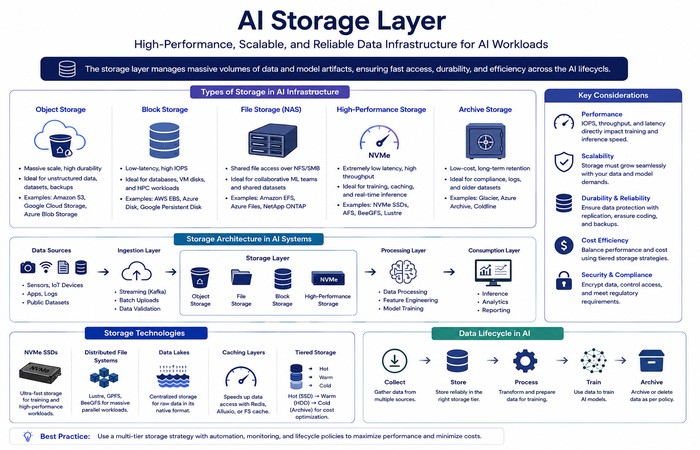
Understanding the Memory Wall
Infrastructure engineers often refer to the memory wall when discussing AI performance.
The concept is straightforward.
Modern GPUs can process data much faster than traditional storage systems can deliver it.
Imagine a world-class chef capable of preparing hundreds of meals every hour.
Now imagine ingredients arriving one small bag at a time.
The chef isn’t slow.
The supply chain is.
AI compute works exactly the same way.
Every time a GPU waits for training data, checkpoint files, or model parameters, expensive computational resources remain idle.
At small scales, those delays may go unnoticed.
Across hundreds or thousands of GPUs running continuously, even minor storage bottlenecks become extraordinarily expensive.
Why GPU Utilization Depends on Storage Performance
Another especially popular myth in the here is that a training can be done on GPU alone, but in practice GPU is just a (very flexible) engine and the bottleneck lied is considerably the speed of the storage access.
While training models, GPUs constantly request datasets, model checkpoints and other intermediate files. When throughput to storage cannot satisfy those requests, the GPUs are waiting for data instead of performing computational work leading to higher training times and infrastructure costs.
Contemporaneous AI architectures view storage as an active layer of performance, not a passive shelf. The use of high performance storage, parallel file systems and accelerated architectures based on NVMe means compute resources are kept fed with data to run training and inference workloads.
In large-scale AI deployments, finding ways of improving storage performance will normally offer more benefit than scaling out additional GPUs, due to the known fact that a balanced infrastructure will always outperform a hardware silo.
Why AI Storage Differs from Traditional Enterprise Storage
Enterprise storage was originally designed around workloads such as:
- databases
- virtual machines
- ERP systems
- office documents
These applications prioritize:
- reliability
- consistency
- transactional performance
- moderate throughput
AI introduces completely different demands.
Instead of thousands of small transactions, AI workloads involve:
- massive sequential reads
- continuous streaming
- simultaneous access from many GPUs
- enormous checkpoint files
- distributed datasets
Storage therefore becomes a performance system rather than simply a persistence layer.
What Modern AI Storage Must Deliver
An effective AI storage platform should provide several capabilities simultaneously.
High Throughput
Training datasets may contain billions of samples.
Storage must deliver data fast enough to keep every accelerator continuously supplied.
High throughput reduces idle GPU time and shortens overall training duration.
Low Latency
Inference applications cannot afford long delays while retrieving embeddings or enterprise documents.
Lower latency produces faster responses and better user experiences.
Parallel Access
Modern AI clusters rarely access storage sequentially.
Many processors hundreds, or even thousands can read various sections of the same dataset at the same time.
Storage systems must therefore scale horizontally rather than for going on a single machine.
Scalability
AI datasets continue growing.
Storage infrastructure should grow without forcing a re-architecting of the entire system.
Using expanded distributed storage, it is becoming more common for organizations to expand horizontally by adding new nodes, rather than purchasing an entirely new storage system.
Reliability
However, training a large model might take a few weeks even of constant calculation.
Storage failure at checkpointing can waste a vast amount of compute time.
Even if a number of components might be down, redundancy and fault tolerance are nevertheless important.
Why Checkpointing Matters
Checkpointing, which is part of the AI infrastructure system, gets much less attention outside of the infrastructure teams.
Checkpointing is the practice of taking snapshots of a state of a model during training, The snapshot saves the current learned parameters, optimizer state and training progress. In the case of a hardware failure, software crash or maintenance, the model can pick up from the latest checkpoint rather than starting over. This leads to increased dependability, lower wasted compute and is a necessity for training large models that run for weeks on end..
Can be used to quickly resume training from the point it was before an interruption, rather than need to do a full re-train.
Modern foundation models have checkpoint files that are hundreds of gigabytes in size, or even large multi-terabyte files.
Saving those files efficiently becomes a significant infrastructure challenge.
Long checkpointing prolongs training time. Since the GPU freezes when model state is written into storage, writing model state can cost long.
Fast checkpointing has the tendency to reduce the number of interruptions leading to better cluster utilization.
Checkpoint performance is frequently a key motivator in large-scale AI environments.
NVMe-over-Fabrics (NVMe-oF)
Conventional storage protocols generate extra overhead, which is avoidable for AI applications.
The emerging NVMe-over-Fabrics (abbreviated NVMe-oF) protocol enables high-performance NVMe storage to be accessed remotely over a network without incurring high latency.
By providing remote storage similar to stationary storage, and is not considered as slow as external resources, NVMe-oF can access remote flash storage at a much similar performance to local attached devices.
Advantages include:
- Very high throughput
- Low latency
- Better scalability
- Efficient resource sharing
- Reduced storage bottlenecks
Is organizations’ solution of choice for storing AI aggregations, as the framework permits a flexible storage architecture.
GPUDirect Storage
One of the biggest inefficiencies in conventional storage architectures is unnecessary data movement.
Traditionally, data travels through several stages:
Storage → CPU → System Memory → GPU
Each transfer introduces additional latency and consumes CPU resources.
GPUDirect Storage simplifies this process.
Once within the system, sources and destination locations of data are concerned with data going through the CPU and is handled through the memory interconnection architecture. Alternatively, source and destination locations of data are concerned with data passing between storage devices and the GPU memory directly.
Benefits include:
- Reduced CPU overhead
- Lower latency
- Faster dataset loading
- Improved GPU utilization
- Higher training throughput
In the case of big organizations training very large models where the infrastructure is dedicated to this task, GPUDirect Storage can bring tremendous gains to overall efficiency, as the GPU is in-his place waiting.
Parallel File Systems
By design, traditional file servers are the bottleneck of AI setting, it is frustrating.
Parallel file systems Distribute data and metadata across multiple storage nodes so many clients can access data at the same time.
This design makes it possible to achieve huge throughput and avoid presenting any bottleneck.
A few parallel file systems have become popular in computing for AI and high performance systems.
Lustre
For years, Lustre has been the supercomputer‘s storage system of choice.
Specifically, this is highly effective for sequential applications on large data sets and continues to be used in research laboratories and national institutes.
WEKA
WEKA focuses specifically on modern AI and machine learning environments.
Its architecture emphasizes:
- flash storage
- distributed performance
- cloud integration
- AI workload optimization
Many organizations adopt WEKA when GPU utilization becomes a primary performance objective.
VAST Data
VAST combines high-performance storage with simplified management and efficient scaling.
It is increasingly deployed in enterprise AI environments where both structured and unstructured data coexist.
DDN (DataDirect Networks)
DDN has built a strong reputation within high-performance computing and AI.
Its storage platforms support extremely demanding training environments where throughput and reliability are equally critical.
Object Storage
Not every AI dataset requires ultra-fast storage.
Object storage plays an important role in modern AI infrastructure by providing:
- inexpensive scalability
- long-term retention
- cloud integration
- backup repositories
- archival storage
Common examples include:
- Amazon S3
- Azure Blob Storage
- Google Cloud Storage
- MinIO
- Ceph Object Storage
Object storage often serves as the foundation for enterprise data lakes before information moves into higher-performance storage tiers.
Designing Storage Tiers
One storage technology rarely satisfies every workload.
Most enterprise AI platforms therefore adopt tiered architectures.
Hot Tier
Contains frequently accessed information.
Examples include:
- active training datasets
- vector indexes
- embeddings
- active checkpoints
Typically uses:
- NVMe SSDs
- Parallel file systems
- High-performance flash storage
Warm Tier
Contains data accessed less frequently.
Examples:
- previous training datasets
- fine-tuning resources
- reusable model artifacts
Often combines performance with lower storage cost.
Cold Tier
Stores information rarely accessed but retained for compliance or future reuse.
Examples:
- historical datasets
- archived checkpoints
- backups
- compliance records
Usually implemented using object storage or archival systems.
Tiering allows organizations to balance performance with infrastructure cost rather than placing every file on premium storage.
Balancing Storage Performance with Infrastructure Cost
Selecting a storage architecture isn‘t merely about performance cost, scalability and manageability play roles too. While NVMe storage provides for maximum throughput and minimum latency, it becomes exceedingly expensive to house all of an AI workflow on top tier storage as its footprint grows.
Most enterprise AI platforms therefore align storage performance with workload requirements. Regularly used datasets, checkpoints for current models, indexes of data vectors, and input data for inference should be stored on a fast access store. Less frequently used historical datasets, old checkpoint files, and audit logs should be stored on a cheap object store or archival storage.
This works enables organizations to regulate infrastructure costs while maintaining the effectiveness of AI. Instead of using a one size fits all approach to storage, fresh storage policies can be implemented that will make sure that your most important files are accessed most quickly, while others are stored at a fraction of the cost.
Storage Architecture Comparison
| Storage Type | Best For | Advantages | Limitations |
| Local NVMe | Single-server AI | Lowest latency | Limited scalability |
| NVMe-oF | Distributed AI | High performance with flexibility | Requires modern infrastructure |
| Parallel File Systems | Large GPU clusters | Massive throughput | Higher operational complexity |
| Object Storage | Data lakes & archives | Low cost, virtually unlimited scale | Higher latency |
| NAS | Small AI teams | Simplicity | Performance limitations at scale |
Storage Resilience and Disaster Recovery
AI infrastructure needs to not only be performant but resilient to failure. Because training generative large language models can take days or weeks, storage resilience becomes an important component of infrastructure planning.
Sudden hardware failures, power outages, network failures or powerloss, accidentally corrupted data can cause huge losses in time and money if the training checkpoints or data sets are not stored (punctuated). Various backup and redundancy strategies such as replicated storage, scheduled checkpointing, automated backup, disaster recovery plan geographically spread out are often employed.
Resilient storage architectures add to this equation further by enhancing business continuity. When a storage node or data center malfunctions, workloads are able to pick up again only a few minutes behind instead of catching up from scratch. As enterprise AI workloads become larger and more complex, resilience can be considered just as important as performance.
Common Storage Mistakes
Organizations frequently encounter similar issues.
Buying GPUs before upgrading storage
Compute capacity often grows faster than storage throughput.
The result is underutilized accelerators.
Ignoring checkpoint performance
Slow checkpointing increases total training time.
Checkpoint strategy should be considered during infrastructure planning—not afterward.
Keeping everything on premium storage
Not all data requires NVMe performance.
Tiering reduces infrastructure cost significantly.
Designing only for current datasets
AI datasets expand rapidly.
Storage architectures should scale incrementally rather than requiring disruptive migrations.
Practical Storage Buying Framework
Before selecting storage technologies, ask:
How large are the training datasets?
Gigabytes?
Terabytes?
Petabytes?
Q: Is the workload primarily training or inference?
Training emphasizes throughput.
Inference emphasizes latency.
Q: How many GPUs will access storage simultaneously?
Concurrency determines storage architecture more than total capacity alone.
Q: Will the organization operate hybrid cloud environments?
The storage approach needs to be consistent with longer term planning of the infrastructure.
Key Takeaways
Today, storage is an active actor.
In current AI settings it impacts in real-time on GPU usage, training times, inference latency, and efficiency.
By spending only on compute, organizations commonly find that storage, not GPU, is their major bottleneck that limits performance.
The strongest AI infrastructures therefore treat storage as a strategic performance layer rather than simply a place to save files.
Why Raw Enterprise Data Isn’t AI Ready
Most organizations already possess enormous amounts of information.
Unfortunately, much of it isn’t immediately useful for AI.
Consider a typical enterprise.
Information may exist across:
- Microsoft 365
- Google Workspace
- SharePoint
- Confluence
- Slack
- Teams
- CRM platforms
- ERP systems
- PDFs
- scanned documents
- emails
- customer support tickets
- engineering documentation
- source code repositories
Every system stores information differently.
Some documents are outdated.
Others are duplicated.
Permissions vary.
Naming conventions differ.
Metadata may be missing entirely.
From an AI perspective, this creates chaos.
Before a language model can answer questions accurately, someone—or something—must organize this information.
That’s the purpose of the AI data pipeline.
Data Quality: The Foundation of Reliable AI
A machine-learning system will not reliably generate valid answers to inputs derived from low quality data. Data should be checked for accuracy, comprehensiveness, consistency and pertinence prior to being processed by an AI pipeline. Redundant records, obsoleted documentation, inconsistent data and lack of metadata all detract from the quality of responses regardless of the sophistication of the model.
Efforts to enhance data quality often bestow validation on source materials, delete duplicate entries, normalize data formats, add extra context to dataset metadata, and filter out stale information before it even hits downstream AI all of which curtails gumminess, improves access, and allows models to produce explanations that are cleare Great!
Organizations often invest heavily in GPUs and model development while overlooking data quality. In practice, however, improving the quality of enterprise data frequently produces greater gains in AI performance than deploying larger or more expensive models.
The AI Data Pipeline Lifecycle
While the implementations vary, most enterprise AI pipelines follow a similar process.
Data Sources ↓ Ingestion ↓ Cleaning ↓ Normalization ↓ Metadata Enrichment ↓ Chunking ↓ Embedding Generation ↓ Vector Database ↓ Retrieval Layer ↓ Large Language Model ↓ User
Every stage improves the quality of the final AI response.
Generally speaking, any omission of them is attributable to reliability loss.
Step 1: Data Ingestion
Everything begins with ingestion.
The pipeline connects to existing information sources and imports content into the AI platform.
Typical sources include:
- SQL databases
- Object storage
- File systems
- APIs
- SharePoint
- Google Drive
- Git repositories
- CRM systems
- Email archives
- Wikis
- Customer support platforms
Contemporary enterprises tend to absorb information to be integrated all the time instead of merely import by batch.
The ongoing compliance of these systems is also guaranteed by the involvement of the business if the data is not continuously consumed, the applications will rapidly get out of step with present business reality.
Step 2: Data Cleaning
Most raw enterprise data is a mess.
Some documents contain duplicated paragraphs.
Others contain formatting errors.
Old documents may still reference obsolete products.
Multiple versions of the same policy may exist simultaneously.
Without cleaning, AI systems may retrieve conflicting information.
Cleaning typically removes:
- duplicate content
- corrupted files
- obsolete versions
- formatting inconsistencies
- incomplete records
- unsupported document types
Good cleaning improves both retrieval quality and model accuracy.
Step 3: Normalization
Enterprise information rarely follows a consistent structure.
For example:
One department stores dates as:
01/07/2026
Another uses:
July 1, 2026
Another records:
2026-07-01
Humans understand they’re identical.
Machines often don’t.
Normalization converts information into consistent formats.
This simplifies downstream processing and improves semantic understanding.
Step 4: Metadata Enrichment
Metadata is data about data.
Instead of simply storing a document, AI platforms also store information such as:
- Author
- Department
- Document type
- Creation date
- Last update
- Security classification
- Business unit
- Language
- Version
- Tags
- Expiration date
Metadata dramatically improves retrieval quality.
Instead of searching every document equally, AI systems can prioritize recent, authoritative, or department-specific information.
Step 5: Chunking
Large language models cannot process unlimited amounts of information at once.
Long documents therefore need to be divided into smaller sections called chunks.
For example:
A 120-page employee handbook isn’t embedded as one document.
Instead it becomes hundreds of meaningful sections.
Good chunking preserves context.
Poor chunking destroys it.
Consider this sentence:
Employees may work remotely after manager approval.
If the chunk boundary separates “after manager approval” into another chunk, retrieval quality suffers.
This is why chunking strategy significantly affects RAG performance.
Modern pipelines increasingly use semantic chunking rather than fixed paragraph sizes.
Step 6: Embedding Generation
Once information has been chunked, it is transformed into vector embeddings.
Unlike keywords, embeddings represent meaning.
For example:
These phrases:
- “How do I reset my password?”
- “I forgot my login credentials.”
- “Can’t sign into my account.”
contain different words.
Yet they express nearly the same intent.
Embedding models convert these sentences into mathematical representations positioned close together within vector space.
This enables semantic search rather than exact keyword matching.
Embeddings are one of the fundamental building blocks of modern AI retrieval systems.
Step 7: Vector Storage
Generated embeddings are stored inside vector databases.
Unlike relational databases, vector databases retrieve information based on semantic similarity rather than exact text matching.
We’ll explore vector databases in detail in the next section.
Why Data Freshness Matters
Many organizations focus on accuracy while overlooking freshness.
An AI system trained on perfect documentation from three years ago may still provide incorrect answers today.
Enterprise knowledge changes constantly.
Products evolve.
Policies change.
Employees leave.
Security requirements update.
Data pipelines therefore need mechanisms for:
- continuous synchronization
- document versioning
- deletion handling
- incremental updates
- change detection
Fresh AI almost always outperforms stale AI.
Metadata: The Context That Makes AI Smarter
Data alone rarely provides enough context for AI systems to generate reliable responses. Metadata—information that describes other data—helps models understand where information came from, when it was created, who owns it, and how it should be used.
Common metadata includes document titles, authors, creation dates, departments, security classifications, version history, tags, languages, and access permissions. When preserved throughout the data pipeline, this additional context significantly improves retrieval accuracy and helps AI systems return more relevant and trustworthy results.
Metadata also supports governance and compliance. It enables organizations to trace the origin of retrieved information, enforce access controls, and filter results based on business rules. For enterprise AI, well-managed metadata is often just as valuable as the underlying content itself because it provides the context needed for accurate and explainable responses.
Structured vs Unstructured Data
Traditional analytics focuses heavily on structured information.
AI consumes both.
Structured Data
Examples include:
- SQL tables
- inventory systems
- customer records
- financial transactions
These datasets already have defined schemas.
Unstructured Data
Examples include:
- PDFs
- presentations
- videos
- emails
- support tickets
- engineering documents
- meeting transcripts
- images
- scanned forms
Enterprise AI increasingly derives value from unstructured information because that’s where organizational knowledge usually resides.
Building pipelines capable of processing both data types has become a competitive advantage.
Why Data Lineage Matters
One question enterprise users increasingly ask is:
“Where did this answer come from?”
That’s where lineage becomes essential.
Lineage tracks:
- original document
- author
- update history
- processing steps
- retrieval path
Instead of simply producing an answer, AI systems can explain the origin of that answer.
This improves:
- trust
- auditing
- compliance
- debugging
- governance
Lineage has become especially important in regulated industries.
Real-Time vs Batch Data Pipelines
Not every AI application processes data in the same way. Some workloads require information to be updated continuously, while others can operate efficiently using scheduled updates.
Real-time data pipelines continuously ingest, process, and synchronize information as it changes. They’re commonly used in AI chatbots, fraud detection systems, recommendation engines, monitoring platforms, and enterprise knowledge assistants where users expect the latest information to be immediately available.
Batch data pipelines, on the other hand, process information at scheduled intervals such as hourly, daily, or weekly. These pipelines are well suited for model training, historical analytics, document indexing, and large-scale data preparation where immediate updates are less critical.
Many enterprise AI platforms combine both approaches. Real-time pipelines keep frequently changing knowledge current, while batch pipelines handle large-scale processing tasks more efficiently. Choosing the appropriate strategy depends on business requirements, data freshness expectations, infrastructure costs, and operational complexity.
Building Pipelines for Enterprise RAG
Retrieval-Augmented Generation (RAG) has become one of the most widely adopted enterprise AI architectures.
Unlike traditional language models that rely solely on training data, RAG retrieves current information before generating responses.
A simplified enterprise RAG pipeline looks like this:
Enterprise Documents ↓ Cleaning ↓ Chunking ↓ Embeddings ↓ Vector Database ↓ Retriever ↓ Large Language Model ↓ Grounded Response
The quality of the response depends far more on retrieval quality than many organizations initially expect.
Good retrieval often matters more than a slightly better language model.
Common Pipeline Mistakes
Indexing everything
Not every document belongs inside an AI knowledge base.
Old, duplicated, or confidential information should often be excluded.
Ignoring permissions
Retrieval systems must respect enterprise access controls.
An AI assistant should never expose documents a user cannot normally access.
Poor chunking
Improper chunk sizes reduce retrieval quality dramatically.
Semantic chunking usually outperforms arbitrary paragraph lengths.
Rare updates
Knowledge bases that refresh once a month quickly become outdated.
Incremental synchronization keeps AI aligned with business reality.
Monitoring and Optimizing AI Data Pipelines
Building a data pipeline is only the first step. As enterprise AI systems evolve, pipelines require continuous monitoring to ensure they remain accurate, efficient, and reliable.
Infrastructure teams commonly track metrics such as data ingestion success rates, processing latency, synchronization delays, retrieval accuracy, duplicate detection, failed processing jobs, and data freshness. Monitoring these indicators helps identify bottlenecks before they affect model performance or user experience.
Optimization is equally important. As data volumes grow, organizations regularly refine chunking strategies, metadata extraction, document processing workflows, embedding generation, and synchronization schedules to improve retrieval quality while controlling infrastructure costs.
Rather than treating pipelines as one-time implementation projects, mature organizations continuously improve them as business requirements, data sources, and AI applications evolve. This ongoing optimization helps ensure that AI systems continue delivering accurate, relevant, and trustworthy responses over time.
Reliable AI models depend on high-quality, well-governed data throughout the entire lifecycle. Understanding data governance and integrity during BI migrations can help organizations maintain consistency, accuracy, and compliance as data moves across modern platforms.
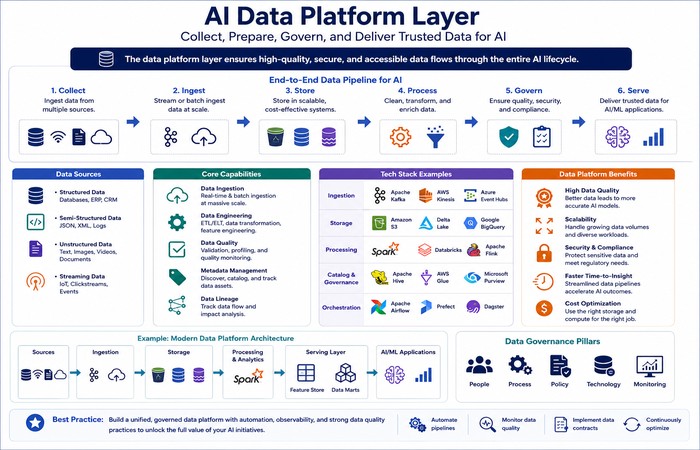
Modern AI infrastructure is built to process enormous volumes of structured and unstructured information efficiently. Learn more about the role of big data in AI and intelligent decision-making to understand why scalable data platforms are essential for enterprise AI.
Best Practices
Successful enterprise pipelines generally follow several principles.
- Automate ingestion whenever possible.
- Clean data before embedding.
- Preserve document metadata.
- Track lineage.
- Respect security permissions.
- Remove duplicates.
- Continuously update embeddings.
- Monitor retrieval quality.
These practices improve AI reliability more effectively than simply deploying larger language models.
Key Takeaways
AI data pipelines transform raw enterprise information into trusted knowledge.
Without them, even the most advanced infrastructure produces unreliable responses.
Modern AI organizations therefore treat data engineering as a core component of infrastructure rather than an isolated discipline.
A fast model connected to poor data remains a poor AI system.
A well-designed pipeline connected to trustworthy information enables AI to deliver consistent, explainable, and business-ready results.
Vector Databases: The Foundation of Semantic AI Retrieval
Traditional databases answer questions like:
“Find customer ID 1458.”
AI asks a different question.
“Find documents that mean the same thing as this question.”
That difference changed database design forever.
Vector databases have become one of the defining technologies of modern AI infrastructure because they enable machines to retrieve information based on meaning, not just matching keywords.
For retrieval-augmented generation (RAG), AI search, recommendation engines, and intelligent assistants, they have become just as important as relational databases were for traditional business applications.
Why Keyword Search Isn’t Enough
Traditional search engines rely heavily on keyword matching.
This works well when users know exactly what they’re looking for.
But people rarely communicate that way.
Imagine three employees asking IT for help.
Employee A says:
“I forgot my VPN password.”
Employee B asks:
“Can’t connect remotely.”
Employee C writes:
“Need access to office network from home.”
Different words.
Same intent.
Keyword search might produce three different results.
Semantic search recognizes that all three questions are closely related.
That’s the power of vector search.
Why Semantic Search Changes Everything
Traditional search systems look for exact words or phrases. If a document doesn’t contain the same keywords as a user’s query, it may never appear in the results—even if it contains the correct answer.
Semantic search works differently. Instead of matching keywords, it compares the meaning of a query with the meaning of stored information. This allows AI systems to retrieve documents that are conceptually related, even when different words or phrases are used.
For example, a user searching for “How do I reset my company password?” may receive relevant documentation titled “Credential Recovery Process,” even though the document never mentions the word “password.” Because semantic search understands relationships between concepts rather than exact wording, it delivers more accurate and context-aware retrieval.
This ability to retrieve information based on meaning rather than keywords is one of the primary reasons vector databases have become a foundational component of Retrieval-Augmented Generation (RAG) and modern enterprise AI systems.
What Is a Vector Database?
A vector database stores mathematical representations of information known as embeddings.
Instead of storing only text, it stores numerical vectors that capture semantic meaning.
When a user submits a question:
- The question is converted into an embedding.
- The database searches for nearby vectors.
- Similar documents are returned.
- The language model generates a grounded response.
Rather than asking:
“Does this document contain these words?”
The system asks:
“Does this document express the same idea?”
That difference dramatically improves retrieval quality.
Understanding Embeddings
Embeddings are numerical representations of meaning.
You don’t need to understand the mathematics to appreciate the concept.
Imagine every document placed on a giant map.
Documents discussing similar topics naturally appear close together.
Completely unrelated topics appear far apart.
Questions about:
- password recovery
- account login
- authentication
would cluster together.
Questions about:
- cloud storage
- GPU networking
- AI infrastructure
would appear elsewhere.
Embedding models automatically create this semantic map.
Vector databases simply search it efficiently.
Choosing the Right Embedding Model
A vector database is only as effective as the embeddings it stores. Embedding models convert text, images, or other data into numerical vectors that capture semantic meaning. If those embeddings fail to represent the underlying content accurately, even the most advanced vector database will return poor search results.
The choice of an embedding model depends on the workload. General-purpose embedding models work well for enterprise search, knowledge assistants, and Retrieval-Augmented Generation (RAG), while domain-specific models may deliver better results for industries such as healthcare, finance, legal services, or scientific research where terminology is highly specialized.
Organizations should also consider factors such as embedding dimensions, multilingual support, inference cost, update frequency, and compatibility with their existing AI stack. Selecting an embedding model that aligns with business requirements often improves retrieval quality more than changing the vector database itself.
For enterprise AI, embedding models and vector databases should be viewed as complementary technologies. One creates meaningful representations of information, while the other stores and retrieves those representations efficiently.
Vector databases enable semantic retrieval by storing embeddings instead of traditional keyword indexes, making them a core component of modern retrieval-augmented generation (RAG) systems. If you’d like a deeper explanation, read our complete guide to vector search for developers.
Hybrid Search: Combining Keywords with Semantic Search
Although vector databases excel at semantic retrieval, many enterprise AI systems achieve the best results by combining semantic search with traditional keyword search. This approach, known as hybrid search, leverages the strengths of both retrieval methods.
Keyword search is highly effective for finding exact matches such as product codes, invoice numbers, error messages, version numbers, and technical identifiers. Semantic search, on the other hand, understands meaning and context, allowing AI systems to retrieve relevant information even when users describe concepts using different words.
By combining both techniques, hybrid search delivers more accurate and reliable results across a wider range of queries. Many enterprise Retrieval-Augmented Generation (RAG) systems use hybrid retrieval to improve response quality, reduce missed matches, and provide users with more relevant information.
As enterprise knowledge bases continue to expand, hybrid search has become a best practice because it balances the precision of keyword matching with the flexibility of semantic understanding.
Why Vector Databases Matter in Enterprise AI
Large language models are powerful.
But they don’t continuously learn your company’s latest documentation.
Without retrieval, a model might answer using outdated information.
Vector databases solve that problem.
Instead of relying solely on training data, AI retrieves relevant enterprise knowledge before generating a response.
Benefits include:
- More accurate answers
- Current information
- Reduced hallucinations
- Better enterprise knowledge search
- Explainable responses
- Lower retraining costs
For many organizations, retrieval quality influences user satisfaction more than model size.
How Vector Search Works
A simplified workflow looks like this.
User Question ↓ Embedding Model ↓ Vector Database ↓ Nearest Matching Documents ↓ Large Language Model ↓ Grounded Answer
Notice something important.
The language model doesn’t search the documents.
The vector database does.
The language model simply uses retrieved information to construct the final response.
That separation improves both performance and reliability.
Approximate Nearest Neighbor (ANN) Search
Searching billions of vectors exactly would be computationally expensive.
Vector databases therefore rely on Approximate Nearest Neighbor (ANN) algorithms.
Rather than comparing every vector with every other vector, ANN identifies highly similar vectors using optimized indexing techniques.
The result is dramatically faster retrieval while maintaining excellent accuracy.
Different vector databases implement ANN in different ways, but the objective remains the same:
Find the most relevant information quickly.
Popular Vector Databases
The ecosystem has matured rapidly over the last few years.
Several platforms now dominate enterprise AI deployments.
Pinecone
Pinecone is one of the best-known managed vector database platforms.
Its primary advantage is simplicity.
Organizations don’t need to manage infrastructure.
Instead, they focus on building AI applications while Pinecone handles scaling, indexing, replication, and availability.
Strengths
- Fully managed
- Easy deployment
- Enterprise scalability
- Minimal operational overhead
- Strong cloud integrations
Considerations
- Higher cost than self-managed solutions
- Less infrastructure customization
Best suited for:
- SaaS products
- Enterprise RAG
- Teams without dedicated infrastructure engineers
Weaviate
Weaviate combines vector search with traditional filtering capabilities.
It supports hybrid search, allowing semantic retrieval alongside keyword search.
This flexibility makes it attractive for enterprise applications where structured metadata remains important.
Strengths
- Hybrid search
- Rich filtering
- Graph-like capabilities
- Open-source availability
Considerations
- More operational complexity than managed platforms
Best suited for:
- Enterprise knowledge bases
- Semantic document search
- AI-powered content management
Milvus
Milvus focuses heavily on scalability.
It performs well when organizations need to manage extremely large vector collections.
Strengths
- Massive scalability
- Distributed architecture
- High-performance indexing
- Active open-source community
Considerations
- Greater deployment complexity
Best suited for:
- Large enterprise AI
- Research environments
- Multi-billion vector datasets
Qdrant
Qdrant has become increasingly popular because it combines strong performance with a relatively straightforward developer experience.
It emphasizes efficient filtering alongside semantic retrieval.
Strengths
- Fast search
- Efficient filtering
- Open source
- Strong developer experience
Considerations
- Smaller commercial ecosystem than some competitors
Best suited for:
- AI startups
- RAG systems
- Recommendation engines
pgvector
Many organizations already rely heavily on PostgreSQL.
Instead of deploying a separate vector database, pgvector extends PostgreSQL with vector capabilities.
Strengths
- Existing PostgreSQL ecosystem
- SQL familiarity
- Easier adoption
- Reduced infrastructure footprint
Considerations
- Not optimized for extremely large vector collections
Best suited for:
- Existing PostgreSQL users
- Small-to-medium AI deployments
- Internal enterprise applications
Chroma
Chroma emphasizes developer productivity.
It’s lightweight, easy to deploy, and commonly used during experimentation.
Strengths
- Simple setup
- Excellent for prototypes
- Active developer community
Considerations
- Less suited for massive enterprise production environments
Best suited for:
- Prototyping
- Local development
- Research
FAISS
Unlike the previous options, FAISS isn’t a complete database.
Developed by Meta, it provides highly optimized similarity search libraries that many AI systems use internally.
It excels when organizations want complete control over vector indexing.
Vector Database Comparison
| Database | Best For | Management | Scalability |
| Pinecone | Managed enterprise AI | Fully managed | Excellent |
| Weaviate | Hybrid search | Self or managed | Excellent |
| Milvus | Massive deployments | Self-managed | Outstanding |
| Qdrant | High-performance RAG | Self or managed | Excellent |
| pgvector | PostgreSQL environments | Self-managed | Moderate |
| Chroma | Development & prototypes | Self-managed | Moderate |
| FAISS | Custom implementations | Library only | Depends on deployment |
Choosing the Right Vector Database
Instead of asking:
“Which vector database is the best?”
Ask:
“Which one best fits my infrastructure?”
Consider:
Existing Infrastructure
Already using PostgreSQL?
pgvector may reduce complexity.
Operational Expertise
Small engineering team?
Managed services like Pinecone reduce operational burden.
Scale
Billions of vectors?
Distributed platforms such as Milvus become attractive.
Budget
Managed services improve simplicity.
Self-hosted solutions reduce recurring costs.
Compliance
Highly regulated industries may prefer self-managed deployments to satisfy governance requirements.
Common Mistakes
Chasing benchmarks
Benchmark results rarely reflect production workloads.
Evaluate databases using your own data.
Ignoring metadata
Semantic similarity alone isn’t enough.
Filtering by department, permissions, dates, or document type often improves retrieval quality.
Storing poor embeddings
A vector database cannot compensate for low-quality embedding models.
Good retrieval begins with good embeddings.
Forgetting governance
Retrieving the wrong confidential document faster doesn’t improve AI.
Security remains essential.
Best Practices
Successful enterprise deployments generally follow several principles.
- Use metadata extensively.
- Continuously update embeddings.
- Monitor retrieval quality.
- Combine semantic and keyword search where appropriate.
- Respect enterprise permissions.
- Evaluate retrieval using real user queries.
Key Takeaways
Vector databases have become one of the defining technologies of enterprise AI because they allow systems to retrieve information based on meaning rather than exact wording.
They are not replacements for relational databases.
Instead, they complement existing infrastructure by enabling semantic retrieval for applications such as:
- Retrieval-Augmented Generation (RAG)
- AI assistants
- Enterprise search
- Recommendation engines
- Knowledge management
- AI agents
Choosing the right platform depends less on benchmark scores and more on workload characteristics, operational expertise, governance requirements, and long-term architectural goals.
Governance, Security, and Data Trust: Building AI Systems That Organizations Can Rely On
Artificial intelligence is only useful if people trust it.
That trust doesn’t come from the language model itself.
It comes from everything surrounding it.
An AI assistant that answers questions quickly but exposes confidential HR documents isn’t useful.
A chatbot that confidently cites outdated company policies isn’t reliable.
An AI agent that makes decisions without recording where its information came from isn’t suitable for enterprise use.
These problems aren’t model failures.
They’re governance failures.
As organizations move AI from experimentation into business-critical workflows, governance has become one of the most important layers of the modern AI stack.
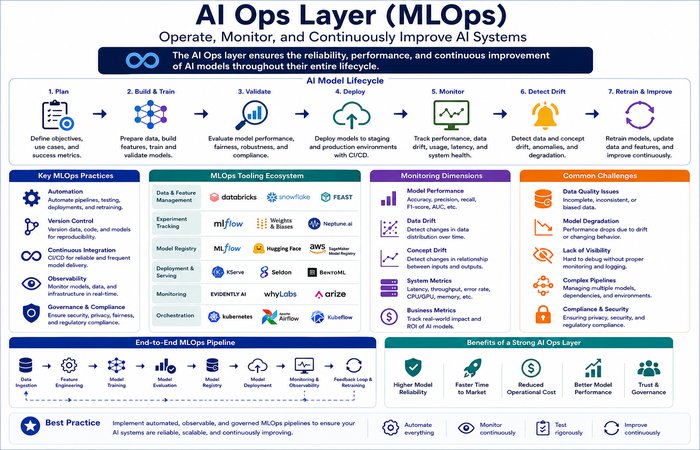
It’s no longer enough for AI to be intelligent.
It also needs to be:
- Secure
- Explainable
- Auditable
- Compliant
- Transparent
- Reliable
Organizations that treat governance as an afterthought usually end up redesigning their AI architecture later.
As AI deployments continue to scale across cloud environments, organizations must also strengthen identity management, encryption, compliance monitoring, and risk mitigation. Following security and compliance best practices for AI systems in AWS can help build resilient and trustworthy AI infrastructure.
The best-performing enterprise platforms build governance into the system from day one.
What Is AI Governance?
AI governance is the collection of policies, technical controls, operational processes, and monitoring mechanisms that ensure AI systems behave responsibly and consistently throughout their lifecycle.
In practical terms, governance answers questions such as:
- What information may AI access?
- Which users may retrieve specific documents?
- How do we know an answer came from an approved source?
- Can we explain why the AI generated this response?
- How do we detect outdated knowledge?
- How do we audit AI decisions?
Governance transforms AI from an experimental tool into enterprise software.
Why Governance Has Become Essential
Early AI applications generated relatively low-risk outputs.
Image classifiers.
Recommendation engines.
Spam filters.
Today’s AI systems are different.
They:
- Answer legal questions.
- Summarize financial reports.
- Assist healthcare professionals.
- Generate software code.
- Search enterprise knowledge.
- Execute autonomous workflows.
The consequences of incorrect answers have increased dramatically.
This is why governance has become a board-level concern rather than simply a technical implementation detail.
AI Risk Management: Identifying Risks Before They Become Problems
Deploying AI responsibly requires more than protecting infrastructure and securing data. Organizations must also identify, assess, and manage the operational risks that AI systems introduce throughout their lifecycle.
Common AI risks include inaccurate or hallucinated responses, biased outputs, unauthorized disclosure of sensitive information, model misuse, prompt injection attacks, and overreliance on automated decisions without appropriate human oversight. Left unmanaged, these risks can undermine user trust, create regulatory challenges, and expose organizations to financial or reputational damage.
Effective AI risk management begins with understanding how AI systems are used, evaluating potential failure scenarios, and implementing safeguards such as human review, continuous monitoring, access controls, audit logging, and regular model evaluations. By addressing risks proactively rather than reactively, organizations can deploy AI systems that are both innovative and trustworthy.
Regulatory Compliance and AI Governance Frameworks
As artificial intelligence becomes more deeply integrated into business operations, organizations must ensure that AI systems comply with evolving regulatory and industry requirements. Governance is no longer limited to internal policies—it increasingly includes demonstrating transparency, accountability, and responsible AI practices to customers, partners, and regulators.
Several frameworks are helping organizations build trustworthy AI systems. The NIST AI Risk Management Framework (AI RMF) provides guidance for identifying and managing AI-related risks throughout the system lifecycle. ISO/IEC 42001 establishes requirements for AI management systems, helping organizations implement structured governance processes. In many regions, regulations such as the European Union AI Act introduce legal obligations for high-risk AI applications, including requirements for documentation, human oversight, and risk management.
Rather than viewing compliance as a barrier to innovation, mature organizations treat governance frameworks as a foundation for building reliable, secure, and trustworthy AI systems that can scale confidently across industries and jurisdictions.
The Five Pillars of AI Governance
Although governance frameworks differ, most enterprise architectures focus on five fundamental pillars.
1. Data Governance
AI learns from data.
If the data is inaccurate, duplicated, outdated, or unauthorized, AI outputs become unreliable.
Data governance ensures:
- trusted sources
- approved documents
- version control
- ownership
- retention policies
- lifecycle management
Good AI begins with good data governance.
2. Access Governance
Not every employee should see every document.
Enterprise AI must respect existing permissions.
If a finance manager asks a question, the AI should retrieve finance documents.
If a marketing employee asks the same question, sensitive financial reports should remain inaccessible.
Access governance extends traditional identity management into AI retrieval systems.
3. Model Governance
Organizations increasingly deploy multiple AI models simultaneously.
Some generate code.
Others summarize contracts.
Others analyze customer conversations.
Model governance determines:
- which model handles each workload,
- how models are updated,
- performance monitoring,
- rollback strategies,
- version management,
- approval workflows.
Without model governance, AI environments quickly become difficult to manage.
4. Operational Governance
Production AI requires continuous monitoring.
Organizations need visibility into:
- latency
- failures
- hallucination rates
- infrastructure utilization
- retrieval quality
- user satisfaction
Operational governance turns AI into an observable production platform.
5. Compliance Governance
Many industries operate under strict regulatory requirements.
Examples include:
- healthcare
- banking
- insurance
- government
- pharmaceuticals
Governance helps organizations satisfy requirements related to:
- privacy
- data residency
- auditing
- explainability
- retention
- consent
As regulations evolve, governance becomes increasingly valuable.
Data Lineage: Knowing Where Every Answer Came From
Imagine asking an AI assistant:
“What is our company’s travel reimbursement policy?”
The assistant provides an answer.
The next question naturally becomes:
“Where did that answer come from?”
If AI cannot answer that question, trust declines quickly.
Data lineage records the journey information takes through the AI pipeline.
It tracks:
- original document
- source system
- author
- update history
- ingestion date
- transformation steps
- embedding generation
- retrieval path
This allows organizations to audit AI decisions rather than accepting them blindly.
Good lineage transforms AI responses into explainable business knowledge.
Source Attribution
One of the simplest ways to improve trust is source attribution.
Instead of generating responses without evidence, enterprise AI increasingly provides:
- document titles
- links
- timestamps
- confidence indicators
- supporting passages
Users can immediately verify the information themselves.
This dramatically improves confidence in AI-generated answers.
Access Control
Enterprise AI should never bypass existing security policies.
A useful principle is:
If a user cannot access a document normally, AI should not retrieve it either.
This sounds obvious.
Yet many early AI deployments overlooked permission-aware retrieval.
Modern AI platforms increasingly integrate directly with enterprise identity providers so retrieval respects existing security rules.
Examples include:
- Microsoft Entra ID
- Okta
- Active Directory
- Google Workspace Identity
Security should exist before retrieval—not after.
Zero Trust for AI
Many organizations now extend Zero Trust principles into AI systems.
Rather than assuming internal users are automatically trustworthy, Zero Trust continuously verifies:
- identity
- device
- permissions
- requested resources
- context
Applying Zero Trust to AI reduces the risk of unauthorized data exposure while supporting modern hybrid work environments.
The NIST AI Risk Management Framework
If one has to name the most familiar of all frameworks, we believe it should be the NIST AI Risk Management Framework (AI RMF).
Rather than suggesting specific technologies, the recommendations concern as to how to handle the AI risks during the system lifecycle.
Its core functions include:
- Govern
- Map
- Measure
- Manage
Most enterprise AI governance programs share these aspects as well, as they focus on iterative improvement instead of a situation of one-and-done compliance.
For such organizations within regulated sectors, the model offers a good starting point of establishing internal AI policy.
AI Observability
Monitoring infrastructure isn’t enough.
Organizations increasingly monitor AI itself.
AI observability tracks:
- prompt quality
- response quality
- hallucinations
- retrieval effectiveness
- latency
- cost
- user feedback
- token usage
- model drift
Enabled observability makes the engineering teams can continually improve the AIs, rather than just fix after a failure.
Reducing Hallucinations Through Better Governance
Hallucinations remain one of the biggest concerns in enterprise AI.
Many organizations assume hallucinations are purely a model problem.
Often they aren’t.
Better governance reduces hallucinations by improving:
- retrieval quality
- document freshness
- source selection
- permission filtering
- metadata
- version control
Instead of asking the model to “guess better,” governance gives it better information to work with.
Governance Best Practices
Organizations building enterprise AI should consider several principles.
Establish authoritative data sources
Not every document deserves equal trust.
Prioritize approved, maintained knowledge.
Respect existing permissions
AI should inherit enterprise security—not replace it.
Monitor continuously
Governance is a process of ongoing operational activities.
Infrastructure, models and data are and always will be changing and improving.
Preserve explainability
Users should understand why AI generated an answer.
Transparent systems build greater trust.
Build governance into architecture
Retrofitting governance costing is much more expensive than designing it. upfront.
Key Takeaways
Recently when AI is thriving, governance appears to be non-existent.
But these are quickly realised when anything goes awry.
Today‘s enterprise AI is just as much about governance as compute, networking, storage and data pipelines.
Organizations that make the investment in a reliable AI platform see higher engagement as users rely on the ai‘s answers.
Governance isn‘t the layer that makes AI smarter.
A part that ensures AI becomes reliable.
Orchestration Across the AI Lifecycle
AI orchestration is simply not limited to scheduling containers or simply provisioning GPU resources. Contemporary AI platforms orchestrate across the entire lifecycle of AI application from data preparation, model training, and runtime deployment, to tracking and scaling, and finally self-healing and self-improving.
Orchestration platforms automate training steps for example preparing datasets, distributed training, hyper parameter selection, model versioning during development. After a model is in production, they automate deployment, load balancing, auto-scaling, health detection, rollback and resource allocation across various environments.
When operational workflows are automated through orchestration, there is less manual work, better utilization of infrastructure, and AI teams can roll out new models with higher reliability. As the AI systems reaches a broader application level, orchestration becomes essential to maintain the scale and consistency of operations across the full AI lifecycle.
Orchestrating AI Workloads: Kubernetes, Slurm, Ray, and the Modern MLOps Stack
- Powerful GPUs.
- Fast networking.
- AI-optimized storage.
- Trusted data.
They are the foundations of what modern-day AI infrastructure is built upon.
But another question remains:
Who decides what runs where—and when?
It is the orchestra layer that has this responsibility.
The large number (hundreds of thousands/thousands) of accelerators that will make up the AI infrastructure cannot be operated manually.
They require a software that can schedule workloads, share GPU resources, adapt when failures occur, balance utilization, and allow multiple teams to affordably share the infrastructure.
This is precisely where the works of Kubernetes, Slurm, Ray and other MLOps ecosystems prove invaluable.
The orchestration layer doesn‘t really speed up our AI models, that‘s not its role.
It makes the entire AI platform manageable.
Orchestrating AI Workloads: Kubernetes, Slurm, Ray, and the Modern MLOps Stack
Developing the AI infrastructure is just one part of the challenge.
Operating it efficiently every day is another.
Imagine an organization with:
- 600 GPUs
- Five AI research teams
- Three production AI applications
- Multiple fine-tuning projects
- Daily inference workloads
- Continuous model retraining
Now imagine trying to assign GPUs manually.
- Which team gets priority?
- Which servers are available?
- What happens if a node fails?
- How do you prevent one workload from consuming every GPU?
At enterprise scale, these questions can’t be answered manually.
They require orchestration.
The orchestration layer, which can be thought of as the “Operating system” of AI infrastructure, determines where in the cluster do workloads run, manages resources, restarting failed jobs, scale services, and enable organizations to get maximum utilization out of costly GPU clusters.
Without orchestration, the fastest hardware for AI disintegrates into intractability.
What Is AI Orchestration?
AI orchestration involves orchestrating infrastructure resources so that AI workloads run efficiently over its entire lifecycle.
Workload assignment to servers is provided by the orchestrator, which approves/disapproves more than one administrator from various servers by:
- GPU scheduling
- CPU allocation
- Memory assignment
- Storage access
- Network resources
- Job priorities
- Auto scaling
- Failure recovery
- Monitoring
Today‘s AI infrastructure is as much dependent on orchestration as it is on GPUs.
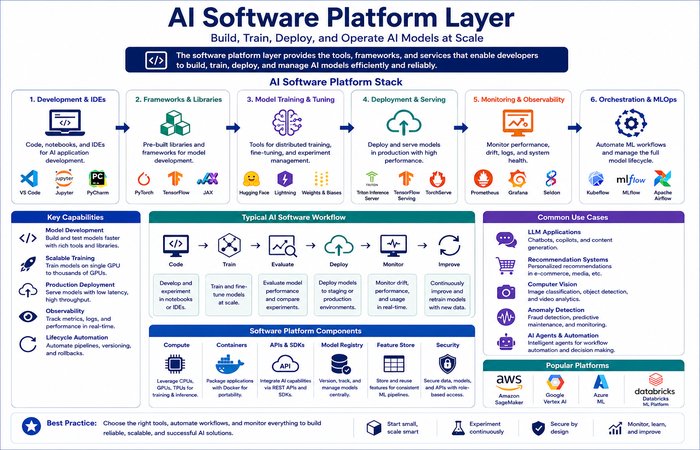
Why Orchestration Matters
Consider two organizations with identical hardware.
Both own:
- 500 GPUs
- High-speed networking
- NVMe storage
- Enterprise vector databases
Company A manages workloads manually.
Company B uses intelligent orchestration.
Which organization gets more value?
Almost always Company B.
Why?
Because orchestration improves:
- GPU utilization
- Infrastructure sharing
- Reliability
- Deployment speed
- Resource fairness
- Operational efficiency
Simply put, if you can get just as much performance out of the system by better orchestration rather than by additional hardware, it‘s the better option.
Kubernetes: The Industry Standard for Cloud-Native AI
Kubernetes Originally started out as a container orchestrator, the Framework does not provide a Plan Management.
Despite this, it is now among the most prevalent foundations for cloud-native AI.
Kube takes care of managing the containers distributed over various clusters, rather than physical servers.
For AI, this means:
- Deploying inference services
- Scaling APIs automatically
- Managing AI microservices
- Running RAG pipelines
- Hosting AI agents
- Serving production models
Advantages include:
- Massive ecosystem
- Vendor neutrality
- Automatic scaling
- Self-healing workloads
- Rolling updates
- Infrastructure portability
Kubernetes excels when AI applications behave like modern software services.
Where Kubernetes Excels
Kubernetes is particularly effective for:
- AI APIs
- Enterprise chatbots
- Customer support assistants
- Recommendation engines
- Image generation services
- AI SaaS platforms
- Continuous deployment
While having the ability to scale workloads automatically, it is ideal for lesser known types of traffic.
Where Kubernetes Is Less Ideal
Training extremely large models presents different challenges.
Large distributed GPU jobs require:
- gang scheduling
- deterministic resource allocation
- synchronized startup
- predictable execution
These capabilities often require additional scheduling frameworks or specialized orchestration tools.
Slurm: The HPC Standard
Years before generative AI was even widely available, supercomputers used Slurm.
Today it remains one of the dominant schedulers for:
- research institutions
- national laboratories
- university clusters
- enterprise AI training
Since Kubernetes is targeted towards microservices, it is not suitable for long-running batch jobs, whereas Slurm is designed mainly for long-running jobs.
Its strengths include:
- deterministic scheduling
- excellent GPU management
- efficient batch processing
- mature HPC ecosystem
- strong distributed training support
Organizations training foundation models frequently rely on Slurm because it minimizes scheduling overhead.
Kubernetes vs Slurm
This comparison appears frequently during infrastructure planning.
The answer isn’t that one replaces the other.
They solve different problems.
| Feature | Kubernetes | Slurm |
| Primary Focus | Applications | HPC Jobs |
| Best For | Inference | Training |
| Auto Scaling | Excellent | Limited |
| GPU Scheduling | Good | Excellent |
| Cloud Native | Excellent | Moderate |
| Batch Workloads | Good | Excellent |
| Production APIs | Excellent | Limited |
Many enterprises deploy both.
Slurm handles research and model training.
Kubernetes serves production AI applications.
Ray: Distributed Python for AI
Ray has become increasingly popular because it simplifies distributed computing for Python applications.
Instead of manually coordinating multiple servers, developers write familiar Python code while Ray distributes execution automatically.
Ray supports:
- distributed training
- hyperparameter tuning
- AI agents
- reinforcement learning
- inference
- data processing
For organizations heavily invested in Python-based AI development, Ray significantly reduces infrastructure complexity.
Why AI Agents Are Driving Ray Adoption
AI agents often execute multiple tasks simultaneously.
An agent may:
- retrieve documents
- call APIs
- summarize information
- generate reports
- execute code
- coordinate additional agents
These workflows require dynamic task scheduling rather than fixed batch jobs.
This type of workload naturally maps to Ray‘s distributed execution model.
Kubeflow
The Kubeflow is a machine learning extension of the Kubernetes.
Rather than replacing Kubernetes, it adds capabilities such as:
- pipeline management
- experiment tracking
- notebook environments
- model serving
- training workflows
Organizations already committed to Kubernetes often adopt Kubeflow to standardize machine learning operations.
Volcano and Kueue
As GPU demand has increased, Kubernetes itself has evolved.
Projects such as Volcano and Kueue improve GPU scheduling for AI workloads.
They introduce capabilities including:
- gang scheduling
- queue management
- workload prioritization
- fair resource allocation
These improvements help Kubernetes support increasingly complex AI environments.
MLOps: Beyond Infrastructure
Infrastructure alone doesn’t guarantee successful AI.
Organizations also need operational processes for:
- model development
- testing
- deployment
- monitoring
- retraining
- rollback
- governance
All of these practices are collectively known as MLOps.
Similar to the impact DevOps had on software delivery, MLOps makes machine learning enable automation and repeatability.
Common MLOps flows comprise:
Data ↓ Training ↓ Validation ↓ Model Registry ↓ Deployment ↓ Monitoring ↓ Retraining
The most successful organizations are incorporating MLOps into their orchestration pipelines.
Choosing the Right Orchestrator
Instead of asking:
Which orchestrator is best?
Ask:
Which orchestrator matches my workload?
Choose Kubernetes if:
- Most workloads are production services.
- Cloud-native deployment is important.
- Auto scaling matters.
- APIs serve customers directly.
Choose Slurm if:
- Large distributed training dominates.
- HPC experience already exists.
- Deterministic scheduling is essential.
- GPU clusters remain dedicated to research.
Choose Ray if:
- Teams primarily develop in Python.
- AI agents are becoming common.
- Distributed execution should remain developer-friendly.
Combine Technologies When Appropriate
Many mature organizations adopt hybrid orchestration.
For example:
Training↓ Slurm ↓ Model Registry ↓ Kubernetes ↓ Production APIs
Ray may operate alongside both for distributed Python workloads.
Hybrid orchestration gives enterprises the freedom of choice, where they don‘t have to impose a single scheduling paradigm to all the workloads.
Common Orchestration Mistakes
Choosing one platform for every workload
Different AI workloads have different scheduling requirements.
Ignoring GPU utilization
Increased GPUs do not resolve much in terms of scheduling inefficiency.
Solving orchestration by an infrastructure problem only
Operations, security, governance and data engineering play an important role in the success of the orchestration as well.
Forgetting observability
The infrastructure team needs to continually monitor the utilization, queues and failures as well as the latency and the health of deployment.
Observability: Keeping AI Operations Running Smoothly
The second task is to run AI workloads. Organizations need to be able to know how their AI systems are doing, and a whole system has to be reliable and up, thus a good observability must be adopted in the infrastructure to give system admin knowledge on failure.
Today‘s AI frameworks have the capability to store information on all types of infrastructure data the GPU, CPU, and memory utilization, queuing time, throughout, number of successful job completion, inference latency, storage throughput, network throughput, and number of orchestration failures. Collection and sharing of this data is critical to identifying problems and checks.
Observability will also make operations proactive. Instead of being alerted when failures occur, companies will be able to see when performance is degrading, predict the boundary at which capacity will be insufficient, and make improvements to scheduling policies over time as work evolve. In the realm of enterprise AI, orchestration and observability can collaborate to maintain a well-optimized, scaled-up, and available infrastructure.
Best Practices
Successful AI platforms typically:
- Separate training from inference.
- Automate deployment.
- Monitor GPU utilization.
- Use Infrastructure as Code where possible.
- Integrate orchestration with governance.
- Plan for hybrid cloud environments.
- Continuously optimize scheduling policies.
Key Takeaways
Orchestration makes all those high-end pieces of hardware working as a real AI platform.
Without intelligent scheduling, organizations are left throwing expensive compute power at their problems and have trouble scaling.
Kubernetes, Slurm, Ray, Kubeflow and others are technologies at different “pieces” along the AI lifecycle:
Good enterprises don‘t look for one “best” orchestrator. They identify the right tool for the right workload, and combine them into one platform..
How to Choose the Right AI Infrastructure Stack
By this point, you have already seen that AI infrastructure is not one product. It’s a collection of technologies that must work together to support your workloads, your team, and your business objectives.
The temptation is to design around the newest GPU, the fastest network, or the latest vector database.
Experienced architects usually begin somewhere else.
They begin with the workload.
Understanding what you’re trying to achieve almost always leads to better infrastructure decisions than starting with hardware specifications.
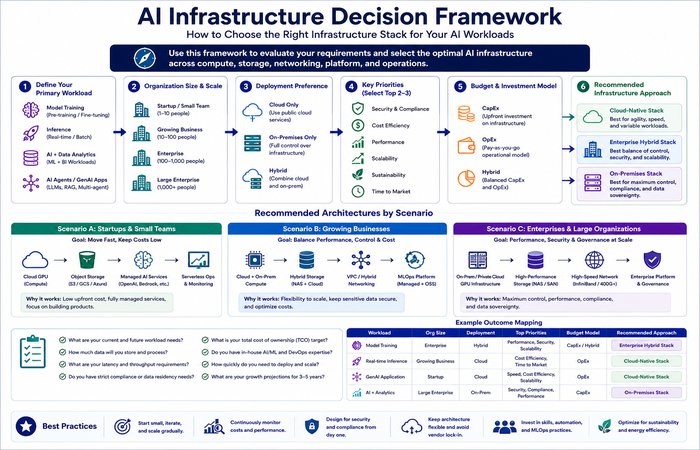
Step 1: Define Your Primary AI Workload
Not every AI application requires the same architecture.
A company training proprietary foundation models has very different infrastructure needs than an organization deploying an internal knowledge assistant.
The first question should always be:
What type of AI system are we building?
Use the following framework as a starting point.
| Primary Workload | Infrastructure Priority |
| Foundation model training | Large GPU clusters, InfiniBand, parallel storage, Slurm |
| Fine-tuning existing models | GPU cloud, fast storage, Kubernetes or Ray |
| Enterprise RAG | Vector database, governance, data pipelines |
| Customer-facing chatbot | Kubernetes, autoscaling, observability |
| Recommendation engine | High-throughput inference, feature stores |
| AI Agents | Ray, Kubernetes, vector databases, APIs |
| Computer Vision | High-throughput storage, GPU inference |
| Batch document processing | CPU + GPU mix with scalable orchestration |
Notice something interesting.
GPUs aren’t always the first priority.
For many enterprise AI projects, better data engineering delivers greater improvements than buying additional accelerators.
Step 2: Decide Where Infrastructure Should Run
The next decision is deployment.
Should infrastructure remain on-premises?
Move entirely to the cloud?
Or combine both?
Each approach has trade-offs.
Cloud Infrastructure
Cloud deployments are ideal when:
- Workloads fluctuate significantly.
- Teams need rapid deployment.
- Capital expenditure is limited.
- Global scalability is important.
- Managed AI services reduce operational complexity.
Challenges include ongoing operational costs, potential vendor lock-in, and data residency considerations.
On-Premises Infrastructure
Private infrastructure becomes attractive when:
- AI workloads operate continuously.
- Data sovereignty is essential.
- GPU utilization remains consistently high.
- Organizations already operate enterprise data centers.
- Long-term operational costs justify capital investment.
The trade-off is increased responsibility for hardware procurement, maintenance, cooling, networking, and lifecycle management.
Hybrid AI Infrastructure
Many enterprises ultimately adopt hybrid architectures.
Sensitive workloads remain on-premises.
Burst capacity comes from public cloud providers.
This approach balances flexibility with control while reducing dependence on any single environment.
Step 3: Design Around Data Rather Than Models
Organizations frequently overestimate the importance of model selection while underestimating data architecture.
The model changes.
Your data remains.
Enterprise knowledge grows every day.
Documents evolve.
Policies change.
Customers generate new information continuously.
Infrastructure should therefore prioritize:
- Data quality
- Metadata
- Retrieval
- Governance
- Continuous updates
Those investments typically outlast any single language model.
Step 4: Balance Performance Against Operational Simplicity
The fastest architecture isn’t always the best architecture.
A highly optimized environment requiring specialized expertise may introduce unnecessary operational risk.
Infrastructure should match team capabilities.
For example:
A startup with three engineers may benefit more from managed AI services than from operating a custom GPU cluster.
A multinational enterprise with dedicated platform teams may gain significant advantages from building specialized AI infrastructure.
Technology should fit the organization—not the other way around.
Build for Tomorrow, Not Just Today’s Workloads
AI infrastructure is a long-term investment. While it’s tempting to design an architecture around current workloads, successful organizations also plan for how those workloads are likely to evolve over the next several years.
A chatbot serving a few hundred users today may eventually support thousands of employees. A retrieval system may grow from indexing a few thousand documents to processing millions of records across multiple business units. New AI capabilities such as multimodal models, autonomous agents, and real-time analytics can also introduce infrastructure requirements that weren’t part of the original design.
Rather than building for maximum performance on day one, organizations should prioritize architectures that can scale incrementally. Choosing modular infrastructure, open standards, interoperable technologies, and cloud-ready designs makes it easier to expand compute capacity, storage, networking, and orchestration without disruptive migrations.
Infrastructure decisions should therefore support future business growth as much as current technical requirements. Designing with scalability in mind reduces long-term costs, minimizes operational disruption, and provides the flexibility needed to adopt new AI technologies as they emerge.
Reference Architectures
The following examples illustrate how infrastructure choices vary depending on business requirements.
Startup Building an AI SaaS Product
- Cloud GPUs
- Kubernetes
- Managed vector database
- Object storage
- CI/CD pipeline
- Managed monitoring
Priority: Speed and developer productivity.
Enterprise Knowledge Assistant
- Hybrid cloud
- Kubernetes
- Enterprise identity integration
- Vector database
- Document ingestion pipeline
- Governance framework
Priority: Trust, security, and accurate retrieval.
Research Organization Training Large Models
- Dedicated GPU cluster
- InfiniBand networking
- Parallel file system
- Slurm scheduler
- High-performance checkpoint storage
Priority: Maximum training throughput.
Building a Balanced AI Infrastructure
One of the biggest misconceptions in enterprise AI is that improving a single infrastructure component will automatically improve overall system performance. In reality, AI platforms behave as interconnected systems where every layer influences the efficiency of the others.
For example, adding more GPUs provides little benefit if storage cannot deliver training data quickly enough. Upgrading networking alone won’t improve retrieval quality if enterprise data is outdated or poorly organized. Likewise, deploying a larger language model cannot compensate for weak governance, inconsistent metadata, or inefficient orchestration.
The most successful organizations therefore optimize their infrastructure as a complete ecosystem rather than as isolated technologies. Compute, networking, storage, data pipelines, vector databases, orchestration, and governance should be designed to complement one another so that no single layer becomes the limiting factor.
This balanced approach improves performance, increases infrastructure utilization, simplifies operations, and reduces long-term costs. More importantly, it creates an AI platform that can adapt as workloads, business requirements, and technologies continue to evolve. In enterprise AI, sustainable success rarely comes from owning the most powerful hardware—it comes from building the most balanced architecture.
Common AI Infrastructure Mistakes
Even well-funded organizations make avoidable mistakes.
Recognizing them early can save significant time and money.
Mistake 1: Buying Hardware Before Designing the Architecture
Infrastructure should solve workload requirements—not the other way around.
Purchasing expensive GPUs before planning storage, networking, and orchestration often creates unnecessary bottlenecks.
Mistake 2: Ignoring Data Governance
Many AI failures originate from poor information rather than poor models.
Outdated documentation, duplicated content, and missing permissions quickly undermine user trust.
Mistake 3: Assuming Bigger Models Solve Everything
Larger models generally require more compute, more storage, and higher operating costs.
Sometimes a smaller model connected to excellent retrieval infrastructure delivers better business results.
Mistake 4: Optimizing Individual Components Instead of the System
Improving GPUs while neglecting networking rarely increases overall performance.
AI infrastructure behaves like an ecosystem.
Every layer influences the others.
Mistake 5: Forgetting Operational Costs
Infrastructure isn’t purchased once.
It operates continuously.
Electricity.
Cooling.
Monitoring.
Maintenance.
Software licensing.
Cloud consumption.
Support.
Long-term operational planning matters just as much as initial procurement.
| Layer | Primary Goal | Typical Technologies |
| Compute | Model execution | GPUs, TPUs |
| Networking | GPU communication | InfiniBand, RoCEv2 |
| Storage | Data delivery | NVMe-oF, Object Storage |
| Data Pipelines | Data preparation | ETL, Embeddings |
| Vector DB | Semantic retrieval | Pinecone, Weaviate |
| Governance | Trust & Compliance | NIST, ISO |
| Orchestration | Automation | Kubernetes, Ray |
Future Trends: Where AI Infrastructure Is Heading (2026–2030)
The pace of AI infrastructure innovation shows no sign of slowing.
Several trends are likely to shape enterprise deployments over the next few years.
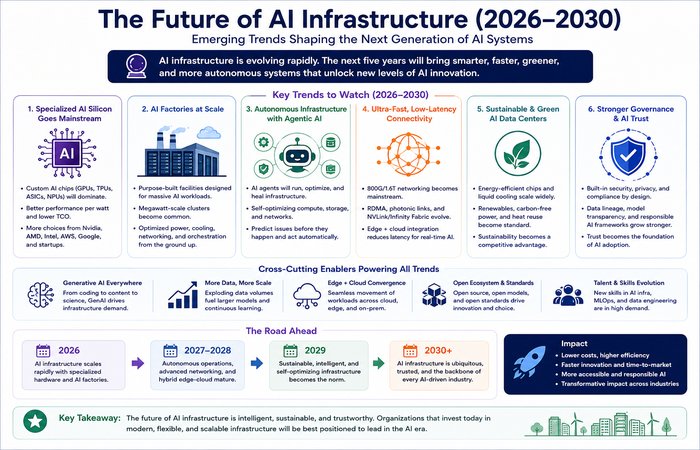
Specialized AI Silicon
Cloud providers and hardware vendors will continue developing purpose-built AI accelerators optimized for training and inference. Organizations will have more architectural choices beyond traditional GPU-centric environments.
Rather than relying exclusively on general-purpose GPUs, enterprises will increasingly evaluate custom accelerators based on specific workload requirements. AI chips such as AWS Trainium, Google TPUs, and other domain-specific processors can deliver better price-to-performance for selected training or inference workloads, particularly when organizations are already invested in those cloud ecosystems. The trade-off is that software compatibility, tooling, and ecosystem maturity may differ from the well-established NVIDIA CUDA platform, making careful workload evaluation essential before adoption.
Higher-Speed Networking
400 GbE deployments are becoming increasingly common, while 800 GbE and next-generation Ethernet technologies continue to mature. Faster networking will reduce communication overhead for distributed AI workloads.
As AI models continue to grow, communication between accelerators is becoming just as important as raw compute performance. Higher-speed networking reduces synchronization delays during distributed training, improves GPU utilization, and enables larger clusters to scale more efficiently. Organizations building large AI environments will increasingly treat networking as a strategic investment rather than simply supporting infrastructure.
AI Factories
Rather than isolated GPU clusters, organizations are beginning to design dedicated AI factories—integrated environments optimized specifically for training, fine-tuning, inference, and AI operations at scale.
These environments combine compute, storage, networking, orchestration, data pipelines, and governance into a unified platform that supports the complete AI lifecycle. By standardizing infrastructure and operational processes, AI factories help organizations deploy new models faster, improve resource utilization, and reduce the operational complexity of managing multiple AI workloads across different business units.
Greater Automation
Infrastructure management will become increasingly automated. AI itself will help optimize resource scheduling, capacity planning, failure prediction, cost optimization, and performance tuning.
As enterprise AI deployments expand, manually managing thousands of GPUs, storage systems, and orchestration platforms will become increasingly impractical. Intelligent automation will continuously monitor infrastructure health, rebalance workloads, predict capacity shortages, and recommend configuration improvements. This shift will allow engineering teams to spend less time on routine operations and more time delivering new AI capabilities.
Stronger Governance
As regulatory requirements evolve, governance, explain ability, and observability will become standard components of enterprise AI platforms rather than optional features.
Organizations will increasingly adopt structured governance frameworks to demonstrate that AI systems are secure, transparent, and compliant with industry regulations. Capabilities such as continuous auditing, model monitoring, source attribution, access control, and policy enforcement will become standard expectations for enterprise AI rather than advanced features reserved for highly regulated industries.
FAQs
Q1: What is AI infrastructure?
A: AI infrastructure is the collection of hardware, software, networking, storage, data pipelines, orchestration platforms, and governance systems required to build, deploy, and operate artificial intelligence applications.
Q2: Why is AI infrastructure important?
A: Modern AI depends on more than powerful models. Infrastructure determines performance, scalability, reliability, security, and operational cost.
Q3: Are GPUs the most important part of AI infrastructure?
A: No. GPUs provide computational power, but networking, storage, data quality, orchestration, and governance often determine overall system performance.
Q4: What is the difference between AI training and inference?
A: Training teaches models using large datasets and significant computational resources. Inference uses trained models to generate predictions or responses for users.
Q5: What is a vector database?
A: A vector database stores embeddings that allow AI systems to retrieve information based on semantic similarity instead of exact keyword matching.
Q6: Should organizations build AI infrastructure on-premises or in the cloud?
A: The answer depends on workload characteristics, budget, compliance requirements, operational expertise, and long-term infrastructure strategy. Many enterprises adopt hybrid architectures.
Q7: How much does AI infrastructure cost?
A: There is no single answer because costs vary depending on workload size, deployment model, and performance requirements. Small AI projects using managed cloud services may cost only a few hundred dollars per month, while enterprise GPU clusters for large-scale training can require investments ranging from hundreds of thousands to millions of dollars. Organizations should evaluate both upfront infrastructure costs and long-term operational expenses, including power, cooling, storage, networking, and software licensing.
Q8: Can small businesses build AI infrastructure?
A: Yes. Small businesses don’t need to build large GPU clusters to benefit from AI. Many start with managed cloud AI services, hosted vector databases, and pay-as-you-go GPU instances that eliminate the need for significant upfront investment. As workloads grow, infrastructure can gradually expand into hybrid or dedicated environments.
Q9: What skills are needed to manage AI infrastructure?
A: Enterprise AI infrastructure typically requires expertise across several disciplines, including cloud architecture, networking, storage, Kubernetes, GPU computing, data engineering, MLOps, security, and AI governance. Smaller organizations often combine these responsibilities within a platform engineering or DevOps team, while larger enterprises usually have dedicated specialists for each area.
Q10: Which orchestration platform is best?
A: There is no universal answer.
Kubernetes excels for cloud-native production workloads.
Slurm remains a strong choice for large-scale distributed training.
Ray simplifies distributed Python-based AI applications.
Q11: Why does governance matter?
A: Governance ensures AI systems retrieve trusted, authorized, and explainable information while supporting security, compliance, and user confidence.
Q12: How often should AI infrastructure be updated?
A: Rather than replacing infrastructure frequently, organizations should design modular architectures that allow compute, storage, networking, and software components to evolve independently.
Q13: What is the biggest mistake organizations make?
A: Optimizing individual technologies instead of the overall system.
Balanced infrastructure consistently outperforms isolated investments in compute alone.
Conclusion
Artificial intelligence is no longer limited by the capabilities of models alone. As organizations move from experimentation to production, the quality of their infrastructure increasingly determines whether AI initiatives succeed or fail.
Throughout this guide, we’ve explored the essential building blocks of modern AI infrastructure—from compute, networking, and storage to data pipelines, vector databases, orchestration, governance, and long-term architectural planning. Individually, each layer plays a critical role. Together, they create the foundation that enables AI systems to scale reliably, operate securely, and deliver consistent business value.
The most successful organizations won’t necessarily be those with the largest GPU clusters or the newest AI models. They’ll be the ones that build balanced, resilient, and adaptable infrastructure capable of supporting changing workloads, evolving technologies, and future business needs.
Whether you’re designing your first AI platform or modernizing an enterprise-scale deployment, think beyond individual technologies. Build an ecosystem where every layer works together.
Because in the years ahead, competitive advantage won’t come from simply using AI—it will come from building the infrastructure that allows AI to perform at its full potential.
Related Guides
If you’d like to explore specific components of AI infrastructure in greater depth, the following guides provide detailed explanations, implementation best practices, and real-world use cases. Together, they form a comprehensive resource hub covering compute, networking, storage, data engineering, orchestration, and modern AI application architecture:
- GPU Architecture Explained
- Vector Databases Explained
- Retrieval-Augmented Generation (RAG)
- AI Data Pipelines
- AI Agents
- Kubernetes for AI Workloads
- MLOps Guide
- Cloud AI Infrastructure
- AI Storage Technologies
- AI Networking Explained
References
The information and best practices discussed in this guide are based on widely recognized industry standards, official documentation, and leading AI infrastructure resources, including:
- NVIDIA Documentation (CUDA, TensorRT, NCCL, NVIDIA AI Infrastructure, and NVIDIA Networking)
- AWS Documentation (Amazon EC2, Trainium, Inferentia, Elastic Fabric Adapter, Amazon S3, and AWS Architecture Center)
- Google Cloud Documentation (Cloud TPU, Vertex AI, Vertex AI Vector Search, Cloud Storage, and Google Cloud Architecture Center)
- Microsoft Learn (Azure AI, Azure Kubernetes Service, Azure AI Search, Azure Storage, and Azure Architecture Center)
- Kubernetes Documentation
- Kubeflow Documentation
- Ray Documentation
- NIST AI Risk Management Framework (AI RMF 1.0)
- ISO/IEC 42001: Artificial Intelligence — Management System Standard
- European Union AI Act
- Pinecone Documentation
- Weaviate Documentation
These resources represent authoritative guidance from leading cloud providers, standards organizations, and open-source projects, helping ensure that the architectural recommendations and technical concepts presented throughout this guide reflect current enterprise AI infrastructure best practices.