
Slashing Review Latency with AI Refinement
The traditional creative agency model is currently colliding with a production reality that few were prepared for. While generative models have made it possible to produce a dozen high-fidelity concepts in the time it used to take to sketch one, the “last mile” of production remains a stubborn bottleneck. A designer generates a stunning cinematic shot for a client, only to realize the subject has an anatomical anomaly or the background features a distracting, hallucinated artifact.
In the old workflow, this asset would be kicked back to a specialist retoucher. In the worst-case scenario, the designer would spend two hours in a legacy desktop editor fixing a problem that the AI created in twenty seconds. This is the “90% trap”—the phenomenon where an AI generates the bulk of the work instantly, but the final 10% of refinement consumes the entire profit margin. To survive this, agencies are moving away from a batch-and-wait model toward integrated refinement, utilizing a dedicated AI Photo Editor to handle corrections in-situ rather than through fragmented software hand-offs.
Table of Contents
The Feedback Loop: Where Agency Profit Margins Dissipate
The primary friction point for modern creative operations isn’t a lack of ideas; it’s review latency. When an agency handles a 50-asset social campaign, each asset typically moves through a linear pipeline: generation, internal review, retouching, second review, and client approval. If the generative tool produces “good but flawed” results, the internal review cycle balloons.
Every time a creative director sends an image back for “just a quick fix,” it triggers a context switch for the designer. These micro-delays are the silent killers of agency efficiency. We are seeing a shift where the value-add of a designer is no longer their ability to prompt a model, but their ability to refine and validate the output. If a designer cannot fix an AI hallucination within the same interface where they generated the image, the production velocity gained from AI is effectively neutralized by the administrative cost of the correction cycle.
This is why “refinement” has become the primary metric for creative ops leads. The goal is to minimize the distance between a raw generative output and a brand-compliant deliverable. When teams utilize a robust AI Photo Editor, they are essentially collapsing the retouching phase into the creation phase.
Refinement as a Service: Bridging the Generative Gap
Moving beyond the prompt requires a shift from stochastic (random/probabilistic) to deterministic (controlled) workflows. Generative models like Flux or Nano Banana are brilliant at aesthetic breadth but often fail at specific, localized requirements. A client might love the lighting of a generated lifestyle shot but demand the removal of a specific object in the background that conflicts with their brand guidelines.
Using an AI Photo Editor allows a designer to bridge this gap without leaving the production environment. Instead of re-rolling the prompt—which often changes the entire composition and restarts the review cycle—the designer can use an object eraser or in-painting tool to remove the offending element while preserving the rest of the image. This “in-place” editing is the tactical advantage that allows a small team to perform like a much larger department.
The transition here is from “Creation” to “Curated Refinement.” The agency is no longer just selling a finished image; they are selling the expertise required to navigate the flaws of generative technology. This requires a toolset that prioritizes local edits over global regenerations.
Workflow Compression: From Linear to Concurrent Production
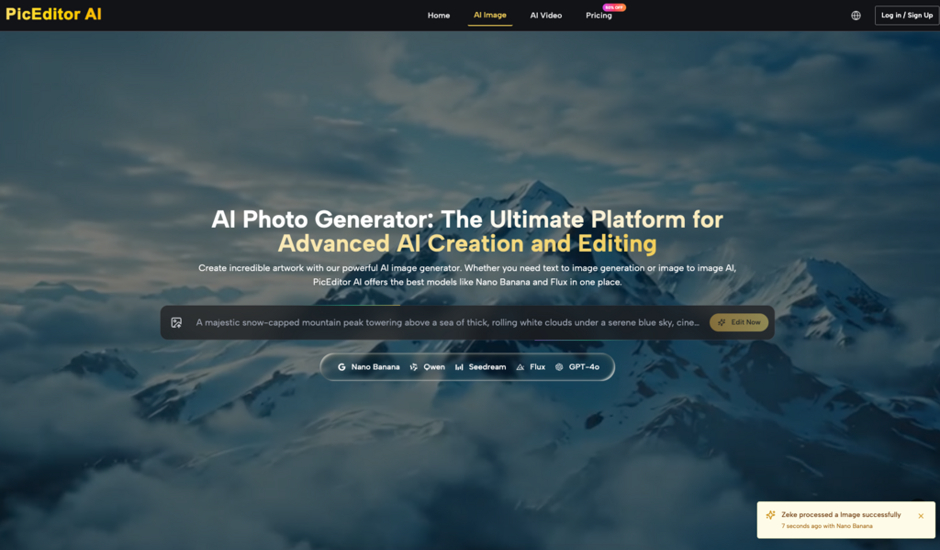
In high-volume settings, the integration of tools like PicEditor AI changes the sequence of production. Traditional retouching is linear: you finish the image, then you edit. Concurrent production allows a designer to polish an asset as it is being evaluated.
Consider a 20-asset social campaign using the Seedream or Flux models. In a traditional setup, you would generate 100 variations, pick 20, and then start the painstaking process of upscaling and cleaning them. With an integrated AI Photo Editor, the upscaling and enhancement happen as part of the selection process.
Tactical Polish with Specialized Tools
- Upscaling and Detail Recovery: Many generative outputs look great at low resolution but fall apart when scaled for print or OOH (Out-of-Home) advertising. Using an AI-driven upscaler ensures that textures remain natural rather than becoming “plastic” or over-sharpened.
- Face Enhancement and Swapping: For brand consistency, agencies often need to maintain a specific “persona” across multiple campaign assets. Tools that allow for face swapping or targeted enhancement enable a team to use a high-performance generative model for the environment while keeping the human subjects consistent and “on-brand.”
- Object Erasure: This is perhaps the most-used tool in the agency arsenal. Removing a stray power line from an architectural shot or a generic logo from a piece of clothing saves hours of manual cloning and healing.
The real-world impact is measurable. We’ve seen internal benchmarks where a 20-asset campaign that previously took 15 hours of retouching is reduced to roughly 3 hours of AI-assisted refinement. The quality remains identical, but the delivery velocity increases fivefold.
Where the Machine Stumbles: Navigating the Limits of AI Editing
Despite the advancements, it is critical to acknowledge where these tools currently reach their limits. An AI Photo Editor is a powerful assistant, but it is not a replacement for a discerning human eye or specific technical requirements.
One of the most persistent challenges is the “Branding Paradox.” AI models still struggle with exact hex-code reproduction. If a client’s brand identity relies on a very specific shade of Pantone “Process Blue,” an AI generator might get close, but it will rarely hit the exact CMYK or RGB values required for strict brand compliance. Agencies must still rely on traditional color grading and manual overlays for high-stakes brand assets.
Furthermore, there is the “Uncanny Valley” risk in automated face enhancement. While the technology can smooth skin and sharpen eyes, it can easily cross the line into a look that feels artificial or “filtered,” which can be detrimental to luxury or lifestyle brands aiming for authenticity. Recognizing when to stop the AI enhancement and leave the natural “grain” of an image is a skill that current automation cannot replicate.
Finally, there is the ongoing uncertainty surrounding the legal and licensing landscape of AI-generated derivative works. While a GPT Photo Editor can fix a generated image, the underlying copyright status of the original asset for enterprise-level global campaigns remains a gray area that requires legal oversight and careful contract management. We cannot yet say with 100% certainty how these assets will be treated in multi-year litigation, so caution in high-stakes environments is mandatory.
The ROI of Integrated Post-Production Pipelines
For agency leads, the decision to centralize on an all-in-one platform like PicEditor AI is often driven by “tool fatigue.” Creative teams are currently overwhelmed by a fragmented stack of single-use plugins, Discord bots, and browser-based beta tools. Each one requires a separate subscription and a different learning curve.
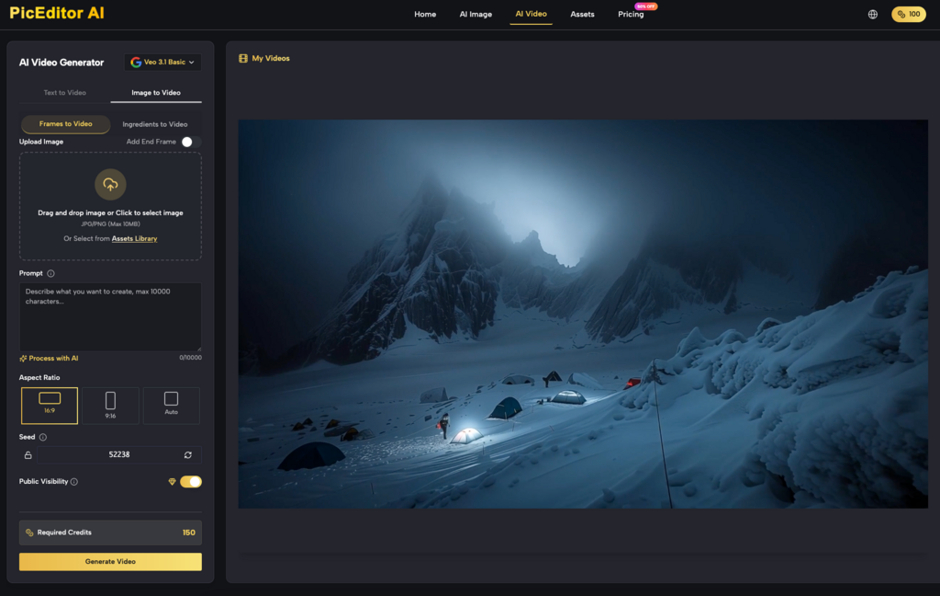
By standardizing on a versatile AI Photo Editor, agencies reduce the cognitive load on their designers. When the same platform offers text-to-image (via models like Flux or Qwen), image-to-video (via Kling or Veo), and a full suite of editing tools, the workflow becomes cohesive. This centralization leads to a significant reduction in overhead costs—not just in subscription fees, but in the time saved by not moving assets between five different web apps.
The commercial reality is that clients are increasingly aware of AI’s speed and are beginning to demand faster turnarounds and lower costs. Agencies that cling to the old, high-latency retouching model will find their margins squeezed. Those who pivot to a refinement-heavy, AI-integrated pipeline can maintain their pricing by delivering higher volumes and faster iteration cycles, ultimately decoupling their revenue from their headcount. This isn’t just about making images better; it’s about protecting the agency’s ability to scale in an era of instant generation.