


Last Updated: June 2026 | Read Time: 22 minutes
Generative ai or GenAI has gone from a flashy internet curiosity to the most important enterprise technology of this decade. But 2026 is the year of reckoning the “trough of disillusionment” 80% of pilots will flame-out and only purpose-built, governed systems will emerge victorious. Here‘s the full strategy, technical and regulatory playbook to succeed.
Table of Contents
Key takeaways:
1. GenAI generates new content (text, images, code, audio, video, proteins) by fitting the probability distributions to the training data;
2. The 2024 2025 correction phase is a consequence of the difficulty to integrate ailing data and data not of good quality that do not return the expected ROI.
3. Domain-specialist, RAG-based systems outperform generic chatbots in healthcare, finance and programming.
4. Hybrid infrastructure (local for sensitive workload + cloud for frontier models) provides a good trade-off between privacy and scale.
5. Regulatory compliance (EU AI Act labelling, tension GDPR versus CLOUD Act, IP litigation) is with no doubt the biggest existential risk24.
6. ROI framework: Build/Analyze/Manage using KPIs which can be measured (accuracy rate, time saving, cost-per-query)
7. Future: By 2027, Generative Engine Optimization (GEO) and agentic AI will revolutionize marketing and interfaces as well as our way of thinking.
Why 2026 Is the Year Generative AI Grows Up
Generative AI is a three-year bubble. Every meeting began with “How are you utilizing ChatGPT?” Every roadmap promised disruption. Every CEO demanded a strategy.
Then reality hit.
By 2026, we‘ve moved from demonstration to evidence. The board no longer wants a demo they want ROI. Regulators no longer tolerate ambiguity—they demand audit trails. And users no longer tolerate hallucinations—they expect accuracy.
Gartner‘s hype cycle and reports in the likes of The Economist shows that generative AI entered a correction in 2024 2025, “trough of disillusionment” this is an industry analysis not a hard date, so we quote it as such
This is the Complete Guide to Generative ai (2026): a comprehensive resource that takes you from the basics of how the technology works, through to its application in different industries, questions around infrastructure choices, regulatory hurdles, and both mitigating risk and the upcoming becoming of AI companions and creative synthesis. Here for CTOs laying out enterprise implementation, founders creating a GenAI product, or strategists executing their next five years this is your bible.
Here are a few beginner explainers, enterprise strategy, model comparisons, pricing benchmarks and an FAQ section aimed at both technical and business users.
In this guide:
- What Generative AI Really Is (and How It Evolved)
- The 2026 Hype Cycle
- Industry Use Cases that Actually Work
- Infrastructure: Local vs. Cloud vs. Hybrid
- Model Comparison & Cost Benchmarks
- The Human Side: AI Companions & Co-Pilots
- Global Regulation
- Risk Mitigation
- The ROI Framework
- The Future: GEO and Agentic AI
- FAQs
1. What Is Generative AI? From Markov Chains to Multimodal Frontier Models
Generative AI (GenAI): Generative AI is a type of AI that “generates” (creates/produce) by learning from the distribution of the data used in training (for example: text, images, code, audio, video, proteins, etc.). This is in contrast to traditional AI that classifies or predicts.
With the building market, the value for U. S. consumers of generative AI products and services will grow through 2026 to a value of $172 billion per year, and U. S. consumers median value per user has been to double between 2025 and 2026.
1.1 Predictive AI vs. Generative AI
The clearest way to understand GenAI is by contrast:
| Dimension | Predictive AI | Generative AI |
| Goal | Classify, forecast, score | Create, synthesize, compose |
| Output | A label or number | Novel content |
| Example | “This email is spam (95%)” | “Write me a marketing email” |
| Training | Supervised on labeled data | Self-supervised on massive corpora |
| Risk Profile | False positives/negatives | Hallucinations, IP leakage |
This isn‘t a small step it s a complete step change. Predictive ai indicates what is, generative ai envisages what might be.
1.2 A Brief History: 1906 to 2026
The “overnight success” of ChatGPT was actually 120 years in the making:
- 1906 Markov Chains: Russian Mathematician Andrey Markov created a conditional probability model to order vowel-consonant patterns in Pushkin‘s poetry.
- 1980s–1990s — Symbolic Generative Planning: Rigid rule-based systems generated autonomous spacecraft routines and military crisis plans. Powerful but brutal.
- 2014 Deep Generative Modeling: Generative Adversarial Networks (GANs) and Variational Auto encoders (VAEs) by Ian Good fellow made computers capable of producing photo-realistic images.
- 2017 The Transformer Revolution: Google‘s hot new paper “Attention Is All You Need” proposed the transformer which led to new contextual language understanding in parallel.
- 2022–2024 The ChatGPT Era The series of OpenAI‘s GPT, Anthropic‘s Claude, and Google‘s Gemini have made LLMs household appliances.
- 2025–2026 Multimodal and agentic AI: futurist capable frontier models will support multiple modalities (text, image, audio, code etc.) within the same model, and experimental agentic systems will be operating effectively on multi-step tasks but reliable autonomous agents are still a remaining safety challenge for research.
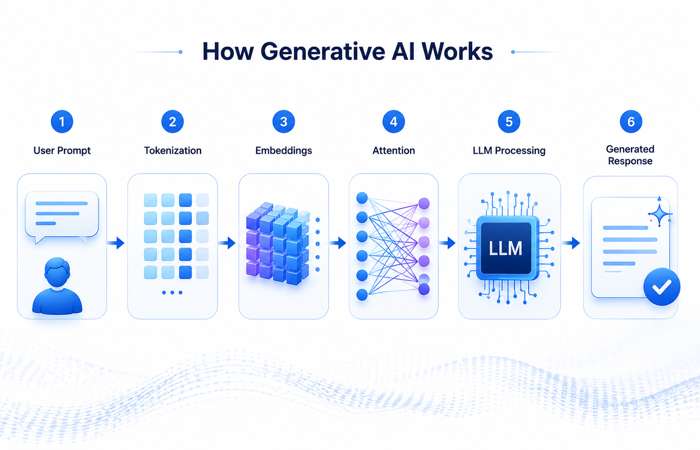
1.3 How Generative AI Actually Works (Transformers Explained)
All current Generative AI runs on the transformer architecture. Here’s the simplified mental model:
- Tokenization: Your input (“Write a poem about Mars”) is broken into tokens (sub-word units).
- Embedding: Transformeach token intovectorofhugedimensioncoords in “meaning space”.
- Attention: the model considers how every token interacts with every other token in the window of context. This is the “magic.”
- Generation: It predicts the next most probable token, then the next, then the next—until it has built a complete response.
The result feels like creativity, but it’s actually probability at planetary scale.
Click on our cluster article: How Text-to-Image AI Produces Images: The Perfect Beginner‘s Guide to Text-to-Image AI
2. The 2026 Hype Cycle: Navigating the Trough of Disillusionment
Gartner‘s hype cycle‘s at expected inflection point. After Peak of Inflated Expectations 2023-2024 has drops down into Trough of Disillusionment 2025-2026. (This isn‘t a failing of Gen AI so much as a maturing of it.)
2.1 Why Enterprises Are Hitting the Wall
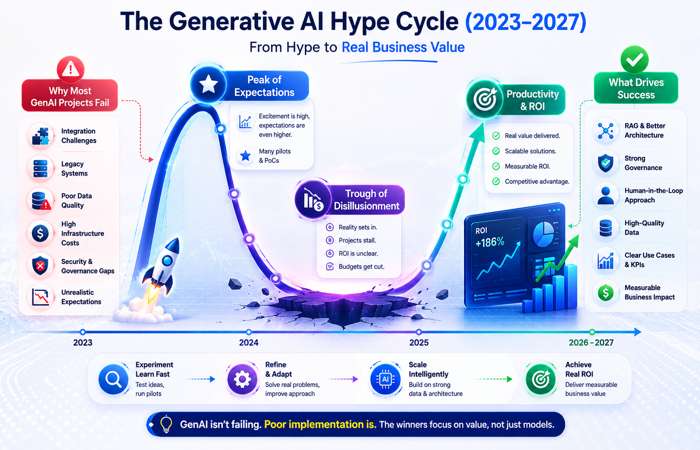
Three forces are dragging enterprises down:
- Integration challenges most independent chatbots are not in communication with the legacy ERP, CRM systems, or data warehouse. The maze of incompatible pilot projects opened up Pandora‘s box and threw transformation in disarray.
- Unquestionably, Bad Data Quality: Garbage in garbage out is the iron law of machine learning. Improbably labeled and biased or out-of-date training data will create inconsistent results and cause model drift.
- Unmet ROI: Training and inference on H100-class clusters is capital-intensive—multi-hundred-thousand-dollar capital and many thousands monthly in operating costs are common—so CFOs demand clear ROI.
2.2 The Strategic Filter: Who Wins by 2027
The trough is a competitive filter. It separates:
- ❌ Companies generating “plausible BS”—content that sounds smart but says nothing.
- ❌ Companies treating GenAI as a science fair project.
- ✅ Companies building domain-specific, governed, grounded systems.
Come 2027, the winners will be those who cracked what we have dubbed “The Last Mile of Gen AI“ the brutal chasm that exists between a working demo and a production system that scales, conforms, and makes money.
For a deeper technical breakdown of why most AI projects fail after the demo stage, read our guide on The Last Mile of GenAI, where we explain the infrastructure, governance, and scaling challenges behind enterprise AI adoption.
Establish an outcome based AI adoption framework Companies that adopt an outcome-based AI adoption framework are able to scale from pilots to production more quickly, de-risk, and realize greater ROI for AI initiatives.
Deep dive The last mile of genai why 80 of enterprise pilots never make into production
3. Sector-Specific Use Cases: Where GenAI Delivers Real ROI
The exit from the trough is industry-specific. Generic chatbots are dying. Domain-grounded copilots are thriving.
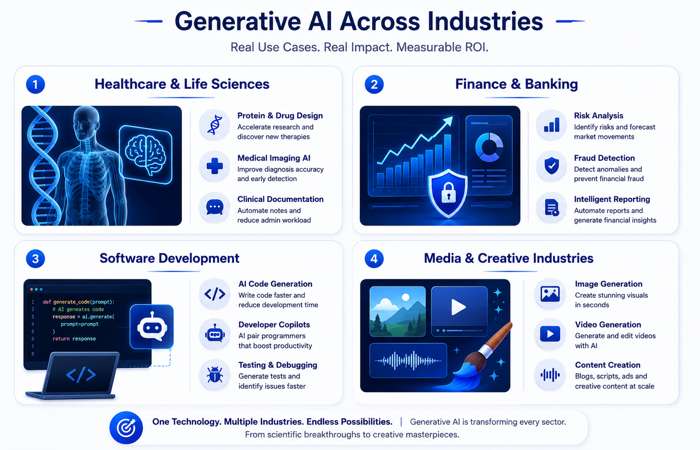
3.1 Healthcare & Life Sciences
Healthcare is arguably the highest-value GenAI vertical of 2026:
Application Impact
Protein Synthesis (ProGen) Engineering vaccines and novel medications that don’t exist in nature
Diagnostic Imaging VAEs reduce MRI noise and produce higher-resolution scans
Clinical Documentation Auto-generating SOAP notes and informed consent forms—reducing physician burnout
Knowledge Retrieval RAG-powered search across millions of journal articles
The are a new transparency requirement on the see of artificial intelligent-assisted scientific discovery (The Leiden Declaration, 2025) bringing into line peer review of academic and commercial research.
3.2 Financial Services
Banks and asset managers use GenAI for:
- Trading strategy generation and Monte Carlo risk simulation
- Personalized financial advice at retail scale
- Fraud narrative reconstruction from transaction graphs
- Regulatory compliance drafting (SAR/KYC)
The Critical Risk: “Information Laundering”—where AI-generated misinformation gets indexed by other AI models as truth, potentially skewing market sentiment. Combined with the “black swan” problem (models trained on historical data can’t predict unprecedented events), financial GenAI requires aggressive human oversight.
3.3 Software Development & “Vibe Coding”
The top job for 2026 is software engineering but not quite as predicted.
Vibe coding—writing software through natural language prompts—has democratized development. GitHub Copilot, Cursor, and Claude Code now ship a significant portion of all new commits in modern repositories.
But there’s a dark side:
- Skill atrophy among junior developers who never learn first principles
- Security flaws embedded in AI-generated snippets
- The “Last Mile” problem: prototypes work, but production-grade systems still require senior engineering judgment
Related: The Last Mile of GenAI: From Prototype to Production
3.4 Creative Industries & Media
The creative economy is being rewritten in real time:
- Significant displacement has been reported in some creative sectors—there are industry reports and surveys suggesting notable job impacts among illustrators and asset creators in China and elsewhere, but precise percentages vary by source and should be cited.
- Hollywood movies utilizing previs and storyboarding produced through artificial intelligence
- Independent artists, using Midjourney, DALL-E 3 and Stable Diffusion to compete with the large studios; Modern creative AI systems rely heavily on diffusion models and multimodal learning. Our detailed Text-to-Image AI guide explains how AI image generators work and compares leading platforms.
- Music labels experimenting with Suno and Udio for backing tracks
This is the most hotly contested frontier battling creators and platforms in Courtrooms across the globe.
Find: Text-to Image AI in 2026: Complete Range of Midjourney, DALL-E & Stable Diffusion
4. Infrastructure Strategy: Local vs. Cloud vs. Hybrid Deployment
The second critical decision in starting your model business is the location of your model. This will influence your risk, your costs and the moat of your model business.
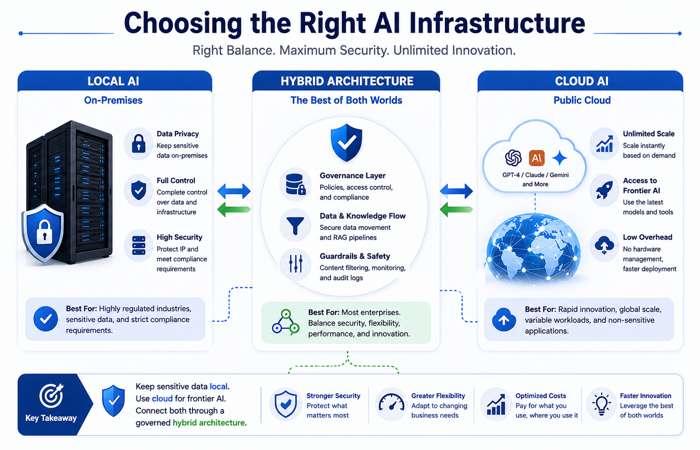
4.1 The Case for Private Local Deployment
Running models on your own hardware even consumer-grade or edge devices is increasingly viable:
- A scaled-down, quantized smaller size models that have been optimized (e.g. LLaMA-family forks 7B-parameter models) can easily be run on high-end laptops with CPU / GPU and memory management.
- Tiny SLM slices (with extreme quantization or distillation) can be hosted on edge hardware, but don‘t have much speed or context length.
- On-prem H100 clusters serve regulated industries (healthcare, defense, finance)
Why go local?
- Data Privacy: Sensitive data never crosses your firewall
- IP Protection: Proprietary knowledge isn’t fed into someone else’s training set
- Censorship Avoidance: No rate limits, no content filters, no API outages
- Sovereignty: You control the stack end to end
4.2 The Cloud Imperative for Frontier Models
Cloud is needed for the SOTA results (GPT-5, Claude 4 Opus, Gemini 2 Ultra). Frontier models require:
- Thousands of clustered NVIDIA H100/H200 GPUs
- Petabyte-scale training datasets
- Specialized cooling and interconnect infrastructure
The outcome? An unintended strategic reliance on hyperscalers: AWS, Azure, GCP and OCI. You‘re not just purchasing compute you are leasing civilization.
4.3 The Full-Stack AI Framework
Modern enterprise GenAI is never just an LLM. The full-stack architecture includes:
| Layer | Function | Examples |
| Foundation Model | Core generation engine | GPT-5, Claude 4, LLaMA 4, Palmyra |
| RAG Layer | Connects model to your proprietary knowledge | Pinecone, Weaviate, ChromaDB |
| Knowledge Graph | Structured business context | Neo4j, custom ontologies |
| Guardrails | Brand, legal, factual enforcement | NeMo Guardrails, Guardrails AI |
| Observability | Monitoring drift, latency, cost | LangSmith, Arize, Helicone |
| Orchestration | Multi-step workflows & agents | LangGraph, CrewAI, AutoGen |
| Criteria | Local Deployment | Cloud-Based Services |
| Security/IP | Superior; air-gapped | Lower; provider may retain data |
| Scalability | Fixed hardware ceiling | Elastic, on-demand |
| Cost Model | High CapEx, low OpEx | Low CapEx, high OpEx |
| Model Access | Open-source only | Frontier + open-source |
| Compliance | Easier for regulated sectors | Requires careful contracts |
Deep dive: The Last Mile of GenAI: Infrastructure, RAG & Guardrails Explained
4.4 Quick Model Comparison and Cost Benchmarks
There is no single best model. Grok 4 and Claude Opus 4.6 lead coding benchmarks. Gemini 3.1 Pro leads reasoning. Claude writes the most natural text.
Below is brief direct comparison of the most widely used models (pricing changes quickly; check on vendor pages):
| Model | Strengths | Context Window | Open/Closed | Input $/MTok | Output $/MTok | Best For |
| GPT-5.2 | General reasoning, broad knowledge | 128K+ | Closed | $1.75 | $14.00 | General-purpose tasks |
| Claude 4 Opus | Long-context analysis, natural writing | 200K+ | Closed | $15.00 | $75.00 | Coding, long documents |
| Gemini 2.5 Pro | Multimodal, reasoning | 1M tokens | Closed | $0.30 | $2.50 | Balanced cost/quality |
| LLaMA 4 (forks) | Open-source, customizable | 32K–128K | Open | Varies | Varies | On-prem deployment |
| GPT-4.1 | Cost-effective, fast | 128K | Closed | $2.00 | $8.00 | Budget tier |
| Phi-3 Mini | Tiny SLM, edge-friendly | 16K | Closed | Low | Low | Edge devices |
Pricing correction is very fast; take vendor pricing pages and a small example table to your live article.
When used through hosted API vendors such as Together AI, Fireworks, or Groq it would be priced around $0.05 to $0.90 per one million tokens.
5. The Human Side of AI: Companions, Collaborators & Co-Pilots
Here is the single native story of 2026 that was inevitably ignored more than it was promoted in business it is emotional.
5.1 The Rise of AI Companions
AI Companions (Replika, Character. AI, Pi, Kindroid,) have emerged as billion-dollar consumer segments. Users form genuine attachments, seeking:
- Emotional support in a loneliness epidemic
- Practice partners for difficult conversations
- Creative collaborators for roleplay and storytelling
- Always-available companions without social cost
The implications are even greater. We aren‘t just building tools, we‘re building relationships, and those relationships raise fantastic implications about mental health, dependency, manipulation, and consent.
The rise of digital companions is powered by advances in language models, synthetic speech, and personalization. Learn more about how LLMs and voice cloning power today’s AI companions and why conversational AI feels increasingly human.
Read more: AI Partners in 2026: The Definitive Guide to Replika, Character AI & how the future of on-line love spreads
5.2 From Tools to Teammates: The Co-Pilot Paradigm
In the enterprise, the framing has moved away from “AI as automation” and “AI as collaborator.” The most successful deployments are leveraging GenAI as an “all-star teammate” not a replacement.
This means:
- Human-in-the-loop approval for high-stakes outputs
- Augmentation, not replacement of judgment workers
- Explainability so humans can verify and correct
- Iterations that keep the system learning
Organizations who get this culture right outperform “automation-first” peers by orders of magnitude.
6. Regulatory Landscape: GDPR, CLOUD Act, EU AI Act & Beyond
Regulatory non-compliance is the single greatest existential risk to AI initiatives in 2026.
6.1 Transatlantic Data Friction
A fundamental legal collision exists between:
- US CLOUD Act: US authorities can compel data from US providers regardless of physical location, often with nondisclosure orders preventing user notification.
- EU GDPR Article 48: Restricts data transfer to foreign authorities without specific treaties.
For multinational enterprises, this means choosing your cloud provider is now a geopolitical decision, not just a technical one.
6.2 Global Regulatory Models Compared
| Region | Framework | Core Requirement |
| United States of America | Executive Order 14110 | Reporting requirements for some high-impact models within the scope of national security systems check EO text for scope and any reference to the DPA services |
| European Union | EU AI Act | Transparency, copyright disclosure, mandatory AI labeling; providers must publish public summary of training datasets |
| China | Interim Measures | Adherence to “socialist core values,” watermarking AI content |
| United Kingdom | Pro-innovation framework | Sector-specific guidance, lighter touch |
| India | DPDPA + draft AI rules | Consent-based data processing |
Starting in 2026, the EU AI Act will require every AI companies to disclose training data sources, respect copyright opt-outs, and label AI-generated content.
Providers of generative AI systems — producing text, images, audio, video – must mark outputs in a machine-readable format and ensure they are detectable as artificially generated or manipulated.
6.3 Copyright & IP in the Age of AI
Litigation by major news publishers and authors against AI companies has also raised legal questions concerning the use of training data. Reference particular courts rulings, filing numbers or web links when citing legal opinion.
Current US Copyright Office guidance establishes:
- AI-assisted works may be registrable if humans exert significant creative control
- Purely AI-generated works lack “human authorship” and cannot be copyrighted
- Training data licensing is becoming a multi-billion-dollar market (see: Reddit/Google, OpenAI/News Corp deals)
Governance Audit Checklist:
- Data Provenance: Verify training data for copyright issues
- Notification Risk: Audit US providers for CLOUD Act exposure
- Regional Compliance: Label per EU AI Act; watermark per China rules
- RAG Poisoning Defense: Validate RAG pipelines against influence campaigns
7. Risk Mitigation: Hallucinations, Model Collapse & RAG Poisoning
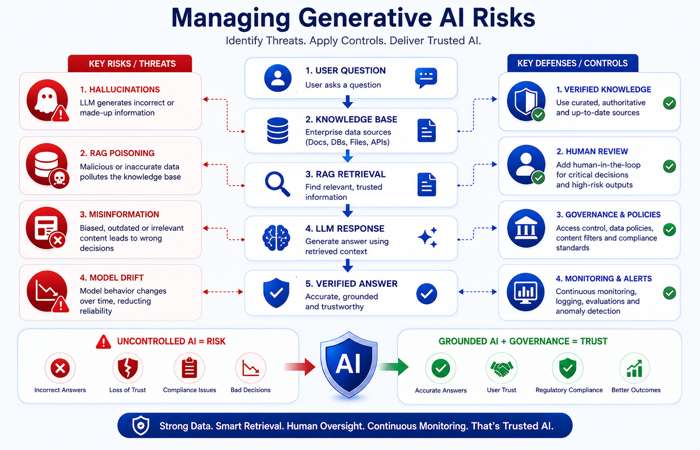
7.1 Defeating “Plausible BS” with RAG
Retrieval-augmented Generation (RAG) frameworks anchor our model‘s output in established, reliable data sources greatly minimizing hallucinations. The architecture:
- User asks a question
- System retrieves relevant documents from a vetted knowledge base
- The LLM generates an answer constrained by retrieved content
- Citations are provided for verification
But RAG isn’t bulletproof. RAG poisoning is the new attack vector—illustrated by the reported $6 million Clock Tower X contract designed to influence AI model outputs by flooding social media with specific narratives, knowing those narratives would be ingested by web-crawling RAG systems.
This example has been reported in major outlets; include a link to the primary reporting before using it as evidence.
7.2 The Model Collapse Threat
Model Collapse is the existential risk of recursive AI training: when models trained on AI-generated data degrade in quality over generations, eventually becoming functionally useless. As the internet fills with synthetic content, finding clean training data becomes a strategic resource—like clean water.
7.3 Energy Costs & Environmental Footprint
The numbers are sobering—but variable:
- A single ChatGPT query: ~0.3 Wh to 2.9 Wh (estimates vary by model, infrastructure, and methodology)
- A household’s electricity per minute: ~20 Wh
- Estimated GenAI emissions by 2035 (depending on estimate): 245 mllion tons of
These per-query and long-term emissions estimates are model-, infrastructure- and methodology-dependent; provides primary sources (provider publications or peer-reviewed lifecycle analyses) for these estimates, when used.
Suggested sources to cite:
- Energyorsustainabilityreports(GoogleDeepMind/OpenAI)
- Peer checked lifecycle analyses (e.g. Joule/Elsevier papers on ML footprints)
- The 2023–2025 academic literature on model training emissions
Sustainable AI strategy now demands:
- Model right-sizing (don’t use GPT-5 for spell-check)
- Edge inference to reduce data center load
- Green data center procurement
- Carbon-aware scheduling of training runs
8. Measuring ROI: The Create/Analyze/Govern Framework
Use this 2×2 matrix to prioritize GenAI investments:
| Low Complexity | High Complexity | |
| High Value | START HERE — Knowledge bases, customer support, content drafting | STRATEGIC BETS — Drug discovery, specialized code optimization, autonomous agents |
| Low Value | Basic email drafting, meeting summaries | AVOID — Experimental 3D fan art, novelty projects |
Begin with business outcomes and then add technology. Experience has shown us that we found measurable, business-oriented goals as grading criteria in a few key areas for your AI solutions.
The Three Pillars of GenAI ROI:
- Create: Where can AI generate content/code/assets faster than humans?
- Analyze: Where can AI surface insights from unstructured data humans can‘t process?
- Govern: Where will AI enable policy, compliance and quality to be delivered at scale
Suggested KPIs to track:
- Accuracy/ factuality rate (answers human verified / all sampled answers)
- Time-to-resolution or search time reduction (minutes)
- Cost-per-query or $/1k inference requests
- Human review rate and rework hours saved
- Revenue uplift or cost savings attributed to AI features (A/B tested)
- Model drift incidents per quarter
Organizations who embrace outcomes based AI adoption method will speed up from pilot stages to production stages faster, reduce the risk and achieve maximum ROI from AI.
9. Future Outlook: Generative Engine Optimization (GEO) & Beyond
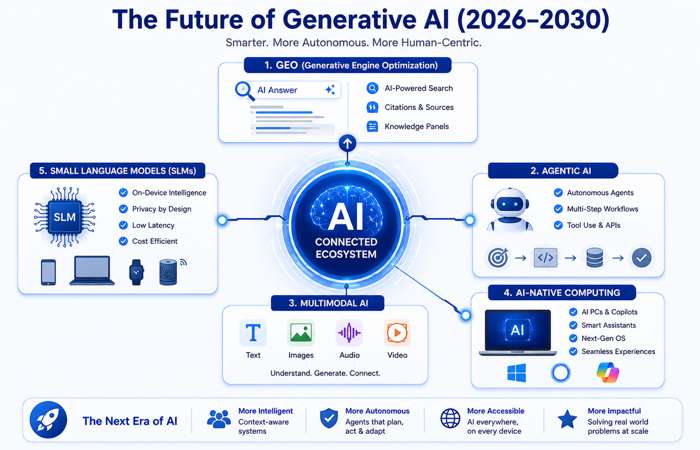
The Rise of GEO
And as SEO defined the search era, GEO (Generative Engine Optimization) will define the AI era.
Generative Engine Optimization(GEO) The practice and science of tailoring content so that it is displayed in the responses generated by the engines themselves (ChatGPT, Gemini, Perplexity) instead of ranking in ordinary search results.
GEO (Generative Engine Optimization) means structuring content so LLMs and RAG systems surface and cite you; brands not surfaced by leading LLM-based tools risk missed referral traffic from AI-mediated discovery.
Below isn‘t being referenced by ChatGPT, Claude and Perplexity and you‘re invisible to one half of a new generation of users.
Agentic AI: The Next Frontier
The next wave isn’t generative—it’s agentic. Multi-agent systems that:
- Plan multi-step tasks autonomously
- Use tools (browsers, APIs, code interpreters)
- Coordinate with other agents
- Learn from outcomes
Agentic AI is a new interface paradigm that is not expected to be dominant yet certainly is likely to grow in importance. Consensus among many experts is that adoption will keep growing through 2027 but estimates vary; the value and speed are contingent on safety and reliability of these AI-powered agents as well as broad regulatory buy-in.
“AI agents” will dominate the interface paradigm no chatbots by 2027.
Other 2026–2030 Trajectories
- Multimodal everything (text + image + video + audio + 3D in one model)
- Small Language Models (SLMs) running on every device
- Synthetic data economies replacing scraped data
- AI-native operating systems (Apple Intelligence, Microsoft Copilot+ PCs)
- Neuromorphic chips breaking the GPU monopoly
10. Frequently Asked Questions
Q1: What are the variations in AI and Generative AI?
A: Artificial Intelligence is the general term for the field of machines doing intelligent things. Generative AI is a specific use case where the focus is on generating something text, images, code, audio and not specifically on understanding or classifying existing data.
Q2: Is it safe to work with Generative ai in the enterprise?
A: Certainly, with guardrails in place: RAG grounding, human-in-the-loop oversight, compliance with regulations and protection of IPR. Raw consumer ChatGPT in production environments is unsafe, properly architected enterprise systems are not.
Q3: Which Generative AI model is best (in 2026)?
A: That‘s use case specific. GPT-5 is the best general reasoner, Claude 4 does the best long context analysis as well as coding, Gemini 2 Ultra is the best at multimodal, LLaMA 4 is best for open source. Actually there is no “best” in AI language models.
Q4: Will Generative ai replace my job?
A: Most jobs will be augmented, not eradicated. Likely to be jobs that will be replaced: junior copy writers, illustrators. Entry-level coders, Customer service (tier-1). Roles most safe: complex judgment, physical work, human-centric relationships.
Q5: How much does enterprise Generative AI cost?
A: Estimated costs contingent on scope: Small pilots tend to be in the $50K–$200K range; full production deployments tend to be in the ~$500K level and up per year depending on number of models, number of services, operational scope, etc. (these are order-of-magnitude estimates, provide your own TCO model for your org).
Q6: What is RAG and why is this important?
A: RAG (Retrieval-Augmented Generation) can be integrated with an LLM to your enterprise knowledge base, which significantly decreases hallucinated answers and provides all pieces of information with actual sources.
Q7: Can a copyright be given if they have been created with the assistance of AI?
A: In the US, work created by AI cannot be copyrighted. AI-assisted work where humans exercise significant creative control may be registrable.
Related Generative AI Resources
- The Last Mile of GenAI: Moving AI From Prototype to Production
- How LLMs and Voice Cloning Power Today’s AI Companions
- Text-to-Image AI: How AI Image Generators Work
Conclusion
Generative AI in 2026 isn‘t a magic wand. It is a supercharged collaborator powerful, dangerous, and necessary. The leaders who win will:
- Prioritize ruthlessly: Target high-value, low-complexity use cases first
- Audit relentlessly: Protect against model collapse, RAG poisoning, and compliance gaps
- Govern proactively: Build the regulatory muscle before regulators force you to
- Embrace GEO: Adapt marketing to the era of AI-mediated discovery
- Invest in the Last Mile: The gap between demo and production is where competitive advantage lives
The trough of disillusionment is not a graveyard. It‘s a gauntlet. The survivors will be the companies that dominate the next decade.
Primary Sources & Further Reading:
- Gartner Hype Cycle for Artificial Intelligence (2024–2025)
- EU AI Act Official Text & Code of Practice on Marking/Labeling
- S. Executive Order 14110 (Safe, Secure, and Trustworthy AI)
- Vaswani et al., “Attention Is All You Need” (Transformer paper, 2017)
- EPRI & IEA Energy Consumption Analysis for AI Queries (2024)
- Stanford HAI AI Index Report 2026
- LLM API Pricing Comparisons 2026 (GPT-5, Claude 4, Gemini, Llama)
- Generative Engine Optimization (GEO) Guides 2026
- AI Model Benchmarking & Comparisons (2026)