


Limitations of the Pareto Principle
Have you ever wondered if focusing on just 20% of your efforts can really deliver 80% of your results?
The Pareto Principle, also known as the 80/20 rule, is a widely used concept in productivity, business, and decision-making processes. It allows teams to prioritise tasks, focus on significant activities, and increase performance by concentrating on what is most important.
But real-world situations are rarely that simple.
Not every problem follows a perfect 80/20 pattern, and relying on it too much can sometimes lead to missed opportunities, poor prioritisation, and unbalanced decisions.
In this blog, you’ll learn about the Pareto Principle’s key limitations and how to apply it more effectively for balanced and long-term decision-making.
Table of Contents
What is the Pareto Principle?
The Pareto Principle is based on the concept that approximately 80% of outcomes come from 20% of causes. It began as a wealth distribution rule and has since expanded to include business, project management, and product strategy.
Teams use it to prioritise high-impact tasks, identify key customers, and focus on activities that provide the greatest value. It is a pattern, not an absolute rule, so while it makes decisions easier, it is important to remember this.
Why the 80/20 Rule Isn’t Always Reliable
The Pareto Principle, or 80/20 rule, is a popular tool for productivity and business strategy. It provides a straightforward framework for simplifying challenging decisions. However, real-world data, customer behavior, and market dynamics are rarely divided 80/20.
Using this rule can lead to poor prioritisation, missing important tasks, and ignoring long-term value. It’s not all about the 80/20 rule. It is about quantitative analysis, flexible thinking, and balanced choices.
Key Limitations of the Pareto Principle
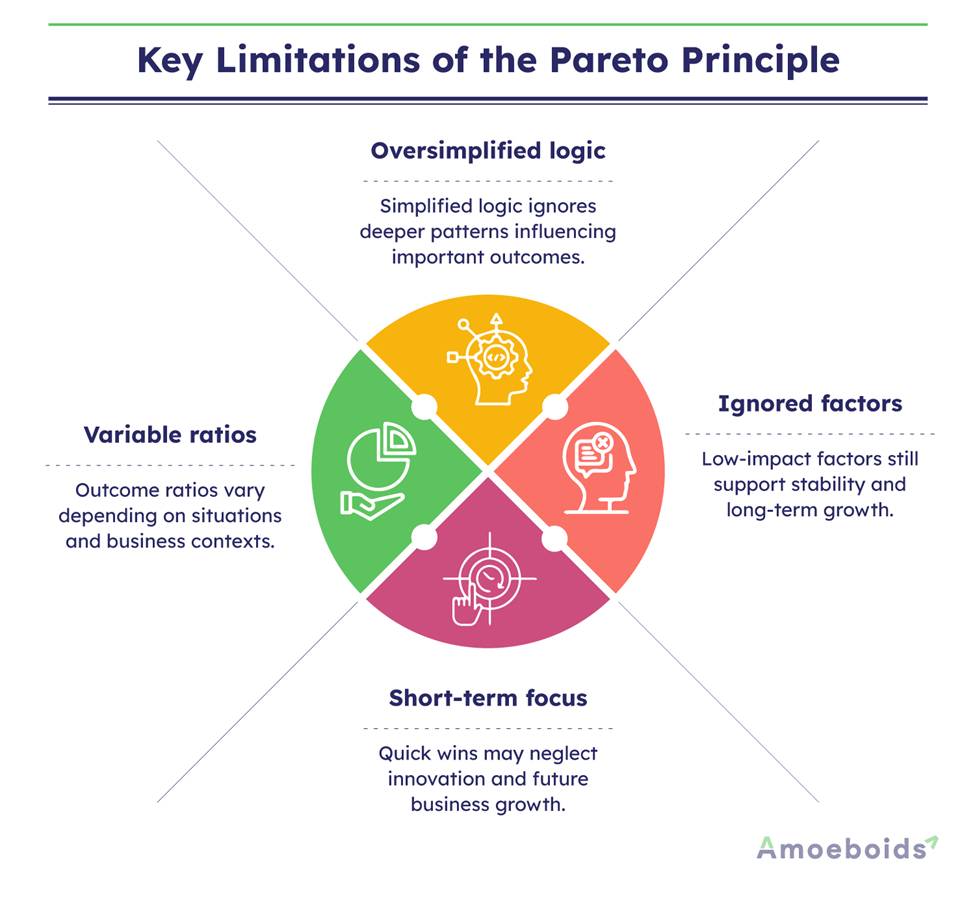
The Pareto Principle helps teams focus and organise tasks, but it also has limitations that can impact decisions if not properly considered in dynamic business environments.
- Variable ratios: It’s misleading to assume outcomes will always break down 80/20. In reality, the ratio can vary greatly, such as 70/30 or 90/10, depending on the situation.
- Oversimplified logic: The principle simplifies complicated systems into a simple causal relationship. It often ignores deeper connections, interactions, and underlying patterns that influence outcomes.
- Ignored factors: Even though low-impact components are crucial for stability, compliance, or long-term growth, they may be missed if high-impact contributors are the only focus.
- Short-term focus: The Pareto Principle often pushes teams to prioritise quick wins and fast results. Because of this, long-term investments, innovation, and basic foundational work may be neglected, despite their importance for future growth.
Real-World Scenarios Where the Pareto Principle Falls Short
The Pareto Principle is not always effective in real-world scenarios, especially when dealing with intricate systems, changing markets, and long-term strategic decisions.
Diverse customer segments with varying needs
Different customer segments bring different types of value, and focusing only on the big segments can limit growth. Smaller segments may provide niche value and opportunities for the future. If you ignore them, you could miss out on potential influence and long-term gains.
Features with long-term vs short-term impact
Some features may not produce immediate results, but they are important for future success. They improve retention, strengthen your product, and provide a long-term competitive advantage.
Essential low-impact tasks that cannot be ignored
Documentation, maintenance, and compliance tasks may fail to produce visible outcomes. They are, however, required for efficient operations, risk reduction, and long-term product stability.
Industry-specific variations that don’t follow 80/20
The 80/20 rule does not apply in every industry. Sectors such as healthcare and education rely on a variety of equally important factors. It also highlights balanced efforts over focusing on a few key areas.
Early-stage products with limited data
New products often don’t have enough data to see clear patterns. Using the Pareto Principle too early can lead to wrong decisions and poor priorities during early business growth.
How to Use the Pareto Principle More Effectively
The trick is not to throw away the Pareto Principle, but to use it wisely and adapt it to the context of your business, product, or project environment.
- Flexible approach: Use the Pareto Principle as a guideline, not a hard-and-fast rule. Don’t try to force decisions into the 80/20 rule, but instead adapt your approach to fit the context, goals, and data.
- Data validation: Always back up your beliefs with real-world data. Look for trends, customer behavior, and performance metrics to verify if a Pareto-like distribution actually exists in your scenario.
- Regular review: Company environments change all the time, so periodically review your analysis. What works today might not work tomorrow, so ongoing evaluation is essential for good decision-making.
- Balanced focus: Concentrate on high-impact activities, but do not overlook low-impact yet essential tasks that contribute to long-term reliability, stable performance, and overall system health
Conclusion
The Pareto Principle is a great way to think about productivity, prioritisation and decision-making, but it should never be applied as a blanket rule.
Real-world decision-making requires flexibility, more in-depth analysis, and a data-driven mindset. Relying too heavily on the 80/20 rule can limit growth, miss opportunities, and create an unbalanced strategy.
Treat it as a guideline, not as an absolute rule. Check your norms against real data, be adaptable, and focus on what works not only now but also in the future.
The most effective approach combines performance and balance.
Now is the time to reconsider your priorities, apply the Pareto Principle strategically, and make decisions that will truly drive long-term success.