Conductor Write for Us – Submit an Electrical Conductor Guest Post
Electrical conductors make modern technology possible by providing controlled paths for current and signals. They appear in power cables, printed circuit boards, connectors, integrated circuits, antennas, motors, batteries, communication systems, vehicles, consumer electronics, and electrical infrastructure.
Computer Tech Reviews welcomes original contributions from electrical engineers, electronics specialists, material scientists, technicians, PCB designers, cable professionals, researchers, educators, repair experts, and experienced technical writers. Through our Conductor Write for Us section, contributors can share material guides, technical explanations, design advice, testing methods, comparisons, and practical discussions about electrical conduction.
This contributor page forms part of our broader Electronics Write for Us section, which covers electronic components, circuits, semiconductors, power systems, embedded devices, testing, and repair. It also belongs to our wider Gadgets Write for Us contributor network.
What Is an Electrical Conductor?
An electrical conductor is a material through which electric charge can move relatively easily under suitable conditions. Metals are widely used as conductors because they contain mobile charge carriers that respond to an applied electric field.
Common conductive materials include:
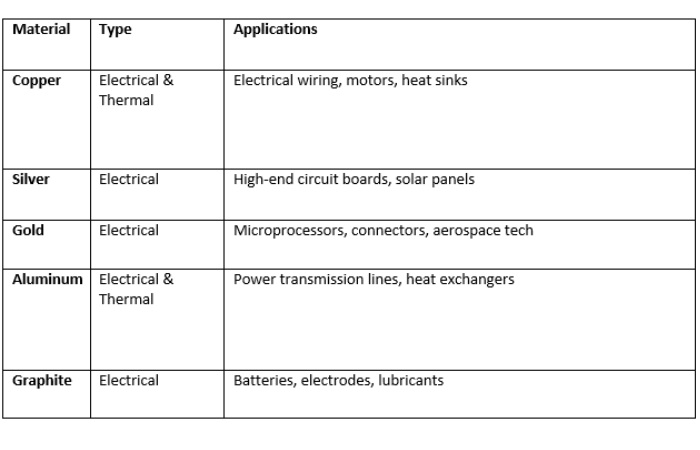
- Copper
- Aluminum
- Silver
- Gold
- Nickel
- Tin
- Conductive alloys
- Graphite and other carbon-based materials
- Conductive polymers and composites
- Electrolytes and ionically conductive materials
A material is not selected simply because it has the highest conductivity. Cost, mass, mechanical strength, flexibility, corrosion resistance, temperature, manufacturability, availability, and the intended environment may all influence the choice.
Conductor Topics We Welcome
We welcome articles that help readers understand conductive materials, electrical resistance, wire and cable selection, PCB design, contacts, grounding, shielding, testing, and practical applications.
Suitable topics include:
- Electrical conductivity and resistivity
- Copper and aluminum conductors
- Wire gauge and current capacity
- Voltage drop and conductor length
- Printed circuit board traces
- Connectors, terminals, and electrical contacts
- Grounding and bonding conductors
- Shielding and electromagnetic compatibility
- Flexible circuits and conductive films
- Busbars and high-current connections
- Conductive adhesives and coatings
- Corrosion and contact degradation
- High-frequency conductor behavior
- Superconductors and emerging materials
- Conductor testing and fault diagnosis
Conductivity, Resistivity, and Resistance
Conductivity describes how readily a material permits electrical current under specified conditions. Resistivity describes the material’s opposition to current flow. The two properties are inversely related.
The resistance of a conductor depends on several factors:
- The material’s resistivity
- The conductor’s length
- Its cross-sectional area
- Its temperature
- Material purity and physical condition
- Connection and contact quality
For a uniform conductor under simplified conditions, resistance can be expressed as:
R = ρL/A
In this relationship, R is resistance, ρ is material resistivity, L is conductor length, and A is cross-sectional area.
Real installations may also be affected by joints, connectors, strand construction, frequency, skin effect, proximity effect, environmental exposure, and temperature cycling.
Copper Conductors
Copper is widely used in electrical and electronic systems because it combines high conductivity with useful mechanical, manufacturing, and connection properties.
Common applications include:
- Building wiring
- Electronic cables
- Printed circuit board traces
- Motor and transformer windings
- Connectors and terminals
- Grounding systems
- Busbars and power distribution
Copper is not automatically the best material for every application. Cost, weight, mechanical requirements, corrosion, thermal conditions, and conductor size may make another material more appropriate.
Aluminum Conductors
Aluminum has lower conductivity than copper by volume but is considerably lighter. It is frequently used in overhead power lines, large power cables, busbars, and other weight- or cost-sensitive applications.
An aluminum conductor usually requires a larger cross-sectional area than a copper conductor to provide comparable resistance. Its connections also require suitable terminals, installation methods, surface preparation, and consideration of thermal expansion and oxidation.
Writers should avoid encouraging direct substitution between copper and aluminum without checking conductor size, connectors, protection, temperature ratings, mechanical support, and applicable electrical requirements.
Silver, Gold, and Contact Materials
Silver has very high electrical conductivity and is used in selected contacts, coatings, conductors, and specialized electronic applications. Its cost and surface behavior can limit widespread use.
Gold is valued in many low-current or reliability-sensitive contacts because it resists oxidation and can maintain dependable surface performance. It is normally applied as a thin plating rather than used as a bulk conductor.
Contact-material selection may consider:
- Electrical and thermal conductivity
- Contact resistance
- Oxidation and corrosion
- Mechanical wear
- Mating cycles
- Current and voltage
- Environmental contamination
- Manufacturing and cost
Conductors, Insulators, and Semiconductors
Conductors, insulators, and semiconductors have different electrical properties, but the boundaries are not always as simple as one material conducting and another not conducting at all.
- Conductors allow charge to move relatively easily under the intended conditions.
- Insulators strongly resist unwanted current flow and electrically separate conductive parts.
- Semiconductors have electrical properties that can be controlled through material composition, doping, electric fields, temperature, light, and device structure.
Semiconductor devices such as transistors still require conductive terminals, metal interconnects, contacts, and PCB traces to connect them to the rest of a circuit.
Writers focusing on BJTs, MOSFETs, switching, amplification, transistor biasing, power devices, and semiconductor testing can contribute through our Transistor Write for Us page.
Wire Gauge and Current Capacity
Wire gauge or cross-sectional area is an important factor in determining resistance, voltage drop, heating, and current-carrying capability. However, a conductor’s acceptable current is not determined by size alone.
Relevant factors may include:
- Conductor material
- Insulation temperature rating
- Ambient temperature
- Installation method
- Bundling with other conductors
- Ventilation and enclosure
- Permitted temperature rise
- Continuous or intermittent operation
- Applicable electrical standards
Articles must identify the relevant standard, jurisdiction, cable type, temperature rating, and installation environment when providing current-capacity guidance. A single current table should not be treated as universal.
Voltage Drop in Conductors
Current flowing through resistance produces voltage drop and heat. Long cables, small conductors, high currents, and poor connections can increase these effects.
Voltage drop may result in:
- Reduced equipment performance
- Unreliable startup
- Lower motor torque
- Dim lighting
- Incorrect sensor readings
- Additional power loss
- Excessive conductor or connector heating
Writers should explain whether a calculation uses one-way conductor length or the complete current path. DC and single-phase circuit calculations often need to account for both outgoing and return conductors.
Printed Circuit Board Traces
PCB traces are conductive paths that connect components on a printed circuit board. Their width, thickness, length, geometry, layer position, and surrounding materials affect electrical and thermal performance.
PCB conductor topics may include:
- Trace width and copper thickness
- Current capacity and temperature rise
- Voltage clearance and creepage
- High-speed signal routing
- Ground and power planes
- Return-current paths
- Differential pairs and controlled impedance
- Vias and current sharing
- Thermal relief and heat spreading
- Flexible and rigid-flex circuits
A trace-width recommendation appropriate for a low-voltage hobby circuit may be unsuitable for mains voltage, high current, high frequency, or safety-critical equipment.
Connectors, Terminals, and Contact Resistance
A circuit can use adequately sized conductors and still fail at a poor connection. Loose, contaminated, corroded, damaged, or incorrectly crimped contacts can create resistance, heat, intermittent behavior, and voltage loss.
Articles about connections may discuss:
- Crimped, soldered, bolted, and spring contacts
- Terminal material and plating
- Contact force and mating cycles
- Wire preparation and strain relief
- Galvanic corrosion
- Environmental sealing
- Connector derating
- Inspection and maintenance
Contributors should avoid treating solder as a universal mechanical connection method. The suitable termination depends on wire type, movement, temperature, current, vibration, and applicable requirements.
Grounding, Bonding, and Shielding
Grounding, bonding, and shielding are related but distinct practices. Their purpose and implementation depend on whether the system addresses electrical safety, fault-current paths, signal reference, lightning protection, static discharge, or electromagnetic interference.
Suitable topics include:
- Protective-earth conductors
- Equipment bonding
- Signal ground and reference planes
- Cable shielding
- Shield termination
- Ground loops
- Electrostatic-discharge paths
- Electromagnetic compatibility
Writers should not present one grounding arrangement as suitable for every building, circuit, audio system, vehicle, industrial installation, or radio-frequency application.
Conductors in Transistor Circuits
The performance of a transistor circuit can be influenced by the conductors around the transistor. PCB traces, wires, package leads, bond wires, connectors, and grounding paths add resistance, inductance, and capacitance.
These effects become particularly important in:
- High-current switching circuits
- Fast MOSFET and IGBT drivers
- Radio-frequency amplifiers
- Precision measurement systems
- Low-voltage power converters
- Motor controllers
- Battery-management systems
A poorly designed conductor path can create voltage overshoot, ringing, heat, electromagnetic interference, unstable operation, or incorrect sensing even when the transistor itself is correctly selected.
Conductors in Triode and Vacuum-Tube Circuits
Triode circuits use conductors to connect cathodes, grids, plates, heater supplies, transformers, and passive components. Layout and conductor placement can influence noise, unwanted coupling, oscillation, hum, and safety.
Vacuum-tube equipment may operate at hazardous voltages. Conductor insulation, spacing, routing, grounding, and secure connections are therefore essential.
Writers focusing on triodes, vacuum-tube amplification, biasing, heater circuits, transformers, audio equipment, and historical electronics can visit our Triode Write for Us section.
High-Frequency Conductor Behavior
At higher frequencies, current distribution and conductor interactions become more complex. Resistance may increase due to skin effect, while nearby conductors can influence current distribution through proximity effect.
High-frequency articles may examine:
- Skin depth
- Proximity effect
- Transmission lines
- Controlled impedance
- Coaxial cables
- Microstrip and stripline structures
- Return-current paths
- Signal reflections
- Connector performance
At sufficiently high frequencies, a wire or PCB trace cannot always be treated as an ideal zero-delay connection. Its geometry and relationship to the return path become part of the circuit.
Thermal Effects and Conductor Heating
Conductors generate heat when current flows through resistance. Temperature can also change the resistance of many conductive materials, creating an interaction between electrical and thermal behavior.
Thermal design may consider:
- Power loss in the conductor
- Ambient temperature
- Insulation limits
- Airflow and enclosure design
- Conductor spacing and bundling
- Connection resistance
- Duty cycle
- Heat transfer to surrounding materials
Articles should distinguish short-duration current capability from continuous current capacity. A conductor that tolerates a brief pulse may overheat under a sustained load.
Superconductors and Emerging Conductive Materials
A superconductor can exhibit extremely low electrical resistance below a material-dependent critical temperature and within other operating limits. Superconductivity supports research and specialized applications in magnets, sensing, energy systems, transportation, and scientific instruments.
Contributors should distinguish between laboratory research, specialized commercial deployment, and technology available for ordinary consumer use.
Other emerging conductor topics may include:
- Graphene and carbon nanotubes
- Transparent conductive films
- Printed and stretchable conductors
- Conductive inks
- Flexible electronics
- Wearable conductive textiles
- Conductive polymers
Performance claims should identify the material, manufacturing method, measurement conditions, and development stage.
Testing Conductors and Connections
Conductor testing may involve resistance measurement, continuity checks, voltage-drop tests, insulation testing, thermal imaging, visual inspection, or specialized material analysis.
A standard multimeter may confirm continuity but may not accurately measure very low resistance. Four-wire or Kelvin measurement techniques can reduce the influence of test-lead and contact resistance when greater precision is required.
Useful testing topics include:
- Continuity and resistance measurement
- Four-wire resistance testing
- Voltage-drop testing under load
- Thermal inspection
- Connector and contact testing
- Cable fault location
- Insulation-resistance testing
- Current measurement
Contributors should identify the instrument, measurement range, test current, conductor temperature, and whether the circuit was energized.
Conductor Safety
Conductors can carry hazardous voltage and enough current to cause burns, fire, equipment damage, or electric shock. A conductor that appears physically small may still be connected to a high-energy source.
Responsible articles should:
- Identify voltage, current, and stored-energy hazards
- Specify appropriate overcurrent protection
- Use properly rated insulation and connectors
- Explain isolation and lockout procedures where relevant
- Avoid recommending improvised wiring
- Account for temperature and environmental exposure
- Recommend qualified assistance for mains and high-power installations
We do not accept instructions encouraging fuse bypasses, undersized wiring, unsafe backfeeding, exposed live conductors, or work on energized high-voltage equipment by inexperienced readers.
Conductor Guest Post Guidelines
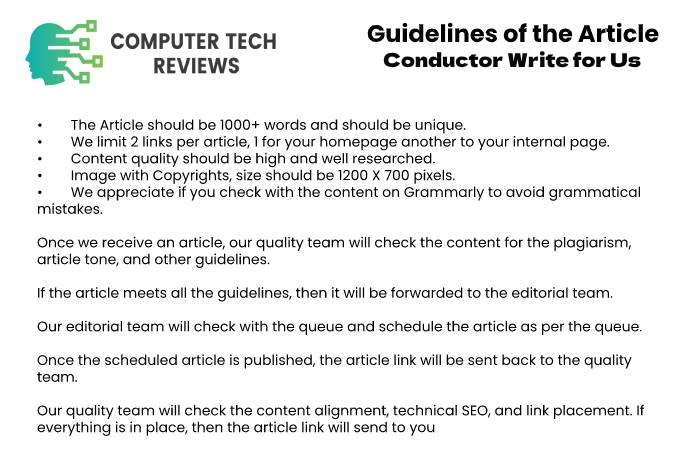
- Submit original content that has not been published elsewhere.
- Write naturally and explain electrical terminology clearly.
- Identify the conductor material, size, length, load, and environment.
- Use consistent units and show calculation assumptions.
- Cite the applicable electrical standard or jurisdiction where relevant.
- Distinguish material conductivity from complete conductor performance.
- Explain temperature, connection, and installation limitations.
- Include appropriate electrical-safety guidance.
- Do not recommend undersized conductors or protection bypasses.
- Disclose supplied products, sponsorships, and commercial relationships.
- Avoid keyword stuffing, copied tables, and disguised advertisements.
- Check calculations, diagrams, links, spelling, and grammar before submission.
How to Submit Your Conductor Article
Email your proposed title, a short summary, and either an outline or completed article to contact@computertechreviews.com. Use “Conductor Write for Us” as the subject line so your proposal can be directed to the appropriate editor.
Include a short author biography and explain your experience with conductive materials, electronics, electrical engineering, wiring, PCB design, testing, manufacturing, installation, or technical education. If your article contains calculations or test results, include the relevant material, dimensions, equipment, load, temperature, and measurement method.
Explore Related Electronics Contributor Topics
Recent Posts
M4A vs MP3 for Transcription: What Actually Changes the Transcript
M4A vs MP3 for Transcription Comparing M4A vs MP3 for transcription is close to a non-question, and the reason is…
The Patch Window Problem: Why Small IT Teams Fall Behind on Updates
The Patch Window Problem This Article is a part of Cybersecurity Guides and Best Practices Every breach report that mentions…